

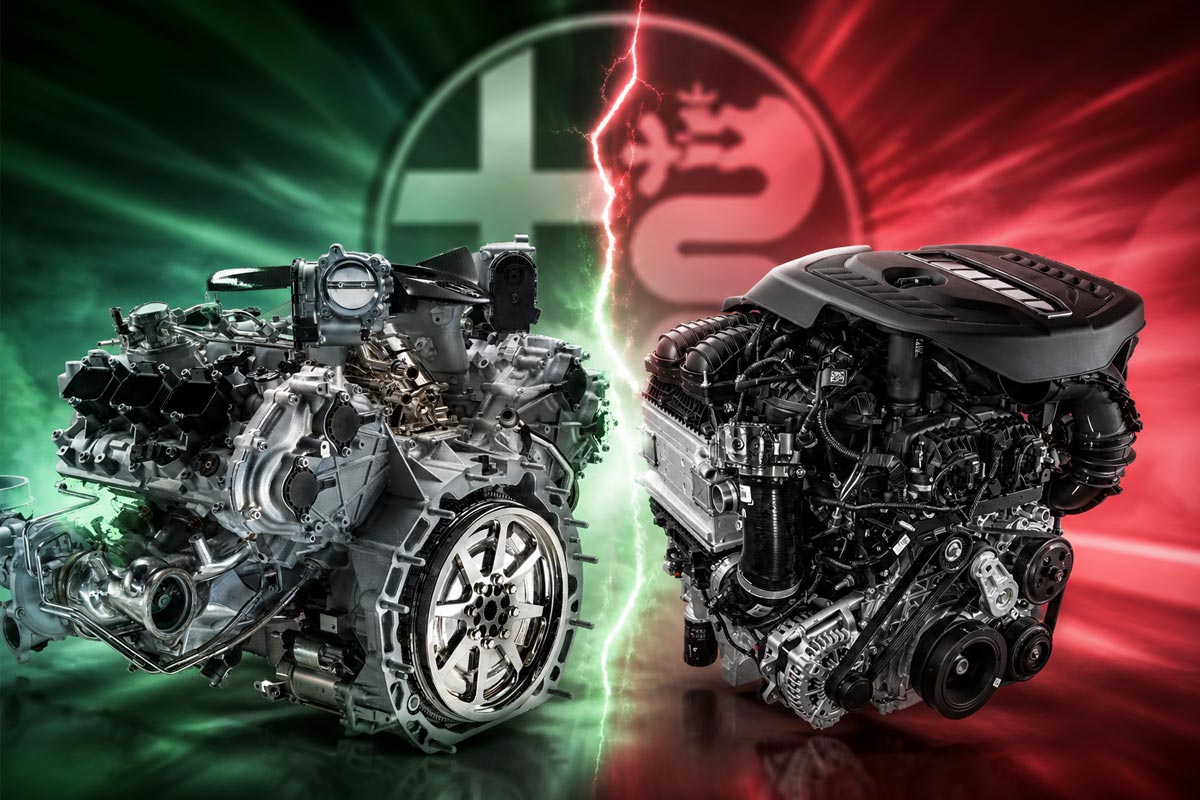
Since his return to favour with the Alfa Romeo Giulia Quadrifoglio and Alfa Romeo Stelvio Quadrifoglio, Alfa Romeo's mechanical signature is based on an engine that has become emblematic: the V6 2.9L biturbo. An engine of Italian origin, today closely linked to Maserati with the Nettuno V6 engine. But as standards evolve, electrification takes hold, and Stellantis reshuffles the cards in its industrial strategy, one question keeps coming up: which engine for future Quadrifoglios?
From an electric promise to a return to electrified combustion
Until a few years ago, the management of’Alfa Romeo announced a complete switchover to 100 % electrics for its high-performance models. A radical vision, now clearly nuanced. The economic context, customer expectations and market realities have prompted the brand to rethink its plans. Future generations of the Giulia and Stelvio, expected around 2028, are likely to offer electric versions... as well as thermal-hybrid versions. The Quadrifoglio badges could therefore survive thanks to electrified powertrains, like Maserati's future Trofeo versions. It remains to be seen which ones.
The natural scenario: the continuity of the Italian V6
If we follow a brand and image logic, the answer seems almost obvious. The merger between Alfa Romeo and Maserati changes the game. The two brands could potentially share common technical foundations. In this context, extending the life of the Italian V6 seems an obvious choice.
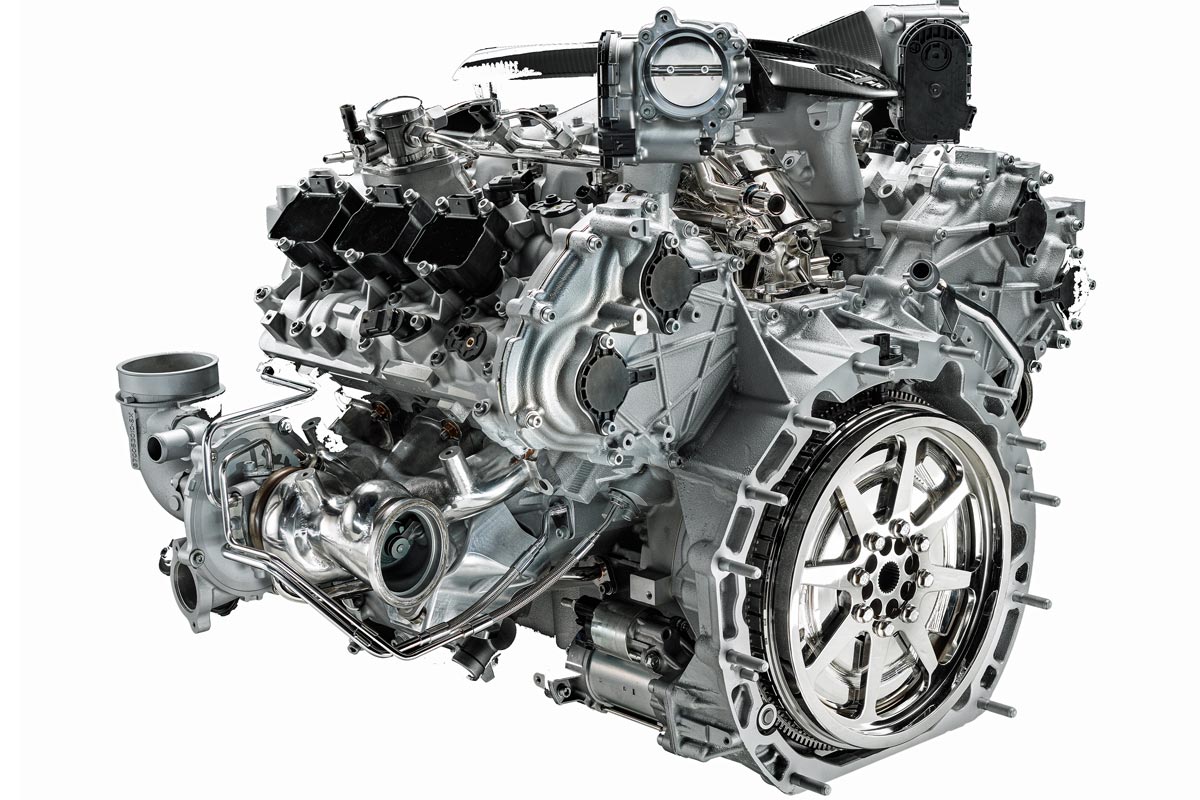
It's hard to imagine a Maserati Trofeo powered by an American engine such as the GME in-line 6-cylinder. And if Maserati retains an Italian V6, Alfa Romeo could logically follow suit for its Quadrifoglio models. Beyond technology, it's a question of identity. A high-performance Alfa Romeo equipped with an electrified Italian V6 would have far greater marketing power. The history, the sound, the character: everything points in favor of this solution.
The credible alternative: the American 6-cylinder in-line engine
But there is another option. More rational, more industrial: the 6-cylinder in-line GME, nicknamed Hurricane. Initially developed by FCA before the merger with PSA, this 3.0L engine is already a reality in the USA. In particular, it equips certain Jeep models with power ratings of up to 510 hp and 780 Nm in its most powerful version.
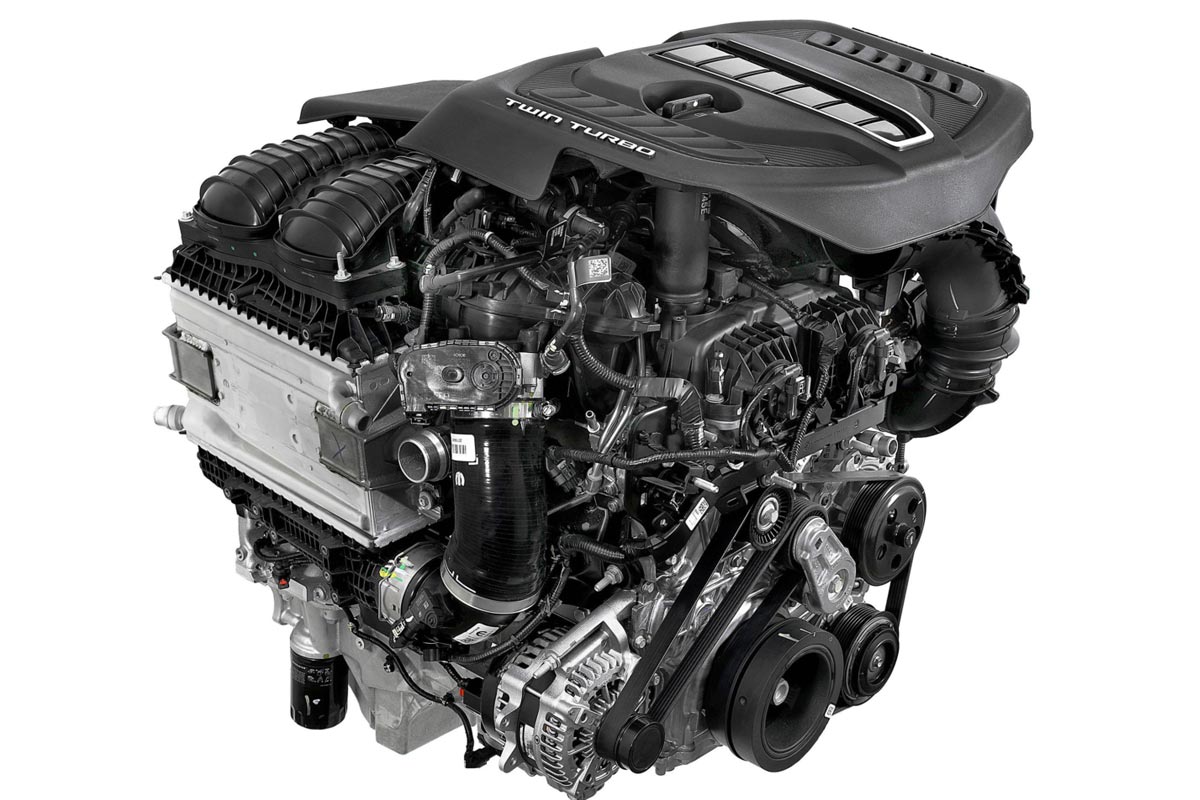
On paper, it ticks a lot of boxes. Hybridization-compatible, powerful, modern and, above all, already integrated into the Stellantis ecosystem, it could be adapted to future Alfa Romeo models. Especially as the brand already uses the 4-cylinder GME. Switching to an in-line 6-cylinder from the same family would make sense from a technical and industrial point of view.
But this scenario raises several limitations. The main one is geographical: this engine is currently produced in Mexico. To integrate it into European models, production would have to be launched on the Old Continent. A heavy investment, which would only make sense if shared with other Group brands (why not Lancia!).
A question of philosophy rather than technique
At the end of the day, the choice is not just a technical one. It's almost philosophical. Alfa Romeo must decide what it wants to be in the years ahead. A deeply Italian brand with a strong mechanical identity? Or a brand integrated into a global Stellantis logic, where rationalization takes precedence over emotion?
The American in-line 6-cylinder is a credible solution. High-performance, modern and already amortized, it could perfectly meet the requirements of future standards. But what a Quadrifoglio lacks is perhaps its soul. While the hypothesis of an American in-line 6-cylinder engine cannot be ruled out, it does not seem the most obvious. An Alfa Romeo Quadrifoglio is sold as much for its performance as for what it represents. And on this point, an electrified Italian V6, shared with Maserati, remains a far more coherent proposition.
 English
  French
  Italian
  Spanish
  German
  Japanese
  Dutch
Dutch
If Imparato was still at the helm, he would have offered a 408 1.6L PureToc painted in red, and that was that.
We can't say that the L6 is American, even if like the F160 V6 it's produced there, it's a 100% European design.
In its DNA, it is European by GME L4, but even so, the L6 was designed by FCA US, produced in Mexico and marketed in North America.
On this point it's clear
I think the L6 and STLAL should be reserved for premium brands and the Giorgio & V6 for sports cars.
The V6 is an obvious choice, since it's already manufactured on site, so there's no point in offering the 6-cylinder GME.
bei dem von italpassion beschriebenen « Strategie(?) »wechsel mit Konzentration der Mittel auf die vier volumenstärksten « Kernmarken » liegt die Beantwortung der Frage nach eigenen (italienischen) Motoren für die Modelle von Alfa bzw. Maserati eigentlich schon nahe: wohl eher in Richtung des amerikanischen Reihensechszylinders, zumal der bereits im (relativ verkaufsstarken) Jeep - Modellprogramm zum Einsatz kommt. Mit der langsamen Erosion der technischen Eigenentwicklungen geht - absehbar - auch das Image fahrzeugtechnischer Kompetenz , für die Alfa bisher (noch) steht verloren. Nochmal: schade um Alfa Romeo.....................der Rest (Konzentration der Marke auf lokale Märkte etc. ..... ) klingt für mich nach PR - Geschwurbel........
You make me laugh too much with this origin story. An engine has to be good. If it is, it doesn't matter whether it comes from Papua or the Vatican, does it? I recently drove a 159 2.2 petrol. Surprisingly willing engine, not very noisy, not vibrating... in short, if it didn't consume 9l on average, it would be a good engine.
You don't think people in France are going to complain about Peugeots with Fiat engines? It's the same here.
In any case, if the in-line six-cylinder engine is adopted, it will certainly be reworked by Alfa Romeo, as was the Holden V6 engine in its day.
The Holden V6, even if it had been reworked by I don't know who, was a piece of shit.
Alfa Romeo. After that, quality...
Portrayal of a good engine that's not at all reliable and has nothing to envy the puretech when it comes to recurring problems! It's true that the French love problem engines 🤣.
V6 e busso ...
Definitely keep it in the Italian family!!!!!!! You put a dodge engine and everything will be ruined??!!!!
A quadrifoglio buyer is different to a normal buyer; performace with emotion. So sight, sound and «feel» of an engine takes on more importance when making a purchase.
Association with a Maserati engine carries more prestige and emotion even though the Huuricane engine might be just as good or even better.
Different buyers.
A preference for the Italian V6, but the 6-cylinder GME Hurricane wouldn't be prohibitive if it had character.
As long as it's not Peugeot under the hood, that's good enough.
SINN MACHEN ist grammatikalisch leider vollkommen falsch. Als qualitätsbewusster Alfista mit Giulia QV würde mir wünschen, dass sie wieder zu SINN ERGEBEN zurückfinden. Das würde weitaus mehr Sinn ergeben.
😉
Creo que alfa Romeo y Maserati deberían tener motores exclusivos. Además agrego de que el grupo necesita una de estas 2 marcas en la F1 para potenciar la imagen histórica de deportividad.
There is no alternative for the V6. Made in Italy, or all kinds of problems occur due to Italian legislation (see Milano vs Junior). It should be a V6, or V8 (33, Montreal), much smaller (1.6-2.0) with PHEV. Besides a base model 1.3 PHEV 4-cilinder and ofcourse EV with big batteries and high output.
I sincerely hope this discussion is already closed at Alfa Romeo. Otherwise the Giulia and Stelvio will be postponed even further.
To put an end to the debate, all they have to do is bring out the v6 busso.
does anyone dodge charge it? It's got some soul though from the video tests.
And why not on a DS or even a Peugeot?.
We did have a lancia thema 8.32 with a Ferrari V8, while the alfa cars of the time had no equivalent. Alfa had benefited from FIAT's front-wheel-drive platforms with the chroma lancia thema and the saab 9000, brands that were in great difficulty or had disappeared...
Always the economic logic, but why not the American V6?
does anyone dodge charge it? It's got some soul though from the video tests.
And why not on a DS or even a Peugeot?.
We did have a lancia thema 8.32 with a Ferrari V8, while the alfa cars of the time had no equivalent. Alfa had benefited from FIAT's front-wheel-drive platforms with the chroma lancia thema and the saab 9000, brands that were in great difficulty or had disappeared...
Always the economic logic, but why not the American V6?
it would be enough to take back the V6, 3 liters
Alfa-Romeo 60°, which powered the 164.
And to improve it