

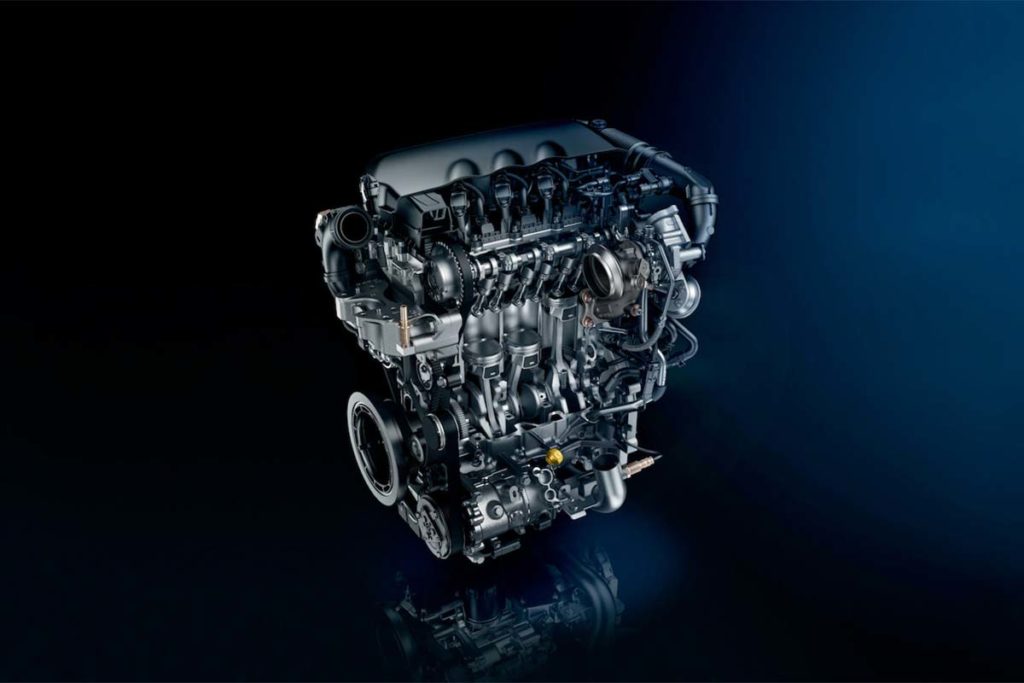
For several months, everything seemed to indicate that the famous 1.2L PureTech engine from Stellantis was slowly coming to an end. Between the return to favor of Fiat FireFly engines, industrial investment in Italian engines and the constraints imposed by the future Euro 7 standard, many signals suggested that the group was preparing a switch from French to Italian engines. However, official information has now reshuffled the deck.
While a large number of media outlets have relayed our idea of a gradual replacement of the PureTech engine by Fiat GSE engines, Stellantis finally clarified his position with Caradisiac with a statement that profoundly changes the reading of its strategy: «the EB2 Gen3 engine has also been made compatible with Euro 7 standards. It will remain under the hood after the end of 2027 in the cars it equips today». In other words, the PureTech is not doomed. At least, not in the short term.
The PureTech will survive the arrival of Euro 7
This clarification is far from insignificant. For several months now, many people have imagined that the introduction of the Euro 7 standard would automatically signal the end of PSA engines on the Group's compact models.
It has to be said that the context was clearly in this direction. Stellantis was multiplying announcements concerning Fiat FireFly engines: extension of investments with Euro 7 standard accounting, development of new hybrid versions, industrial modernization in Italy and ramp-up of the eDCT electrified gearbox. At the same time, GSE engines were gradually becoming the Group's new thermal showcase.
But the official statement changes the perspective. If the EB2 Gen3 engine is indeed Euro 7 compliant, this means that a model launched today with this engine can continue to be marketed after November 2027 without having to change powertrain. And this applies to many more cars than you might think.
Alfa Romeo, Fiat and Lancia models directly affected
In practice, this means that several strategic Stellantis models will probably retain this engine until the end of their commercial careers. This is particularly true of the’Alfa Romeo Juniorthe Lancia Ypsilon or the Fiat Grande Panda, all launched with different variants of the engine known by different brand names: PureTech, EB2 Gen3, TGEN3 or Turbo 100. Even future models announced, such as the next Fiat Grizzly or the new Lancia Gamma, could finally retain this mechanical base throughout their careers.
This is precisely where the situation becomes particularly interesting: the PureTech engine, which many already imagined to be at the end of its life, could end up remaining the main combustion engine for a large proportion of the Group's city cars and compacts until the early 2030s.
And the Fiat FireFly engine?
This new reading of Stellantis' strategy does not mean that Fiat GSE Turbo engines are disappearing from the landscape. All indications are that Euro 7-compatible FireFly engines still exist in the Group's industrial plans. But their role may be different from what was initially envisaged.
Rather than immediately replacing PureTech engines on existing models, these Italian engines could ultimately be reserved for future generations of all-new vehicles. In other words, Stellantis could have several families of internal combustion engines living side by side for many years to come.
Between development costs, Euro 7 constraints, global market differences and the slowing electric transition in Europe, Stellantis now seems to want to secure several technical solutions in parallel, rather than focusing on a single engine architecture.
Will we be getting Turbo 100s with the Puretech engine, Turbo 130s and Turbo 150s with the Firefly (GSE) engine, and Turbo 200s with the GME engine?
One thing is now certain: contrary to what many imagined just a few weeks ago, the PureTech engine will indeed continue its career after 2027. And it may even remain at the heart of Stellantis' European models for much longer than previously thought.
 English
  French
  Italian
  Spanish
  German
  Japanese
  Dutch
Dutch
With the cost of switching to electric power and standards, as well as increased competition, they have to be pragmatic.
You can't turn the table upside down at the snap of a finger and believe that hypotheses are certainties and therefore truths.
One day's truth is not tomorrow's
Economically, it would be difficult to have two engine ranges. The current ranges are designed for puretech, and changing them all at once would represent too great a cost for relative gain.
Real enconomy
Not so much, as current Peugeot and Citroën models have been fitted with Italian engines in South America since the beginning, so there's no need for any major transformation apart from the gearbox if it's a hybrid.
The best thing to do would be to start from a new base that can be more easily adapted to standards 7 and 8, and so on.
Not surprising, since it would be too expensive to modify PSA vehicles for this group, which is adept at saving money at all costs.
However, if future vehicles use FireFly, that's a step in the right direction (but it's a long, long way off).
I speculated here and elsewhere that the switch to FF would be a sham to appease the Italian unions. The 500, Panda and Tonal are the last vehicles in the group to use these engines. And their replacement is not about to happen. We're talking 2029 for the little Fiat models... Which means a compulsory switch to the E7 standard and adaptation of the FireFly. Everyone got carried away with the idea that all brands were going to make the switch, and the Group slyly suggested as much. But it seems that this adaptation to the E7 standard is just there to keep the 500/Panda/Tonal going...
Too bad for them if they do that, it would be shooting themselves in the foot with the ultimate rocket...
Are GSE and GME engines also intended for the Pandina/500/TonalE?
Incidentally, these three models are not the only ones to come from the former FCA: there will also be the big Alfa Romeos, the Maseratis and the American cars. However, I can't see them being equipped only with the 1.6L PureTech, let alone the 1.2L.
It was becoming predictable... This band doesn't deliver on any of its promises. It combines the failings of the two merged companies. FCA's failed product plans and PSA's economies of scale.
What's more, the EV is performing well at the moment, and I think they've revised their plan. Should they invest millions to adapt the MEDIUM or SMALL platforms, which should be almost ready, or drag out the PT until 2035, and the FF on the 500/Panda/Tonal as much as possible?
Stop your ranting, you have no information and you're completely off the mark ...
Exactly.
Who wants to buy an Italian car with a PureTech engine?
Stellantis just doesn't get it.
This is a very big drawback for those who love Italian cars, but don't want this engine.
Bah more people than with an Italian engine: the best-selling models from Fiat, Alfa, Jeep and Lancia are Puretechs.
Which means nothing, since the models in question (Fiat 600, Jeep Avenger, Alfa Junior, Lancia Ypsilon) only have PureTech in the catalog, or electric motors.
What's more, these are the least expensive models from these manufacturers (excluding the Fiat 500 hybrid and Pandina), so they sell in higher quantities.
Totally False, in fact, the worst sales are made on models equipped with the puretech dustbin, and sales show it.
France has become the laughing stock of the world with these engines that would make a Lada or a Tata laugh.
No one wants the worst French engines in automotive history.
The 500x, the old Ypsilon...etc sold a thousand times better than their replacement on a crappy French base... customers aren't stupid.
Puretock as he is nicknamed.
exactly, thats why I havent replayed my 10 year old 500x 1.6 Multijet
Last time I checked, the Pandina doesn't have PureTech, and neither does the 500. The 600 isn't selling all that well, and the Ypsilon is a flop. Only the Avenger, Grande Panda and Junior are selling well. And even for the latter, sales are relative.
Yes, we can see that with the success of the Junior
Compare this with past Giulietta or MiTo sales. The Junior is selling, but there's a long way to go before you can call it a success.
Success is an overstatement. It's Alfa Romeo's best-selling model - and its smallest - but it's no gold rush either.
Stanislas and the others are in their own wonderful world.
Need we remind you of the supernatural performance of the Fiat 500 hybrid with its FireFly!
Unless you're mistaken, EB gen3 has been globally reliable for over 3 years!
Reputation and reality are often two different things!
Not only are you living in an illusory utopia, because the puretech is still unreliable and we're seeing the results of your so-called premium brand, but without France (and Renault is even better) Peugeot would have disappeared, and again it's the French taxpayer and Donfgeng who have been taken for the pigeon in the joke... without FCA PSA would have disappeared a long time ago 🤣
Ah yes Scudric... Prove it!
I'm not talking about before 2023 and I'm talking about EB gen3.
Until proven otherwise ... It's very reliable!? ... More so than some VWs, more so than the Tonale's 160hp 1.5L GSE T4 DOHC, and so on.
No, it's just the opposite, and I gave you the proof in the last article about this engine.
The PureTech is still unreliable, last time I checked. And yes, a reputation, whether justified or not, often takes precedence over reality and makes for happiness or damage.
«Will we be getting Turbo 100s with the Puretech engine, Turbo 130s and Turbo 150s with the Firefly (GSE) engine, and Turbo 200s with the GME engine?»
I would be fine with that! I just want a reliable 130-150 PS Firefly Hybrid and I want it fast 😉
I understand that you're partisan, but in the end, a little pragmatism doesn't hurt.
You haven't heard about the bent connecting rods on the 1.5L Firefly?
It only concerns one engine, the 160hp, one model, the Tonale, and it's linked to a software problem, not to the engine itself. Alfa Romeo has launched a campaign to fix the problem. This is a far cry from the catastrophic 1.2L PureTech series.
Twisted connecting rods? But of course, this isn't a puretech 🤣
I didn't know there was software in the Firefly connecting rods 😂
Since the Firefly came out, there have been no reliability problems, the 1.5 l hybrid is a little more recent, but its bent connecting rod problem is only found on a small quantity of engines produced, whereas it's been around since Jeep. Compass, Renegade, Fiat 500 X , Tipo and then on the Tonale.
So it's nothing to do with the Puretech, a problem that's been around for years.
We're talking about a combustion engine, the puretech has been redesigned and the firefly is reliable.
We need to see the next stage, a future hybridization ahead of its time.
We have to invest or we'll be eaten up.
Tavarès, Filosa or Tatenpion, it doesn't matter who decides, this group will always be run by baltrons! 😂😂😂
You can apply to run a large group like Stellantis because you think it's so easy. .
Take Filosa's place if you think it's easy to run a group like Stellantis.
The FIAT FIREFLY engine must be installed as soon as possible !!! A hyper RELIABLE FIAT engine !!
Don't wait for Peugeot PURTECH to stain the group's new cars!
For French vehicles, keep the PURTECH!
And the Italian vehicles that put the engine FIAT FIREFLY!
Trumpets.