

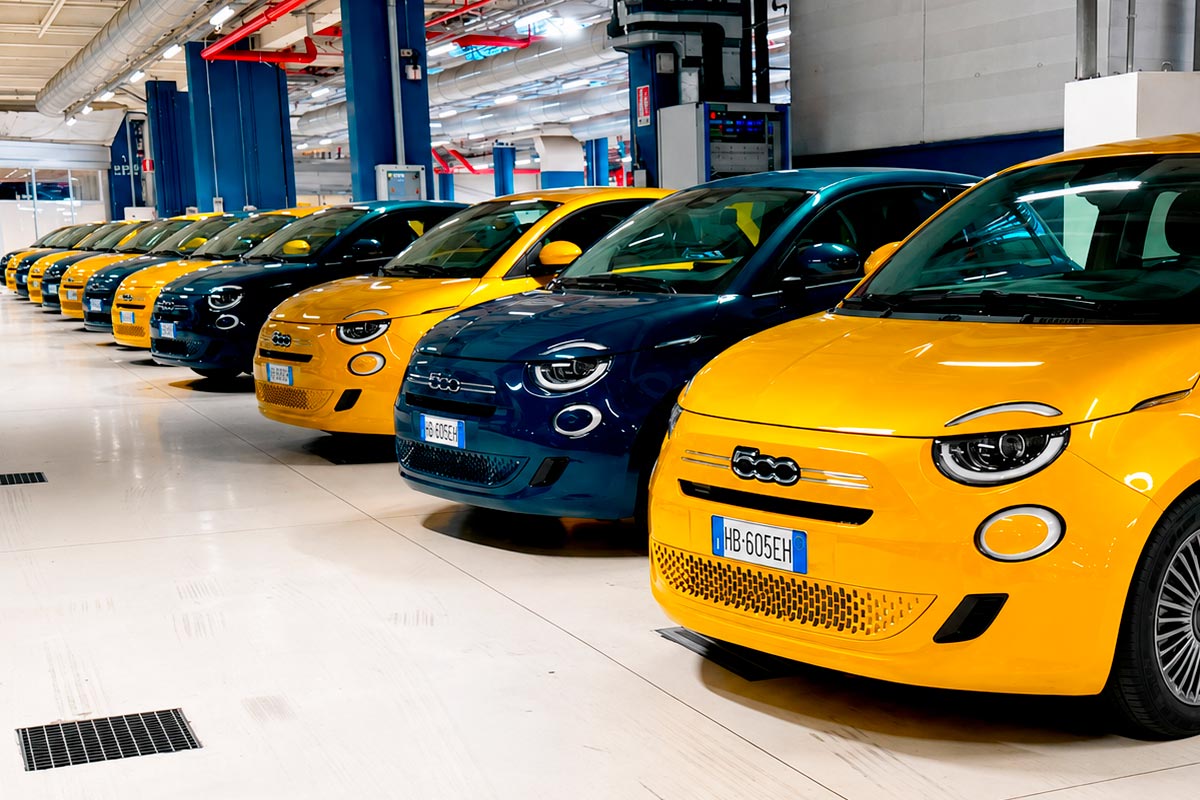
This marks a major shift in strategy for one of the most iconic models from Fiat. While Stellantis was still claiming just recently that the next generation of Fiat 500 was supposed to be exclusively electric, but the company now appears to have changed its plans. The future Fiat 500, expected around 2030, will not, after all, be solely 100 % electric: it will be multi-energy.
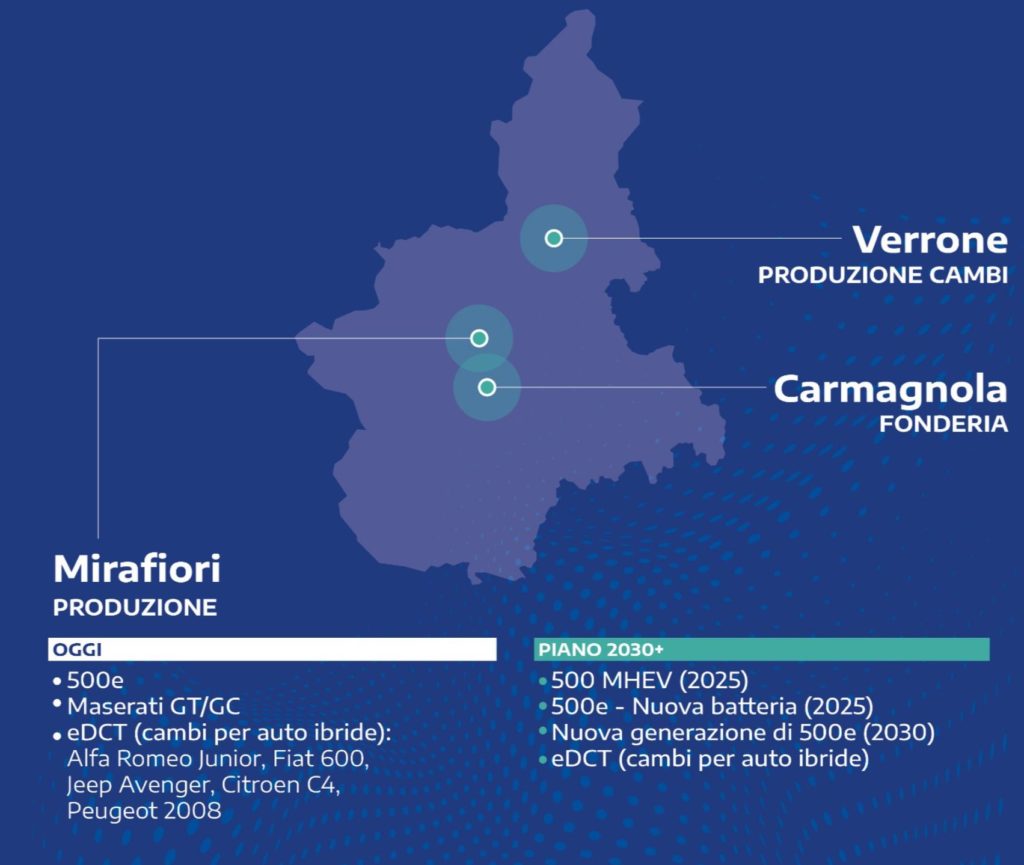
The announcement was made by Antonio Filosa, the new CEO of Stellantis, during his appearance before the Industry Committee at Montecitorio in Italy. It was an opportunity for him to confirm the future of the historic Mirafiori plant, as well as to unveil a new direction for the small Italian city car.
A strategy that is completely different from the one announced in 2024
To understand the significance of this announcement, we need to go back a few years. In 2020, Fiat launched an all-new generation of the 500 with a bold decision: to offer the model exclusively as an electric vehicle. It was an ambitious strategy designed to support the Italian automaker’s transition to zero emissions.
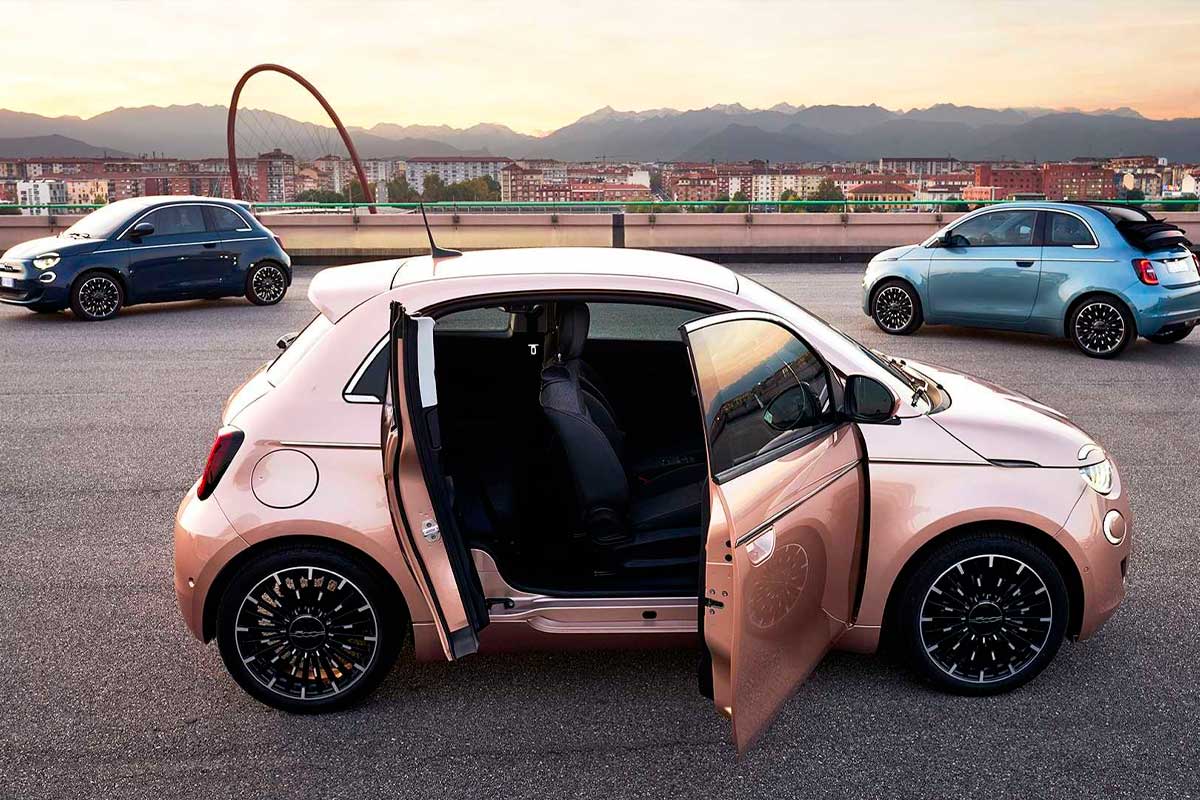
But the market did not evolve as quickly as expected. Faced with slowing demand for electric vehicles in Europe, Stellantis ultimately decided to adjust its strategy. In 2025, a hybrid version of the Fiat 500 was added to the lineup to revive production at Mirafiori and reach a broader customer base. This change was intended to be temporary. In late 2024, Stellantis still indicated that the next generation of the Fiat 500 would return to an all-electric lineup. Ultimately, that will not be the case.
The 2030 Fiat 500 will be multi-fuel
«At Mirafiori, following the 500 Hybrid, we’ll introduce the new 500 starting in 2030–2031. It will be a multi-energy vehicle and will come in different forms. It’s as if there were several models,» said Antonio Filosa. This is an important statement because it confirms two things: the Fiat 500 will continue to be produced at Mirafiori, Fiat’s historic birthplace, and it will no longer be based on a 100% electric strategy.
The CEO of Stellantis also mentioned several variants. It’s hard not to think of the models we already know, such as the 500 Cabrio or the 3+1, but the automaker could go even further to transform the 500 family into a truly broader lineup.
The goal remains ambitious: to reach approximately 100,000 copies per year. This figure is still far from the current reality, since, given figures for the first half of 2026, annual production could instead be around 50,000 units.
Which platform?
Before this new generation arrives, the current electric Fiat 500 will undergo a major upgrade in 2027. In particular, it will be equipped with a new battery produced in Spain by the joint venture between Stellantis and CATL. The goal is clear: to offer an electric Fiat 500 with greater range and a more affordable price.
For the generation expected in 2030, the big question now is which platform will be used. Although this is still speculation, it seems unlikely that Stellantis would repeat the decision to develop an architecture dedicated to a single model, as is the case with the current Fiat 500. The future 500 could therefore logically be based on the platform used by Future E-Car models expected starting in 2028 in Pomigliano d’Arco, notably the future Fiat Pandina and Citroën 2CV, which are themselves technically related to the Leapmotor C03.
That leaves one question: if this platform truly becomes multi-energy for the Fiat 500, will the other models based on it (Pandina, 2CV, etc.) also be available with hybrid powertrains? Or will Stellantis reserve this privilege solely for its Italian icon? As for the engines, several options exist, ranging from the 1.0L GSE—already familiar to Fiat—to the 1.2L EB2, which is used more widely by Stellantis. The decision is likely already under internal discussion, but one thing is certain: by 2030, the Fiat 500 will no longer rely on a single energy source… unless Stellantis changes its mind again!
 English
  French
  Italian
  Spanish
  German
  Japanese
  Dutch
Dutch
A great decision!
I'm really surprised that the 500 Hybrid isn't selling. What's the problem? It was supposed to take over from the electric model, but that's not what's happening. What's going on?
For the next-generation 500, a Giardiniera version would be welcome—or even a more «refined» model. I remember some slides from a few years ago that showed a sort of sporty 500 Clubman. Is that going to happen?
I'm not really sure… maybe because a €20,000 A-segment hybrid gas-electric car no longer meets market demand…
Just look at the first half of 2026: a gasoline-powered Fiat Panda priced at €15,000 sold 60,000 units in Italy, while an electric Leapmotor T03 priced at €15,000 sold 24,000 units (again, in Italy). Despite its merits, the 500 is probably still too expensive for its segment. I looked up the prices of the Fiat 500 in 2019; they ranged from €15,990 to €18,890.
Yes, I think the 500 Hybrid should lower its prices by 2,000 euros.
There are also no regular special editions, as if Fiat were neglecting this product in favor of the Panda family. Too bad.
Too expensive and underpowered.
That says it all!!
As for the engine, which has laughably poor performance under Euro 7 standards—just look at what Toyota offers with the new Aygo—all of this in relation to the price, which is high. It’s a shame, because the 500 is really beautiful and well-suited for city driving.
The 500 Hybrid engine is the problem. Even for a small car, it is woefully underpowered and slow—and it also has poor fuel economy. It is barely a hybrid system and lags far behind competitors in both performance and fuel economy. Fiat says it cannot fit one of its larger engines, but the result will be a slow car with slow sales.
I just think that the 500, as appealing as it may be, doesn’t offer anything worthwhile for the price! 20,000 euros for a so-called hybrid with 65 ch and a manual transmission!!! On top of that, Fiat has almost no customer base outside of Italy anymore. For the same price, a Panda offers so much more!! It’s the last straw.
That's fine, except that the timing is a bit tricky.
In 2020, going all-electric with a 500 was obviously too soon.
In 2028, building a multi-energy platform often requires making compromises and risks slightly reducing the performance of the all-electric 100 % models.
If in 2020 the breakdown was 1/4 EVs and 3/4 internal combustion engine vehicles (including hybrids)… it could be the other way around after 2028!
A 500 is rarely used for long family trips.
EVs often have a range of up to 400 km; that's more than enough for 95 % of 500 customers.
But who would have thought that sales would reach 100% by 2030?
Hybrid models definitely have a future—that much is clear.
That said, we also need to look at what other automakers are doing—for example, Renault with the 5 E-Tech or the new electric Twingo. And, curiously, we don’t see any hybrid models. It would be interesting to know how well these Renault 5 and Twingo E-Tech models are selling, as well as the electric Alpines.
By 2030… It was a mistake, to be sure.
But 2035, or worse, 2040… Certainly.
The current 500, which has been on the market since 2020, was too expensive… Its premium image made it palatable for three years, but by 2024 it had become unsellable at that price.
The value for the price is terrible! Even though the setting is lovely…
Without a powerful engine, you don't stand a chance in the market. .
The R5 is on track to sell 80,000 units a year. Just like the 500 did at the start. Except I can't really see Renault discontinuing this model after just 3–4 years. And then there are the Nissan Micras, which are clearly rebranded R5s.
And the next-generation Ford Fiesta
I’m currently in Italy with my Tesla. Leap, Link&Co, BYD, and other Chinese brands already account for 15–20% of new cars. Some brands I’ve never even heard of are already here… and they’re beautiful and surely inexpensive…. Fiat will have to hang on! Like many others, for that matter… but with what? That is the question… and these developments will be fatal!
Waiting until 2030 to update a model released in 2020 feels like an eternity, even if there are changes to the engine.
The 500 may still be left behind if it sticks with the mild hybrid system
I hope that the extension of the renewal period will allow the 500 to benefit from a truly innovative hybrid system.
If there were changes in prices and battery types, that wouldn't be a problem.
The style is somewhat timeless… But the technique isn't.
But 10 years at FCA was nothing!
And what about the Abarth?
The main thing is that they don't submerge the engine with the timing belt in oil.
Then it'll backfire. .