

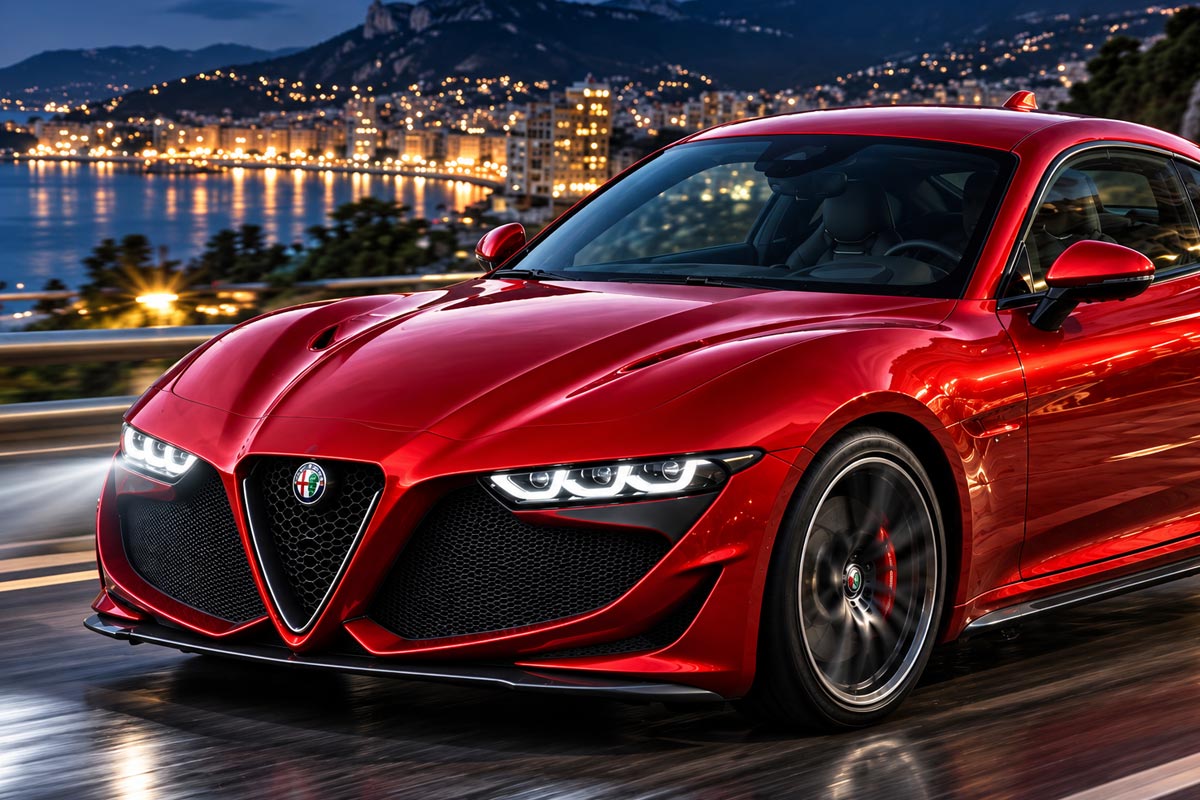
A few days ago, we were wondering on the future of Alfa Romeo. After dreaming of 400,000 annual sales during Sergio Marchionne’s tenure, the brand may have to settle for about 60,000 this year. With a Giulia and a Stelvio at the end of one's career, a Tonale in difficulty and a Junior Since it now accounts for a significant portion of the volume, the question was simple: what should be done? Alfa Romeo Now?
Clearly, the topic has inspired you. French, Italian, German, Dutch, and American readers, as well as those living in Switzerland and Spain, have responded in large numbers. And behind these sometimes very strong opinions, a few major trends are emerging.
First request: Let an Alfa be an Alfa again
This is probably the message that comes up most often among Italian readers. For them, the main danger would be turning Alfa Romeo into nothing more than a custom body style mounted on components from other Stellantis brands.
Andrea summarizes this sentiment quite well: anyone who buys an Alfa wants an Alfa, not «a Peugeot or some other similar vehicle.». Marco He takes it even further with a very vivid comparison: taking a Peugeot, changing the headlights, and putting an Alfa Romeo logo on it would, in his view, be like having just anyone wear Messi’s jersey in the hope of winning the World Cup. Giovanni, who learned to drive in a Alfa Romeo 75, also looks back fondly on that era when the brand offered a truly unique design, featuring rear-wheel drive, a transaxle, and a De Dion axle. For him, the question is almost philosophical: Would he buy an Alfa Romeo SUV today—one he considers to be nothing more than a Peugeot with a different body? His answer is no.
Many French readers echo this sentiment: Italian engines, Italian design, and distinctive handling are often considered the three essential ingredients.
Not everyone dreams of owning a Giulia, though.
That’s where the debate gets more interesting. Because while enthusiasts are eager for a rear-wheel-drive model or a successor to the Giulia, others believe that Alfa Romeo must first become more affordable again. A Dutch reader believes the brand has been stuck for too long in the market for overly expensive cars. In his view, what Alfa Romeo really lacks is a car like the MiTo, capable of attracting a broader audience. An American reader reaches exactly the same conclusion, but from a different perspective. MLopez believes that the main obstacle to Alfa Romeo's return to the United States is price. In his view, offering a Giulia Quadrifoglio for around $90,000 made the brand unaffordable for the vast majority of buyers.
CyberGene puts the paradox another way: even if Alfa Romeo were to build the perfect car for Alfisti today, many of them simply couldn’t afford to buy it new. They’d have to wait several years for it to hit the used car market. Ultimately, this ties back to an old weakness of Alfa Romeo’s: the brand has an extraordinarily passionate community, but passion doesn’t necessarily mean purchasing power.
A new Giulietta—and, most importantly, an estate car
On one point, the French, Germans, Dutch, and Americans seem surprisingly in agreement: there is a lack of more traditional body styles. Several readers are thus calling for the return of a Giulietta, while others also want a new MiTo. An American reader sums up his opinion bluntly: SUVs now look just like every other car, so Alfa Romeo should get rid of them and bring back the Giulietta.
But the greatest regret is undoubtedly the Giulia Sportwagon, which never actually existed. A German reader says he still drives an 18-year-old Alfa Romeo 159 2.4 JTDM today, with 350,000 km on the odometer. After owning two 156s and a 159, he explains that he doesn’t know what to replace his car with. In his view, Alfa Romeo made a major mistake by not offering a Giulia station wagon. Several French readers echo this sentiment: compared to the BMW 3 Series Touring, Mercedes C-Class station wagon, or Audi A4 Avant, the lack of a Giulia station wagon has cost Alfa Romeo a significant European customer base.
In the United States, the problem isn't just cars
However, the American testimonies highlight another problem: the network. Patty explains that his family owns a Stelvio and a Giulia and really loves both cars. But when warranty service is needed, the nearest dealership is about 200 miles away—more than 300 kilometers. The cars can then remain there for several weeks. For a vehicle used daily, the situation becomes difficult to accept when BMW, Mercedes, and other European brands have a much denser network.
A reader living between Switzerland and Spain describes a similar experience with the European customer service: he loves the car, but support falls short when it comes to handling an issue that spans multiple countries. In other words, simply building an excellent Alfa Romeo isn’t enough. It must also be easy to buy, finance, maintain, and repair.
What if the solution were actually much simpler?
Judging by all these testimonials, Alfa Romeo may not need yet another spectacular plan promising a global revival.
Readers seem to be asking for something concrete above all else: cars that are immediately recognizable as Alfa Romeos, a bold design, credible engines, affordable prices, a compact model, possibly a station wagon, and a dealer network capable of meeting customers' needs.
Some people still dream of a new Alfetta. Others would like to see an evolution of the Giorgio platform shared by Alfa Romeo and Maserati. Still others would be perfectly happy with a MiTo based on the 208 or a Giulietta similar to a Peugeot 308, as long as the result has enough Italian character.
And perhaps that’s where the challenge lies. Alfa Romeo must share technology to survive, but it must never give the impression that it’s interchangeable with the group’s other brands. It needs to cut costs on what the customer doesn’t see, without cutting corners on what makes them want to buy an Alfa.
If Alfa Romeo is reading this article, here is a list of complaints in order of priority:
- Restore a true Alfa Romeo identity to the cars.
- A return to more affordable cars.
- Replace the Giulia with a range of body styles. Stop relying almost exclusively on SUVs.
- Rebuild the sales network and after-sales service.
- Leverage Stellantis' synergies without drawing attention to them.
- Finally finalize the product plan.
 English
  French
  Italian
  Spanish
  German
  Japanese
  Dutch
Dutch
Thank you, fellow Alfisti—you’ve hit the nail on the head. No more ’Peugeot sisters’ with Alfa Romeo badging—that’s what makes our brand unique in every way. Then again, why doesn’t Alfa Romeo race anymore? In South Africa during the ’70s and ’80s, when our brand outsold BMW on many occasions, it was winning races on the weekends and selling Alfas on Mondays.
The Italian Alfa Romeo enthusiasts are right: an Alfa Romeo can’t be a Peugeot with an upgraded design—or with a PureTech engine. The Junior is selling well, and that’s great, but aside from the Junior Veloce, the other models aren’t true Alfa Romeos. Having driven a Fiat 600 Hybrid and then a Junior Ibrida one after the other, there’s no difference other than the look.
I understand what you're saying, but I've driven both cars, and they're quite different. The Junior was our choice. I still own the last Ice 500C. It's very different from the Junior, too. Both are good models. It's a tough time for automakers. And Alfa buyers aren't always willing to pay for design or redesigns either. I drove the Peugeot, too. It’s different from the Junior. Alfa has done a good job with the Junior, in my opinion. I also own some older Alfas and Fiats, so I understand the nostalgia factor.
I drove an Alfa for years and was waiting for something sporty in the electric car segment. Nothing but announcements. Now I have a Tesla Model 3 and a Model Y.
I know not everyone thinks that way. But with solar panels on the roof and a dynamic electricity rate, it's the only affordable option in the future. I'd be happy if Alfa survived the transition and I might be able to buy one.
I owned a 147 for 10 years. It was beautiful, affordable, and different from the rest. You could tell from a distance that it was an ALFA ROMEO.
I refuse to spend 30,000 euros on a Junior that doesn't reflect ALFA's history and spirit.
I don't necessarily want a sports car (given the price of gas and all the various penalties 🫤🫤), but just a car with soul in its design… a car with an Italian flair, Dolce Vita.
And above all, far from this pricing madness that has likely »driven away» loyal—but inevitably wealthy—customers.
And finally, customer service worthy of the name!!!
I'm constantly seeing changes in direction—to the point where I don't know what's going to come out or what's going to be canceled. With nothing but SUVs and no compact cars, it's hard to tell where Alfa Romeo is headed.
On the other hand, I don't see why an Alfa Romeo should be cheaper than a BMW or an Audi in the same segment.
The Giulia isn't cheap, but a BMW 3 Series is just as expensive, if not more so.
If you want to pay less, go to Fiat.
The main goal is to offer models in more affordable segments: city cars and compact cars.
There's nothing there.
What I associate with the brand is motorsports and the joy of driving. I’m only 29, but a Mito was my first car, and I’d love to drive it for another 12 years and 150,000 km. Those ’mere« 170 ps, combined with its light weight, make for a fun drive every time I get behind the wheel.
If something isn't working right, the engine isn't particularly complicated, so I can fix it and keep driving.
I think their product lineup needs a balance between volume and image, and they shouldn't go below the C-segment.
Is it true that Junior generates a large portion of its sales today, but that this also significantly harms its brand perception?.
I’ve owned several Alfas, including two in particular: the 164 Turbo Diesel and the Duetto Spider—two truly spectacular cars—but so far, I haven’t seen any miracles. I currently own a BMW Z4 convertible and a Smart Fortwo Cabrio for around town, and I sold a Porsche Macan, but my nostalgia for Alfa still remains…
It's a great car, and the same goes for the SUV—it's a shame the after-sales service didn't measure up. With a debut model like the Stelvio, Alfa should have set itself apart with its after-sales service.
The problem is clearly the after-sales service, and the «Alfisti» who turn them into souped-up wrecks on the used car market.
No one is asking to take advantage of the synergies with Stellantis. It’s something that’s happening all of a sudden.
A Mito based on a Punto didn't seem to bother Alfa fans; a Junior based on the 2008 model isn't much different—it's up to Alfa's engineers to set the vehicle apart from its cousins.
I've owned quite a few Alfa Romeos—the Alfetta was just great, then a 75 America with a 3-liter engine, and now a Tonale.
I'd be happy if things continued this way, because people drive an Alfa out of conviction, and the few who drive Alfas form a community.
I'm always happy when I see someone driving an Alfa coming toward me and waving hello.
The prices are way too high for all cars, but not everyone has an Alfa Romeo.
Alfa Romeo models from the ’80s to 2001, including the Alfasud TI 1500 Sprint Veloce, Giulia, Alfetta sedan, and finally the GTV6 2.5—I don’t understand why Stellantis isn’t considering releasing an Alfa Romeo model similar to the Alfasud with a Subaru-type engine to get startedand offer the general public a true Alfa at a reasonable price
I'm glad my «Alfisti paradox» was mentioned in the previous article. I'll say it again, because I still see the same illusion among Alfisti—and I say this as an Alfista myself!
We all want Alfa Romeo to be healthy—and therefore profitable. But that requires either high sales volumes or high profit margins. The Giulia and Stelvio are true Alfas, with a dedicated platform and excellent engines, but sales volumes remain insufficient.
Would an Alfa designed exactly as Alfisti dream of it really be profitable?
Alfa must survive by using shared platforms, or it will disappear. It's sad, but that's the reality.
That’s an interesting exchange. There’s clearly a fundamental issue here: respect for the customer. No evolving product lineup (the Giulietta or 159 station wagon—they gave customers the middle finger), Panda-level customer service for customers spending 50,000 euros, and a haphazard dealer network. In short, passion is no excuse.
Alfa was known for making sports cars affordable and appealing.
Alfa has been dead ever since Twin Spark and Busso were discontinued. Alfa sold its soul.
RIP 75, 155, 156, 164, GTV, and GTA. .
What a waste….
That's exactly how I feel! When I was in college, the saying went that if you ever drove an Alfa even once, you'd never be satisfied with anything else. Those days are gone. Bring them back, and the passion will return—and so will the buyers.
I owned two Giulietta cars in the ’80s. The 1600 barely ran, and the 2-liter 130cv ran a little better—but what a sound! The build quality was shoddy, and reliability wasn’t great.
After that, I only drove C-Class cars and 4x4s.
I wanted a Giulia—it’s a really beautiful car—but my wife was against it, so we stuck with Mercedes. Personally, I regret it, but who still dreams of an Alfa that you could race up the hill on Sunday mornings and drive to work during the week?
This was awesome, but since I just got a Stelvio, all I want to talk about is Stelvios! I just love it to bits (coming from a Honda Pilot)! How much Peugeot is in a Stelvio? (I’m worried)
The Stelvio has no Peugeot DNA; it was developed under FCA (led by CEO Marchionne) on a dedicated platform for the Giulia and the Stelvio. It was Alfa’s first SUV and, despite all the criticism from so-called «Alfisti,» sold significantly better than the «sacred» Giulia. Admittedly, a Giulia station wagon would have been interesting. If FCA had equipped the excellent Giulia and Stelvio with modern multimedia and driver-assistance systems back then, more would have been sold. Of course, Alfisti live in the past—they don’t want a radio, front-wheel drive, or an SUV; they only want yesterday’s technology, which can no longer be registered… thus failing to generate sales volume… and is unaffordable… Alfa certainly won’t survive this way.
We want a GTV. And real Italian engines. And we don't care about luxury. We don't even need a radio.
In the meantime, I'm keeping my Alfa from the 1990s.
I'm still driving a 159 JTDM. A beautiful Giugiaro classic. I loved the GTV, the 156, and the 147 Twinspark. Modern cars are designed by the marketing department. So bland. So many comments reflect this. The Giulia was a bold challenge with fabulous engineering but a bland design indistinguishable from the rest of the pack. Alfa Romeo cannot survive by trying to be everything to everyone.
After owning 14 Alfas (from the 75 to the Giulia), I informed my dealer that, given the current lineup consisting of rebranded Peugeots and Fiats, we would be ending our business relationship.
Sadness….
Rock 'n' roll has been dead since Marchionne left. SUVs? Really?
I'm the proud owner of a Giulia, and before that, a Duetto Veloce. That's Alfa Romeo.
I won't change until I see and feel that true Alfa passion surging back again.
Ciao
Anything but an SUV!
I want a real ALFA ROMEO!!!
Currently: 156 GTA, 3.0 GTV, Giulia...
Where's that cool, lightweight Alfa?
With a 2.5-liter Busso V6... where?
Alfa Romeo is dead
The underlying problem is that there aren't many Alfa Romeo enthusiasts, and they want affordable cars. It's not an easy business model. The solution exists, but someone has already taken it—and that's Cupra.
What's the problem with having Alfa Romeos based on Peugeots?
No offense, but today it’s either this or nothing—discontinuing the Mito and Giulietta is a classic Italian 100% decision! It’s a shame to have platforms available and not use them; at Audi, they borrow from VW for their smaller models.
What's more, the sales figures speak for themselves: the least "Italian" Alfa is the one that sells the best!
The problem is that Alfa Romeos need to be special and have character—they shouldn't just be run-of-the-mill cars like far too many other brands.
However, the Junior Ibrida doesn't really stand out from the competition, aside from its design. On the other hand, I do recognize the sportiness and appeal of the Junior Veloce.
As for the materials used in the Junior, I'd rather not say anything—that would be mean.
That said, a brand has to be profitable and generate sales; at least that's what Junior is for.
There’s nothing stopping manufacturers from producing specialty vehicles using shared platforms; the Mito, 147, andGiulietta were based on Fiats, and that’s precisely what makes these projects viable. BMW uses the Mini platform for the 1 Series and X1, and the same goes for Audi, which happily draws on VW’s resources.
Peugeot’s platforms aren’t bad either—it’s up to Alfa’s engineers to give them some extra character—but the Giulia and Stelvio, built on their in-house platform, are commercial failures. At some point, you have to be pragmatic; otherwise, it’s a future like Lancia’s.
A very good summary, and I hope the Stellantis board—especially Filosa—has read it all. No more excuses, no more opinions about Alfa Romeo’s viability. The fact is: Alfa Romeo can be as successful as BMW or Peugeot, but you have to do the right thing. Here’s our free advice to you, the board members of Stellantis.
How do you think Alfa Romeo can become as successful as BMW? We already have the Giulia and Stelvio, which cost billions to develop and are, arguably, excellent cars—yet they still don’t sell in sufficient numbers. Can you explain why?
Are you suggesting that Stellantis should spend even more billions on another similar, potentially failed attempt?
The reality is that Alfa Romeo can only survive by becoming more like a Peugeot—but Alfisti don’t want that. I don’t want it either. But the alternative is Alfa Romeo’s demise.
Why can't everyone understand this?
They failed because of terrible product management and after-sales service. Definitely not worthy of a premium brand. They've also left the products almost unchanged since their debut.
I drive a 147 GTA and a 1750 GTVeloce coupe. I'll never switch to a Stellantis model—especially not an electric or hybrid one!!!
What if you were offered a Giuletta based on the 308 with the company's own 2L engine under the hood?
See my reply to Rob above. To follow up on that, unfortunately, I believe the only viable path for Alfa Romeo now is to offer practical cars built on shared platforms, while incorporating the unmistakable Italian flair in the exterior design, a distinctly Italian interior, and a sportier character through Alfa’s expertise in handling and driving dynamics.
Developing a completely independent, genuinely Italian Alfa Romeo from scratch is simply out of the question today. That’s the sad reality, and I think we need to accept it.
The fact that there are no coupes or convertibles in the lineup is also a problem. Alfa Romeo has a wonderful history and tradition, and its greatest defining feature should have been its beautiful, attractive, and fun-to-drive cars. Mediocre SUVs and BEVs that feel like driving electronic devices simply don’t suit a brand like Alfa Romeo.I hope to see the return of affordable, rear-wheel-drive, pure gasoline-powered cars. And please don’t forget to offer a manual transmission option for the Japanese market. I’m extremely dissatisfied that the Japanese models are currently available only with automatic transmissions.
I’m sick of their SUVs! There’s no hope for Stellantis—its strategy is completely vague and contradictory, with too many brands stepping on each other’s toes… The ideal scenario (a dream) would be to sell the brand to wealthy investors outside the auto industry—or even better, sell it to Toyota! They have reliable engines and are the only ones still making real sports cars! Otherwise, the brand will eventually disappear…and we’ll end up seeing Alfas in museums….
Could someone (e.g., Drache) please explain to me what they consider to be affordable and how a manufacturer today can produce large numbers of purely gasoline-powered cars—given the exorbitant CO2 taxes—and still successfully sell them at an affordable price? The laws of physics apply universally, and the CO2 emissions from a pure gasoline engine cannot be eliminated. It’s simply time to face reality and be glad if the AR brand manages to meet the legal specifications (which apply to all manufacturers) and continues to exist. Anything else is wishful thinking, like «Alice in Wonderland»…see CyberGene’s realistic comment.
I've been driving Alfa Romeo (and other brands as well) for more than 50 years.
But now the world has undergone fundamental changes—technologically, economically, and politically—so we must not keep clinging to the old ways.
I agree with the comments made by CyberGene and Werner Fischer.