

At the beginning of 2026, the Maserati no longer really comes as a surprise. It simply confirms, in figure after figure, what we had been seeing coming for several years. After a conclusive 2025 to just 7,800 cars sold worldwide, With 1,321 registrations in the main markets monitored by Italpassion, the first quarter of 2026 is a continuation of the trend... a decline of -41 % compared with 2025.
An unsurprising fall
In detail, all or almost all markets were down. The United States, long a pillar of the brand, fell by a further -55 %. Italy is down -42 %, Japan -31 %, Germany -28 %. Even normally solid markets such as Australia and Spain are plunging. There are a few exceptions, such as the UK (+2 %) or Switzerland (+128 %), but they remain marginal and do not alter the overall trend: the contraction is global, uniform and structural. This point is essential. Maserati is not suffering from a localized problem, or a simple product blip. The brand is in difficulty everywhere.
| Country | Q1 2026 | Evolution |
|---|---|---|
| United States | 466 | -55% |
| Italy | 277 | -42% |
| Japan | 152 | -31% |
| Germany | 107 | -28% |
| United Kingdom | 104 | 2% |
| Switzerland | 66 | 128% |
| Australia | 54 | -39% |
| Turkey | 33 | -33% |
| Spain | 45 | -42% |
| France | 17 | -29% |
| Austria | 3 | 200% |
| Netherlands | 0 | -100% |
A trajectory written a long time ago
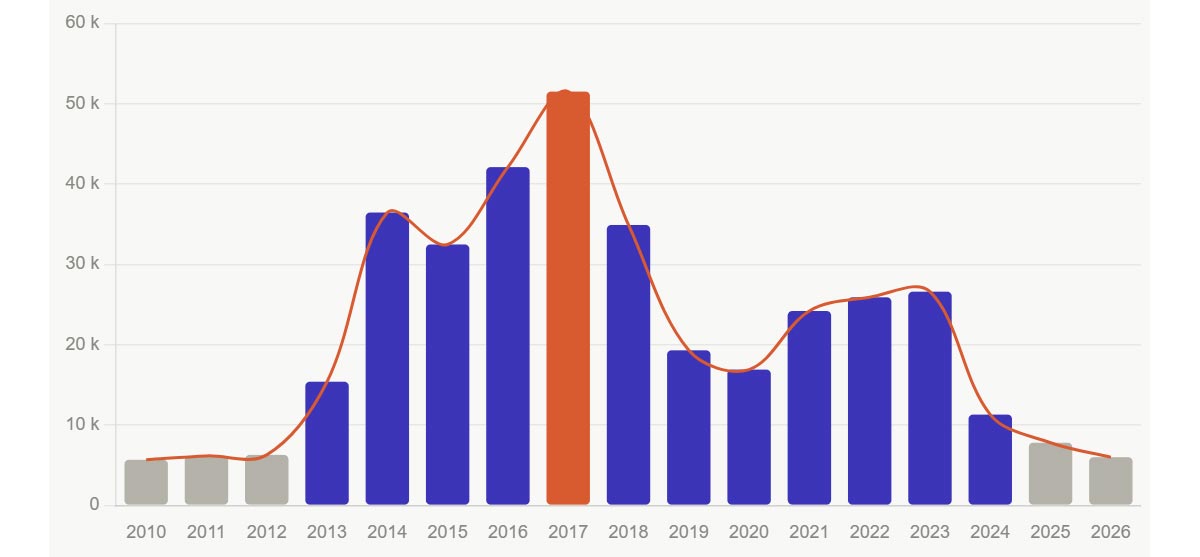
If the first-quarter pace continues, Maserati could end 2026 between 5,000 and 6,000 units. A level that takes the brand... back to the early 2010s. In other words, the entire growth cycle driven by Quattroporte, Ghibli and Levante has been wiped out. More than ten years of industrial strategy swept away, with the added bonus of a weakened brand image. And yet, it's hard to speak of surprise.
What is happening today at Maserati is no accident. It is the logical outcome of questionable strategic choices accumulated since the beginning of the decade. The brand has introduced 4-cylinder MHEV engines that are totally out of step with the expectations of the luxury segment. At the same time, it failed to anticipate the arrival of high-performance V6 or V8 PHEV hybrids, unlike its direct competitors.
The Folgore range was an attempt to go electric, but it didn't really meet the needs of its clientele. Relying on a wealthy urban clientele for electric 100 % models was more of a gamble than a sound strategy.
On the product side, the picture is just as complex. The supercar MC20 is still interesting on paper, but it's already entering its sixth year without any major changes. The Grecale is a good SUV, but lacks a truly attractive range. As for the new Granturismo and Grancabrio, they are positioned in a segment that has become extremely narrow.
2026: the year of the reset
Against this backdrop, 2026 appears to be a pivotal year. A year of transition, almost reconstruction. The arrival of Jean-Philippe Imparato at the helm of the brand a few months ago marks a turning point. After turning Peugeot around and then stabilizing Alfa Romeo (with the launch of the Tonale and Junior), he has inherited a much more complex task.
The message is already clear: the electric 100 % will not be the only horizon. A strategic rethink is underway. Internally, the message is deliberately positive. COO Santo Ficili insists on team cohesion and the need to move forward together. CMO Cristiano Fiorio talks of trust, a shared vision and a “bright” future. Strong, almost mobilizing words. But at this stage, they stand in stark contrast to the reality of the figures.
The real question is no longer whether Maserati is doing badly. It's what Maserati wants to become. Ultra-luxury à la Ferrari? Volume control à la Porsche? Premium in-between like in the 2010s? Until now, the brand has oscillated between these positions without ever making a clear decision. And it's precisely this vagueness that has brought it to where it is today.
More than two years ago, a question was asked: “Maserati: does Stellantis know what she's doing with this luxury brand?”Looking back, the answer seems obvious. No. This observation is not an attack. It looks more like a form of weariness. For this situation was largely foreseeable. The signals had been there for a long time. To see Maserati today returning to volumes close to 2010 is inevitably frustrating, almost sad, given the brand's potential.
One last chance?
While the brand is currently celebrating the centenary of its emblem, the Trident, the period 2026-2030 will be decisive. With a new management team, a strategy being redefined and a clear desire to start afresh on a sounder footing, Maserati is probably embarking on the most important chapter in its recent history. But make no mistake: 2026 will not be the year of the rebound. It will be the year of reset.

 English
  French
  Italian
  Spanish
  German
  Japanese
  Dutch
Dutch
We urgently need to get Maserati (and Alfa Romeo) out of Stellantis. Especially now that Imparato is in charge.
The Peugeot clan can't handle such coats of arms.
Volume mastered by Porsche?
Is this a joke?
Not only have they never controlled their volume, but over the past 2 years they've gone from free fall to an inevitable crash.
it's an image, to give an order of magnitude in volume. it's not a praise of porsche (after all, apart from the last two years, they've clearly been good).
One question - and Stellantis has nothing to do with it - is why Maserati didn't put the Alfieri into production, after it had been such a success at the time of its presentation! Mystery, when talking about Porsche in difficulty for comparison with Maserati, for info Porsche sold 280,000 vehicles in 2025 worldwide, 7 times more than Alfa and almost 20 times more than its so-called competitor Maserati! 🤔
I have a levante and it is more fun better drive than a PORSCHE, I love my Maserati Levante
Quattroporte und Ghibli vom Markt genommen anstatt zu überarbeiten.
Wo soll da ein Wachstum herkommen?
Selbst wenn sich die anderen Modelle besser verkaufen würden ist es ausgeschlossen dass aufzufangen.
Den Vierzylinder mit über 300PS nur in den Maserati einzubauen ist auch eine teuere Entscheidung gewesen.
Wieso kam diese Variante nie in der Gulia?
Den auch da keine motorischen Updates.
Die ältere Generation kauft sich keinen Maserati mehr und die Jüngeren haben entweder Topcars im Auge oder denken umweltbewusst.
Meiner Meinung nach sollte Maserati sich an Ferrari und Co. annähern und unterhalb bleiben. Zudem mit einem anspruchsvollem Motor. Ein Quattroporte mit guter Ausstattung sollte folgen. Primär gilt den Namen wieder mit Glanz zu versehen.
I think Alfa Romeo and Maserati should get the Fuk out of Stallantis and go private. I would welcome that decision and buy some shares.
Imparfait didn't put Peugeot back on its feet, at most he stabilized what had been there before him. At Alfa, it's the opposite: he hasn't put anything in place, just destabilized what's left a little more. As a result, there'll be no new model before 2027, apart from the next Peugeot-based tinkerer. This guy's the door, that's all.
Whoever is running Maserati needs to be fired ASAP. It seems corporate doesn't know how to maintain the brands long history of excellence and tradition.
I've suggested it before. Show the results from Belgium:
Q1 2025: 30, year 2025: 121
Q1 2026: 48 (+60%!)
Reason (for me): Bigger Maserati presence on events/car shows