

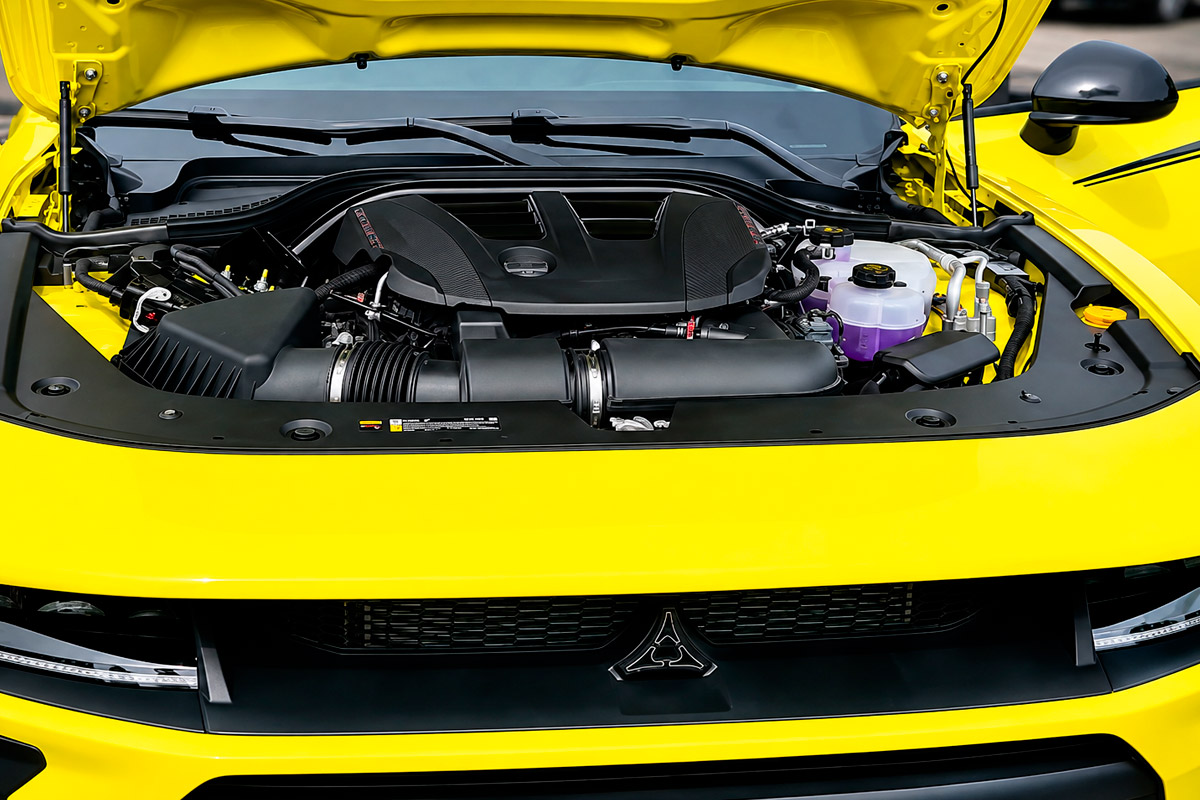
A few weeks ago, Stellantis promised to show just how far its new Hurricane engine could go. We now know the answer: 600 ch. At the unveiling of the new Dodge Charger Super Bee, Stellantis has just revealed the most powerful version to date of its 3.0-liter twin-turbo inline-six engine. And naturally, from a European perspective, this powertrain is sparking some ideas…
Because behind this American Dodge Charger lies a combination that would likely have been the stuff of dreams for many Alfa Romeo enthusiasts: a rear-wheel-drive car based on the STLA Large platform and equipped with a six-cylinder engine producing 600 ch. In a parallel universe, it’s hard not to imagine what that might have looked like under the hood of a new Alfa Romeo GTV.
The Hurricane now delivers 600 ch
Until now, the High Output version of the Hurricane engine installed in the Charger SIXPACK produced 550 ch and 720 Nm. With the new Charger Super Bee Launch Edition, Dodge gains an additional 50 ch while maintaining 720 Nm of torque.
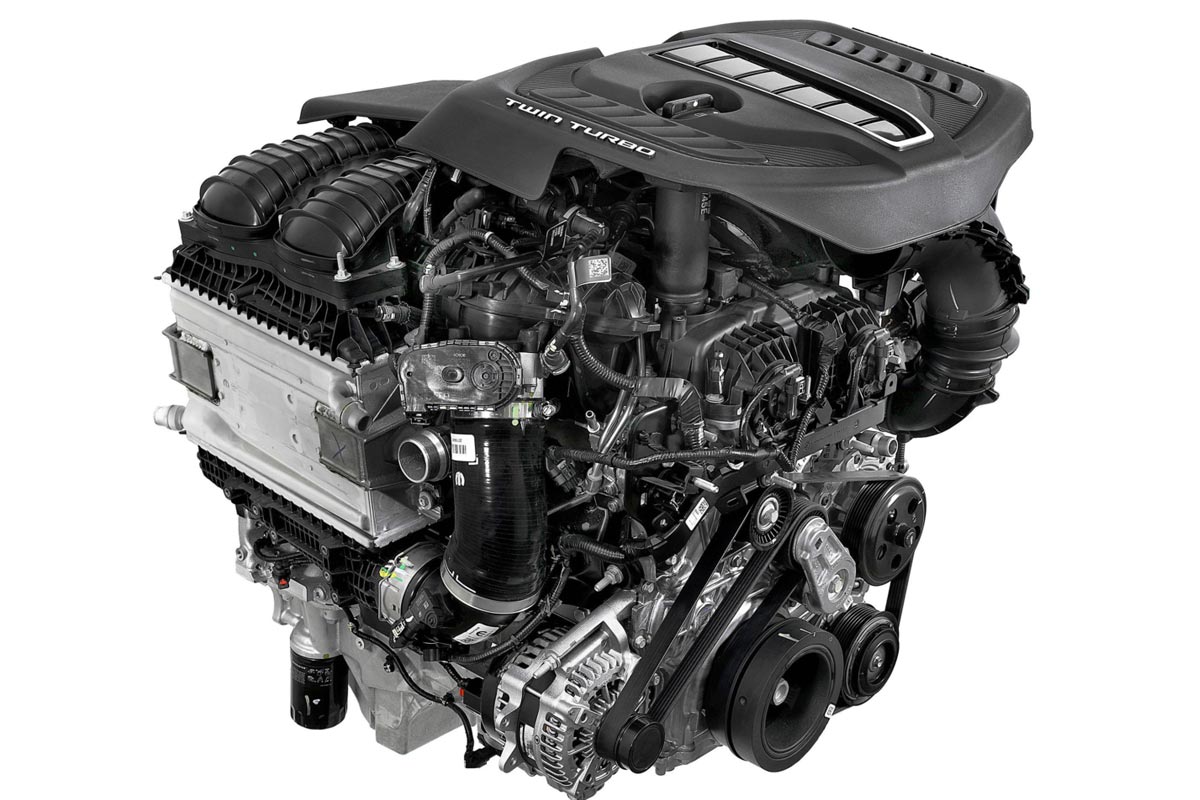
Contrary to what one might have imagined at the time of our previous article, Dodge didn't settle for a simple remap. The six-cylinder engine features larger 56-mm Garrett turbochargers operating at up to 30 psi, a modified intake, a redesigned exhaust system, and a new electronic control unit.
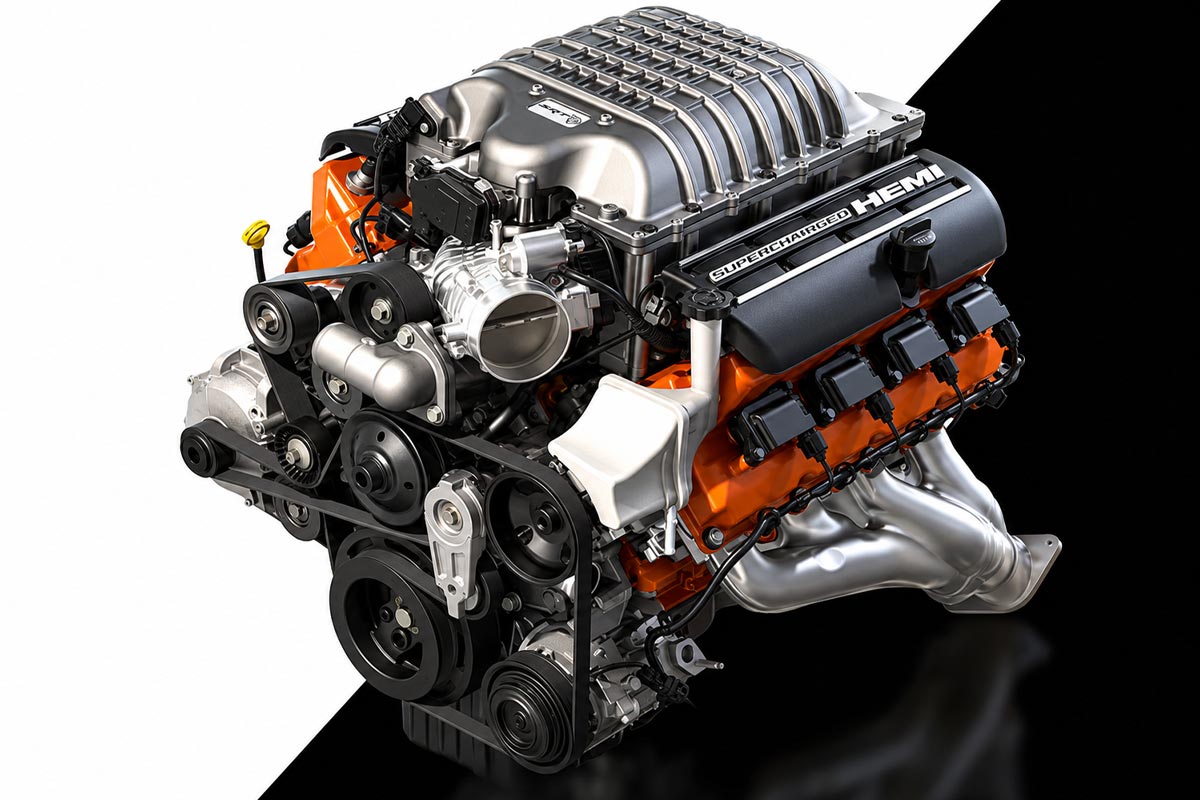
The result is quite impressive: with 200 ch per liter, this Hurricane enables the Charger Super Bee to go from 0 to 60 mph (96 km/h) in just 3.6 seconds. That’s even a tenth of a second faster than the previous 707 ch Charger Hellcat. Over the quarter-mile, however, the V8 retains the edge with a time of 11 seconds, compared to 11.8 seconds for the newcomer.
| Model | Load Hellcat 2015 | Download Super Bee 2023 | Load Scat Pack 2026 | Charge Super Bee 2027 | Maserati Nettuno |
|---|---|---|---|---|---|
| Engine | 6.2-liter supercharged V8 | 6.4-liter naturally aspirated V8 | L6 3.0-liter twin-turbo | L6 3.0-liter twin-turbo | 3.0-liter twin-turbo V6 |
| Power | 707 hp | 485 hp | 550 hp | 600 hp | 630 hp |
| Power per liter | ≈ 116 ch/L | ≈ 77 ch/L | ≈ 186 ch/L | ≈ 203 ch/L | 210 ch/L |
| Couple | 880 Nm | 640 Nm | 720 Nm | 720 Nm | 730 Nm |
| 0 to 100 km/h | 3,7 s | 4,5 s | 3,9 s | 3,6 s | ≈ 2.9 s* |
Stellantis wants to show that a six-cylinder engine can replace the V8
Dodge didn't stop at the engine, either. Radiator cooling has been improved by more than 50 %, while the Super Bee features new adaptive suspension, large Brembo brakes, 20-inch forged wheels with 305 mm tires, and several specific driving modes, including Track and Drag.
The all-wheel drive can also be disengaged via a rear-wheel-drive mode—just to remind us that this is still a Dodge, and that a Charger should also be able to make its rear tires smoke. Above all, it’s yet another demonstration of the Hurricane’s potential. Criticized for having the daunting task of succeeding the HEMI V8s, Stellantis’s six-cylinder engine is starting to really step up its game.
What if this engine had found its place at Alfa Romeo?
And that’s probably where this new Charger becomes particularly frustrating when viewed from Europe. Stellantis now has the STLA Large platform—an architecture capable of supporting rear-wheel-drive vehicles—and a twin-turbo inline-six engine producing 600 ch.
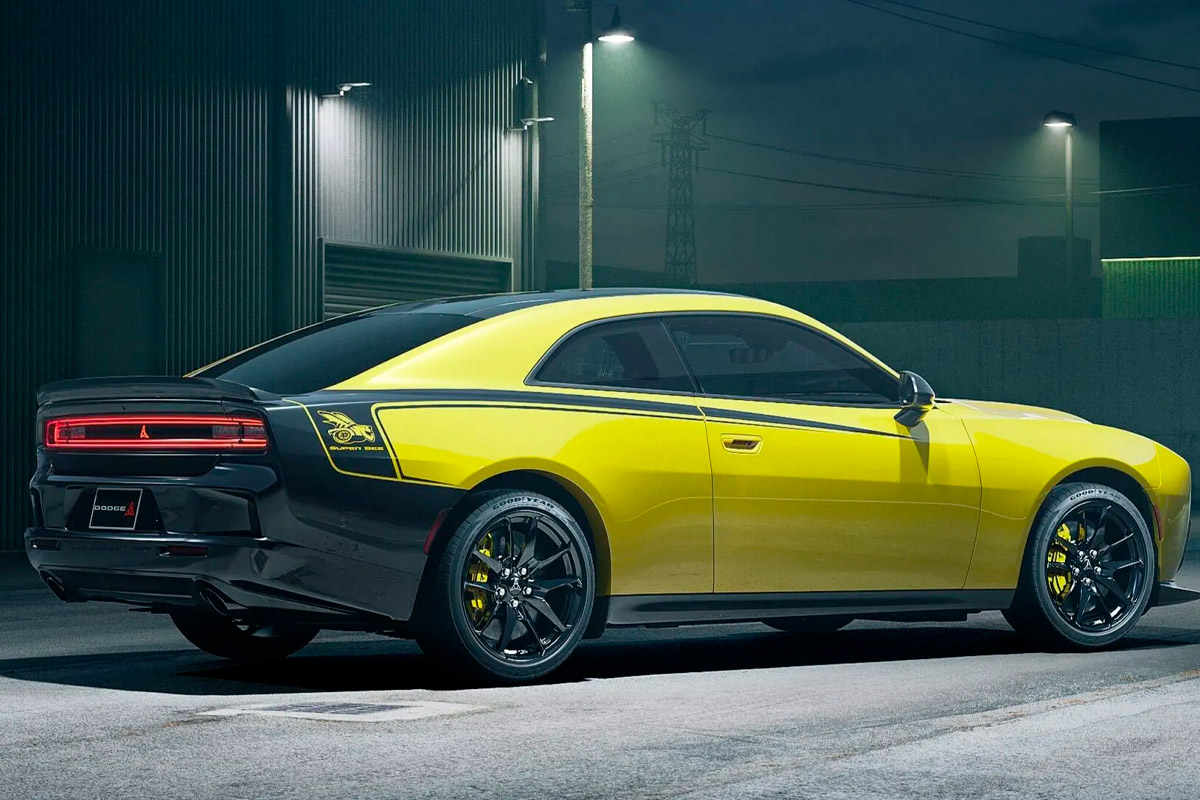
It's hard not to imagine, in a parallel universe, an Alfa Romeo GTV built around these elements: a longitudinally mounted front engine, rear-wheel drive, a 600 ch six-cylinder engine, and the body of a grand Italian coupe.
That’s unlikely to happen. Stellantis has made different choices for Alfa Romeo, and the Hurricane remains, for now, a platform intended primarily for North America. But this Dodge Charger Super Bee at least gives us a sense of what was technically possible. And with 600 ch from a Stellantis inline-six, there was probably enough potential to create a rather spectacular Alfa Romeo.

 English
  French
  Italian
  Spanish
  German
  Japanese
  Dutch
Dutch
«What if this engine had found its place at Alfa Romeo?»
Or Maserati.
In my opinion, Maserati’s situation is different. If they want to sell supercars and large SUVs, it has to be an Italian V6—not the same 6-cylinder engine that an American might find in a Dodge, even if the performance is ultimately very similar. As for Alfa Romeo, there’s already the 4-cylinder GME; a Giulia, Stelvio, or GTV with this 6-cylinder GME could be the Quadrifoglio version. In short, pair it with a good hybrid powertrain for Europe!
As for Alfa Romeo, I agree. It'll be much better than the PureTech.
But we mustn't forget that, for an Alfa Romeo enthusiast, an Alfa Romeo without an Italian engine isn't an Alfa Romeo. See the 159/Brera models with the original Holden V6.
Gone are the days of Italian engines; now we have to talk about European, American… or Chinese engines.
Unfortunately (for Italian engines).
I'm totally against that! In an Alfa, Fiat, Ferrari, or Maserati, if you're going to have a six-cylinder engine, it absolutely has to be a V6—period!
Are you familiar with the Alfa Romeo 6C? Or the Maserati 3500 GT? Two iconic cars with inline-6 engines.
Stellantis has followed the European guidelines on all-electric vehicles, and, as with other automakers, the results are poor.
I feel like we're seeing a repeat—in reverse—of what happened 50 years ago with China...
Stellantis is partially backtracking on internal combustion engines and partnering with China on electric vehicles. In my opinion, these are winning bets.
Now is the time to buy Stellantis stock. It will be a very good investment.
Given Stellantis's struggles in Europe, personally, I wouldn't take that risk… But fortune favors the bold, so I wish you «good luck» 😉
Instead of this 6-cylinder engine, we'll see other Alfa Romeo models with Peugeot engines, due to emissions standards and penalties...
Gasoline engines (excluding Quadrifoglio models) have already been removed from the Giulia and Stelvio lineups. That's a shame.
A true Italian sports car needs a V6—not some BMW-style knockoff—and that's that!
I have no idea, but the main thing is to make a claim!
I think the 6-cylinder engine in a world of 8-cylinders is like introducing the 3-cylinder engine into a world of 4-cylinders. .
I would have preferred the introduction of 8-cylinder engines that can be downsized to 4 cylinders under low load.
Strange… a high-performance 6-cylinder engine is being developed for the U.S.…while its established European «counterpart» is «slowly emerging from obscurity» with minimal production volumes… does this have anything to do with Stellantis’s «two-pronged» engine strategy? A combustion engine renaissance for «petrolheads» in the U.S. and a—continuing—shift toward electric powertrains in Europe? We’ll likely have to WAIT for answers; this time, until December(?)
In any case, with the penalty on cars in France, Citroën will soon be bringing back the modernized two-cylinder engine from the 2CV to incorporate it into its new models. It’ll be just like in the postwar era.
That's true! And it's a real shame! France accounts for 0.08% of CO2 emissions, but we're being made to feel guilty so they can impose new taxes that were supposed to make it easier to buy EVs—but no, the electric vehicle incentives are getting smaller every year!
Please keep the 6-cylinder engines in Italian car brands in a V-configuration!
Yeah, I also think you can't compare Alfa and Maserati to a Stellantis vehicle
The portfolio should be restructured. On the one hand, it’s a matter of tradition. But it must also be said that mismanagement has caused serious damage to both brands. Marchionne wanted to set things right, but he passed away suddenly. As a Stelvio Quadrifoglio driver, I have a very strong connection to the Italians and their art of building cars. This model is no longer being sold. I hope for both brands that this art of building cars isn’t lost. The DTM SGT 55 shows what the Italians are capable of. SGT is an Italian company.
But an American who buys a Dodge Challenger wants a V8—period. So the V6 can only appeal to Alfa, Lancia, and Maserati in Europe… but even there, who’s going to buy a V6 given the price of gas and the penalty fees?
It's all well and good with all that fuss over huge engines and the latest news. Those big gas-guzzling cars here—which are usually run on LPG anyway—only make a few people happy. It’s about time they started focusing more on the quality of their European club cars—the very ones whose great brands they’re killing off—and stopped lining their pockets in America.
Or, more than anything, it just shows that Americans couldn’t care less about the future! Climate change is here (they’re feeling the effects too), and reducing their carbon footprint—or simply cutting down on overall pollution—could mitigate the effects. But no, they’re just speeding headlong into madness (600 ch is really useful for driving in traffic jams). After all, crashing full speed into a wall might actually hurt less!
You’re clueless and brainwashed. All transportation in the U.S. combined accounts for 3% of global CO2 emissions. Most of that comes from diesel used to transport goods by truck and train.
600 HP is nice, but that twin-turbo setup isn’t a muscle car. A naturally aspirated V8 or supercharged V8 is. The 392 SRT engine is bulletproof. That’s what we want. Come on, Stellantis, give us a 426 option! That being said, the Charger desperately needs a redesign—take a cue from the Italians if necessary. The new design can’t hold a candle to the previous Charger or Challenger. Give us back those curves instead of the current boxy design of this new generation. Now, the Rumble Bee looks amazing, but it’s based on the very good-looking Ram 1500. That’s a truck I can get behind.
With Maserati, Stellantis already has a 3.0L V6 that performs really well.
Why bother with a new engine?
Its 3.0L V6 isn't more powerful than a V8. The 3.0L V6 with two additional turbos is more powerful than the V8. There is a difference: more potential points of failure, higher temperatures, and higher fuel consumption.
Guy, one is RWD and the other is 4WD…
So the 0-60 mph results aren't all that surprising…
My MG4 XPower has about 430 hp and can do it in 3.4 seconds, thanks to the electric motor's characteristics and 4WD…. Is it more powerful than a supercharged V8? No!
So you're inferring from the fact that a 4-wheel-drive (Supercharged 2027) goes from 0 to 100 faster than a two-wheel-drive model but is slower over the quarter-mile means that the supercharged HEMI V8 is less powerful than a twin-turbo V6???
What is the world coming to…