

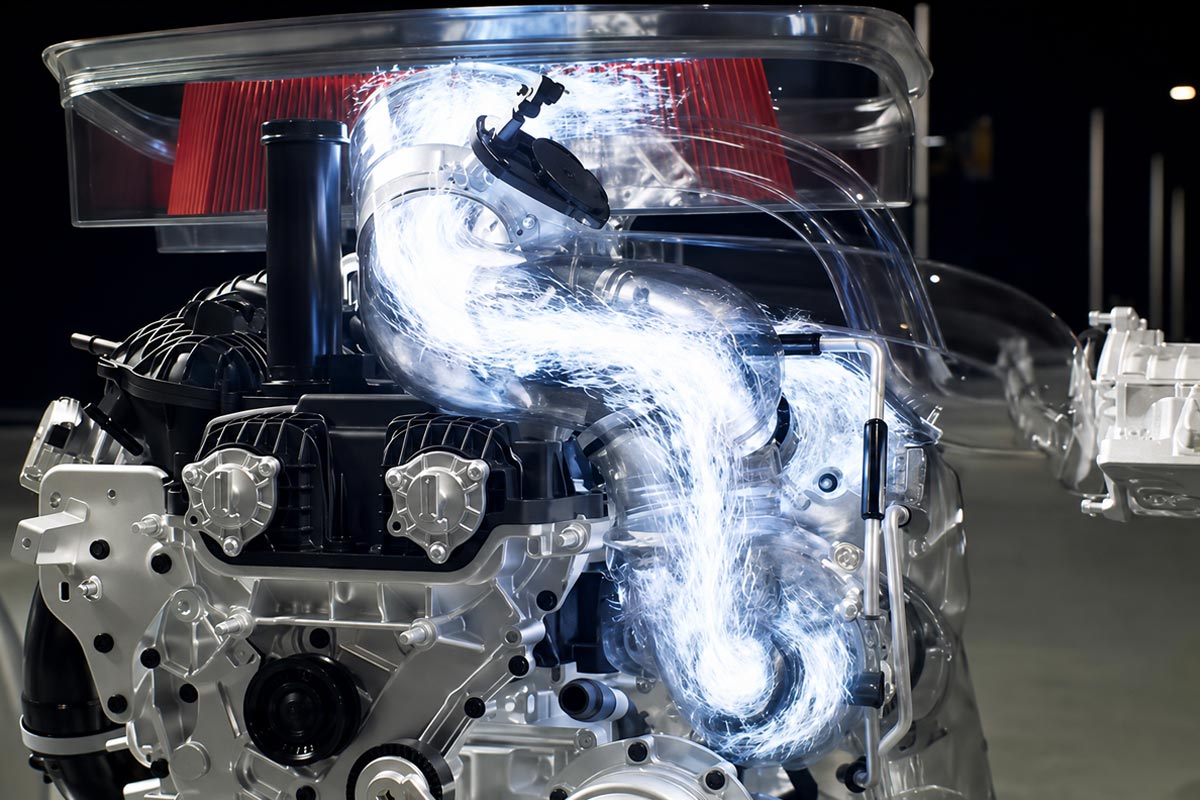
A few days ago, Stellantis revealed just how far it could go its new Hurricane six-cylinder engine : 600 ch in the Dodge Charger Super Bee, achieved in part through the use of larger turbochargers. But larger turbos generally mean longer response times. This is precisely the problem that SRT engineers now aim to tackle with a technology called eBoost Air.
The idea is fairly simple on paper: keep large turbochargers—capable of delivering plenty of air at high RPMs—while regaining the immediate response at low RPMs that was part of the appeal of Dodge’s older supercharged V8s.
An electric compressor to wake up the turbos
Unlike certain technologies already used by Mercedes-AMG or Porsche, eBoost Air does not directly integrate an electric motor into the turbocharger. SRT chose to install a separate electric compressor upstream of the two turbos on the 3.0-liter Hurricane. When the driver floors the accelerator at low RPM, a bypass valve directs air to this supercharger. It immediately creates positive pressure in the intake, thereby helping the conventional turbochargers spool up much more quickly.
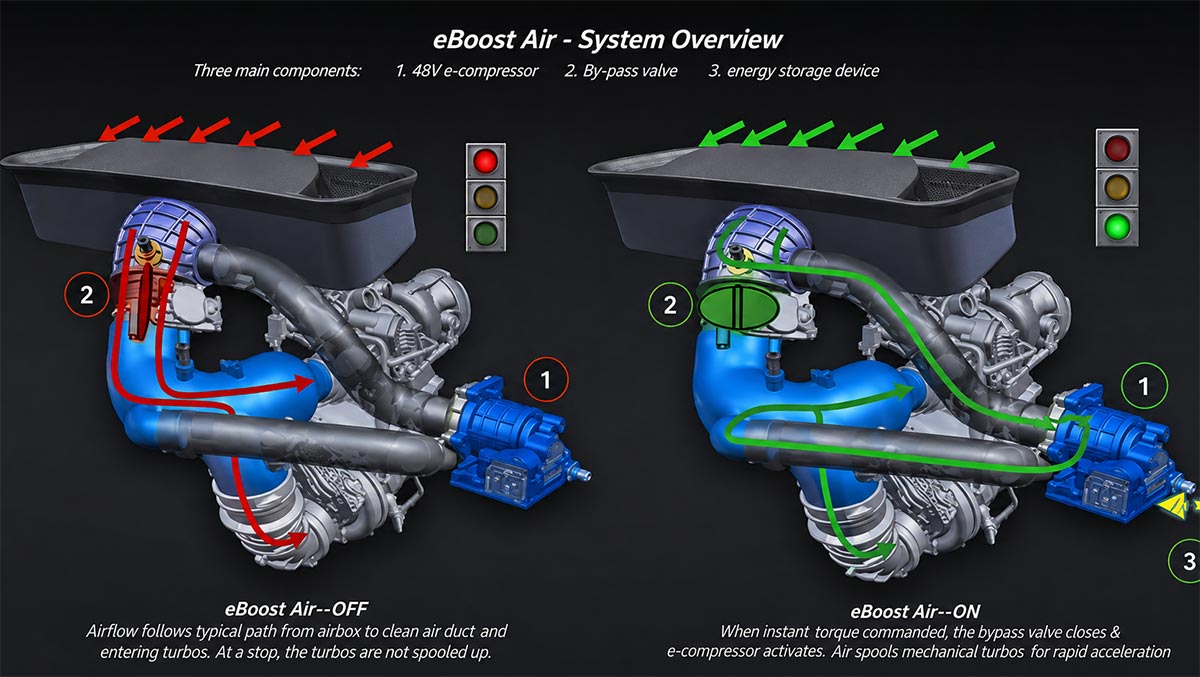
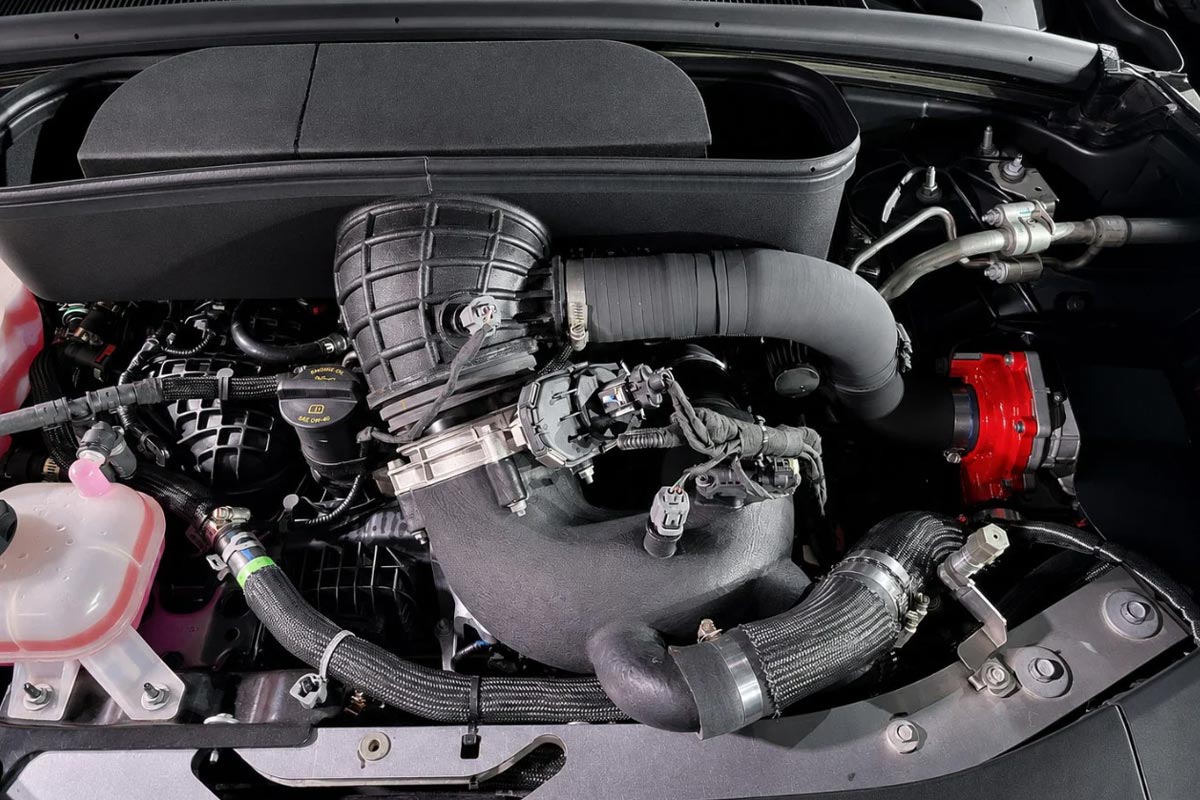
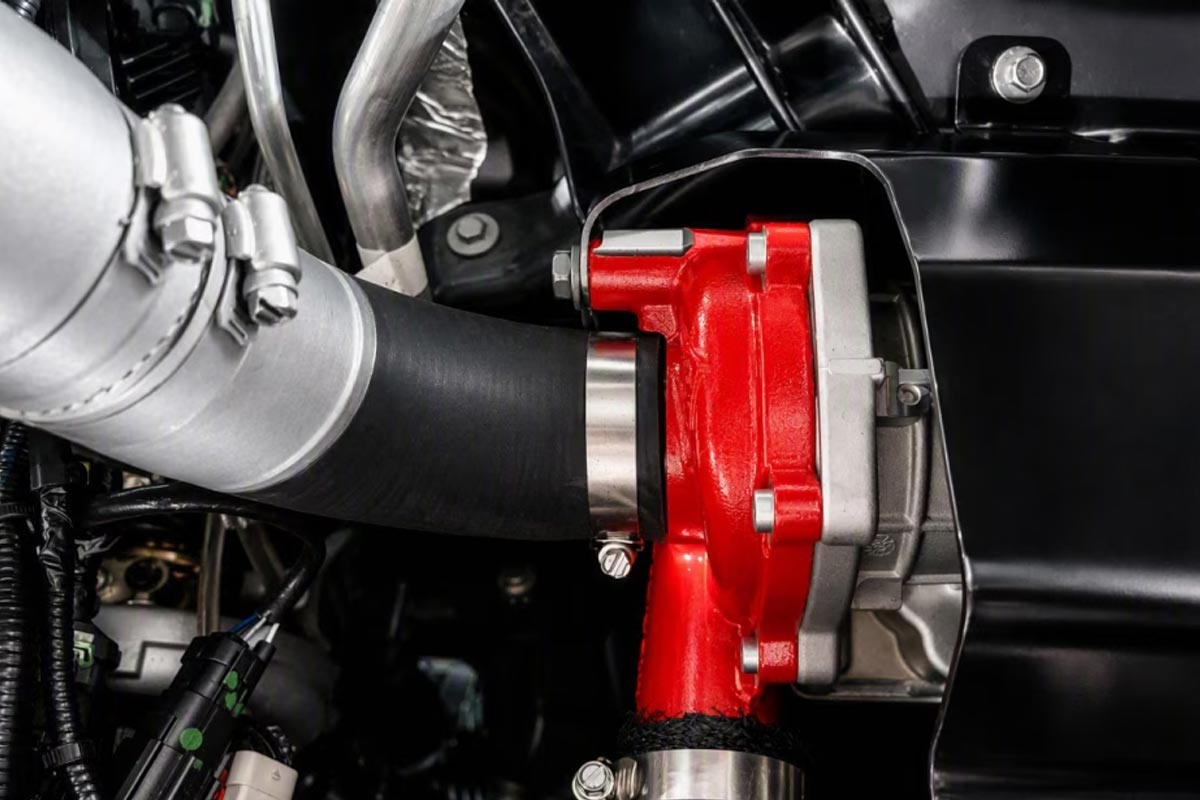
Once the exhaust gases generate enough energy to drive the turbos, the electric compressor is no longer needed: the intake system then returns to its conventional operation. According to SRT, the system thus allows boost to be maintained over a much wider range of engine speeds and virtually eliminates the notorious turbo lag.
10 psi in just 0.65 seconds
And the initial figures give a better idea of the system’s benefits. According to tests conducted on a prototype equipped with the Hurricane, eBoost Air is capable of delivering approximately 10 psi—or 0.7 bar of pressure—to the intake just 0.65 seconds after a firm press of the accelerator.
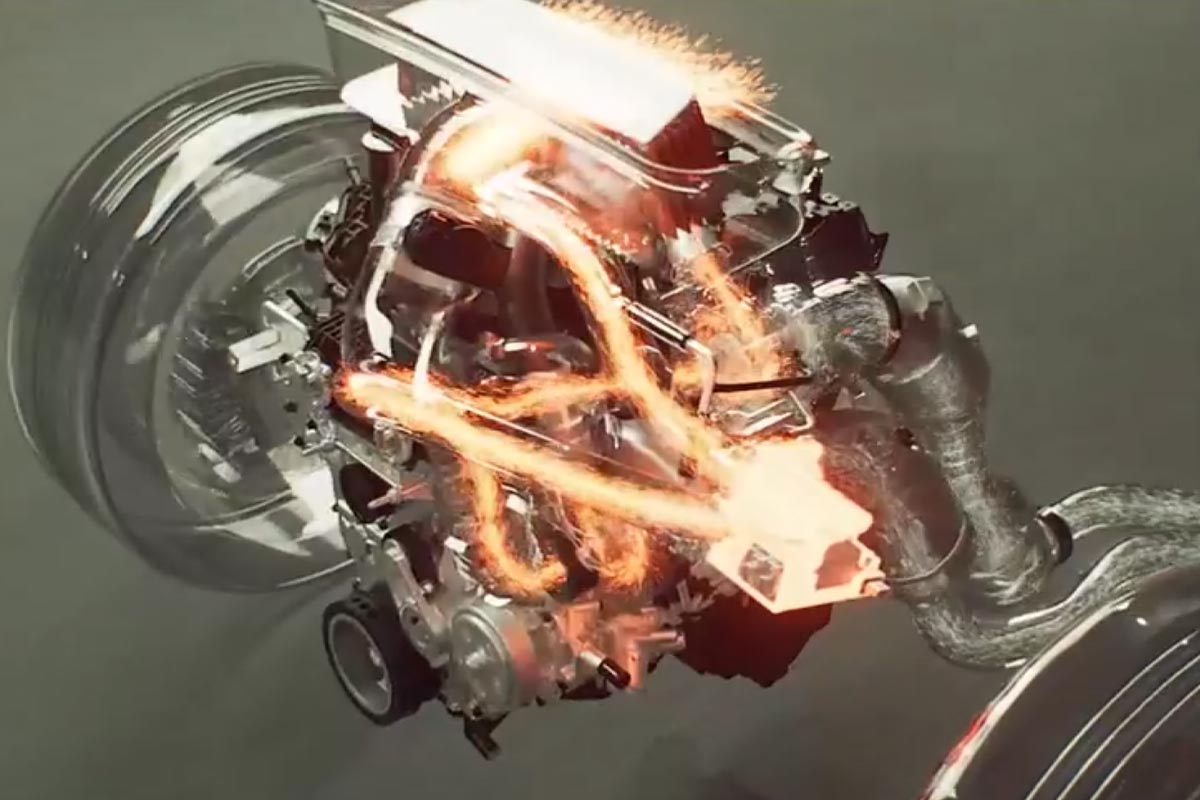
The prototype used by SRT even produces 630 ch and 810 Nm of torque, compared to 550 ch and 720 Nm for the base engine. Keep in mind, however, that eBoost Air does not directly generate this additional power. This increase stems primarily from a new engine calibration and mechanical modifications, with the electric supercharger mainly serving to improve low-rpm response. The ultimate goal is quite straightforward: to give the twin-turbo six-cylinder engine the linear and immediate response of a supercharged V8, without sacrificing the efficiency and power potential of the turbochargers.
A technology developed in just seven weeks
SRT claims to have gone from concept to a working prototype in just seven weeks. The experimental system currently runs on a small 48-volt, 1-Ah battery, powered by a DC-DC converter and a reinforced 12-volt alternator. Other energy storage solutions, particularly those based on capacitors, are already being explored.
For now, Stellantis is presenting eBoost Air as a technology concept and has not confirmed any plans for commercialization. SRT is, however, already considering adapting it for use with other engines, including the 2.0-liter Hurricane four-cylinder.
A few days after demonstrating that a 6-cylinder Hurricane engine could produce 600 ch and enable the new Charger Super Bee to outperform the old 707 ch Hellcat V8 in the 0 to 100 km/h sprint, Stellantis is sending a second message: replacing the V8 is clearly not just about peak power. The group is now also seeking to recapture its character and responsiveness. And inevitably, from a European perspective, the question arises: if this technology eventually makes its way into Jeeps, RAMs, and Dodges, it’s hard not to imagine what such a six-cylinder engine might one day deliver under the hood of an Italian model…
 English
  French
  Italian
  Spanish
  German
  Japanese
  Dutch
Dutch
Stellantis has a completely different customer base and set of preferences in the U.S. market. Top European cars, such as the Maserati Quattroporte, should be powered by a V8. It’s all about the sound and prestige. This could very well be the last V8 model developed, as the next generation has less of a passion for gasoline.
More complexity, faster wear and tear, and more heat. Ask Toyota Tundra owners what they think of the turbocharged V6 that replaced the old V8. No thanks…
Why would I ask Toyota owners about a Stellantis engine? Different manufacturers, different designs.
I completely agree with this view. A V8 can't be replaced by a 6-cylinder engine. Because engine displacement can't be replaced.
A star always shines brightest before it collapses. How about focusing on reliability instead of turning trucks into race cars?.
Listen up, Stelantis! This is what we want!
Stellantis is getting more and more ridiculous, but why should we care about that here in Europe? Then again, do the U.S. even care anymore?!
Could this engine be intended for a brand with the "biscione" logo here?
Why would I ask Toyota owners about a Stellantis engine? Different manufacturers, different designs.
Just like a Lancia Delta from 35 years ago
A V6 engine—some people would like one that is reliable, powerful, and more fuel-efficient than a V8.
Also, the V6 might be cheaper to maintain and easier to repair than the V8. We'll never know until we actually use this specially designed engine. What do you think?
People are always jealous of a company like Stellantis (formerly PSA) because it’s not a Ford, Toyota, Chevrolet, or whatever brand you’re always bragging about. Yet Stellantis—formerly PSA—is the oldest continuously operating company in the world, with over 200 years of history. In case you didn’t know, most of the technology currently used in the majority of vehicles came from PSA—like your twin-cam engine and your cat-eye headlights, just to name a few.
And the idea isn't new—just ask the old-timers. Citroën's system of multiple intake chambers. I think the engineers had this in the back of their minds.
Who cares about this Stone Age technology anymore?.
Tinkering with outdated technology??? A complete waste.
Multiple intake chambers??
Unfortunately, it’s impossible in France—or even in Europe—because of the CO2 taxes. In France, it will cost at least €80,000, if not more, with the revision of the tax scale.