

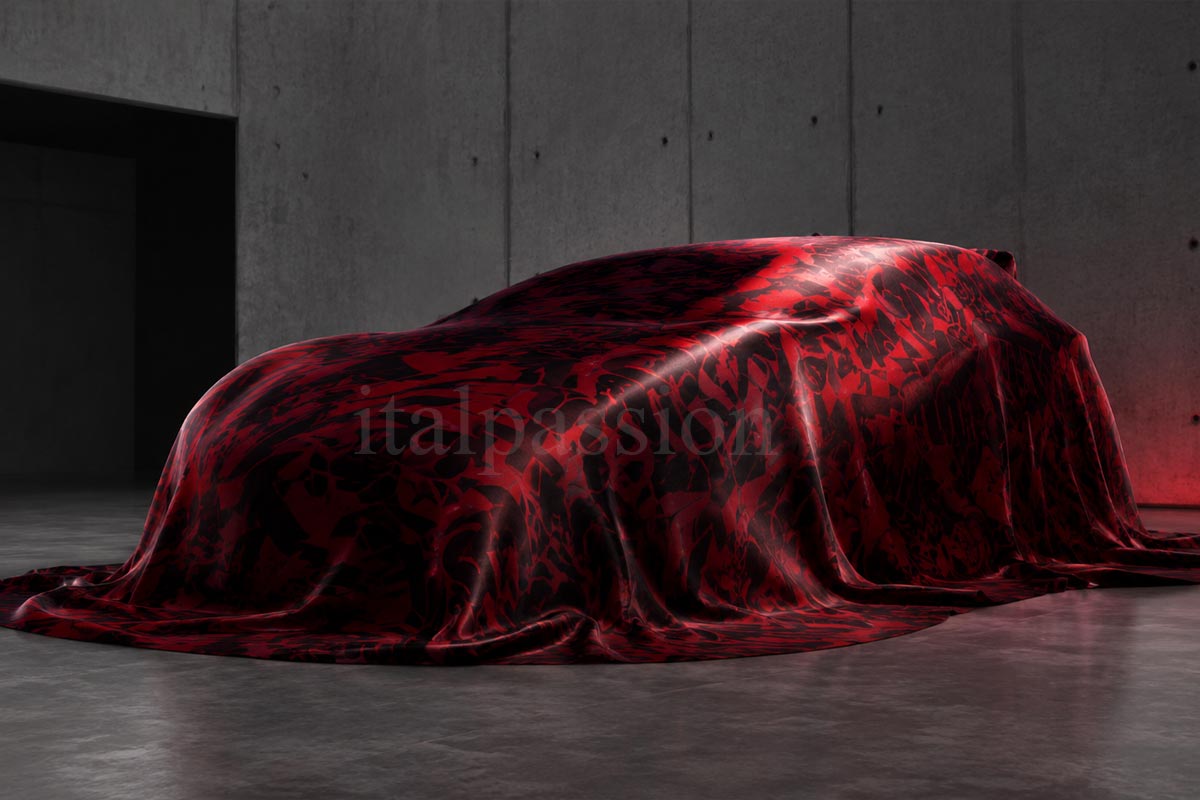
There was a time when Alfa Romeo was aiming to rival the world's leading premium brands with a target of 400,000 sales a year. The reality today is very different. For several years now, the Italian brand has been operating in a commercial survival zone, with volumes fluctuating between 60,000 and 70,000 cars sold per year worldwide. A far cry from the brand's ambitions when it made its comeback in the mid-2010s.
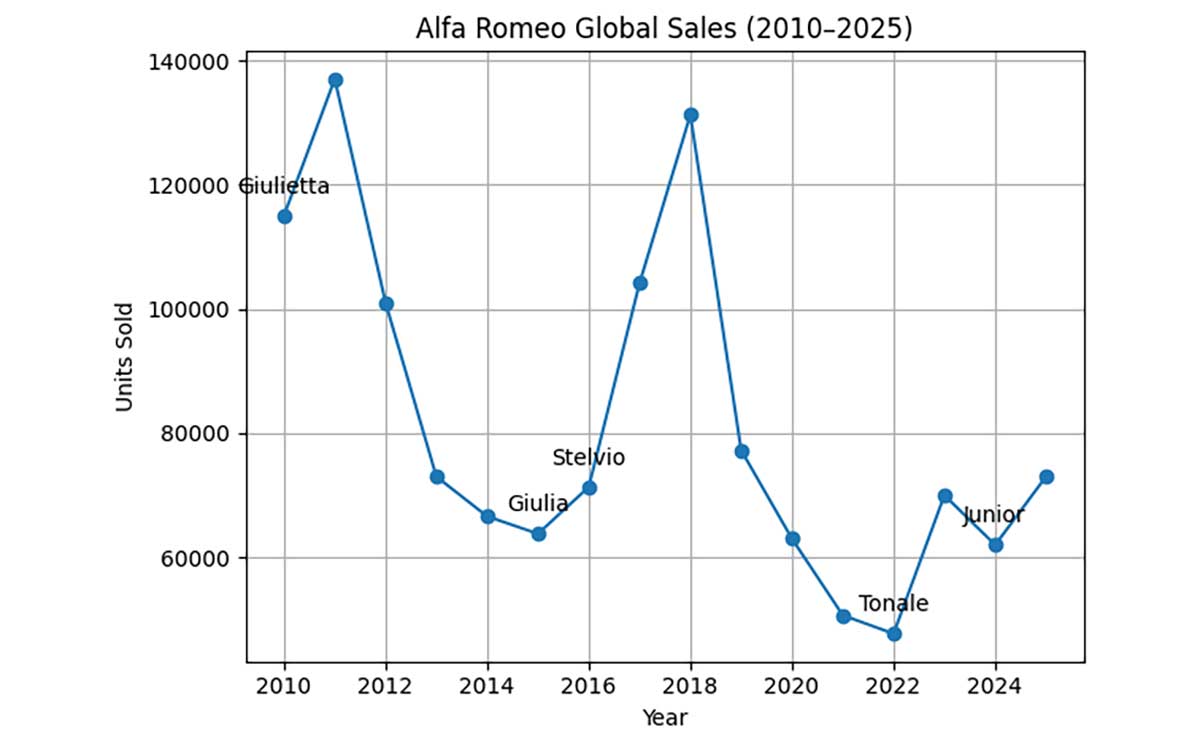
Yet despite the difficulties, Alfa Romeo continues to forge ahead with resilience. After the launch of the Tonale in 2022, followed by the Junior in 2024, the future seemed relatively clear: the new generations of Giulia and Stelvio would take over by 2026 at the latest. But the scenario did not unfold as planned.
Postponement of Giulia and Stelvio changes the game
The future Giulia and Stelvio models have been postponed. The reason is now well known: these models had been developed with a strategy initially focused on the 100 % electric, a choice that no longer fully corresponds to the realities of the European and world markets. Alfa Romeo has been forced to adjust its timetable. A decision that may seem frustrating, but today appears to be a necessity to avoid launching models that would not meet demand.
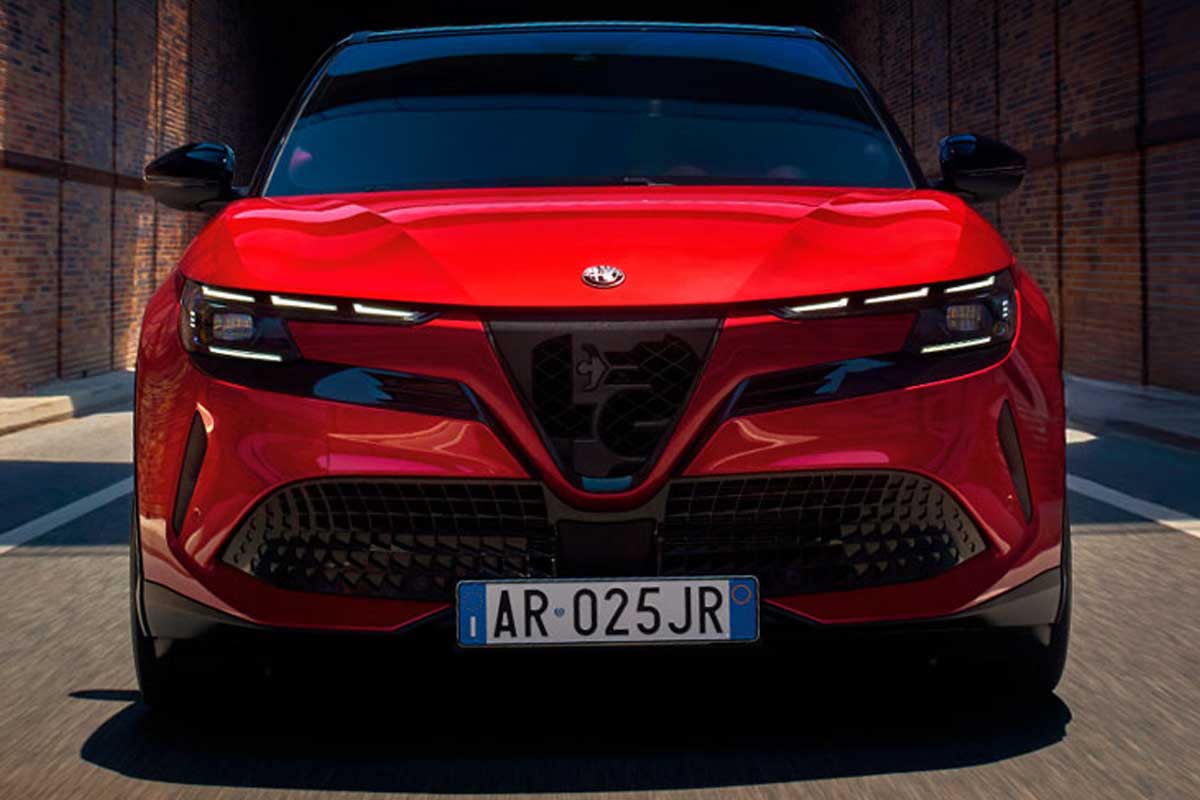
In this period of transition, one reality is clear: it is now Junior, the brand's main sales driver. The small SUV has become Alfa Romeo's main sales driver, virtually single-handedly renewing its customer base.
A refocused, more realistic range
At the presentation of its latest product plan, Alfa Romeo confirmed the bulk of its future range. However, one announcement caught the eye: the return of a compact sedan to the C segment (not shown in the presentation below), a model that could resurrect the spirit of the Giulietta. At the same time, ambitions in the E segment have been abandoned. This more upmarket positioning will now be left to Maserati within the Stellantis Group.
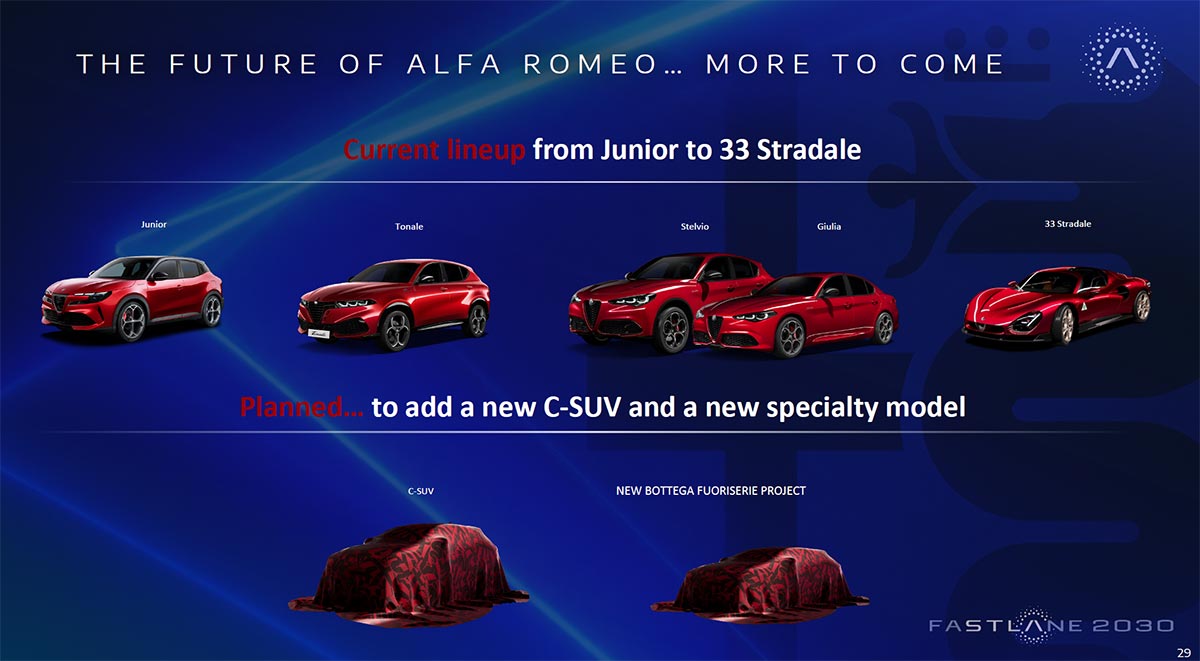
This choice may seem less ambitious on paper, but it's probably more consistent with the reality of the market and with Alfa Romeo's current resources.
Faced with BMW and Audi, a range that finally makes sense
If we compare the future Alfa Romeo range with those of BMW and Audi, the whole appears particularly coherent.
| Alfa Romeo | BMW | Audi | |
| B | Alfa Romeo Junior | Audi Q2 | |
| C | Alfa Romeo Giulietta Alfa Romeo A4U | BMW 1 Series BMW X1 | Audi A3 Audi Q3 |
| D | Alfa Romeo Giulia Alfa Romeo Stelvio | BMW Serie 4 BMW X3 | Audi A4 Audi Q4 |
The Junior would take on premium entry-level models such as the Audi Q2. In the C segment, the future Giulietta and A4U SUV would meet up with natural rivals such as the BMW 1 Series, BMW X1, Audi A3 and Audi Q3, while in the D segment, the Giulia and Stelvio would continue to compete with benchmarks such as the BMW 4 Series, BMW X3, Audi A4 and Audi Q4. In other words, Alfa Romeo would have a presence in the most important segments of the European premium market, without seeking to spread itself too thinly in categories where volumes remain limited.
The right engines, the right prices and Alfa Romeo DNA
But a coherent range is not enough to guarantee success. It's even more important to offer the products that customers really want.
As John Elkann, President of Stellantis, recently reminded us, we need to put « the right models with the right engines ». A simple phrase, but one that perfectly sums up the challenges facing Alfa Romeo today. Future models will have to offer powertrains adapted to market expectations, whether hybrid, electric or, depending on the region, internal combustion.
Design will also play a decisive role. Gilles Vidal, Stellantis Europe's new design director, has already stressed the need to preserve a strong Alfa Romeo identity, with distinctive, driver-centric carsr. An essential point for a brand whose history has always been built around driving pleasure and emotion.
Finally, there's another crucial issue: pricing. Future models must remain accessible to their target customers. Alfa Romeo cannot simply compete with German premium manufacturers on price without offering equivalent perceived value.
A reasonable target for 2030
Alfa Romeo probably won't become a brand selling several hundred thousand cars a year overnight. But that may no longer be the goal.
If the future range is coherent, if powertrains really meet demand, if design remains true to the brand's DNA and if prices remain reasonable, then Alfa Romeo could return to a sustainable growth trajectory. Doubling current sales by 2030 to around 120,000 to 140,000 units a year would not seem unrealistic. It would even be a reasonable target for a brand that must first rebuild its commercial credibility before dreaming of higher ambitions.
After all, for Alfa Romeo, the challenge is no longer to conquer the world. It's first and foremost about regaining a solid, lasting place among European premium manufacturers.
 English
  French
  Italian
  Spanish
  German
  Japanese
  Dutch
Dutch
On the contrary, we need to move away from the German model. The latter is in deep crisis and is no longer the benchmark; models are too expensive, technologically outdated and no longer meet the needs of everyday users. Focusing on the German models means losing one's own identity. Tesla and BYD have written their history from scratch. And it works! There's a technology, a concept, reasonable prices, innovative design, space, performance and comfort. I wish Alfa the best of luck elsewhere, and soon!
Certainly, with a compact based on the CMP, PureTech engines and even a Peugeot design, the Germans are already trembling...
Let's be serious, Alfa Romeo is an image, a different idea of the automobile. With Stellantis, all that has been stunted.
Look no further than the Volkswagen Group, which has SERIOUSLY transformed the Cupra finish into an entire brand. Is there a strong resemblance between a Tiguan and a Formentor? Here, the next «Alfa Romeo» C-SUV will be a pale copy of a bland PureTech SUV...
Things aren't serious with Stellantis, so let's keep our wits about us.
Potté is definitely out of touch with reality.
Stellantis has intervened once for Alfa in 5 years: Junior, and he's saving the brand from bankruptcy for the time being.
Just look at the sales of the still recent Tonales from the pre-Stellantis era!
Personally, I'm waiting for a truly extensive range based on the renewed Stellantis... As for Lancia, with its Ypsilon alone, you can't attract people with just one model - it's counter-productive!
Stellantis is Italian too !!! Especially now ...
No you wait to sell 3008s behind the dealership desk 😬
How exactly is Junior saving Alfa Romeo from bankruptcy?
By barely reaching 50% of its planned sales numbers, and ruining their image, because it has nothing to do with a premium brand, and mechanically is identical to Fiat 600, and Jeep Avenger?
All sensible people think like you 😌
Not knowing how to read curves and refusing to see the economic context makes NO sense whatsoever!
I see a lot of other sensible people thinking the same way.
Luc, it's clear.
Without junior ... it's over!
Look at the curves.
And you should know that since COVID in 2020, worldwide sales have always been bad for everyone.
It's like saying that Ferrari needs a B-suv, because they sell just ~14k cars a year.
Junior sells more than Giulia, Stelvio, and Tonale because it's a cheap B-suv.
Nonsense, because without the Junior nothing is finished for Alfa, but what is finished is its DNA and pedigree with the Junior, just like the Tonale.
I'd like to see how Peugeot would sell a model like the 33... ten years for half and the rest down the shredder like they've always done...!🤣
Luc
Nothing to do with sauerkraut!
You've got it all mixed up .... In 2026, what is the relationship between Alfa and Ferrari... Are they in the same segment!?
Otherwise yes the Junior sells better since it's Alfa's entry-level AND it pays the bills... Certainly not the Giulia, Stelvio and Tonale now.
Thank God he's here!
Scudric
We're not talking pedigree.
There's talk of the brand's survival, with sales of the remarkable Giulia and Stelvio plummeting since 2019, despite being an excellent benchmark automotive year, unlike 2020 so far.
When I see Junior's sales during this difficult period, I say we shouldn't spit in the soup.
When it comes to margins and image, the Junior is pin-up compared to the Giulia and Stelvio. Now that's concrete.
Whether tonal or Junior, they have no place in Alfa's range and encroach too much on Peugeot, Fiat, Opel, Abarth, Citroën (alas), in short, a lot of nonsense.
I think that Lysandre, in fact, we don't understand each other. Junior at Fiat, (Abarth), Peugeot (?), Opel (Vauxhall) why not (the customers will be crazy with joy it's an SUV), but it's not the role of Citroën/DS, Afla, Lancia, Chrysler, Dodge, Jeep, Maserati.
For this to work, everyone needs to stay in their place and gradually face up to the evolution of their product, and make an exemplary update on the concession in general.
Alfa, without the Tonale or the Junior, is not in trouble because the brand can make very high-end vehicles and sell them at a premium, but what's screwed up is the after-sales service and maintenance garage!!!!
Intolerable for brands like Alfa, Lancia, Citroën, Jeep, Chrysler, Dodge and Maserati.
Before building a castle, make sure it's not built on quicksand.
Scudric
Oh yeah!???
Junior is nothing on the side!?
THEN the old Ypsilon is a thousand times less than the new one, according to your «knowledge».»
You're funny in your arguments.
HS the [ Reply ] box doesn't exist!
Scudric
I'm not against Alfa bringing out new Giuliettas, sedans and coupes.
So why didn't FCA have any plans in this direction in 2010, when the merger took place?
An SUV on an outdated base.
Stellantis has a good reputation for being responsible for all our current misfortunes.
An Italian, if not several, has been at the helm for over a year and a half; the good news is still linked to the Tavares era.
Precisely the opposite is true, because Tavares hasn't had any good ideas and has even managed to massacre Citroën in the process.
The Giorgio remains more advanced than any PSA platform by far... very, very far indeed.
No problem, because a vehicle that's been written off for ages, like the second-to-last Ypsilon, is a godsend, nothing like the garbage can that is the last one, or an unsaleable Abarth 600 that will never be profitable.
Scudric
Too bad for you, because Citroën is on cloud nine thanks to the models launched during the Tavares era... OK, they're crap to please you, but in the meantime, they've been a hit for 6 months!
Scudric
Model amortization is not infinite.
Once the development studies have been paid for, the price is the cost of the MO and materials and overheads, which are generally higher on older models.
The Junior, where you foolishly criticize it, is in fact a modern clone already largely amortized by the immense success of the 2008 and other clones. (except the DS3).
«Abarth 600 unsellable and therefore never profitable.» Well, yes, precisely for the reasons given above.
No, that's not true at all, because the Ypsilon, 500 Abarth or 500X, just like the Panda, has been for a very long time, and when you forget the raw materials, the excessive electronics and the engines that have to be rebuilt all the time.... It's not a return on investment, it's a huge failure!
Citroën is on such a cloud that it falls apart year after year!
If you count the numerous recalls and the history of the country puretech not finished, there's only you who sees a success when everyone else sees a disaster and the great DS idea of Tavares we've seen ... the worst flop unimaginable!!! Have you forgotten? Selective memory?
Stellantis wasted years of Alfa Romeo's time with the STLA Large platform for the Giulia and Stelvio renewals, and his impact is not limited to Junior.
Before Stellantis,
Lancia used to sell more Ypsilons than it does now,
Abarth sold 10 times more cars than it does now.
Without FIAT Stellantis would be bankrupt.
Before Stellantis Alfa had regained its real brand image.
In short, Stellantis is just a dick who saved PSA.
«Before Stellantis Alfa had regained its real brand image.»
NO but are you blind???
Look at the sales curves... it was already a huge disaster in 2018!
It's Stellantis' fault for starting in 2021!?
Seriously, you're serious!
No, you're the one who's being serious, because not only has this been announced by everyone, but the Giulia and the Stelvio are an absolute success in terms of image and products.
What hurts you so much? Knowing that Peugeot can't do it? Ah, that's for sure!
Scudric
The Trick you don't want to understand, I've figured out how you work.
«Giulia and Stelvio are a success».»
A thousand times YES!
But these are extremely costly commercial failures.
AND this «shit» to caress you in the direction of the hair... the Junior makes live the baraque!
That's reality, whether you like it or not!
HS the [ Reply ] box doesn't exist!
No, the problem isn't with the Giulia per se, but with Marchionne's unrealistic sales figures and the fact that Maserati is a volume brand.
All 2 (or 4, with Citroën and Lancia), simply have to limit the number of models they sell each year.
You only have to look at VAG, Audi or Porsche, who also wanted to become huge, and the result smacks of bankruptcy!
There are already 3 brands for volumes, so stop, we're not doing 15 at Stellantis, otherwise it's a sure fall.
Scudric
Before you mess with Stellantis
Alfa sales from 1973 to 1984 were well over 180,000 a year.
The figure for 1988 and 1989 was over 220,000.
And over 190,000 between 1999 and 2001.
The overall decline even began in 2007... Still more than 150,000 per year, though!
Above the graph Alexandre Filluzeau shows us!
In 2007, it was already Stellantis' fault ????
Check, I'm not making this up. 🤔
Alfa has gone back downmarket with an INVENDABLE Junior that saves nothing and, above all, destroys Alfa's image.
DS is still a mess.
Citroën at the bottom of the abyss.
Peugeot is still at the bottom of the range and has been overtaken by Dacia in terms of quality and reliability.
PSA was saved by stealing money from Dofgeng, from the dealers they robbed and from French taxpayers, who were robbed without their authorization!
Clearly, this is counterproductive.
Scudric
Why are you in constant denial?
Why unsaleable? When it accounts for 2/3 of sales.
Can you read curves?
It only sells well when you compare it to other Alfa Romeo models, which aren't even in the same segment.
Since I can't answer to your upper comment, yes Ferrari and Alfa Romeo aren't in the same segment, just like Junior isn't in the same segment as Giulia and Stelvio, so comparing their sales doesn't make sense.
Also, profits are more important than volume.
Junior doesn't have any imput in Alfa Romeo's production, as well as engineering.
Compared to other B-suvs, it's a flop, and it ruins the image of the company, just like Tonale.
For a small product compared to the later range... no, it's not a success, and the curves show just that.
OK Łukasz.
I don't disagree.
But, for the current period, sales of the Junior are doing a lot of good, where the rest of the range, under the responsibility of FCA is selling very poorly since 2019!!!!
(despite being a global automotive benchmark year)
So, I'll say it again: Stellantis has a lot to answer for if he's to blame for today's ills... we'll have to look for other scapegoats.
HS the [ Reply ] box doesn't exist!
Scudric
Damn it!!!
Compare the period versus the pre-2020 period!!!!
Your arguments are totally out of line... It's almost out of order.
We can compare before 2020 and see the sales of Alfa, Abarth, Fiat and Lancia, even Dodge and Jeep, a hit whereas now a disaster!!!!
The figures speak for themselves.
I agree with Cupra in the sense that VW was able to invest in a real range...
But where do we stand in terms of sales? Apart from the handsome Formentor, the range doesn't really shine on the streets: the Terramar is just a clone of the Formentor (and it's hard to tell them apart when you see them), and the Tavascan is nowhere to be seen. The Léon is just a Seat...
In short, I'd like to know if the brand is that profitable, outside Formentor at least...
As for the next C-SUV, a copy of another Puretech SUV, you don't know anything about it and neither do I. A little optimism wouldn't hurt!
I'm optimistic when there's reason to be, and I take an empirical look at what Stellantis has done since the beginning. I draw my own conclusions.
Don't confuse optimism with blindness...
The proof is in the Giulia and Stelvio, and even the Tonale sells around 30k units a year, while Peugeot sells over 100k 3008s!
Except that they are 2 different brands and Alfa has never been a high-volume brand. Peugeot is a generalist that only sells in the EU, and even then, and has been totally overtaken by Fiat.
Selling cars with constantly troubled engines and the worst possible reputation isn't a success story, especially if you have to pay back the money.
Scudric
It's as if, historically, Fiat has been in the same segments as Peugeot!
Are you kidding?
DS, cited as a failure, has in the past sold more cars than Alfa ... And even before Stellantis.
You're talking nonsense, because not only does Peugeot not make better products than FIAT (you're killing us with laughter trying to persuade us otherwise, and DS hasn't sold more than Alfa and has even been fined by Lancia with just one model in just one country!
In the land of the blind, milestones are kings!🤣
Good article. Mirror my thoughts. The recipe for success has already been proven with Giulia/Stelvio and Junior. Simple yet beautiful Italian design with sportiness should be in focus.
«The recipe for success has already been proven with the Giulia/Stelvio».»
Black humor!?
Apart from 2018, the balance sheet is catastrophic!
Not a reality, because the Stelvio and Giulia are the benchmark in their field, along with the Grecale, and that's already 2 feats:
Set the benchmark for pure DNA, but to understand this you need to know the history of the automobile.
Catastrophic?
It was best FCA's year ever.
The Giorgio platform was such an ambitious and expensive project, that it needed a few years to become profitable, as it happened a few years later.
NO Luc, with 2 new models, that's less than in 2010!
And it's already collapsing in 2019, a very good year for automobiles that has been kept as a global benchmark ever since... Because since Covid, the years have been abysmal.
As I've said before, there were more models planned, but some were cancelled, and others moved to Maserati because of Marchionne's death.
The models offered by Alfa in 2010 weren't as profitable, and not even half as outstanding as the Giulia and Stelvio.
At the same time, DS kept releasing «premium» cars based on cheap platforms shared with their budget brands.
Łukasz
I don't know whether DS No. 4, 7 and 8 are economic platforms.
Because otherwise there's a lot of BAM!
So obviously, it's not up there with Maserati, Porsche, etc.
And when it comes to exceptional performance, there's nothing like Alfa's N°8.
But it will come thanks to Stellantis surely!? 😙
If we want to compete with German premium cars, we haven't understood a thing! I'm sorry, but in 2001 the 200,000 sales figure was achieved without any real premium...just good cars with a real plus compared to Fiat (base used).
Alfa should be focusing on being ‘entry-level’ Ferrari, say a Lotus competitor.
Alfa 8C - Lotus Evija mid size sports car, electric
Alfa 4C - Lotus Emira, small sports car, hybrid
Alfa StelvioE, Lotus Eletre, Porsche Cayenne, mid size electric SUV
Alfa GuiliaE, Lotus Emeya, Porsche Taycan, executive car, electric
Alfa Romeo keeps changing targets. We've gone premium with the Giulia and Stelvio, then downmarket with a Jeep Compass Tonale and a Junior with Peugeot's lower-end finishes.
What's it all about? Alfa Romeo's DNA is good engines, good design and good character.
The Junior makes good numbers, but apart from the Veloce, which is sharp and fun to drive, it's a car that's unworthy of the brand, with uninteresting engines.
You're forgetting that Alfa is also partly about lightness.
Exactly why it should be targeting Lotus and Alpine and entry Porsche.
Maybe sell off a percentage to Ferrari, so they can use it as an entry level brand into sports cars.
By entry I dont mean cheap, I mean smaller cars.
«Peugeot's low-end finishes.»
Stanislas
Only here can you read that!
Total delirium 😟
No, it's not a delusion but a reality, and it's not just here that you can read about it, just like the nightmarish reliability problems of whatever French engine has become the laughing stock of Made in PSA.
Scudric.
You mean finish OR reliability?
You'd have to know!
The overall finish has improved significantly over the last 10 years... When BMW owners complain about the finish of a VS 15 years ago...
You're surfing on the unresolved reliability problems under the Tavares era ... Although solutions have been found for new vehicles for more than 3 years.
But Peugeot's century-old reputation is built on reliability.
Except that the Giorgio, Stelvio and Giulia have nothing to do with Fiat. What's more, the German premium segment is feeling the pinch, as Audi has permanently discontinued the A1 and Q2 for lack of buyers.🤣
True enough! But there was less competition back then (fewer brands, fewer nationalities...) and the cake was bigger to share.
It also counts
I don't think they were good cars.
I've owned an Alfa Romeo 147 and while it was gorgeous and the driving feel was exquisite, it was extremely unreliable and parts were quite expensive.
Actually, it was the most unreliable car I've ever owned.
I think the new designs of the Giulia and Stelvio were really bad, which should have been launched in 2024/25.
With the same lack of being possible to perceive the true road experience as with the Tonale and Junior.
The scoops showed bad designs, designs that only show a continuation of the simple Junior design, focusing at costs.
Now this all has had to change. Where were the best designers? Did they do the -excellent- 33 Stradale project?
Please Alfa Romeo, and Stellantis, grab all opportunities to the max.
For a «premium» image, don't use 3-cylinder low-range models, but mini 4-cylinder models.
Leave the 3-cylinder to PEUGEOT if that's enough for them to charm the customer.
If it's only Peugeot that has to bring out the internal combustion engines, there's still the 1.6 L, which has been very reliable for over a decade.
It produces up to 330 hp in pure combustion mode, with some preparations without changing the engine base.
So with electrification: 400 or 500 hp are conceivable.
Pfff but n'importe quoi because already the 1.6 it can not support very hardly 270 to 300hp then 330hp or 500hp is to die laughing! 🤣
A GME is a thousand times more reliable, and it gets them out without any problems, without hybridization and while remaining reliable.
You speak from experience!? Scudric.
I do, and I can testify!
So I'd like to see that, because no préparateur worthy of the name has succeeded, so I don't believe it for a moment.
🤣
«Stellantis 1.6 PureTech: yes, there are reliable PureTech engines, here's the list!»
L'Automobile Magazine
«Direct answer: The PureTech 1.6 THP engine is indeed the most reliable in the PureTech range, with a major failure rate of just 0.8% since 2020. Its timing chain (versus belt on the 1.2) explains its superior robustness and exceptional longevity.6 sept. 2025 »
plan-relance-autoroutier.
etc.
While all the Stellantis brands are initially releasing clones of the Lancia Gamma 2026 style.
You will gradually see a return of customers to the dealerships.
Commercial boxes are not insured, of course!
But FCA's NON-investment in renewals, in the name of flattering financial results, is not the way to prepare for the future! ... by giving only dividends to shareholders.
FCA's non-investment????
The Giorgio platform was more ambitious and costly than anything developed by PSA, and supposed to be the base for Alfa Romeo, Maserati, Jeep, Chrysler, Dodge, but eventually their development was stopped after Marchionne passed away.
At the same time PSA got rid of most Opel engineers, never made a serious, RWD platform (one of the reasons why DS was never a serious premium brand).
Yes, I agree with a big investment for the Giorgio platform and then almost nothing until the merger in 2021.
DS in rear-wheel drive? The SM was a front-wheel drive.
But you're right, it's a shame for HdG Opel and Peugeot, who could share platforms with Alfa and Lancia.
Marchionne passed away in 2018, and Manley stopped investments because of the planned merger with PSA.
While the original DS was FWD, it had an extremely advanced base.
The DS was based on common platforms shared with Peugeot and Citroën.
Michel 6-4
It's time to stop fixating on the 3-cylinder, which has been renewed at 80 % for the past 3 years and has not been in the news since 2023, so what about the future?
In the meantime, he fills the bowls and pays the bills.
Big engines... You have to pay the taxes! For the manufacturer and the customer: there's not much left.
Don't forget the progression in purely electric GMP offerings, which are only at 20 % at the moment, but which could triple in a short while!...
Hello
I'm not fixated on the 3-cylinder (Purtech or not).
I think that on a premium model, I like to find engines that are a little more «noble», i.e. a 4-cylinder simply as an entry-level model.
if we continue with current legislation, we'll soon be seeing the twin-cylinder 2CV with one turbo per cylinder 😀
Yes Michel 6-4 to 90 %
However, «premium» does not necessarily mean «big engine».»
We've seen 3-cylinders in BAM, I believe?
In this case, style, equipment and finish - in short, other qualities - have to make the difference.
But in principle, you're right.
Bla-bla-bla again and again, because French electrics, like combustion engines, don't sell and are unreliable (even Lada does better).
French internal combustion engines are the worst in the history of the automobile, and even Russia has found better without force.
FCA must sell the French brands to the Chinese for a handful of cherries because these phony brands are counterproductive!
Alexandre Filluzeau
Thank you for your very clear sales charts. 👍
The historical situation is clear to see.
For those who blame Stellantis for the drop in sales
Don't forget that the decline has been general AND worldwide since 2020! ...and very steep.
Stellantis, from 2021.
So 2025 VS 2019 sales comparisons are irrelevant.
Come on, admit it, it's you Carlos !!!
We recognized you!
Potté.
That's it... Change the subject when we talk about facing reality!
Now compared the market cap.
Stellantis current market cap is lower than FCA's in 2019.
They're having financial difficulties at Stellantis...
The situation in 2026 has nothing to do with 2019.
And FCA in 2019: how many new models in the pipeline?
It costs money to invest!
There were many planned investments, that were cancelled when Manley became CEO, and because of the fusion with PSA.
Marchionne's last planned industrial plan focused on the development of hybrid/EV cars and more models based on the excellent Giorgio platform.
I agree; I keep saying it. Before Sergio Marchionne's death, a Stelvio PHEV was indeed in development, along with the entire Maserati lineup as PHEVs.
From July 25, 2018, the date of Sergio Marchionne's death to 2021, FCA had 100 % of the powers!
Tell Scudric before you read his shortcuts.
That's what we've been hearing for 40 years about Alfa... talk, talk, talk... and the only one that sells is the Junior!
Bla-bla-bla, the Junior saves nothing because the proof is in the pudding, and we know the French bla-bla by heart... DS is a dung that only the French think is presentable, Citroën is dead and Peugeot has nothing left and is being eaten alive by Dacia.
We've been hearing about the French car revolution for the past 50 years... and as usual, it's all just hot air to fleece the suckers of their dough.
Scudric... Jacques knows how to read sales curves! 😉
You're assuming that Giulia and Stelvio will be renewed, but the latest Alfa-specific press release from Stellantis sows a lot of doubt. Still, I get the impression that they're preparing for a non-renewal of these 2 models.
Incidentally, Alfa's last best-selling sedan (the 156) was a front-wheel drive!
That's right Polo!
But with rear-wheel drive, it's more fun and more classy for the HdG.
Well, as far as I know, Audis aren't rear-wheel drive. And with over 1.6 million sales a year, I don't think there's any shortage of customers.
You're right... But remember that Piech invented the mass-produced Quattro to compensate for this.
It's not systematic, but it helps!
The Citroën SM was a traction car... It bordered on luxury in today's sense.
I understand that Audi sales are down, and that the entry-level A1 and Q2 will not be renewed.
Audi, like many Volkswagen Group brands, will miss its customers.
Die ERneuerung der Kundenbasis?
Indem man den KUNDEN den ALFA ROMEO FAN VERTREIBT?
HAT MAN DEN LEUTEN BEI STELANTIS INS HIRN GESCHISSEN?
Die letzen 3 Jahre das geholt ( Geld ist genug da)
Alfa Romeo_ GTV 1986er 164 3,0 erste Serie
2x 156 GTA 1 GTV 3.0 1998 1 Giulia V6 2018 handgeschalten.
und dann ist es aus.
ich will keinen SUV. dfer Stelvio ist so grausam wie jeder BMW_Audi_wasimmer SUV
der JUnior? ein Kaspler auf Rädern.
ICH WILL EINEN ALFA ROMEO. geht das ins zugeschissen hirn?
To do this, we have to stop investing in the Peugeot ball and chain and its rotten engines. Sell Peugeot and DS for a symbolic €01 to Donfgeng, to compensate them for the rip-offs suffered by the French (always the same when they're taking money from others) by offering them French engines that they're going to throw straight into the garbage can!
There's no bigger drag than PSA, because even the alliance didn't want it!
Your bistro blabla doesn't mean a thing! You need to back that up a bit. Right from the start, you've seemed to be nothing but a service troll for some Russian AI . mouarf.
Scudric
Are you a Russian or Chinese proxy???
Why are you talking rubbish about Peugeot?
Did something happen in your childhood?