

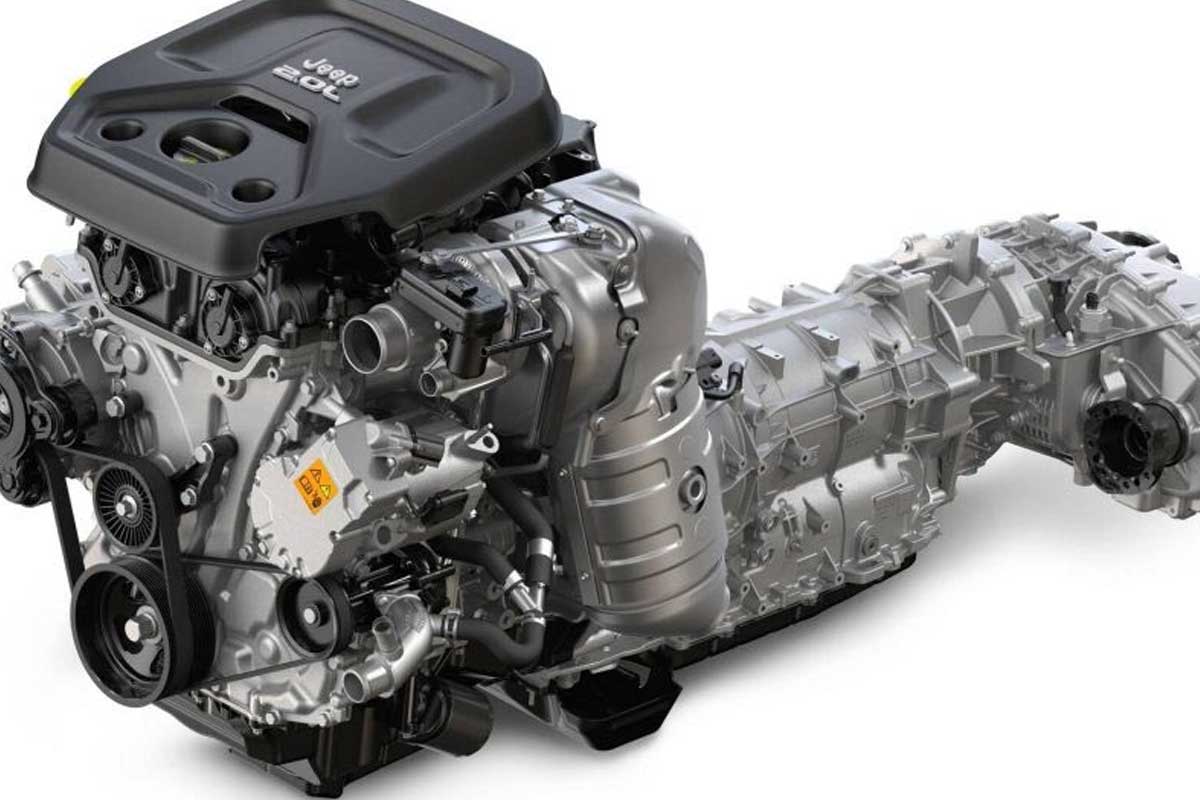
Just a few months after a massive first recall, Stellantis is once again faced with a problem that is as unexpected as it is embarrassing for its plug-in hybrid engines. This time, it's not the vehicles that are directly affected, but the replacement motors themselves... contaminated with sand.
A second recall reopens an already sensitive issue
The case dates back to November 2025, when Stellantis recalled over 112,000 plug-in hybrid vehicles in the USA, including the Jeep Wrangler 4xe and Grand Cherokee 4xe. The cause: a risk of engine failure linked to residues from the manufacturing process.
But the problem didn't stop there. In April 2026, Stellantis North America launched a new recall campaign, this time on 2,689 2.0L turbo GME engines intended to replace those already defective. These engines, supplied by Mopar as spare parts, could also contain internal debris... including sand from the casting process. A particularly problematic scenario: engines that are supposed to correct a defect could in fact reproduce the same risk of failure.
Contamination linked to the industrial process
The origin of the problem has now been clearly identified. It stems from the foundry process used to manufacture engine blocks, carried out by supplier Nemak in Mexico. During this stage, sand is used to mold the aluminum parts.
But in some cases, this sand may not have been properly removed after manufacture. As a result, particles can remain inside the engine, causing internal damage and even complete breakdown.
According to Stellantis estimates, around 4.3 % of the engines affected by this new recall could be contaminated. While no accidents or fires have been reported to date for this new campaign, the previous recall already gave an idea of the potential seriousness of the problem: loss of propulsion, engine fires, and even several reported injuries.
Investigation re-launched after suspicious fire
This second recall didn't happen by chance. It was triggered after an incident in 2024, when a Jeep Grand Cherokee 4xe caught fire in the engine compartment.
This vehicle was not part of the first recall, but its engine had been produced during the same risk period. This event prompted Stellantis to reopen the investigation, which eventually led to the identification of new potentially defective engines, including those sold as spare parts.
To rectify the problem, Stellantis is applying a now well-established procedure: complete inspection of the engines and replacement if necessary. Engines not yet installed will be inspected or repurchased, while those already installed in vehicles will be replaced at no cost to the customer. In some cases, an engine management software update will accompany the intervention. Affected owners will be informed from May 7, 2026.
A new blow for Stellantis PHEVs
This recall comes at a time when the Group's plug-in hybrids are already under pressure in North America. As we recently reported, Stellantis has decided to end sales of several PHEV models as early as 2026, including the Jeep Wrangler 4xe and Grand Cherokee 4xe.
Officially, this decision is linked to changing demand and a strategic refocusing on conventional hybrids and range-extending electrics. But it's hard not to make the connection with the accumulation of technical problems and recalls that have severely damaged the image of these models.
In any case, this latest episode reinforces a clear trend: the 2.0L GME PHEV engine, once the mainstay of the Group's plug-in hybrid offering, seems to be living out its final hours in North America. Between repeated recalls, the gradual abandonment of 4xe models and a strategic reorientation, Stellantis is gradually turning the page on the PHEV. It remains to be seen whether this technology will one day return in a more reliable form... or whether it is already a thing of the past for the group in the USA. Engines produced in Europe are not concerned.
 English
  French
  Italian
  Spanish
  German
  Japanese
  Dutch
Dutch
A GME must be produced in Italy, not in Mexico.
The GME is more of an American design than an Italian one. After that, engines are produced locally where they're needed. Brazil produces gse/firefly for them, and that's no problem. The problem lies with the supplier of the blocks, who didn't have a good quality control.
Would we have had this quality problem in Italy? :/
ah ça...
Auch die in Europa verbauten 3-Zylinder Motoren sind dramatisch unzuverlässig; zudem hat der Chaos-Konzern Stellantis einst stolze Marken wie Opel, Peugeot etc. Wer heute noch diesen Stellantis-Müll kauft, dem ist nicht mehr zu helfen.
Stellantis recalls replacement engines, not replaced. Stop using ia and read again.
You're boring me with AI, you've been so burned by AI sites that you see them everywhere. It's getting tiresome.
Surprisingly, I own a 2025 Giulia 2.2 diesel with exactly this problem (and I'm not the only one), and yet: no recall, no technical note, no engine replacement under warranty.
This applies to petrol versions, not diesel. Mercedes has been complaining for 10 years about its V6 twin-turbo diesel engines, which break like crystal.
If you had sand in a diesel engine.... you couldn't go 1,000 km without the whole thing disintegrating.