

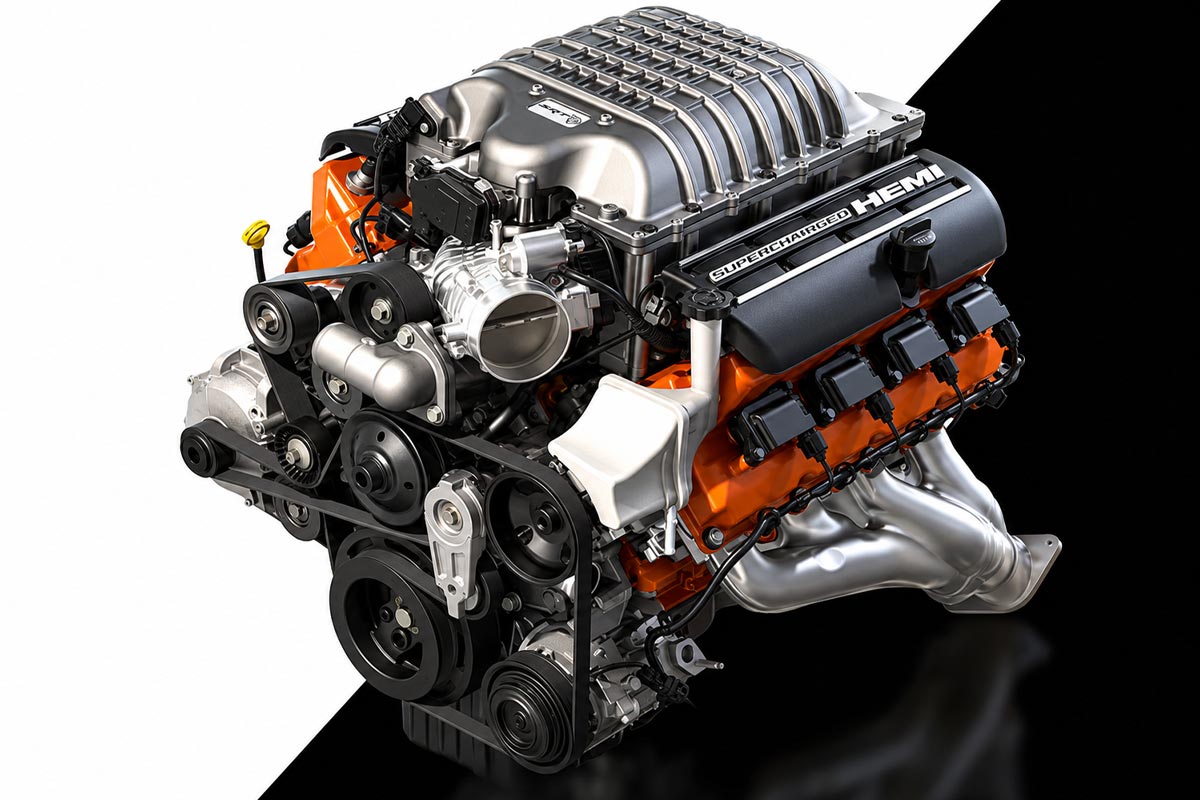
A little over a year ago, the return of the HEMI V8 to Stellantis This was already seen as a dramatic shift in strategy. Now, the automaker’s U.S. division is going even further: after reintroducing its 5.7L V8 with eTorque mild hybrid technology, Ram will gradually phase out… hybrid technology. This decision likely meets the expectations of some American customers, but it raises questions about the group’s decarbonization strategy.
The HEMI V8 will once again be powered entirely by a combustion engine
It's now official. Ram has confirmed to MoparInsiders that, starting with the 2027 model year, the 5.7L HEMI V8 equipped with the eTorque system will be gradually replaced by a non-hybrid version.
A few 2027 Ram 1500s will still be produced with the eTorque system during the industrial transition, before the traditional engine becomes standard. This change is significant. The eTorque system relies on a belt-driven motor-generator paired with a 48V battery. The system is designed to recover energy during braking, enable stop/start functionality, and provide occasional assistance to the internal combustion engine.
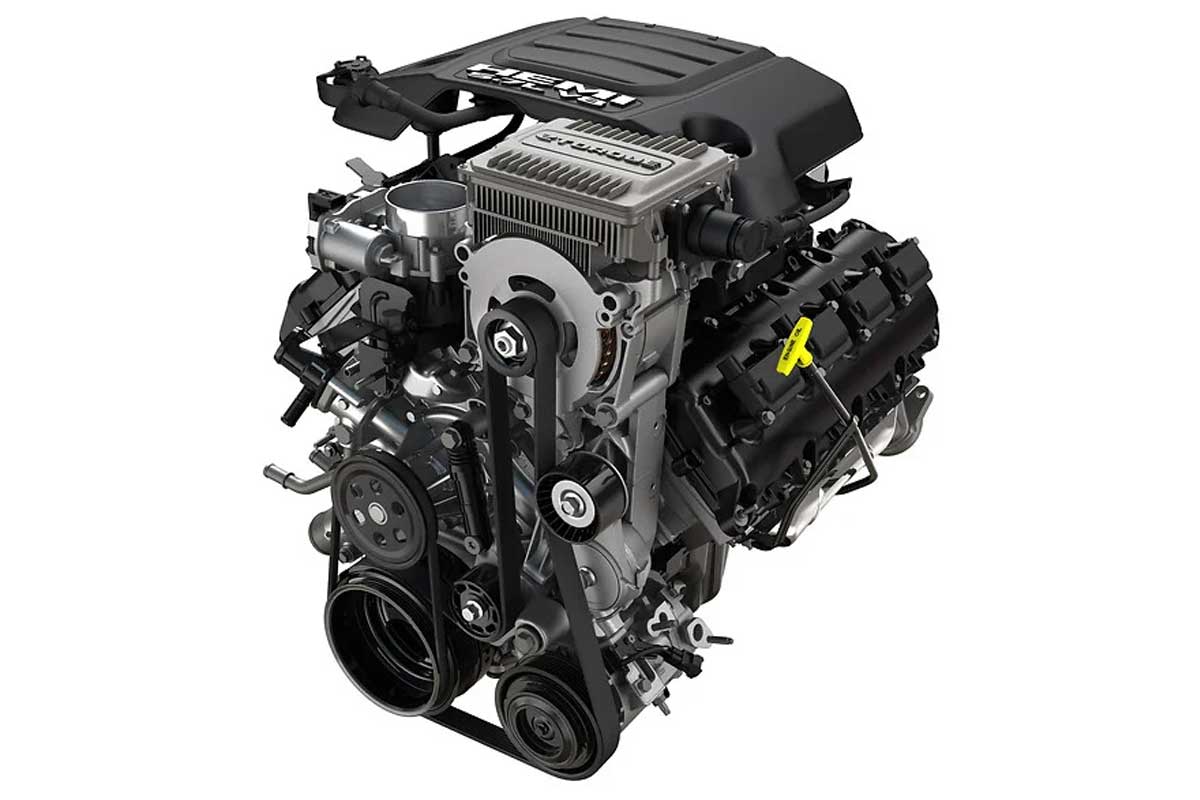
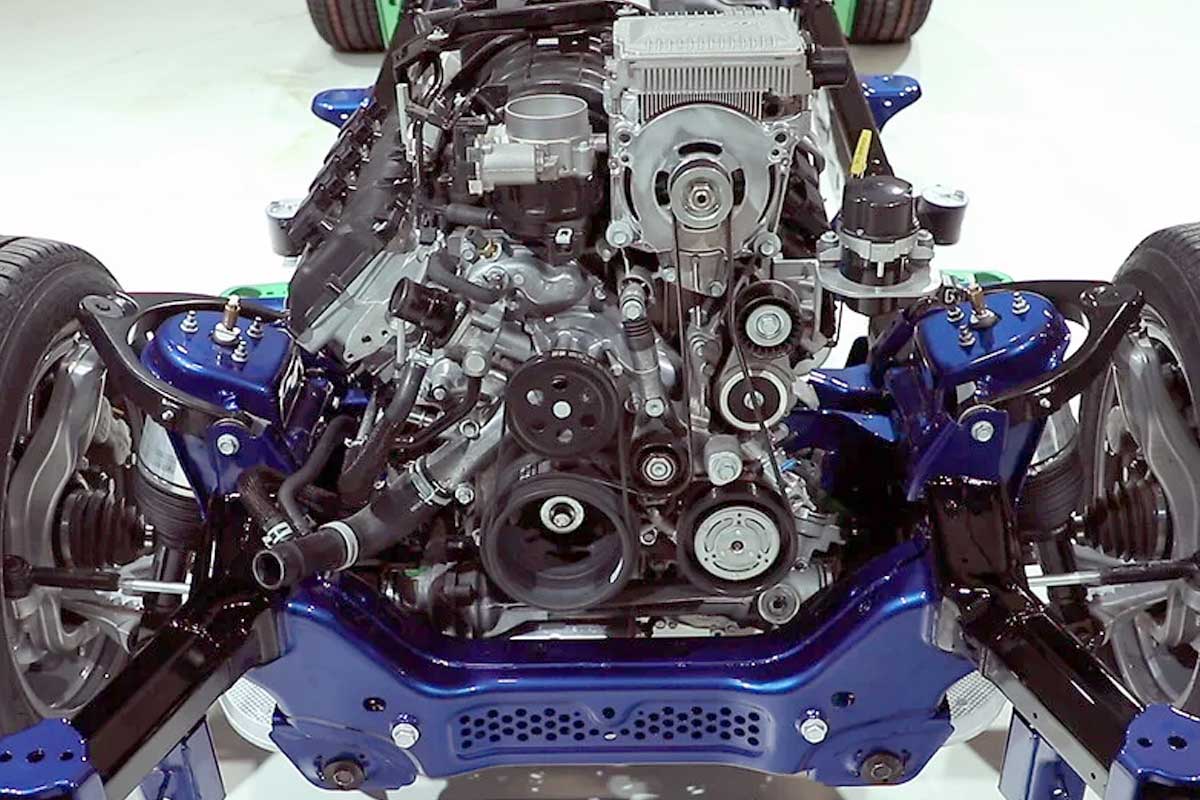
All of that will disappear. The V8 will, however, retain its cylinder deactivation feature, allowing it to run on four cylinders when power demand is low. Its power output remains rated at 395 ch.
Above all, hybridization had made it possible to bring back the V8 quickly
This decision also sheds some interesting light on the HEMI’s hasty return. In June 2025, we explained that Stellantis had relaunched the 5.7L V8 with eTorque after to have acknowledged that he was wrong to remove it from the Ram 1500. A dedicated team of engineers then completed the work required to reintegrate this mechanism in just six months.
According to MoparInsiders, the decision to use eTorque was also driven by a very pragmatic reason: this configuration already had emissions data, calibrations, and a production history, allowing Ram to expedite the engine’s return. Hybridization therefore appears today to be more of a quick fix to bring back the HEMI than a long-term technical strategy.
More and more choices, but at what cost?
For Stellantis, its U.S. strategy is becoming particularly clear: to give customers a choice of powertrains again. The Ram 1500 will thus be available with Pentastar V6 engines, Hurricane six-cylinder engines, as well as several HEMI V8s, including the spectacular 6.2L supercharged engine producing 777 ch.
From a business perspective, this makes sense. After several years during which Stellantis had heavily invested in the electrification of its model lineups—an effort that proved to be a failure in the United States—the group is now seeking to respond more directly to market expectations. But eliminating even the mild-hybrid system from a 5.7L V8 is still perplexing. It’s obviously highly unlikely that we’ll ever see this engine under the hood of an Alfa Romeo or a Maserati, and even its presence in Europe will remain negligible. Its evolution is nonetheless worth following, as it illustrates how Stellantis is now building its global engine portfolio.
On the one hand, Stellantis is therefore continuing to explore hybridizing its internal combustion engines in Europe. On the other hand, in the United States, the group is even going so far as to remove an existing 48V system from its V8 engine to meet customer expectations.
Offering more choices could help boost sales. One question remains: How far is Stellantis willing to compromise its decarbonization goals to achieve this? Because after the return of the V8, the return of the V8 without hybrid technology sends a new signal. And this clearly goes against the tide of history and looks like a desperate attempt by Stellantis to boost RAM sales in the United States, whatever the cost!
 English
  French
  Italian
  Spanish
  German
  Japanese
  Dutch
Dutch
If only they could go back even further in time so that Italian brands would never have joined this group…
A V6 is much better—it's simpler, has fewer problems, and lasts much longer. Plus, it's much easier to configure as a full hybrid!!!!!!¡
I completely agree with you….
FIAT shouldn't have merged with PSA—it should have wiped it out… Only PSA could make those lousy engines with oil-bathed timing belts…
If FIAT had had much more confidence in itself—especially in Lancia and Alfa Romeo, just as it did in the ’80s and ’90s…—it would have taken down the VW Group as well.
The oil-immersed timing belt isn't really a problem specific to PSA. Ford also had this issue with the 1.0L EcoBoost.
Why does the Fiat Group want to copy the Chinese now? Their cars aren't attractive.
I think Fiat should look into nuclear turbine engines! And get ahead of the competition—Fiat has always been an innovator, so here’s a niche to tap into!
They should also look into the quantum engine... 🙄
«I think Fiat should look into nuclear turbine engines!»
This isn't Fallout, is it? 😂
Eliminating even the slightest bit of hybridization means pandering to those redneck hicks who just want to floor it. What a sad world we’re building.
Citizens are expected to cut back on CO2, while world leaders couldn't care less and wage wars that produce massive amounts of CO2 emissions
Nothing is as sad as being brainwashed into thinking that the hybridization of American pickup trucks has any impact on the world.
All transportation in the United States combined accounts for less than 3% of annual global CO2 emissions.
It's about time they realized that it's not ideology that drives the market—it's the customers…
Driven by ideological standards and laws, manufacturers have adopted foolish strategies.
They realize this far too late.
They are penalized by their customers.
We've paved the way for the Chinese…
They'll never catch up.
What bothers me is that, rather than improving an engine in the right direction—for example, by pairing it with HEV or PHEV technology—they’d rather remove the hybrid component, likely to sell the car at a lower price and boost sales volume. This new proposal from Stellantis seems to be yet another way to boost sales—making something new out of something old.
With hybrid technology, things get complicated and the system becomes prone to breakdowns. Americans want simple, rugged technology.
The Chinese aren't offering V8s and are pushing electric vehicles instead. So, in fact, the U.S. shift back to V8s is just a way to make America's ultra-rich even richer. What a great prospect.
It's not just Americans who want simple and reliable technology.
Yeah, the Germans will still have tanks tomorrow 😂
Stellantis’ decision confirms that the rush to go all-electric overnight has been highly detrimental, devastating European automakers; citizens are perplexed and are not buying all-electric vehicles in large numbers, whereas purchasing hybrid or plug-in hybrid cars may be a sound choice.
Stellantis and its innovation strategy; in four words: Forward! We must go back!
These considerations are probably—at least for now—correct: (re)gaining market share in a large (and certainly important for Stellantis) «regional » market, in exchange for accepting—future—losses in a powertrain technology that will also gain traction in the U.S.……even against all those there with a «redneck» mentality. The highway for the Chinese is getting wider and emptier……Full throttle……!
I had a 5.7-liter Hemi in a Jeep Grand Cherokee. I couldn't wait to turn the ignition key in the morning. It was a beautiful, spiritual moment—as if a bear were waking up—followed by a sense of calm in the form of the V8 Hemi's rumble.
A Hemi with a hybrid system is a stylistic faux pas. And given gas prices in the U.S., it’s not necessary either. In Europe, the Hemi runs well on LPG.
Why don't you move to America, then?
Strategy is Stellantis’s absolute weak point. It’s always reactive, short-sighted, and even bizarre—like the diesel strategy just before the U.S.-Iran war. With all the risks clearly visible due to climate change and geopolitical turmoil, Stellantis is not prepared for the future.
Fiat should have continued on its own path... but due to economic constraints and sales pressures, the brand had no choice but to merge with Citroën, Opel, Peugeot, and so on... but Fiat is certainly not a bad brand now... Stellantis, on the other hand, is a hopeless company...
Maserati, your salvation is a V8 without a hybrid system—that's what people want.
Do it like Dodge, but in the Italian style 👌 and please, PLEASE don't turn the Quattroporte into a crossover—that would ruin its elegance.
And the absolute highlight would be a reissue (like the 33 Stradale) of the MC12 with a V12 engine. (Maybe from the Ferrari 12Cilindri?)
After that, you'd be »back in the game" again 🙏🙏🙏🙏👌👌V8🔥🔥V12🔥🔥🔥🔥🔥 (the honest opinion of a fan of the brand that shaped my childhood)
Yes, the MC12 should continue to be produced. With Ferrari DNA. The same name—like the Spider or the 911—and a new iconic design that retains the key features of the original MC12.