

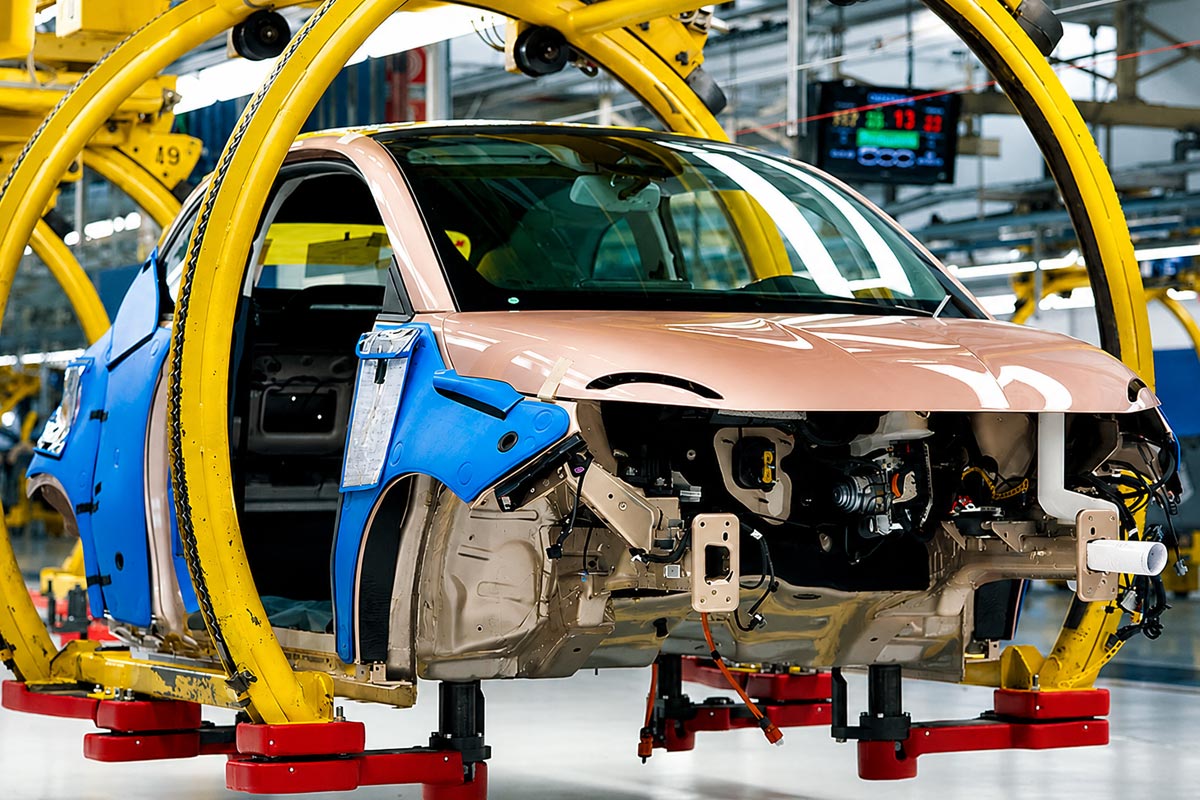
The announcement gave Mirafiori employees reason to be hopeful. On October 13, we reported on statements made by Arnaud Belloni, the new CEO of Fiat, Lancia, and Abarth, who confirmed that it was working on a second model for the Stellantis plant in Turin. A «very compact,» «modern,» and «extremely competitive» car that could arrive sooner than expected. But no sooner had this announcement been made than Italian unions spoke out. In their view, there is still a gap between Stellantis’s promises and industrial reality.
Announcements, but still short-time work
In an interview with the Corriere della Sera, Giorgio Airaudo, secretary general of the CGIL in Piedmont, made no secret of his skepticism. For while Stellantis now speaks of a more promising future for Mirafiori, the day-to-day reality for workers tells a very different story. «There have been too many announcements about Mirafiori’s future, but as of Monday, furloughs are resuming,» the union leader laments.
And it’s hard to disagree with him on this point. Despite the arrival of the Fiat 500 hybrid, which was supposed to revive the plant’s operations, production volumes remain insufficient. Production forecasts for 2026 have fallen to about 60,000 cars, far short of the 100,000 to 120,000 units initially projected. Production stoppages continue to increase, and employees are feeling the direct impact on their paychecks.
A new car subject to unrealistic conditions?
For Giorgio Airaudo, the problem is not so much the announcement of a second model as the conditions that might accompany its implementation. «Today, models are announced, but then conditions are put on the table that risk making them unfeasible,» he explains.
The union leader is focusing in particular on the issue of energy costs, which Stellantis regularly cites to justify production difficulties in Italy. The automaker is calling for local authorities to intervene, but Giorgio Airaudo believes they lack the necessary resources to resolve this problem on their own. In his view, if Italian energy costs truly constitute an obstacle, it is up to Giorgia Meloni’s government to intervene and then bring the issue to the European level. Above all, he fears that Stellantis will impose an impossible condition in order to ultimately postpone its industrial decision.
The Alfa Romeo MiTo as a precedent
To support his point, Giorgio Airaudo recalls a time when Mirafiori had already gone through an industrial crisis. In 2006, under Sergio Marchionne’s leadership, part of the Fiat Grande Punto’s production had been transferred from Melfi to Turin, pending the arrival of a new model. Two years later, the Alfa Romeo MiTo went into production at Mirafiori. Nearly 300,000 units have been manufactured there over the years.
What’s the difference, according to the union representative? Back then, announcements were accompanied by concrete decisions, secured funding, and a genuine dialogue with employee representatives.
And why not a Leapmotor in the meantime?
Giorgio Airaudo doesn’t just offer criticism. He also suggests an interesting possibility: temporarily entrusting Mirafiori with the production of a model from Leapmotor, a Chinese brand partnered with Stellantis. He does not present this solution as a certainty, but as a possibility worth exploring to keep the plant running while awaiting the much-anticipated second model. His message is clear: Mirafiori needs cars to produce now, not just promises for 2030.
 English
  French
  Italian
  Spanish
  German
  Japanese
  Dutch
Dutch