

When Stellantis When the company presented its business plan a few weeks ago, one detail caught our attention: The group plans to launch 24 HEV hybrid models by 2030. At the time, one question arose: What technology lies behind these future hybrids capable of competing with market leaders like Toyota or Renault E-Tech? Since then, new information from Italy has shed much more light on the matter. And it reveals that Stellantis is developing a solution quite different from the one recently launched in the United States on the new Jeep Cherokee.
A future hybrid based on the… 1.2L engine
According to the latest information provided by Emanuele Cappellano, head of Stellantis Europe, the future European full-hybrid system will be developed in-house and will be available starting in 2027.
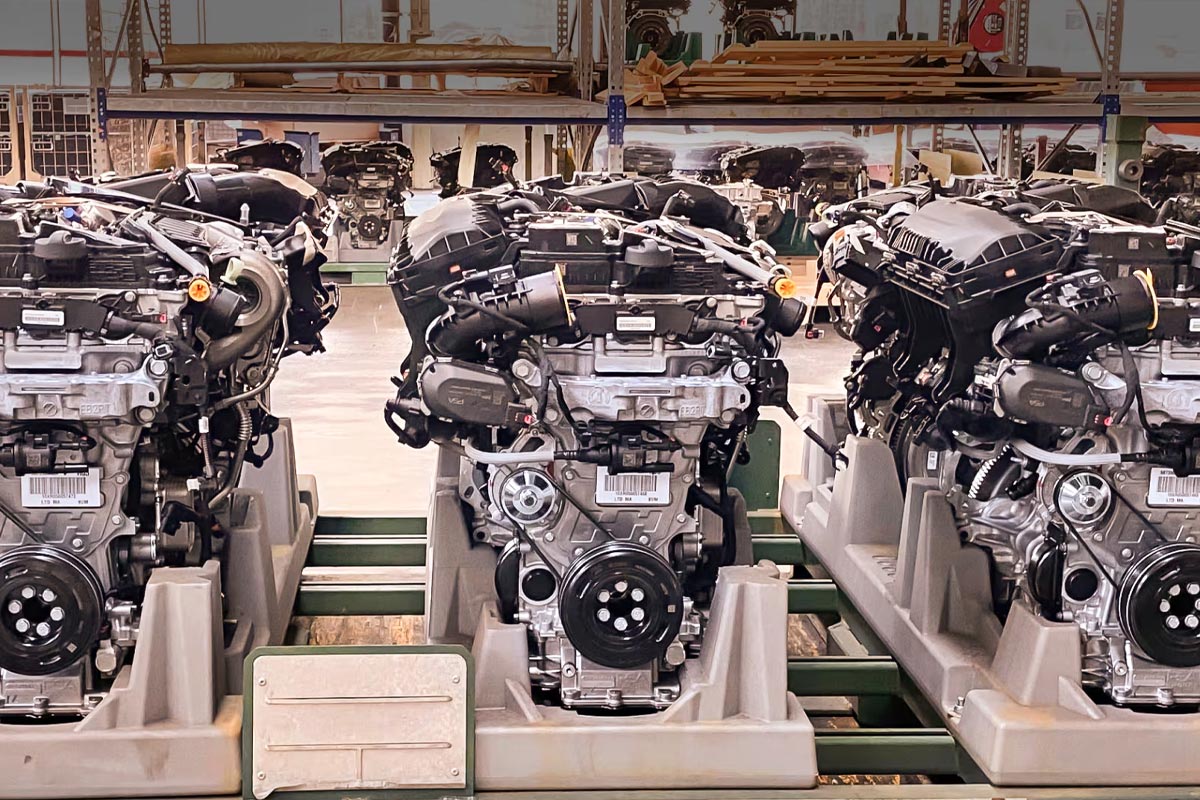
The first surprise concerns the internal combustion engine. Contrary to what one might have expected following the launch of the American Jeep Cherokee Hybrid, the new 1.6L HEV will not serve as the basis for the European models. Stellantis has reportedly chosen to rely on an engine already widely used across its lineup: the famous latest-generation 1.2L turbo three-cylinder, now known as the Turbo 100.
This engine is already well known. It is currently found in many of the group’s models, particularly in its 145 ch mild-hybrid version paired with the eDCT transmission, as in the’Alfa Romeo Junior, the Jeep Avenger, and several Peugeot, Opel, and Fiat models.
But this time, it won’t just be a mild hybrid system. The goal is to offer a true full hybrid, capable of running in electric mode more frequently, with significantly greater power assistance and without requiring charging from an outlet—much like the most advanced hybrid systems on the market.
Technology that differs from the U.S. system
This confirmation also puts an end to another assumption. It was thought that Stellantis would simply import to Europe the technology used in the new American Jeep Cherokee. This model combines a 1.6L turbo engine with a hybrid powertrain supplied by Blue Nexus, a Japanese company affiliated with Toyota. Its architecture is based on a system similar to that of Toyota hybrids, with heavy reliance on the electric motor.
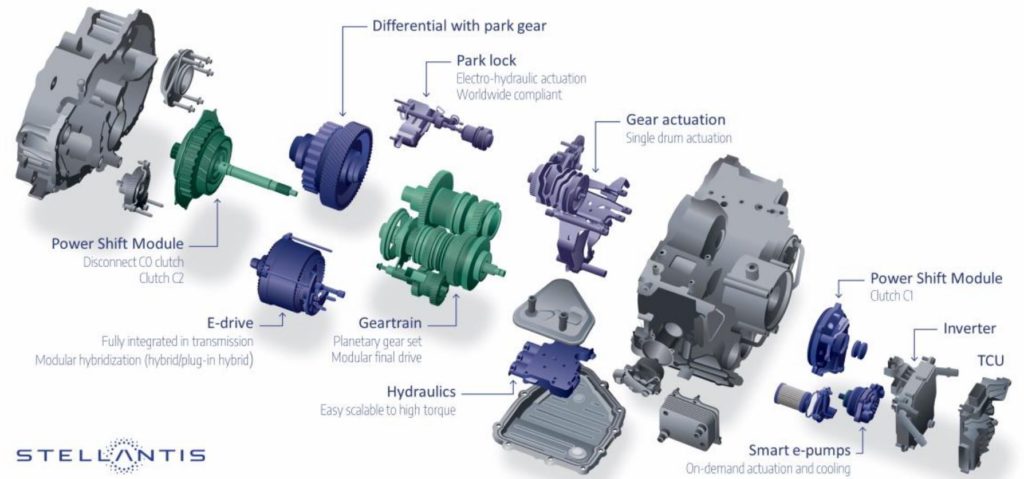
However, Emanuele Cappellano has made it clear that the future European full hybrid will be «developed in-house» and not in partnership with an outside supplier. In other words, the American technology will not make its way across the Atlantic in its current form. Reports published in Italy suggest instead that the eDCT transmission already used by Stellantis will be further developed. This automated dual-clutch transmission already incorporates an electric motor in the group’s hybrid and plug-in hybrid models. This architecture would serve as the basis for the future European HEV system.
A type of motorization set to become widespread
The stakes are high for Stellantis. At its Investor Day, the group announced that this new hybrid technology will be used in vehicles in the B, C, and D segments. According to Stellantis’ presentation, this represents 24 of the 60 models that will be launched by 2030.
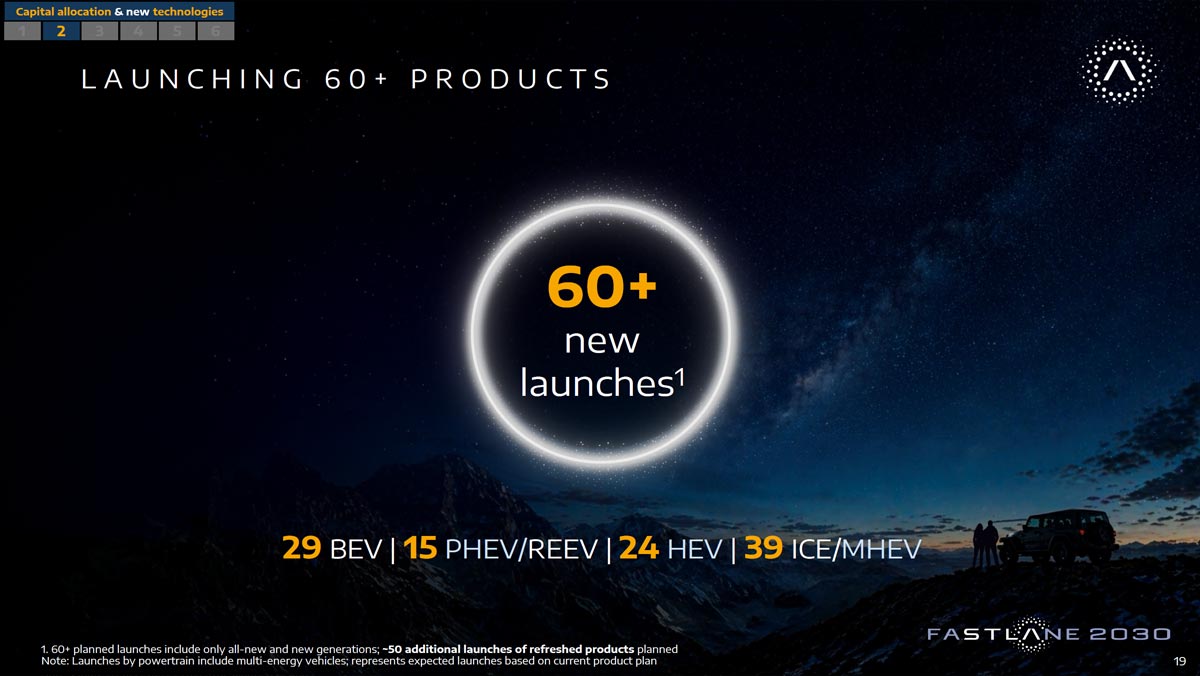
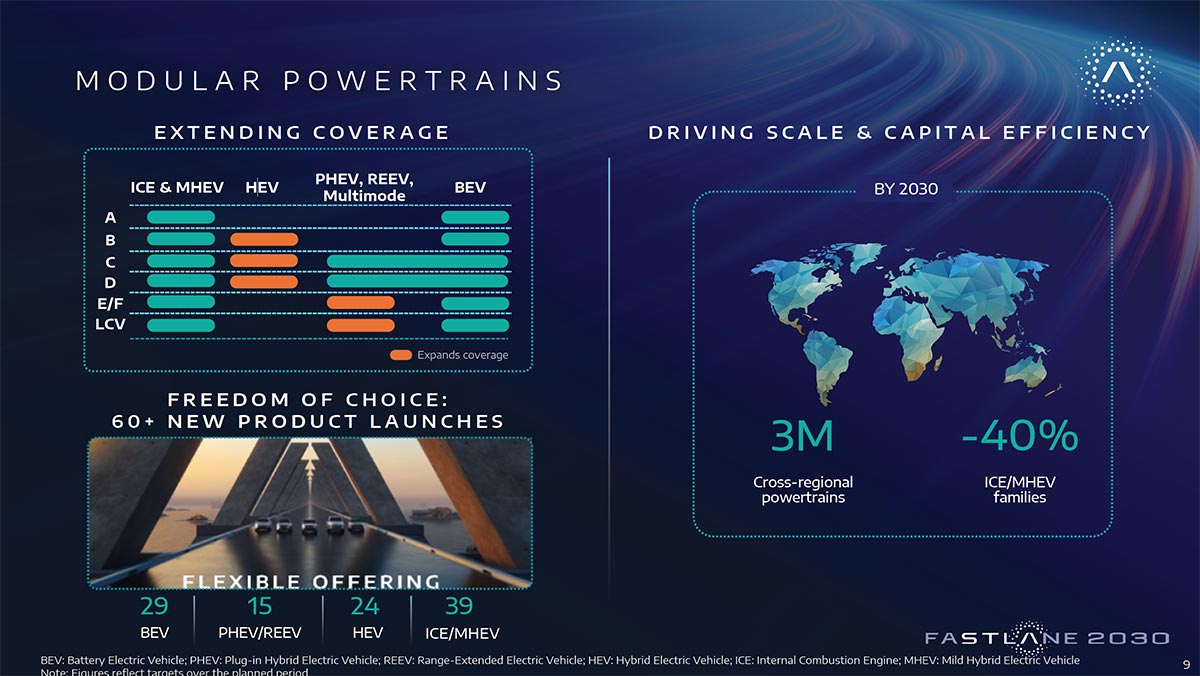
Future generations of vehicles based on the STLA One platform could thus benefit from this, whether they are compact SUVs, sedans, or crossovers. The next generation of the Alfa Romeo Tonale, expected around 2028 on the STLA Medium platform, is already among the most likely candidates.
However, this does not mean that the 1.6L engine is definitively off the table for the European market. Cappellano’s clarification is important: what is off the table today is the use of hybrid technology developed with external partners. Nothing, however, prevents Stellantis from adapting other engines in the future—such as the 1.6L EP6 or even the 2.0L GME—to a hybrid technology developed in-house.
With the complete acquisition of Stellantis e-Transmissions, the former joint venture established with Punch Powertrain, the group now has all the tools it needs to develop its own hybrid systems. And as 2027 approaches rapidly, this future 1.2L full hybrid could well become one of the most important powertrains in Stellantis’ entire European lineup by the end of the decade. The eDCT transmission is produced at three plants: Metz (France), Mirafiori (Italy), and Termoli (Italy). Antonio Filosa, CEO of Stellantis, stated that this represents approximately 1.5 million units to be produced per year.
 English
  French
  Italian
  Spanish
  German
  Japanese
  Dutch
Dutch
😳😳😳😳😳😳😳😳
🤢🤢🤢🤢🤢🤢🤢🤢
🤮🤮🤮🤮🤮🤮🤮🤮
That's how it made me feel.
I'm completely confused: I thought we'd already agreed to bring back engines from FCA?
Me neither, but in the end, there was the announcement of the Turbo 100, and the fact that this EB2 engine will indeed be updated to meet the Euro 7 standard. And all we know officially about the GSE is that it will continue to be produced in Termoli (this has been repeated several times), but I don’t see how Stellantis could logically offer both the Turbo 100 and Firefly engines. I think—and this is just my opinion—that we’re heading toward a lineup consisting of a 1.0L (GSE), a 1.2L (EB2), and a 1.6L (EP6).
As far as I’m concerned, when Stellantis explained that they were going to adapt the GSE to meet the Euro 7 standard, I didn’t understand it to mean that they were going to make it widely available across all brands as a replacement for the Pur… sorry, Turbo. Rather, I thought they were going to keep the Pandina and 500 Ibrida in production for a very long time. And because of that, they had to adapt it to Euro 7 in order to continue selling those models—and therefore that engine. With Stellantis, I think you have to read between the lines to understand the group’s strategy…
Honestly, I even think that if you read between the lines, you won't understand a thing. Stellantis is becoming the FCA of the Marchionne era: lots of announcements but not much substance.
During the Marchionne era, everything except Lancia was revamped.
It’s really more of a PSA Tavares thing—we’ve got crappy engines, but since they’re cheap, they’ll never be made more reliable, they’ve already paid for themselves, and we don’t give a damn about the customers… so let the party continue!!!!
With this engine and the 1.6, they’ve had more problems than in the entire history of FIAT Powertrain Technologies—and even in the history of FIAT… period.
Meanwhile, Leaf is making the most of a platform that we’d love to see Abarth adopt… but still nothing!
Leap, not Leaf—sorry for the mistake...
If Alexandre could sell his design to Stellantis so they’d make us a «Scorpio» compact car, I’d sleep right outside the dealership to make sure I’m the first to drive it (but I never said I’d give them the keys 🔑 back, of course—I’m not that crazy).
«During the Marchionne era, everything except Lancia was revamped.»
Has everything been redesigned? Not the (Grande) Punto, at any rate. And the redesign process at FCA took a loooong time!
At least I know for sure what my next car won't be—it won't be a Stellantis.
We'll just have to get used to the idea of no longer driving an Italian car.
I gave up on driving Italian cars a long time ago. But my last two cars were German—Opels from the GM era—and these will be my last ones, too. Now I’m eyeing Chinese cars (excluding Leapmotor)—that’s how far I’ve come.
Still, Chinese brands are out of the question—the price difference is way too big, and morally speaking, I could never separate the brands from the government they’re tied to, not to mention that they’re out to destroy European brands.
We used to hear the same nonsense about Japanese women, and when it comes to morality, the EU and the US are a million times worse—and they’ve been proving it every day for over 2,000 years—so when I hear Westerners talking about morality when it comes to China 🇨🇳 it’s enough to make you piss yourself laughing!
Maybe because Italian cars don’t lose value quickly? Or certain French or German ones? If Chinese cars lost value just as quickly, how could we explain their success? In May, BYD and MG sold more cars than Citroën and Fiat. At some point, we have to stop spouting nonsense.
@Scudric (11:23 p.m.)
I completely agree. As the saying goes, «sweep your own doorstep.».
That’s the end of the road for Italian brands with the 1.2 PureTech 3-cylinder full-hybrid engine, which seems to be showing up everywhere. As much as I love Italian cars, there are limits.
The limit has been greatly exceeded.
From a purely technical standpoint, this choice is downright absurd: every automaker starts with a robust internal combustion engine for full-hybrid models. Toyota/Lexus uses a 2.5L engine, at least a 1.5L in the Yaris; Renault starts with a 1.8L; and now PSA is set to launch, as early as 2026, a tiny 1.2L three-cylinder engine… Honestly… Even setting aside the fact that this engine is the worst in the world, the spec sheet doesn’t suggest a viable or reliable powertrain…
You just summed it all up… nothing more to add.
The current 1.2 has been significantly modified and reworked compared to the original version, as has the 1.6.
These are Stellantis engines now
PSA—this is getting old; the debate is pointless.
The real debate is about downsizing and developing engines that are both efficient and a true pleasure to drive.
«Stellantis engines» doesn't really mean anything: they come from PSA engine blocks and are modified by the same teams that were already working for PSA, at PSA's facilities. What kind of collaboration is there with FCA that would suggest there has been a "merger" in technical terms?
FCA’s brilliant former executives preferred to make money quickly and easily by taking over PSA’s platforms and engines without having to invest. They planned to achieve economies of scale at the expense of financial health. No one held a knife to the throats of FCA’s executives.
LOL, and who's going to buy this 💩 Sorry, I mean cars churned out by that piece of crap PSA—except for a few Frenchies like Pignon and his 404 in the movie *L’Emmerdeur*, who swear by Peugeot even though it’s total junk. They’re really idiots over at Stellantis! 😂😂😂
Peugeot used to be really reliable—just as much as FIAT—but the French forget that it was FDM that supplied the engines to both groups.
«No one has held a knife to the throats of FCA's executives.»
The shareholders? And who are the former FCA executives? The same people who run Stellantis.
It’s easy to forget that all the problems stem from PSA, whose legendary reliability issues have ruined the brand ever since FDM stopped supplying engines and PSA decided to become an engine manufacturer.
That they deliberately left both customers and dealers in the worst possible predicament.
It is well known that Tavares, who led the group for four years, was a staunch supporter of FCA, the school where he began his career…
Above Tavares was Elkann. The same Elkann who sets Filosa’s goals…
As far as I know, it's not the chairman of the board who makes decisions about product development, but rather the CEO—who happened to be Tavares.
Response to Scudric: It doesn’t matter. Elkann is still the boss. And it’s the board of directors that sets the goals. They’re the ones who represent the interests of the majority shareholders. They expect results. Just as they expected results from Tavares, they’ll expect them from Filosa. Filosa will simply follow the orders of the board, which «elected» him for that very purpose. That’s all there is to it.
In fact, results don't necessarily mean creating subpar products, so if you're already confusing someone who wants to generate revenue with someone who creates products for… nothing, then the very basis of the argument is completely flawed!
I know I'm repeating myself, but no—all the problems came from PSA and Tavares!
For starters, it wasn't FC that came crying three times for an alliance after ripping off dozens of franchisees and thousands of customers.
The ones who really lined their pockets were the Peugeot family, who are every bit as wealthy as the Agnelli family.
They put so much makeup on the bride (PSA) and dressed her up so much that it reeked of a scam, and the government did everything it could to get rid of her.
Don't have a selective memory.
Let’s be honest, though. It was actually FCA that was desperate to merge in order to save the company. PSA was performing well at the time, and Tavares was looking to expand. Before PSA, FCA was courting Renault and VW… The Peugeot family is merely a shareholder. They no longer have any direct decision-making power. Just like the Agnellis, by the way. In fact, we might as well forget the term “Agnelli” altogether, since Elkann (who, in my opinion, has nothing to do with them) has gradually pushed them out to sideline them and take control of Exor. Did you say “Mafia”?…
You're talking about honesty with all that nonsense?
It was PSA that was looking for a partner, and it ended up getting screwed over twice by FCA (yes, yes, you still won’t admit it), because after the acquisition of Opel and the inevitable bankruptcy or takeover by a Chinese group (Dongfeng), the government did everything it could to shove it into FCA’s lap—even though it was taxpayer money that averted a disaster, and they did everything to cover up the problems with those infamous engines!
Thank goodness we're not all fools!
FCA wanted an alliance with Renault, not VAG—which was even dumped by Toyota (you’ve forgotten… but I haven’t)!
FCA's only mistake was not accepting Mazda's proposal for an alliance—which would have been a thousand times more beneficial than PSA's—and it would have been better off securing Honda's partnership instead.
The mafia? Yeah, it’s called Renaissance or En Marche or whatever—because on top of being a mafia, it’s also a dictatorship!!!
Yes, yes—the very same people who did everything they could to get rid of PSA while propping it up with taxpayer money without asking taxpayers for their opinion!
@Stabak
Elkann, Tartenpion, or whoever—John is an Agnelli. Margherita, his mother, is Gianni Agnelli's daughter.
If your mother's name is Poilagratter and she comes from the powerful—fictional—Poilagratter family, then, as the heir, you are a member of that family.
Significantly modified… but still based on a PSA platform, like the STLA One. The Italian models will be nothing more than badged variants. What might pass for a Citroën or an Opel won’t pass for a Fiat, a Lancia, or an Alfa Romeo—brands with character and engines that are generally considered reliable.
Apart from the Fiat/Alfa 2.0 JTS, which really caused problems, I don't know of any other engines that have had issues.
Exactly. We might as well do what Airbus did a few decades ago by merging a bunch of aircraft manufacturers. Sell all models under the Stellantis brand with a common logo. At least that would be clear. And all while maintaining model lines tailored to regional specifics.
Way to go—that's a great example, especially when you see how much Airbus's stock price is going up and down 🪀. There's nothing worse!!!!
The best thing to do is for everyone to pack up and go somewhere else, because once again, without FIAT, this group is finished!
A pointless debate? Of course! And they’ll have to show us where these figures have been verified, because everywhere else you read the opposite—so this is classic French-style disinformation… nobody believes it!! 🤣😂👎
The end of the story!
I wanted to keep believing, but it's definitely over—I was hoping to get a Lancia, but that's out of the question now. I'll have to make a «Japanpassion» version of the site now :’)
«Chinapassion» sounds nicer.
Japan Passion ❤️🔥 I'm all for it at 1000%😍
They want to make the equivalent of the Renault 1.2 3-cylinder 200 Ch hybrid, but well, as mentioned above, we have to face the facts: after the 2026 Tonal, it’s goodbye to Italian cars!
Renault's 1.3L TCe
At Stellantis, everything is unclear; it's hard to tell which direction the group is heading in—it's one thing and its opposite—we don't understand anything anymore; it's really exhausting in the end!!!
…………. »However, nothing prevents Stellantis from adapting other engines, such as the 1.6-liter EP6 or even the 2.0-liter GME, to an in-house hybrid technology in the future. » ……….so why don’t they (at least!) do that……..Future models equipped with this (relatively small-displacement 3-cylinder) engine technology will—I suspect—lead to a further «downsizing» of powertrain technology across a future model lineup ……….The «efficiency»—and concentration (i.e., cost)—maximum in the development of the vehicle’s technical platform appears increasingly dominant and will influence the brand image of the new models (sixty?!)………….We no longer hear anything at all about the (engine) technology for the—now «regional”—Italian group brands…………..
The fact is that production costs remain the absolute key to profitability in the automotive industry. I don't have any information on that right now, but it's very likely that if the 1.2 is being phased out, it's because it costs less!
The previous 1.2 PureTech—which was named Engine of the Year three times upon its release—was a «virtuous» technical and economic «model.» Stellantis is now paying dearly for this and will struggle to regain its reputation, even with the latest, completely redesigned version.
When you gain in one area of accounting optimization, you pay dearly for it elsewhere.
Cheaper? Are you kidding? When you spend all your time doing one recall after another and sales are at an all-time low, there’s nothing good about that—it’s actually the exact opposite, and you’re bleeding the company dry, just like we see every day!
An engine that nobody wants.
I've been driving Italian cars for 25 years, but I'll never buy a 3-cylinder car with the Puretech engine!
I'll check out the German or Japanese brands.
We'll all do the same…
Just hearing the words "3-cylinder" is enough to get me going.
The 1.6L is already available as a hybrid in its 190ch version. After the 1.2L, the one with the timing chain seems to hold up well.
Whether it holds up on the road or not (even though we know it won't), it's still a piece of junk with no character. I drove a Peugeot 600 for 700 km (city, mountain roads, highway), so I know what I'm talking about.
What a nightmare that must have been for you!😖
Even if it’s made more reliable with a chain, a 3-cylinder engine isn’t exactly the stuff of dreams for a premium sports car like an Alfa Romeo.
Neither Alfa nor BMW are premium brands, nor do they consider themselves to be.
Instead of cutting costs and rolling out the 1.6 Hybrid everywhere (EU-USA), those idiots are putting that three-cylinder piece of junk back into the procurement plan 🫣🤣
Yeah, but what you're saying makes sense, so they won't do it (and besides, all the new models are based on a city car platform, so the 1.6-liter engine is already „too big“).
Stellantis stock fell by 3 % today, 7 % this week, 18 % this month, and 32 % this year. Since its founding, the stock has lost 67 % in value. But they’re sticking to their idiotic decisions.
Thanks, Potte
Just buy a Volvo 2.5 T (5-cylinder) from the 1990s for a bargain price.
It never breaks down—I've already driven 307,000 km in it
Jan
Guys, relax. Small engines are the future. Gas will be very expensive, so people will demand fuel-efficient cars. Renault also introduced a 1.2-liter engine last year; VAG has a 1.0-liter engine, and Ford has a 1.0-liter engine. This 1.2-liter Stellantis engine, in a hybrid electric vehicle (HEV) system with a total output of 150–200 hp, could perform well in any car. The era of big engines is over; now we need highly fuel-efficient Euro 7 engines.