

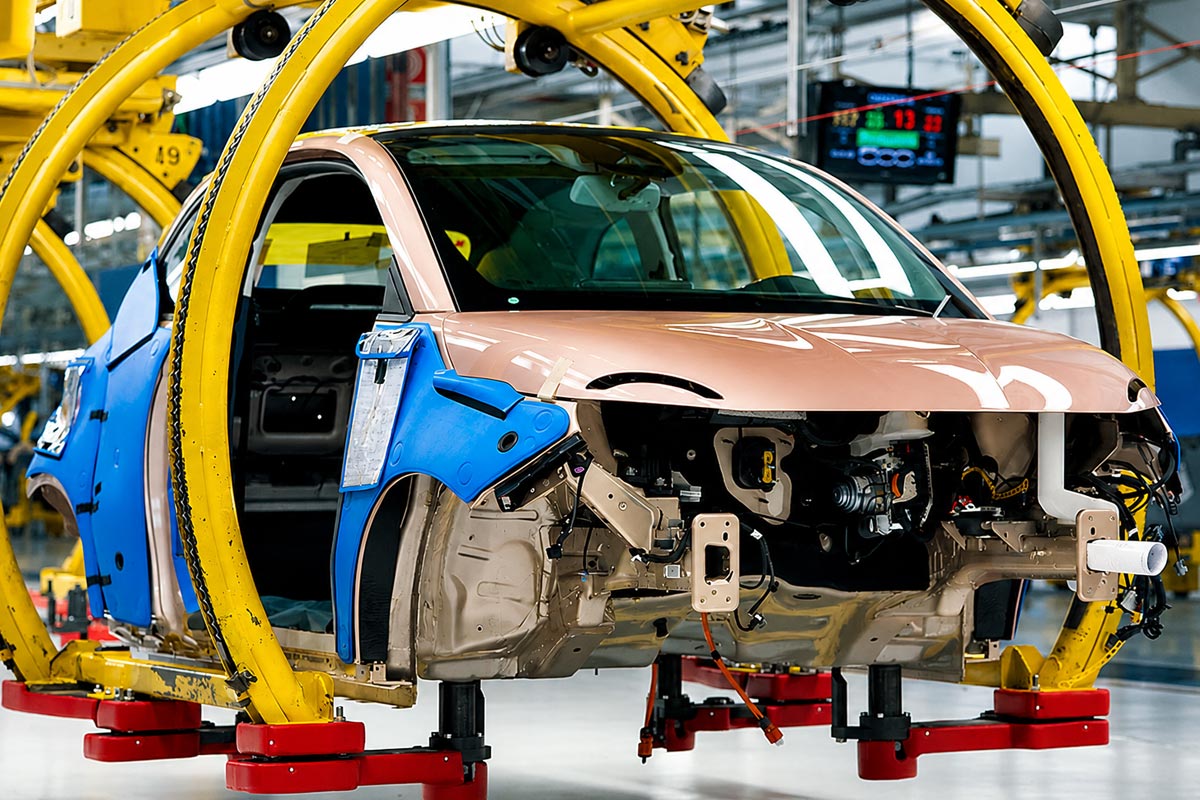
In Mirafiori, the tally keeps rising. Three days of downtime, then six, seven… and now eight since the beginning of September. Stellantis has announced another production halt at its historic plant in Turin: the body shops will remain shut on Monday, September 28. The official explanation is now well known to employees: there is a shortage of engines.
But after a month marked by closures, the unions no longer really believe in it. Because behind this new day without Fiat 500 On top of that, more bad news is now on the horizon: ten days of short-time work are already scheduled for October. And what was supposed to be the year of Mirafiori’s major comeback is looking less and less like the scenario that was announced.
Eight days of downtime in September alone
It's becoming hard to keep track of the situation with announcements coming one after another. In early September, Stellantis had initially halted production three days. The automaker explained at the time that demand for hybrid cars exceeded the production capacity for certain components, particularly those related to the engines. Since then, production disruptions have mounted. Mirafiori has shifted to six days offthen seven, and the shutdown on Monday, September 28, will therefore bring the total to eight days without production in the month of September alone.
And this schedule comes right after a summer shutdown that was already particularly long. The vacation period had been extended to four weeks, whereas two weeks had originally been planned. According to the union FIOM In Turin, if we add up all the various work stoppages since June, Mirafiori would have already lost the equivalent of an entire month of production. Under these circumstances, it will be difficult to regain the stability that employees had hoped for with the arrival of the Fiat 500 hybrid.
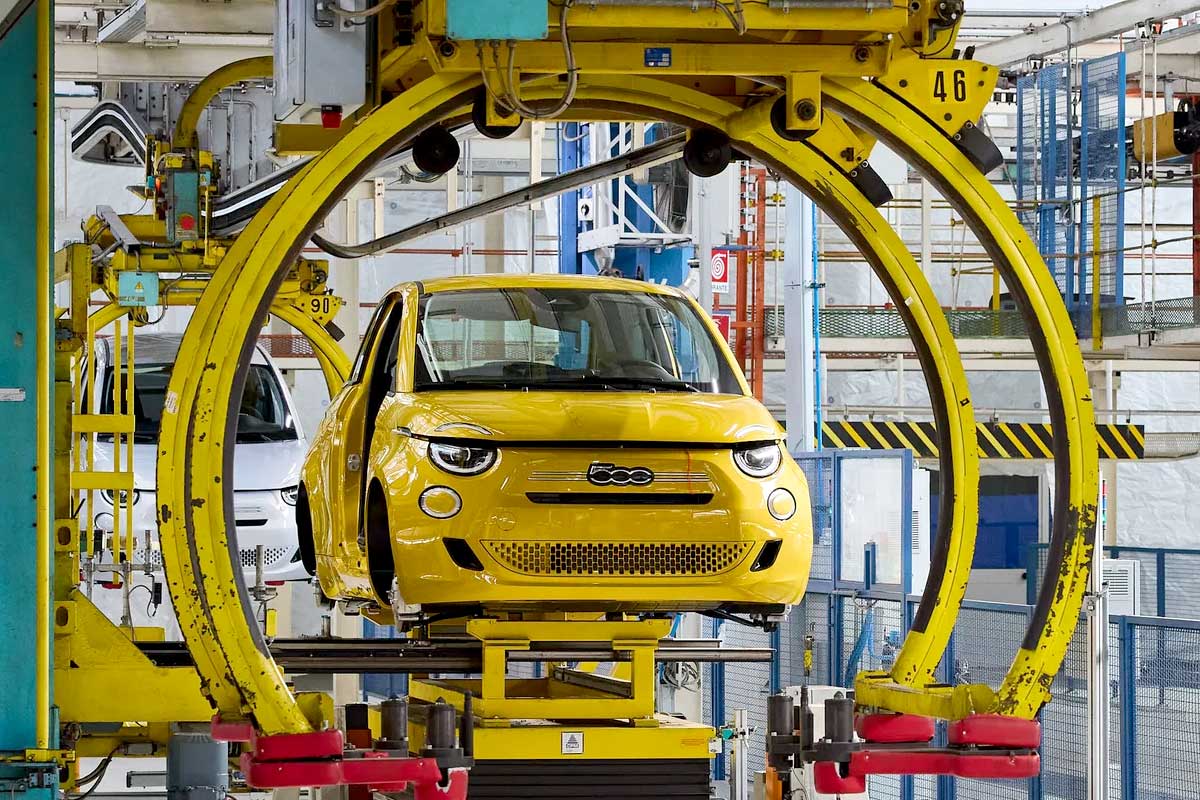
Once again, «there aren’t enough engines»
To justify the shutdown on September 28, Stellantis once again cited a shortage of engines. This is precisely the explanation the company has been giving for several weeks. In particular, the group had cited difficulties in sourcing the components needed for the Fiat 500 hybrid’s powertrain, noting that demand reportedly exceeded the production capacity of certain suppliers.
On paper, the explanation might almost be reassuring: orders are coming in, but the manufacturing sector isn’t yet able to keep up. Except that after eight days of shutdowns in September, the unions are now viewing the situation with much greater suspicion. «Too many shutdowns and the specter of furloughs are bringing us back to a situation we hoped we’d never see again,» warn Rocco Cutrì and Igor Albera of the union Fim-Cisl from Turin.
After September, ten days of short-time work in October
Because another announcement is now significantly altering the way the situation is viewed. Stellantis plans to implement short-time work on the Fiat 500 production line from October 19 to 30. In other words, while the production stoppages in September were due to a shortage of engines, Mirafiori already knows that its production will be sharply reduced again just a few weeks later.
And the unions fear that this won't be the end of it. The union FIOM now fears that it will have to rely heavily on short-time work through the end of the year, particularly given the volume forecasts for November and December. For Edi Lazzi and Gianni Mannori, the figures on production stoppages are now «unrelenting» and paint an even more troubling picture of the near future. The contrast with the announcements made at the beginning of the year is inevitably striking.
A factory that had just resumed operations
With the arrival of the Fiat 500 Hybrid, Mirafiori was set to see a significant increase in production volumes. More than 400 new hires were even made to support this ramp-up. The production target had initially been set at around 100,000 Fiat 500s per year, after volumes of up to 120,000 units had been discussed.
Since then, expectations have gradually been scaled back. The latest projections are now around 60,000 cars in 2026. While Stellantis may point out that this would represent roughly twice the 2025 production level, the unions note that the original target was actually much higher. Above all, employees see a much more tangible reality: production lines are coming to a halt almost every week.
The unions are now demanding answers
Faced with a surge in work stoppages and the return of short-time work, the unions are taking a tougher stance. FIM, FIOM, UILM, FISMIC, UGL, and AQCF have asked Stellantis to hold a meeting to discuss the production situation, as well as the industrial outlook and employment at Italian plants. In particular, the unions want specific details on the expected production volumes at each site and to discuss new production lines that may be assigned as part of the future industrial plan.
At Mirafiori, this issue has become particularly urgent. For months, the unions have been calling for a second model to complement the hybrid and electric Fiat 500s and ensure enough work until the next generation of the 500 is released. For now, that second model still hasn’t materialized. Meanwhile, production stoppages continue to pile up. Three days, then six, seven, and now eight in September. And after hearing for several weeks that these stoppages were caused by demand exceeding production capacity and a shortage of engines, workers are now facing ten days of short-time work in October. At Mirafiori, it is no longer just the engine shortage that is causing concern. Above all, there is a fear that the shortage of workdays will become the new normal.
 English
 French
 Italian
 Spanish
 German
 Japanese
 Dutch
Why is Stellantis talking about a shortage of engines when the Pandina, which has the same engine, has no production issues at all?????
They're hypocrites and won't admit that the 500 isn't selling.
So why isn't it selling?
Who decided to launch it as an all-electric model? Who decided to jack up the prices afterward?
The decision to make the Fiat 500 (the Fiat 500e) available exclusively as an electric vehicle was made by the brand’s management under the leadership of Olivier François, the head of Fiat (and the group’s chief marketing officer), before the start of the COVID-19 pandemic, around 2018–2019.
It's a bit of a cop-out to say that it was Tavares' intention to drive up prices.
Tavares said right from the start in 2021 that the new 500 was too expensive to produce!
Would it have been better to sell at a loss?
Especially since it worked well until 2023.
It was Tavares who wanted a hybrid as soon as possible, but the 2018 design was difficult to implement.
Tavares didn't take office until 2021… And for three years, everything had already been set in stone.
Tavares is Portuguese, too… Not Turkish, as far as I know!
Not Tavares, though
He's definitely done some other stupid things.
«The bottleneck is reportedly occurring at Teksid, a Stellantis subsidiary based in Carmagnola, near Turin. The company supplies components for the hybrid engines used, in particular, in the 500.»
Automobile Magazine
Why won't they just admit that the 500 Hybrid isn't selling well!
And yet, it's equipped with a wonderful Italian engine …
We might as well admit that we don't want to sell any models based on FCA technology.
It's the customers who decide!
The Fiat 500 is technically outdated and, on top of that, far too expensive to manufacture.
The electric versions were offered at outrageous prices.
The hybrid version is a complete technical failure.
We can't wait for a sustainable 100 % Stellantis solution!
Hi, friends, STELANTIS has been crushing these small car brands since the 1950s, but now this company only produces junk, instead of what those old brands used to make. Sure, they weren’t very reliable, but the old Fiat 500 was easy to fix and very simple to work on mechanically.
STELANTIS… I've never heard of it!
And Stellantis has only been around for 5 years.
I think you're talking about a parallel world?
The Fiat 500 is selling well, even on the used car market
Not at all—it's not selling well because the hybrid version isn't powerful enough and is way too expensive.
I think that by 2027, both … electric and hybrid cars will be unsellable.
That would be an admission of serious incompetence! The 500 is an electric car that they’ve “thermified”... by cobbling together a pretty shoddy setup (only 65 ch 😳). A thorough modernization of the old 500 probably would have worked better!.
I find it strange that Stellantis Mulhouse, which produces the 308 Hybrid, is on the same short-time work schedule ?????
I think that information is exactly one year old to the day… So where did the confusion come from?
As it turns out, the 308 is selling below expectations, and on top of that, production of the DS7 and 508 has been halted.
500…500…and once again… 500…the (almost) single-model «family» is a nostalgic reminder of better times gone by and of an «iconic» model from this old and famous car brand………But here’s the thing: this nostalgia—presumably contrary to FIAT’s expectations—does not serve as a «catalyst» for permanently regaining past market success. This is hardly surprising: other manufacturers can now build cars that are just as good—or even better—in terms of technology and quality. A «cute» or «charming» design alone simply isn’t enough in the face of such fierce competition. The same could probably be said for the new Panda…… »postmodern cookie jar» (with all due respect!)……. FIAT used to build wonderful cars……
Good evening, Robert. As an industry professional, here’s how I see it: The FIAT 500 is an icon and a premium compact car. To be completely honest, the FIAT 500 is a brand in its own right, comparable to MINI. You just have to admit that this car has cult status, just like the British have. No other two small cars in the world have this cult status and this aura. And with a cult premium vehicle like this, it doesn’t matter at all what others can or cannot do. It’s the myth of the 500 that can’t be copied. That’s what defines “premium” and “brand”—the 500 has it! Hats off!
As an industry professional, this is how I see it: The FIAT 500 is an icon and a premium compact car. If we’re being completely honest, the FIAT 500 is a brand in its own right, comparable to MINI. You just have to admit that this car has cult status, just like the British have. No other two small cars in the world have this cult status and this aura. And with such a cult premium vehicle, it doesn’t matter at all what others can or cannot do. It’s the myth of the 500 that can’t be copied. That’s what defines “premium” and “brand”—the 500 has it! Hats off!