

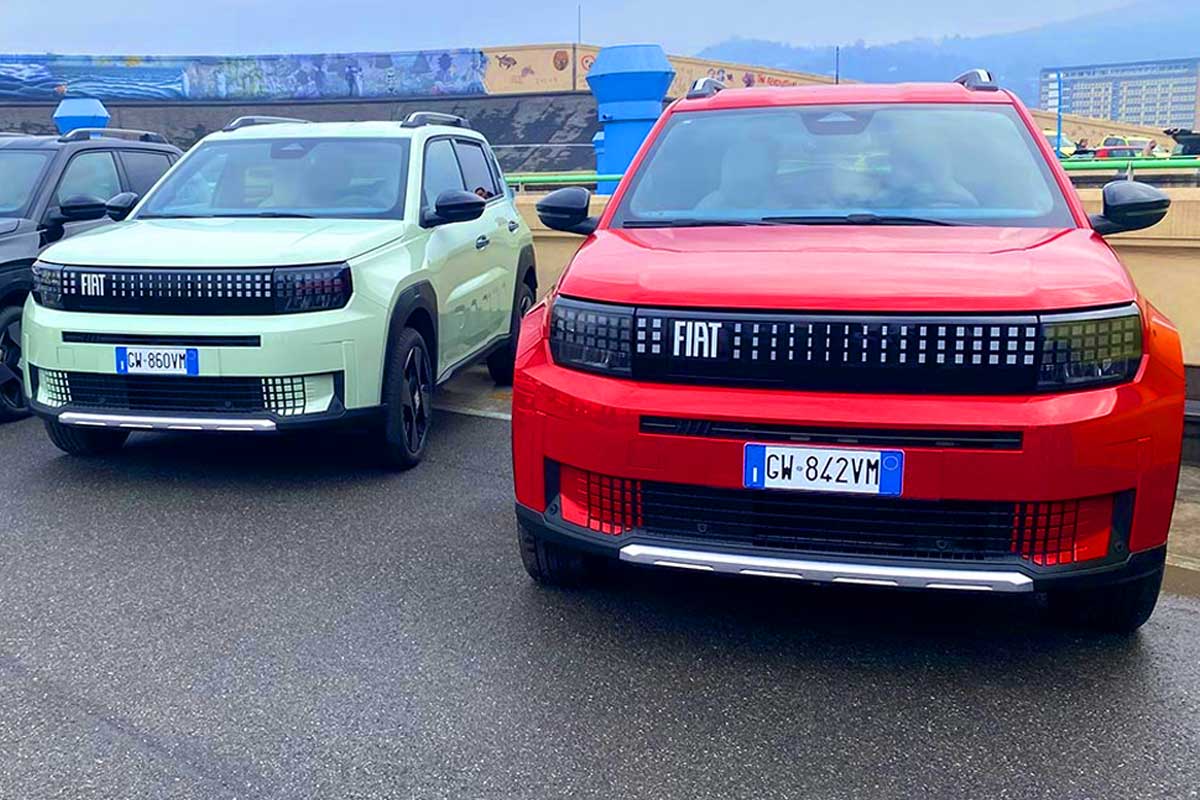
The situation of Stellantis continues to fuel debate among economic analysts and automotive industry specialists. After a catastrophic year in 2025, marked by a record loss of $26.3 billion, some observers now believe that the group has no choice but to radically simplify its brand portfolio.
This is the position of business analyst Chris Buxton, who has just published a lengthy and particularly harsh analysis of the Franco-Italian-American automaker's strategy. And among his many proposals, one sentence sums up his vision perfectly: «Peugeot, Opel, Vauxhall, DS and Abarth must become rebadged Fiat».
Stellantis a victim of his own complexity
For Chris Buxton, Stellantis' main problem is not just electrification or the slowdown in the global automotive market. According to him, the group suffers above all from a structure that has become far too cumbersome and incoherent.
Since the merger between FCA and PSA in 2021, Stellantis has brought together fourteen automotive brands: Jeep, Ram, Dodge, Chrysler, Fiat, Peugeot, Citroën, Opel, Vauxhall, Alfa Romeo, Lancia, Maserati, DS and Abarth. This huge portfolio was initially intended to pool platforms and reduce development costs.
But according to the analyst, this promise has never really been kept. He believes that Stellantis has kept too many duplicates, too many separate networks and, above all, too many competing vehicles within the group itself. In his analysis, he cites in particular the case of Peugeot, Citroën, Fiat, Opel and Vauxhall, all of which target the same European customers with technically very similar models.
«Europe cannot support five generalist brands from the same group».»
Chris Buxton believes that Stellantis should now abandon the idea of maintaining several independent European mainstream brands. In his view, Fiat should once again become the group's global volume brand, with simple, affordable vehicles produced on a large scale. The other European brands, such as Peugeot, Opel, Vauxhall, DS and Abarth, should then either become simple regional variants of Fiat models, or gradually disappear as autonomous carmakers.
For the analyst, «Europe cannot support five overlapping mainstream brands within the same manufacturer». He also believes that Stellantis has made a mistake in trying to reposition Fiat towards more premium segments in recent years. On the contrary, he believes the Italian brand should return to a much more popular and pragmatic philosophy.
The return of a simple, accessible Fiat
In Chris Buxton's vision, Fiat should focus on compact, affordable cars priced under $25,000, with priority given to cost reduction and technical simplicity. The analyst even mentions the idea of removing some of the technology deemed unnecessary for customers. He imagines models using conventional physical controls for climate control, while letting Apple CarPlay and Android Auto handle navigation and infotainment.
In his view, the current rise in oil prices could well favour this type of simple, light, fuel-efficient vehicle. He points out that Brent crude is now over $120, against a backdrop of tensions around the Strait of Hormuz, which puts the issue of energy efficiency squarely back on the agenda.
Jeep, Alfa Romeo and Lancia: very different roles
Chris Buxton isn't just attacking the generalist European brands. His analysis also predicts a very radical repositioning of Stellantis' other brands.
He believes, for example, that Jeep should stop churning out classic family SUVs and return to what has historically shaped its identity: the Wrangler and Gladiator. In his view, it is precisely these models that still enable the American brand to maintain a strong image.
For Alfa Romeo, the analyst imagines a much more focused strategy. In his view, the Italian brand should remain a low-volume sports car manufacturer, concentrating on high-performance compacts and sedans priced between $40,000 and $70,000. He believes that Alfa Romeo should focus on its Italian design and driving pleasure, rather than trying to imitate German premium brands.
As for Lancia, the diagnosis is even harsher. Chris Buxton believes that the Italian brand has only one real chance of survival: to quickly exploit its rallying heritage with sporty compacts inspired by the Delta Integrale. Should this relaunch fail, he already imagines Lancia transformed into a parts business.
A radical vision... but not totally isolated
Chris Buxton's analysis may seem extreme, especially when he speaks of the gradual disappearance of several historic European brands. However, it illustrates a debate that is becoming increasingly present around Stellantis: can the group really continue to support so many brands in a pressurized automotive market?
Between electrification, massive technological investment, the rise of Chinese manufacturers and the slowdown in several Western markets, some analysts believe that the major automotive groups will inevitably have to simplify their structures.
For the time being, Stellantis officially continues to defend all its brands. But with just a few weeks to go before the presentation of Antonio Filosa's new strategic plan, speculation continues to grow that investments will be concentrated on a smaller number of brands.
For our part, you can read our latest analysis: « Stellantis officially focuses on 4 priority brands... but hides a fifth that doesn't completely belong to it. »and « Stellantis has decided between Opel, Citroën and Fiat" .
 English
  French
  Italian
  Spanish
  German
  Japanese
  Dutch
Dutch
Very interesting and not devoid of common sense.
What's the point of continuing to exploit 14 moribund brands? I could see the Lancia logo replacing DS, even if it meant sacrificing one of the 2 brands!
And you think they'll sell more for that?
It won't change a thing, or almost nothing.
The problems are :
1/ the positioning of these brands.
2/ their untapped potential.
3/ In the case of DS, there is also the lack of legitimacy.
Totally agree with you and I would add dealership service, after-sales service and customer care at the top. 👌
The issue will be which country leads, France with Peugeot, or Italy with Fiat? Answers on a postcard, please!
Reuters recently reported that Stellantis had no plans to abandon any of its 14 brands. Antonio Filosa confirmed this on Tuesday, saying that abandoning a brand would be tantamount to ceding customers to the competition. On the other hand, not all brands will be treated equally.
Stellantis makes common platforms to amortize investments.
Each brand has its own region, its own clientele and, above all, its own culture.
You can't manage assets like that like a chartered accountant.
These assets are more than just a line item in an operating account.
Alfa Romeo's history is worth much more than the sales it generates from a financial point of view.
Then there's a lot of Stellantis Bashing.
We prepare our minds for painful moments by launching this or that pseudo-analysis or rumours transformed into information.
Personally, I've been following Alfa Romeo news for almost two decades... and apart from the Giulia / Stelvio period, which excited me (and the 4C too, even if it didn't get the development it deserved), I don't expect anything more... I'd rather be positively surprised than disappointed.
We can't say that the 4C hasn't had the development it deserved, because Marchionne had warned that it wasn't for everyone to get their hands on, because it was really track-oriented, and that's really the case. On the open road, it's like the F40: you have to have both hands on the wheel and pay attention to everything. In this respect, it's closer to the Opel Speedster or Lotus Europa than to the Elise or Alpine A110.
Another stupid economist talking for nothing. We can't do away with brands like Peugeot and put in only Fiat.
We need to refocus on brands that are doing well
Stop making ds 8s that don't sell.
Making cars simple and reliable
It's clear that each brand must keep its DNA and understand, as VAG and Toyota have just announced, that the race for volume was a monumental mistake (hats off to VAG for understanding this, at least) and that it's better to make quality cars by sharing elements between certain brands while creating a different car.
Even if the GT86 and BRZ are twins in every respect, the chassis set-up makes them literally 2 different cars.
You just have to understand that Thermique isn't me, and aim for something other than autophobic France.
At the same time, when they «gave» Alfa Romeo to PSA, what did some people expect? People who have NEVER been able to break into the premium segment would succeed in one fell swoop?
Their segment was the generalist, and even there they have a bad image. So why give them the keys to premium/sports and prestige brands? We're talking about Alfa Romeo and Maserati here. They didn't wait 3 years to put their lame 3-cylinders under the hood...
If you look at the history of Citroën and Simca alongside Peugeot, their HDG cars have worked without a hitch, whereas the «so-called» HDG Peugeots (archaic as can be) have always flopped, and the last one to have not too disastrous figures was the 604, and even then it had to evolve quite a bit for a result that was totally below expectations.
That's what I'm saying, there's been nothing remotely convincing from Peugeot for half a century. The Citroën DS, for example, was before the brand was integrated into PSA...
You're right about Citroën, the DS, the SM, the GS...etc. Their true descendants were the C6 and the DS9, but like Lancia with Fiat, Peugeot wanted to put its money where its mouth was and instead of taking the time to make them reliable and give them engines worthy of the name, they preferred to give up (as with the Thesis and the Thema 2 (which is an aberration).
You need cars that make you dream, bold technology and style.
We'll end up with cars that are too impersonal (we started a long time ago) and we'll be left behind, and it won't be three brands that disappear.
It will be much more...
I agree with you. The people in charge of Stellantoc need to be told...
Just to set the record straight: if the Group is where it is now, it's the fault and the sole fault of its successive managers/decision-makers. Rather than thinking about firing brands, maybe we should think about firing something else...
«For the time being, Stellantis officially continues to defend all its brands.»
Officially.
Unofficially, EVERYTHING, at least in Europe, has revolved around Peugeot since the «merger». Every European model designed since 2021 is a rebadged Peugeot, no less.
True, and it underlines the knowledge of this «specialist» who knows nothing about the subject.
He finds that salaries are not justified, and wonders whether his own is. Because by giving his opinion without taking the time to find out, he risks sinking the companies he advises.
That was Tavares' wish at the time.
There is space for these brands.
Alfa becomes a low volume small sports cars maker like Lotus.
FIAT semi premium brand offering chic cars based around 500 and 600 styling, think MINI.
Citroën develops as the value brand, Dacia.
This leaves space for Peugeot to become a semi premium brand think of Hyundai and KIA, and entry level BMW et al.
Vauxhall and Opel should merge with Dodge and become a sporty brand, like Cupra, with regional badging.
This leaves Lancia as the premium brand, looking at BMW, and Maserati as the high-end cars.
Netter Gedanke. Allerdings würde ich als Peugeot Fahrer auch meinen nächsten eher bei Peugeot kaufen. Es ist gar nicht mal so sehr die technische Basis, sondern die französische Note im Innenraum. Wobei das auch eher ein aussterbender Vorteil ist im Zuge der Design Globalisierung.
Wenn ein Fiat, Peugeot, Citroen usw. dann alle gleich sind bis auf die Embleme, wie soll dann noch eine Markenbindung aufrecht erhalten werden?
There's no point in making Peugeot clones of Fiat. Using a common platform is fine (as was the case with the Tipo platform, which launched the car-sharing craze in the EU long before the VAG group did), but making clones like the Ypsilon would be pointless the other way round! Everyone should keep their DNA and build on it.
As far as DS is concerned, it initially succeeded in the role of «pulling the range upwards», which was done routinely and successfully (see the 205 gti and golf gti). Trying to make it a luxury brand in its own right had the main effect of turning Citroën into a low-cost brand. Reintegrating DS into the citroën range for optional top-of-the-range versions would give citroën a boost and stop putting pressure on DS.
As for Alfa Romeo, it's enough to draw inspiration from successful periods rather than repeat mistakes.
Peugeot is the group's 1st brand in Europe and Fiat the 4th. Not a very logical analysis.
What really needs to be done is to separate the hybrid and electric platforms - that's what makes everything so complex.
Fiat is the brand that makes the most group profit and sales when Peugeot is just 8th in the EU, so the analysis is in a sense fair.
«Peugeot is the group's 1st brand in Europe and Fiat the 4th, not a very logical analysis.»
Stellantis is not limited to Europe. On a global level, the opposite is true. Hence his analysis.
Astounding ignorance by Mr Buxton. STLA is nothing more or less than the sum of FCA + PSA brands.
Goal: Synergy in the wake of the Chinese Invasion and imposed emission legistation. Positive side effect: rejuvenation of AR, Lancia and FIAT EU thx to shared components.
Quite a cardboard analyst, that one. Obviously no technical or industrial skills. Cars also have to be produced and earn money. The only thing that's obvious is that FCA and PSA weren't made to end up together without major breakups.
They should have formed an alliance and shared the elements that could be shared between Fiat and Peugeot, Citroën and Lancia, which would have enabled PSA to see the future. It's not DS that's missing at PSA, but a brand like Dacia.
Stellantis are dealing with a similar problem to British Leyland in 1970s as the market changed. It took them 20 years to get a single coherent model strategy and by then the brands were very diminished.
BL = STLA. Hilarious! ;)) BL directors were spending their days in the London Director's Club, smoking cigars, drinking vodka and telling tales of the «Britain Rules the Waves» era. STLA on the other hand is a rock solid €180 bn enterprise, home of cash kings Jeep, Ram, Peugeot and FIAT.
With only 4 cars in the catalog and another national brand in front, Stellantis could easily pull the plug on Citroen, with buyers going to Fiat for the popular models and Peugeot/Opel for their qualitative C-SUV.
Opel is more complicated if the brand disappears customers can go to VW/Skoda
DS has a ridiculous potential compared to the Alfa heritage, ditto Lancia, to choose Alfa has maintained a range
If necessary, keep a joint Fiat 500/DS3/Ypsilon program
Above that in terms of price, volumes will never be there.
«Unplug Citroën and customers will go to Fiat. Nothing less than that.
Yakafokon...
Of course, each brand has its own defensible «global» history. For example, Lancia: at the outset, these were rather comfortable, technically innovative cars (a bit like Citroën with traction and suspension), and then the success of the Stratos, Fulvia HF and Delta meant that today we read it as a sporty brand.
Why not keep 3-4 families: according to degrees of finish / sportiness: Citroën-Peugeot-DS // Fiat-Lancia-Abarth // Alfa-Maserati // Opel? > for sale 😉
...... »dass Stellantis einen Fehler gemacht hat, als er in den letzten Jahren versuchte, Fiat in Richtung Premium-Segment zu repositionieren.»......?? für meine Wahrnehmung wurde FIAT « unter » Satellantis wohl in Richtung Volumenmarke, aber für den sog. « globalen Süden » « ent »wickelt.....wo die in der Überschrift zu dem Artikel erwähnten Marken dann bei FIAT zu ihrer weiteren Entwicklung « anschließen » sollten bleibt mir schleierhaft. Die einzigen wirklichen Technik - und Design »perlen» sind bisher am ehesten (noch) Alfa und Maserati. Der Grund für die üppige und weitgehend unrentable Markenwelt liegt wohl eher in einem im Hintergrund laufenden « Kulturkampf » zwischen der italienischen und der französischen Managmentsphäre......
On what basis!???
Apart from the 500, which is already dated, what else have they done since then?
The FireFly and 500 are more «modern», more recent than the PureToc and CMP...
208 : 2019
2008 : 2020
308 : 2021
408 : 2023
3008 : 2024
5008 : 2024
Topolino: 2023 (Citroën base)
Panda III: 2011 (Fiat base)
Argo : 2017 (Punto base )
Fiat 500: 2020 (Fiat base)
Fiat 600: 2023 (Peugeot base)
Grande Panda: 2024 (Citroën base)
Fiat Tipo: 2016 (Fiat base)
... Well, it's well known!
And it speaks for itself...
Consumers are too individualistic to want mega-brands, so there remains room for a portfolio. Also, there has never been a successful migration of consumers from one brand to another in the industry - brands just implode.
Therefore, it makes sense for STLA to rationalise based on white label manufacturering and a lower number of generic brands. But imo they'll do that in a tempo that is foremost determined by their leakage to the Chinese brands - the only ones who have a strategic advantage to disrupt.
There are too many brands at Stellantis: we need to keep Fiat (with sporty models under the Abarth logo) and Peugeot as generalists, and Alfa Romeo, Maserati and Lancia at the top of the range.
Alfa Romeo was supposed to be a premium, sporty brand (and it is, with the Giulia and Stelvio), and instead we get a Junior that borrows everything from Peugeot. It just doesn't make sense.
Opel has no identity, the fake premium DS, and the low-end Citroën are useless. French luxury cars have never worked.
Well, Citroën has more captive customers overall than Peugeot ... and a stronger image (not necessarily always positive, but that doesn't really matter, otherwise we'd have pulled the plug on Alfa, which hasn't always had a big customer base).
In short, FCA and PSA have nothing to do with each other.
Sergio Marchionne was against an FCA - PSA alliance, and now we realize just how right he was. Declining Peugeots in all Stellantis brands, or how to kill brands.
Citroën, sorry but its aura is gone, it's just cheap Peugeots now.
Alfa Romeo is self-destructing through mistakes, non-renewal of the range, downsizing and trivialization with the Junior and Tonale. It's sad, but I don't even know if there's anything left to hope for this brand, even though I'm a convinced Alfaist and Alfa Romeo's history is unique.
Citroen has been Peugeot for 50 years. So yes, it's no longer the historical Citroen. But until recently, PSA allowed Citroen to be «different» to a greater or lesser extent, and to still have «top-of-the-range» models (not like BMW or Merco ...) which gave customers a real feeling of vehicles still in the Citroen spirit. And the DS badge, as ridiculous as the name was, was still a plus. For the past 5 years, they've been doing Dacia like and DS has been peeing higher than its ass on the side. Result: global losses.
Alfa has never been premium, and that was fine by making the Sportif like affordable.
Alfa:
Small sports car - 4C (Lotus Emira)
Sports SUV - Stelvio (new) (Eletre)
Sports Sedan - Guilia (new) (Emeya)
Sports cars- 8C (Esprit)
Peugeot PSA should never have integrated stellantis. PSA had made record profits for several years in a row, while fiat and other jeeps were on the brink of collapse. Now fiot is back in the driver's seat and wants to bet everything on its fiat panda and other multi-purpose crap, which has never been a success. On the other hand, PSA has placed its 208, 3008 and 5008 in the top European sales rankings. So PSA, which was able to optimize its production lines and gain in margins, must get out of this guetapan and fiat must disappear, like jeep. .