

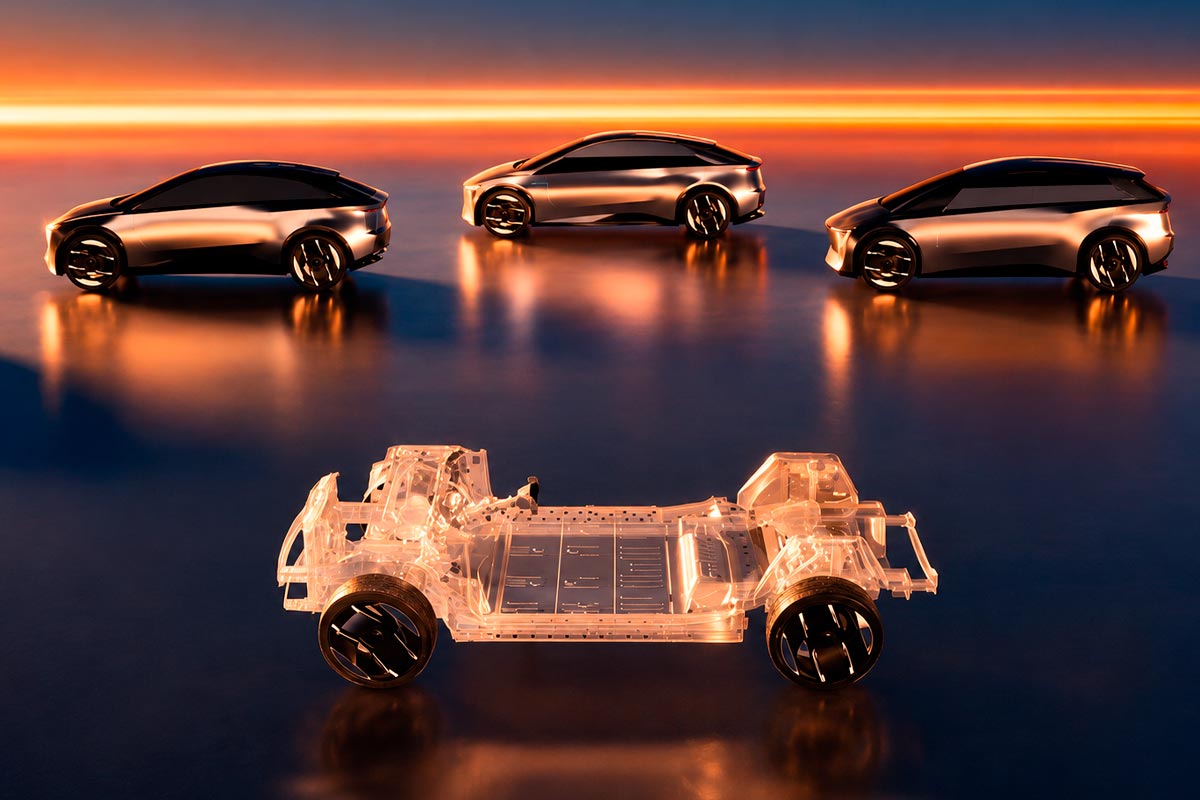
This is perhaps the most important technical announcement of the year. Stellantis since the group's creation in 2021. After several years of talking about STLA Small, STLA Medium, STLA Large, STLA Frame and STLA Smart platforms, the automaker is changing its strategy completely. The new architecture is called STLA One.
Behind this name lies an industrial revolution that could profoundly transform the Group's future Peugeot, Alfa Romeo, Fiat and American models. For STLA One is not simply a new platform: it is intended to replace many of those already announced.
A single platform to replace five architectures
In its official presentation on May 21, 2026, Stellantis explains that STLA One will be launched in 2027, and that it aims to «combine five platforms into a single, scalable architecture». A sentence that already says a lot.
In concrete terms, this means that the STLA City, STLA Small, STLA Smart, STLA Medium and STLA Large projects will gradually evolve towards a single technical base capable of covering the B, C and D segments. In other words: from the small city car to the family sedan or mid-size SUV.
The objective is clear: to drastically reduce industrial complexity. Today, Stellantis manages a multitude of different platforms, components and technologies, depending on region and brand. With STLA One, the Group aims to standardize as many elements as possible in order to save time, cut costs and improve profitability. And the ambitions are enormous: more than 30 models will be based on this platform between 2027 and 2035, with a target of over 2 million units produced.
A platform that changes Stellantis' strategy
The other important sentence in the press release concerns Stellantis« 2030 objective: »50 % of the Group's volumes will be based on three global platforms".
If STLA One is already replacing five platforms on its own, this means that by 2030, Stellantis will only be working with three main global architectures. If we do the math, we can see that the Group is determined to streamline its industrial organization. In this scenario, STLA One would become the central platform for vehicles in segments B to D, while other architectures would remain dedicated to more specific uses.
For example, the STLA Frame platform should continue to exist for American pick-ups and large SUVs. As for STLA Large, it could continue its career, mainly in the USA, for future Jeep, Dodge and Chrysler models... eventually to be replaced by STLA One.
One big question remains for the luxury brands: what will happen to future E-segment models, especially the upcoming Maseratis? Will we see more Giorgio Evo for Maserati, or will Stellantis integrate these new models into the STLA One universe?
STLA One: evolution of STLA Small or merger with STLA Medium?
This is probably the most interesting aspect of this announcement. After all, a number of clues suggest that STLA One did not come out of nowhere. Traces of the project can be found long before it became official. Some had already been working on «STLA ONE» since early 2025. Others mention responsibility for the STLA Small platform, presented at the time as the Group's future reference electric platform for the A and B segments.
STLA One seems to be much more than a simple replacement for STLA Medium. All the indications are that it's more a far-reaching evolution of STLA Small, originally intended for segments A and B, but which has gradually gained in modularity to cover segments C and D as well. In other words, Stellantis has decided to merge several projects into a single mega-platform.
An ultra-flexible, multi-energy platform
The technical challenge is colossal. STLA One must be able to do everything. The platform is designed to be multi-energy, which means it will be able to accommodate several types of powertrain without any major technical compromises. Electric, hybrid, or even internal combustion depending on the market: Stellantis wants a single base that can be adapted anywhere in the world.
It will also have to handle different vehicle sizes, wheelbases, battery types, transmissions and even traction modes. STLA One will also inaugurate several of the Group's key technologies, including STLA Brain, STLA SmartCockpit and steer-by-wire, a technology that removes the traditional mechanical link between the steering wheel and the wheels.
On the electric side, Stellantis is already promising 800-volt compatibility and a strategy based more on LFP batteries to reduce costs. The group is also talking about «cell-to-body» integration, where the battery directly becomes a structural element of the vehicle. In short, STLA One is set to become Stellantis' central technological base for the next ten years.
First cars in 2027
The first STLA One models will arrive as early as 2027. In parallel, Stellantis is also planning a new «E-Car» platform for small electric cars from 2028 (we imagine for the future Fiat 500). This could mean that future very affordable city cars will still have a dedicated architecture, while STLA One will focus on the core of the global automotive market. The first model to inaugurate the STLA One platform could be the Peugeot 208.
 English
  French
  Italian
  Spanish
  German
  Japanese
  Dutch
Dutch
Stellantis will not survive to 2030. It's game over for them.
De verkopen van het eerste kwartaal 2026 zijn met 20% procent gestegen en bovendien gaan ze redelijke korte termijn de Eurofly motoren van Fiat gebruiken. Stellantis is daarnaast een partner van Dongfeng en Leapmotors. De toekomst ziet er positief uit! Het merk Fiat is groot in Zuid Amerika en heeft 2 nieuwe modellen voor dit jaar aangekondigd. De Fiat Grizzly. Ook de Lancia Gamma is al aanstaande. Kortom niet azijnzeiken!
To hear you talk Stellantis has prepared his funeral. .
You're really defeatist !!!!
A single stretched Peugeot city car platform for all B, C and D segment vehicles from 14 brands.
Haha, who can smell disaster coming?
I'm willing to criticize a lot of things, but PSA's CMP platform isn't bad. I preferred the Junior's behavior to the Tonale's (of course, no comparison with giorgio...). STLA Medium wouldn't be bad either, but apparently too heavy (I'd have to check with the Gamma). For this STLA One, an evolved version of STLA Small that we've seen nowhere, I'll give it a chance. That's my opinion.
Personally, I have an empirical view of the situation: we've been giving them a chance for 6 years, and what's the result? We can give them a chance again, yes, but I'm not confident...
As for the Tonale, based on a Jeep Compass, it was a foregone conclusion. I'm willing to believe that the Junior, more compact and lighter, is more pleasant. In fact, I'm thinking of trying it out (in 280).
It could be pretty good, and it finally seems smart to me. But as for me and many Italians and/or enthusiasts of Italian brands, what will be most important will be the place of manufacture and the type of engine.
- Segmento A -> piattaforma regionale «E-Car»
(evoluzione della citata STLA City?)
- Segmenti B, C, D -> piattaforma globale STLA One
(Davide Mele ha commentato che consoliderà 5 attuali piattaforme in 1 solo alla fine del prossimo Piano Prodotto, quindi 2035)
- Segmento E -> piattaforma speciality
(nulla è stato detto, io fremo per sorprese e chiarimenti nel Piano Prodotto di Maserati 🤞in stile Giorgio Evo)
- Segmento PickUp -> piattaforma globale STLA Frame
- Segmento LCV -> piattaforma globale LCV
»The platform is advertised as multi-energy from the outset, which means it will be able to accommodate several types of powertrain without major technical compromises.»
As with the problems encountered on STLA Medium, isn't being multi-energy a source of compromise?
And to say that the 208 will be the first model on the STLA One is not entirely honest on the part of Stellantis, since it will be launched only as an electric model (STLA Small, not One), and the combustion versions will be allocated to the current 208, which will be restyled once again.
Yes, but perhaps at launch it will be electric, but gradually it will also have hybrid thermals.
STLA One is not replacing STLA Large.
STLA Large will be used for premium/elite Maserati and Alfa models, alongside Dodge.
As long as there is a business case for a longitudinal I-6 or V8, it cannot be part of STLA One.
STLA is currently available only in the U.S. As for Maserati and Alfa Romeo, it’s still unclear.