

Maserati is at a new turning point in its history. After spending a decade pursuing volume targets with the ambition of sustainably exceeding 40,000 annual sales, the Trident brand now appears to be taking a different path. Officially, this is a repositioning toward a more exclusive and profitable luxury segment. Unofficially, some will see it primarily as a necessity in the face of the gradual decline in sales volumes observed over the past several years.
Some recent decisions seem more logical than others. Maserati’s participation in the GT2 championship now seems much more relevant to the brand’s image than his stint in Formula E. Similarly, the partnership with the luxury watchmaker Bianchet has been particularly well received by enthusiasts. However, one undeniable reality remains: new car registrations continue to decline in most key markets. As we await the refresh of its lineup, here’s where Maserati stands after the first five months of 2026.
The United States remains number one, but for how long?
The United States, which has long been Maserati's largest market worldwide, still holds that status in 2026. But the trend has become a cause for concern.
From January through May 2026, the brand registered only 733 cars in the U.S. market. That’s roughly what Maserati used to sell in a single month during its peak years. To gauge the extent of the decline, consider that during the same period in 2025, 1,625 cars were registered. With a year-over-year decline of 55 %, it now seems very likely that Maserati will not even reach the 2,000-registration mark in the United States for the entire year of 2026.
Italy is holding its ground, but is no longer making up for the shortfall
Italy, the brand’s second-largest market, is faring little better. Between January and May 2026, Maserati registered 457 cars there, compared with 778 a year earlier. This represents a decline of 41 %. Once again, the decline is even more dramatic when viewed from a broader perspective. In the first five months of 2023, Maserati had recorded 1,748 registrations in its home country. In just three years, sales volumes have thus fallen by nearly fourfold.
Japan Confirms a Global Trend
Japan has always had a special relationship with Maserati. The Japanese market has long been one of the Italian brand’s most loyal markets. However, it too is now following the general trend. With 226 registrations in the first five months of 2026, compared to 317 during the same period in 2025, the decline stands at 29 %. The decline is less severe than in some other markets, but it confirms that the slowdown is not limited to any one region of the world.
Germany: The Grecale Saves the Day
Germany has long been a strong market for Maserati. Just a few years ago, the brand regularly exceeded 1,000 annual registrations. Today, the situation is quite different. From January through May 2026, only 188 Maseratis were registered in Germany, representing a 38 % decline.
German statistics, however, allow for a more in-depth analysis. Of these 188 cars, 144 are Grecale models. In other words, this SUV alone accounts for more than three-quarters of the brand’s sales in the country. Another telling figure: only five electric Maseratis were registered during this period. This data illustrates the challenges faced by the Folgore models in several European markets.
At this rate, exceeding 500 registrations for the entire year of 2026 would be nothing short of a feat.
The United Kingdom and Switzerland are exceptions
Amid this generally bleak picture, a few markets still offer some cause for optimism.
The United Kingdom is even one of the few positive surprises of the year. Maserati registered 191 cars there between January and May 2026, compared with 138 a year earlier—a 38 % increase. However, this performance should be put into perspective. During the same period in 2023, the automaker had recorded 459 registrations. The brand therefore remains far below its historical levels. Nevertheless, unlike most other countries, it is no longer declining.
Switzerland is also showing encouraging growth, with 95 registrations compared to 70 in 2025—a 36 % increase. One might think that the Swiss market naturally remains favorable to luxury cars. This is true to a certain extent, but even so, volumes remain far below those seen a few years ago. In the first five months of 2023, Maserati registered 245 cars there.
Australia, Turkey, Spain, and France continue to see a decline
In the other markets monitored, the figures continue to trend downward.
In Australia, Maserati recorded 80 registrations, compared with 121 during the same period in 2025. The contrast is even more stark when compared with the 161 units registered in 2024 and the 214 in 2023.
Turkey’s registrations will drop from 93 in 2025 to just 50 in 2026. In 2023, the Turkish market still accounted for 275 registrations in the first five months of the year.
The same trend was observed in Spain, where Maserati recorded 72 registrations, compared with 105 in 2025, 139 in 2024, and 275 in 2023.
France, for its part, remains a very marginal market for the brand. With only 27 registrations between January and May 2026, compared with 36 in 2025, 38 in 2024, and 57 in 2023, the trend remains negative.
Finally, some countries are now seeing numbers that are almost negligible. Austria recorded only four registrations in the first five months of the year, while the Netherlands recorded just three.
Maserati is preparing for the post-2026 era
Ultimately, the figures for January through May 2026 confirm a reality that has been evident for several years now: Maserati is going through a particularly challenging transition period.
The United States remains the brand’s largest market with 733 registrations, ahead of Italy (457), Japan (226), the United Kingdom (191), and Germany (188). However, most countries are still seeing declines, some of which are dramatic. Only the United Kingdom, Switzerland, and, to a lesser extent, Austria are showing growth.
The question now is how long Maserati can wait before revamping its lineup. While the strategy of returning to a more exclusive form of luxury may make sense on paper, it can only truly be judged once the future models hit the market.
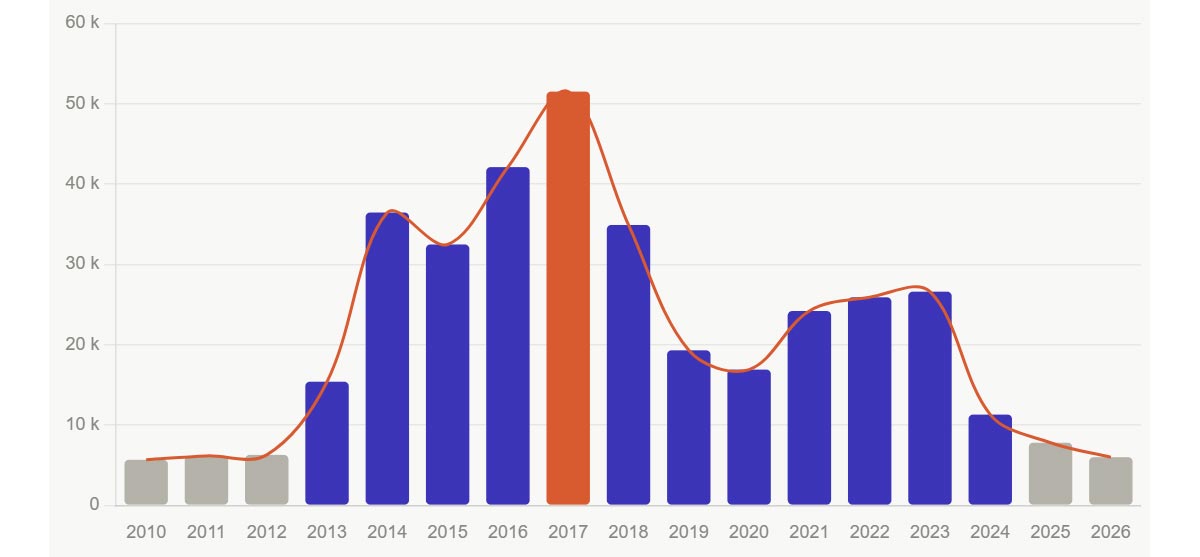
Until then, global registrations continue to tell a simple story: that of a prestigious brand still searching for a new lease on life. If it continues on this trajectory, it is highly likely that by 2026, sales will drop to 5,000 units—the same volume as in 2010. That would still be double Jaguar’s volume and on par with Aston Martin’s, but the brand would now be trailing behind Lamborghini and Ferrari, which are aiming for 15,000 annual sales.
| Country | January–May 2026 | Evolution |
|---|---|---|
| United States | 733 | -55% |
| Italy | 457 | -41% |
| Japan | 226 | -29% |
| Germany | 188 | -38% |
| United Kingdom | 191 | 38% |
| Switzerland | 95 | 36% |
| Australia | 80 | -34% |
| Turkey | 50 | -46% |
| Spain | 72 | -31% |
| France | 27 | -25% |
| Austria | 4 | 33% |
| Netherlands | 3 | -75% |
 English
  French
  Italian
  Spanish
  German
  Japanese
  Dutch
Dutch
And it's no bad thing that the Trident is back to its 2010 annual sales level!!!
Two diesel sedans were sold to boost sales volume. And there was a lack of new model introductions.
Maserati needs to be sold to Ferrari right away. The Trident brand will focus on GT models and offer a more comfort-oriented experience, at a lower price point, with shared dealerships (to reduce costs and increase customer satisfaction).
You're right, because the latest Maseratis are... perfect Lancias (V6 and 4-cylinder hybrid).
In fact, switching to Ferrari and limiting production—just like the Prancing Horse does—is precisely what drives up prices.
As for the rest, you're absolutely right.
With environmental penalties and other taxes on cars, things are going to get increasingly complicated for a brand that has traditionally been committed to high-performance engineering. Perhaps they should look to the United States, where models are already accustomed to high-performance internal combustion or electric vehicles, to help reduce design costs.
Only Stellantis could squander the potential of brands like Maserati and Alfa Romeo. Their incompetence transcends borders and logic.
On top of that, with Imparato at the helm of the brand (might as well put Jean-Claude Dus in charge while we’re at it), we could end up with a Grecale that looks like a 5008 at any moment…
It's funny to look at the numbers from a brand's die-hard fans…
Is Stellantis to blame for the sharp drop in sales starting in 2018?
It's the same at Alfa, by the way.
Is the increase after 2022 due to FCA?
Etc.
The big drop in sales in 2018? Well, it came after the sales boom in 2016–2017, sweetie…
Oh, really? So sales were unusually high, then?
And how do we explain the second drop in sales since 2018… is it still Stellantis' fault?
And does that explain the increase in sales following the merger and the creation of Stellantis?
Etc.
Will sales increase after the merger?
You're done smoking the curtains, and now you're moving on to the wallpaper?!
Where do you see a net increase after the merger? Because it's actually the exact opposite.
Where'd you see that 2022 increase? In your crystal ball? Are you secretly hooking up with Ms. Irma, you chronic shooter on puretoc?
Can you show us where Alfa sold the most cars in 2022?
I can't wait to see that.
P.S.: In the meantime, the 5008 is a huge success!
Sure, it's not as classy as the Stelvio and Giulia, but at least it's profitable.
It pays so well that he spends his life backtracking on his motor issues… You’ll never change, and you’re willing to make people swallow a lot of bitter pills without realizing that you’re wasting your time, because we all know how this will end.
The Panda sells 1,000 times better than a 5008, if we're going by that.
The prices of the 5008 overlap with those of the Stelvio.
The 5008 and the Panda—I don't think so!?
Unfortunately, this is not surprising. Italian automakers have a bad habit of discontinuing models without replacing them.
Where are the new Ghibli, Quattroporte, and Levante?
As far as I know, it was indeed Tavares who put a stop to the renewal.
And you just keep ignoring the strong sales figures from Belgium. At the end of May, the figure for 2026 rose further to 63, compared to 46 in 2025. That's more than twice the combined sales of France and the Netherlands.
With the disappearance of Jaguar, Saab, large Lancias, and Rover, I’m glad there’s still one luxury car brand that produces a 4- or 5-door model within the Mercedes/BMW/Audi price range. There’s still a market for non-German but European premium cars.
Maserati doesn't have the same prestige as Ferrari. It would be more accurately classified as an Italian counterpart to the German premium brands. However, it's too expensive and isn't on par with them technically, simply because it lacks the funding for development. I fear that Maserati will not survive, and it is too late for a turnaround.
Ideally, Maserati would be bought by Ferrari, but that will never happen.
Stellantis will eventually sell the brand, in whole or in part, to a Chinese automaker. And that will mark the true end of Maserati.
Except that Ferrari has veto power over Maserati, if that's still the case.