

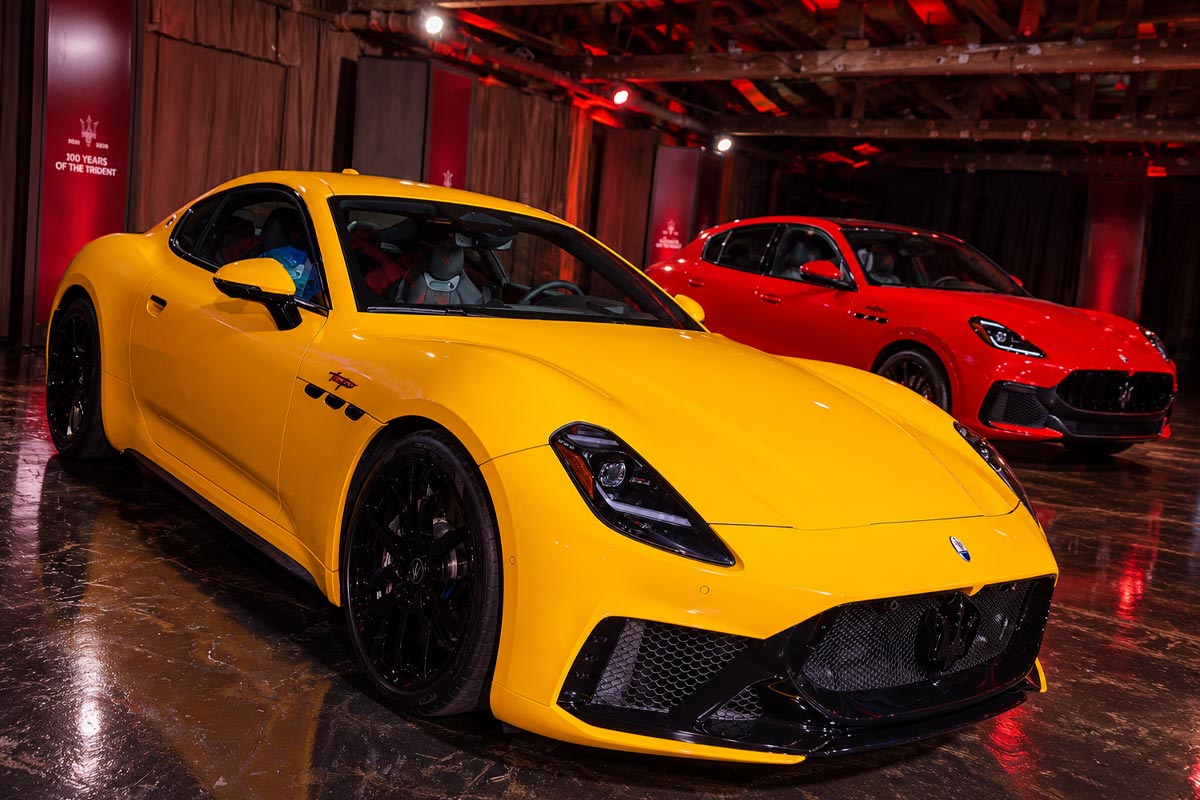
The months go by, and the numbers continue to be staggering at Maserati. As the Italian brand prepares a strategic plan that will be decisive for its future, its new car registrations continue to decline in most of its markets. According to data compiled by Italpassion, Only 3,758 Maseratis were registered between January and September 2026 in the 13 countries surveyed, representing a 38 % decline compared with 2025. Yet, even amid this particularly bleak picture, two countries are still managing to post growth.
The United States, Maserati's largest market, is in free fall
For nearly a decade, the United States was Maserati’s true sales driver—a market particularly fond of large sedans, powerful SUVs, and high-output engines. But those days now seem long gone. With With 1,171 registrations in the first nine months of 2026, compared with 2,432 a year earlier, Maserati’s sales in the United States plummeted by 52% in Q3. This is probably the most alarming figure in this study.
It must be said that the lineup has changed dramatically. The Ghibli, Quattroporte and Levante have disappeared without being replaced. The new ones GranTurismo, GranCabrio and Grecale have clearly failed to make up for these departures. As for the Folgore electric vehicle strategy, it has not been as successful as hoped. On top of that, U.S. tariffs are further complicating the situation.
Maserati is now trying to respond. A special lineup, offering less powerful V6 engines and more affordable prices, was developed for the United States. The New 2027 Vintage Collection, which has been slightly restyled, has just been unveiled to the American press.
But one question remains: Has Maserati truly understood the expectations of American customers? Looking at this market, Italpassion notes that large SUVs and supercars equipped with eight-cylinder engines continue to play a significant role. However, Maserati now relies almost exclusively on its Nettuno V6 for its sporty gasoline-powered models. It remains to be seen whether these adjustments will be enough to reverse the trend by 2027.
In Italy, even electric Maseratis have become invisible
The situation is hardly any more encouraging in the domestic market. With 869 registrations, compared with 1,398 in 2025, Maserati saw a 38 % decline in Italy. But another figure stands out: the number of Folgore electric models. In the Italian statistics on electric vehicle registrations by brand, Maserati does not even appear among the manufacturers listed, suggesting a volume of fewer than 300 units.
Even more telling is the fact that no Maserati appears in the ranking of the 100 most-registered electric cars in Italy between January and September 2026. The Audi e-tron GT, which ranks 100th, has only 114 registrations. This means that no Maserati electric model has reached that threshold. This is a particularly concerning result for a brand that had initially placed a strong emphasis on the electrification of its lineup.
Germany Falls Behind, Japan Struggles to Keep Up
Another cause for concern is the German market. Although Germany is a major market for luxury cars and a key customer for Ferrari and Lamborghini, it appears to be gradually turning its back on the Trident. Maserati registered only 294 cars there in nine months, compared with 531 a year earlier—a 45 % drop. In September, only 11 cars were registered nationwide.
Japan, the third-largest market in our ranking, has managed to limit the damage somewhat, with 460 registrations compared to 578—a 20 % decline.
Elsewhere, the results are just as complicated. Australia saw a decline of 34 % with 143 cars, Turkey a decline of 44 % with 83 units, and Spain a decline of 32 % with 130 registrations.
In France, Only 51 Maseratis have been registered since January, compared with 80 the previous year. A 36 % decline that illustrates the manufacturer’s virtual disappearance from the French market.
There are two exceptions: the United Kingdom and Switzerland
Amid these negative results, two markets are nevertheless managing to grow. The first is the United Kingdom, which posted 347 registrations, compared with 274 in 2025, representing a 27 % increase. This performance is all the more noteworthy given that the country has now surpassed Germany to become Maserati's fourth-largest market among those surveyed.
Switzerland is the second pleasant surprise, with 162 registrations compared with 148, representing an increase of 9 %. These two markets show that Maserati can still attract certain customers, even with its current lineup. However, their sales volumes are insufficient to offset the losses incurred elsewhere.
Maserati now needs to win people over—and fast
Last July, we had already mentioned a 37 % decline in the first half of 2026. Three months later, the trend has not reversed. It is important to note that these The 3,758 registrations refer to the 13 markets tracked by Italpassion and do not represent Maserati's official global sales. But they provide a particularly clear indication of the manufacturer's business situation.
The December 2026 event in Modena is therefore of considerable importance. Antonio Filosa, CEO of Stellantis, recently acknowledged this : «We can no longer afford to make mistakes; we have no other choice.»
New hybrid powertrains, a possible return of the V8, future SUVs and sedans: Maserati will have to come up with concrete answers. Because while the brand is now pursuing a strategy that prioritizes exclusivity over volume, It still needs to prove that it can stabilize its sales before claiming to be able to boost them.
| Country | January–September 2026 | Evolution |
|---|---|---|
| United States | 1 171 | -52 % |
| Italy | 869 | -38 % |
| Japan | 460 | -20 % |
| United Kingdom | 347 | +27 % |
| Germany | 294 | -45 % |
| Switzerland | 162 | +9 % |
| Australia | 143 | -34 % |
| Spain | 130 | -32 % |
| Turkey | 83 | -44 % |
| France | 51 | -36 % |
| Luxembourg | 25 | 0 % |
| Netherlands | 17 | -29 % |
| Austria | 6 | -40 % |
| Total | 3 758 | -38 % |
 English
 French
 Italian
 Spanish
 German
 Japanese
 Dutch