

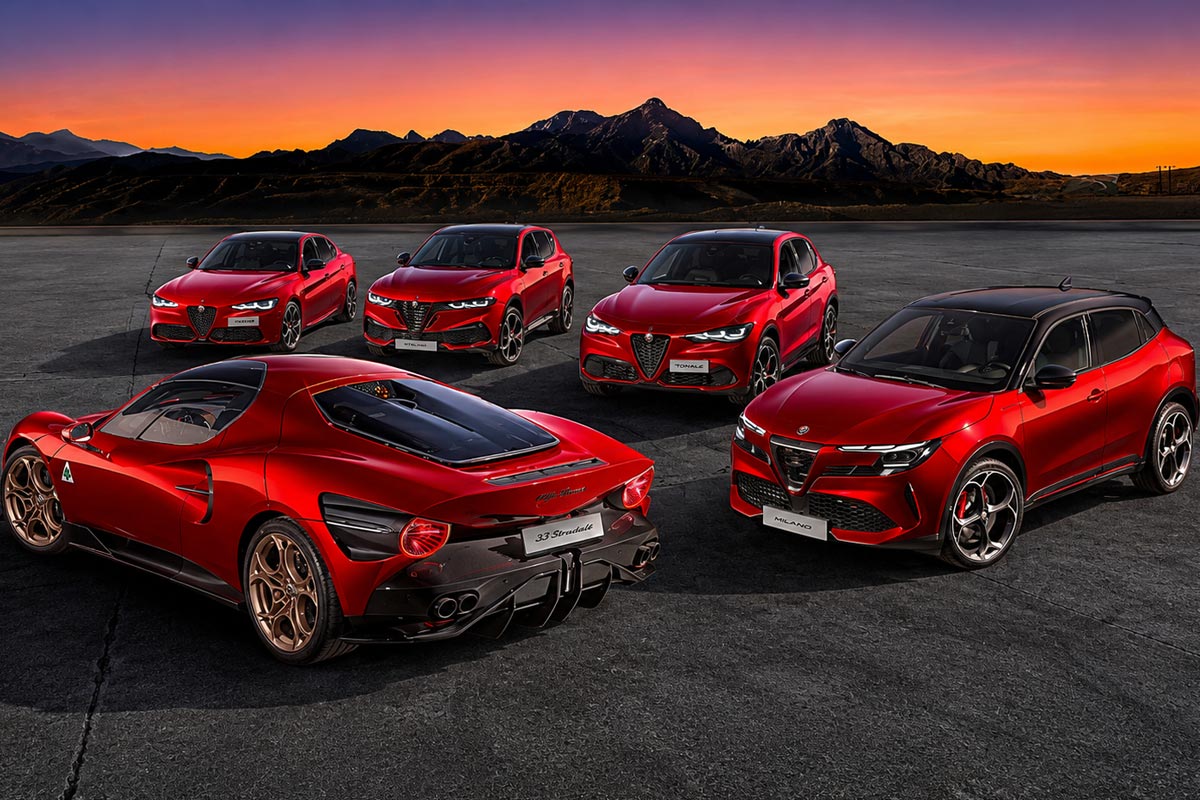
The first half of 2026 has come to a close, and it’s time to take stock of the business performance of’Alfa Romeo. This is a particularly interesting analysis, as several factors should normally have enabled the Italian brand to regain momentum.
It has now been over a year since Antonio Filosa took the helm at Stellantis, about a year and a half since Santo Ficili took over at Alfa Romeo, and more than six months since the Tonale The restyled model is available for order, and it's been two years since the’Alfa Romeo Junior is sold in Europe.
In short, the conditions were right for an initial rebound. So, where does Alfa Romeo really stand? Let’s take a look at the situation country by country.
Italy: Alfa Romeo's Historic Market Is Collapsing
Let's start with the most important thing: Italy. Alfa Romeo's home country remains its largest market worldwide, but the figures for the first half of 2026 are cause for concern.
In the first six months of the year, Alfa Romeo registered 12,882 cars in Italy, compared with 16,819 during the same period in 2025. By comparison, the brand registered 12,173 units in 2024 and 14,612 in 2023.
At first glance, the figure for 2026 might seem to simply reflect a return to 2024 levels. However, the recent trend is much more concerning: May and June 2026 were particularly weak, with only 1,789 and 1,526 registrations, respectively. These figures place Alfa Romeo at the lower end of the range seen in recent years.
A telling sign of this situation: in June 2026, not a single Alfa Romeo model appeared in the Top 50 best-selling cars in Italy.
Specifically, since the beginning of the year, the Alfa Romeo Junior has ranked 41st in the Italian sales charts with 6,506 registrations, including only 231 of the all-electric 100 % models. For the rest of the lineup, the situation is even more complicated: the Tonale, Stelvio and Giulia are not included in the Top 50.
We've said this before last month, and the numbers continue to confirm it: the Tonale, launched in 2022, is a commercial failure. This isn’t a judgment; it’s a fact. The recent facelift didn’t provide the much-hoped-for second wind.
As for the Junior, after two years on the market, the urban SUV already seems to be losing momentum in its main market. As a result, Alfa Romeo’s sales in Italy are down 23 % compared to last year.
United States: The Decline Continues
For several years, the United States was Alfa Romeo’s second-largest market worldwide, thanks in large part to the success of the Giulia and Stelvio. But those days now seem long gone.
In the first half of 2026, Alfa Romeo registered only 1,747 cars in the United States, a 38 % decline compared to 2025. To put this decline in perspective: the brand still had 4,768 registrations in 2024 and 5,570 in 2023 during the same period.
And in the end, there’s really no mystery to it. Alfa Romeo can release as many special editions as it wants, but the Giulia and Stelvio are now 10 years old and have hardly evolved at all. The Tonale has never really found an audience in the United States, while the Junior simply isn’t sold there.
At this rate, a question begins to arise: Will Alfa Romeo be able to maintain a long-term presence in the U.S. market?
Germany: Even the Junior Isn't Enough
Germany has long been an important market for Alfa Romeo. It is a market with a strong preference for sports sedans and SUVs, where the Giulia and Stelvio have succeeded in winning over a loyal customer base.
But here, too, the decline is clear. Alfa Romeo recorded 2,511 registrations between January and June 2026, compared with 3,952 in 2025, 3,708 in 2024, and 3,116 in 2023.
Here are the details:
- Alfa Romeo Giulia: 180 units
- Alfa Romeo Stelvio: 460 units
- Alfa Romeo Tonale: 374 units
- Alfa Romeo Junior: 1,497 units, including 251 electric models
Yes, the Junior is clearly saving the day in Germany. Without it, the numbers would be much more alarming. But that’s not enough to prevent the brand from experiencing a sharp decline. The most striking example remains the Stelvio: for years, it was one of Alfa Romeo’s mainstays in Germany. Today, it is gradually fading from the scene.
France: The Junior Carries the Team on His Own
In just a few years, France has become Alfa Romeo’s second-largest market worldwide. That’s not really surprising, considering that we’re also the biggest buyers of the Peugeot 2008 (just kidding… sort of).
In the first half of 2026, Alfa Romeo recorded 2,882 new vehicle registrations in France. This is lower than the 3,542 units registered in 2025, but it remains higher than the levels seen in 2023 and 2024.
The sales figures speak for themselves:
- Alfa Romeo Junior: 2,291 units, including 1,073 electric vehicles
- Alfa Romeo Tonale: 507 units
- Alfa Romeo Giulia: 49 units
- Alfa Romeo Stelvio: 34 units
The situation in France is therefore very clear: the Junior now accounts for the vast majority of the brand’s sales. Another interesting point: more than one in three Alfa Romeos registered in France is now 100 % electric.
Spain: same conclusion
In Spain, Alfa Romeo has recorded 1,439 registrations since the beginning of the year, compared with 1,681 in 2025.
Here are the details:
- Alfa Romeo Junior: 1,135 units
- Alfa Romeo Tonale: 186 units
- Alfa Romeo Stelvio: 93 units
- Alfa Romeo Giulia: 20 units
Once again, the conclusion is the same: without the Junior, sales volumes would be extremely low.
Other markets: a few rare gains
In Poland, where the Alfa Romeo Junior is manufactured, the brand enjoyed strong growth in 2025. But in 2026, even that momentum already seems to be fading. Alfa Romeo recorded 965 registrations in the first half of 2026, compared to 1,091 a year earlier. Even in its country of origin, the Junior is no longer enough. In Turkey, the brand is also seeing a decline, with 632 cars registered, compared to 812 in 2025.
There are, however, a few exceptions. In Japan, Alfa Romeo is showing strong growth, with 954 registrations in the first half of 2026, compared to 483 in 2025. This increase is largely due to the later launch of the Junior, which has only been available in this market since June 2025.
The same trend is seen in the United Kingdom, where Alfa Romeo’s registrations rose from 1,308 in the first half of 2025 to 1,625 in 2026. Thanks to the Junior, the United Kingdom has now surpassed Spain in sales volume and is even closing in on the United States. But are these gains sustainable, or are they simply tied to the launch of the new model? We’ll find out in the coming months.
In other European markets, the trend remains largely negative or stable:
- Belgium: 807 registrations in 2026, compared with 922 in 2025
- Switzerland: 461 in 2026, compared to 461 in 2025 and 463 in 2024 (Swiss punctuality?)
- Austria: 750 in 2026 compared to 748 in 2025
- Netherlands: 409 in 2026 compared to 542 in 2025
Conclusion: Alfa Romeo is still waiting for its true revival
The results for the first half of 2026 are quite clear: apart from a few exceptions, such as the United Kingdom and Japan—where the Junior is still benefiting from its first full year on the market—Alfa Romeo is losing ground almost everywhere.
The biggest problem is probably the lack of major new models. The cancellation of the new Stelvio and Giulia—originally scheduled for 2025 and 2026 before Stellantis’s shift to a multi-energy strategy—is now taking a heavy toll on the brand. The lineup now relies almost entirely on the Junior, while the Tonale, despite its facelift, has not shown any real sales rebound.
We’ll now have to wait until 2027 to see the successor to the current Tonale, and hopefully a new Giulietta will arrive that same year (or in 2028). As for the Junior, it will likely need an update soon to revive its career.
Alfa Romeo still has a very strong image, but today the numbers reveal the reality: it simply lacks new models to turn that passion into new car registrations.
| Country | January–June 2026 | Evolution |
|---|---|---|
| Italy | 12882 | -23 % |
| France | 2882 | -18 % |
| Germany | 2511 | -36 % |
| United States | 1747 | -44 % |
| United Kingdom | 1625 | 24 % |
| Spain | 1439 | -14 % |
| Poland | 965 | -11 % |
| Japan | 954 | 97 % |
| Belgium | 807 | -12 % |
| Austria | 750 | 0 |
| Turkey | 632 | -22 % |
| Switzerland | 461 | 0 |
| Netherlands | 409 | -24 % |
| 28064 | -21 % |
All the figures in the article above were sourced from Italpassion. Please respect their work and credit Italpassion if you use them.
 English
  French
  Italian
  Spanish
  German
  Japanese
  Dutch
Dutch
The 33 Stradale, while amazing, shouldn’t be overhyped. What Alfa needs is a new Giulietta and a new Spider. Success in the automotive market can’t be achieved overnight; it takes time. I’m a happy Giulia owner and will remain loyal.
I owned a 147 for 10 years.
I chose ALFA ROMEO for its styling, its engines, and its excellent value for the money.
My 147 cost me 15,000 euros in 2002.
These days, a JUNIOR costs about 30,000 euros for a soulless, generic Italian-style engine… so no, thanks.
Same as above: 147, then Giulietta.
The Junior is out of the question. Whenever the salesperson brings it up, I make it clear right away that it’s not an option. By their own admission, it’s sold «to people who need a car,» not to Alfa enthusiasts… It generates sales volume at first, especially in France since it’s a rebadged PSA, but only at the very beginning…
Alfa Romeo is sorely lacking in models, and when they do come out, there’s a good chance they’ll just be Peugeots painted red…
The Junior is a total disaster. For the past few months now, its sales in Italy have been lower than those of the Tonale.
Still, the style is definitely 100% Italian and quintessentially Alfa!
As for prices… aside from the Chinese, what are the others doing?
In that case, should you buy something that isn't Italian—and is even more expensive?… or something from China?.
100% Italian—I doubt it. You can easily spot elements from 2008 on the Junior; you’d have to be being disingenuous to say otherwise.
Oh, and her «dad,» Alejandro Mesonero-Romanos, is Spanish. 😉
It's a design by a team at Centro Stile, but it's based on a 2008 model… with a strong design focus…
A big party that wasn't exactly a success, as we'll all agree.
Yes, especially since at the time, Carlos TAVARES—that sinister cost-cutter—was at the helm of Stellantis!
You can really tell this is the pro-PSA version—it has absolutely no taste ^^
The Junior has literally the same roofline and proportions as the 2008…
I've read various complaints about the very short lifespan of certain parts in different cars—not just Alfa, but across the entire Group 🤷♂️ Are they trying to pull a fast one? Or what?
But it's not "Ital Passion"—it's "Ital Deconstruction"
I go to the Stellantis website to check Alfa Romeo's sales figures, and it's actually the exact opposite.
Besides, when it comes to engine performance, the Alfa Junior isn't without character—by the way, I also owned a 147 for nearly 10 years.
I'm sticking with Alfa, and actually, I'd like to treat myself to the Junior—I think it's gorgeous—but people come up with all kinds of excuses to switch to the competition just to line the pockets of the Germans and the Japanese, pfff, and then they complain.
Ital Passion, you're traitors
Alfa Romeo is constantly changing its strategy—it doesn’t understand the market and can’t do marketing. The Junior is the least “Alfa Romeo” of all the Alfa Romeos (aside from the Veloce model), with uninspiring PureTech engines—and they expect it to sell over the long term?
Alfa Romeo under Stellantis is a disaster. It's disheartening for Alfa Romeo fans.
I don't think Alfa Romeo changes its strategy all the time.
When Stellantis was founded in 2021, the Tonale was the only model in the pipeline.
Tavares, as well as former FCA executives, believed (wrongly) that there would be a major surge in EVs driven by the EU.
The COVID crisis, the flea crisis, and the EU incentives… NOTHING went as planned!
«When Stellantis was founded in 2021, the Tonale was the only model in the pipeline.»
We have no idea about that.
That’s almost certain. There were indeed Giulia and Stelvio PHEVs, but production was halted in 2018/2019 when FCA was looking for a partner—first Renault, then PSA. There was really only the Tonale and nothing else…
Absolutely true
My bad, then
Alfa Romeo is like Ferrari—an electric version is out of the question.
These are cars that have made their engine sound a trademark.
The Junior Poi—oh my goodness, who would buy a Peugeot with the Alfa logo on it?
The other products more or less have a recognizable style and aren't bad, but they're not for everyone given the cost.
That debate is over; there will be electric versions, and that's a good thing.
The program is almost the same, except that there is a lot of thermal power generated by the hybrid system to meet demand.
This causes programs to fall years behind schedule.
But not really any major changes… just an adaptation.
Stellantis is ONLY 5 years old!
Five years is more than enough time to develop synergies, especially if—as is the case with Stellantis—you do just the bare minimum.
Raw sales figures are meaningless. Alfa Romeo was selling over 200,000 units in the early 2000s, yet it still didn’t earn a single penny for the Fiat Group.
Junior really has no say in the brand's survival. I'll wait for the Giulietta.
Maybe this isn't interesting to you! Still, it's good to know which models are selling and which aren't—which ones are selling as electric versions, and so on. Thanks for the time I spent gathering these useless numbers.
I mean that these numbers are meaningless when it comes to Alfa Romeo's survival. As for your page, I think you're doing a great job. No clickbait, fake news, or baseless speculation.
Thanks! You know it takes a lot of work to write this kind of article, and not many automotive media outlets are doing this anymore…
Keep up the good work, and let's hope Alfa survives...
Thank you so much for your work, Alexandre!
ItalPassion is THE go-to spot for enthusiasts like us, and we have you to thank for that!
Respect 💪🏻
The Alfa models designed during the Stellantis era need to hit the market soon to save the brand!
Well, given the Junior's sales figures, I'm not sure that's the case.
Exactly. It barely reached 50% of its projected sales, and the numbers are already falling….
No automaker is meeting its sales targets… AND certainly not under FCA! Have you already forgotten recent history?
zafira500, given the current sales figures, only the Stellantis models can save the brand… Can you read the numbers?
They still sold more than their Stellantis successors. For example, the Fiat 600 is a disaster compared to the 500X. The Junior doesn’t even come close to the Mito and Giulietta. And comparing its sales to those of the Giulia and Stelvio doesn’t make sense, since they’re D-segment cars. It’s like comparing the sales figures of a BMW with those of a Ferrari.
And let’s not forget that Imparato, Tavares’s right-hand man, was the one who canceled the Giulia and Stelvio PHEV models, which were set to debut in 2022. They would certainly have boosted their sales figures.
Yes, I can read numbers. And even compare them. And apparently, I'm not the only one (see our friend Lukasz's comment).
Now, being the brand’s best-seller doesn’t necessarily mean it’s a success. You have to compare it to the brand’s projected sales figures. If Alfa Romeo plans to sell 20,000 units a year but only sells 10,000, well, sorry, that’s not a success.
The Junior is Alfa Romeo's best-selling model, so it's no surprise that it outsells the other models. But sales are plummeting, and there's a reason for that.
Well, Lysander, instead of making a fool of yourself in every article, why don't you tell us what you're driving right now and how many Alfa Romeos you've owned?
Stellantis is indeed the main cause of Alfa Romeo’s decline. It’s incomprehensible that major automakers like Stellantis were unable to deliver a competitive hybrid powertrain for the Stelvio and Giulia several years ago. Such as a good PHEV that can compete with the Germans. In terms of body design, both the Stelvio and the Giulia are still beautiful cars, but their powertrains are completely outdated.
If you can read the numbers and the articles, you'll understand that it's actually the exact, complete opposite!
I'm sorry for you, but that's just a fact…
It's interesting to note that only the new model launched by Stellantis is keeping the brand afloat; the models so beloved by the brand's die-hard fans aren't selling.
Given the sales figures, it clearly didn't save anything at all. And if the other models aren't selling, it might be because they're too expensive, underpowered in some cases, or don't offer a complete lineup. Oh, right, I almost forgot—they might also be more high-end.
I’ve owned seven Alfa Romeos in the past, and I’d really like to have a Junior. The exterior looks great, but I find the abundance of hard plastic on the dashboard and doors disappointing. My current 2008 GT mild hybrid has a much nicer interior finish, even though it’s technically almost identical. Who knows—if they improve that aspect, I might get back into an Alfa…
As long as they keep selling stuff like my Tonale Q4, phev, ………..🤮
Unfortunately, this is a tragic series of events for Alfa Romeo, stemming from a global crisis.
It started with COVID-19 lockdowns bringing economies to a standstill. Then came Europe’s senseless «Green Deal» electrification mandates, followed by Carlos Tavares’s brilliant decision to make Alfa fully electric by 2027. Add to that the war in Ukraine and the Nord Stream explosion—which German prosecutors now link to Ukraine.
Consequently, the German auto industry is collapsing due to high energy costs and competition from cheap Chinese electric vehicles, dragging Europe down with it. To make matters worse, the orange clown’s war with Iran sparked a crisis in the Strait of Hormuz.
Alfa is just collateral damage. It won't survive.
To be precise, the list price for a 147 1.6 TS with 105 ch started at 16,700 euros. As for the features, it didn’t even have air conditioning, so it’s not really comparable to a Junior. In today’s euros, that’s about 25,000—24 years later. So yes, the Junior is more expensive on paper. It remains to be seen whether the 145ch mild hybrid and the better equipment justify a 5,000-euro price difference compared to a base 147. In terms of performance, the Junior is ahead, as it is in comfort. That leaves the «sound,» where the 3-cylinder PureTec just can’t compete.
In 2002, for 15,000 euros, my 147 came with air conditioning, a CD stereo, and—as a free customization—red-backlit gauges, as well as the Rosso Alfa paint job for zero euros.
In terms of performance, for an engine that is over 30 years old, its top speed is 190 km/h, compared to 205/206 lm/h for the JUNIOR.
0 to 100 km/h in 11.5 seconds compared to 8.5 seconds for the JUNIOR……but there’s a gap of more than 30 years.
So yeah, the TS engine guzzles gas if you have a heavy foot, but what a sound!!!
You can't compare the price of a car from 20 years ago with the price of a car today. There's inflation, very different features, additional safety features, and so on…
Cars have become more expensive, and there are reasons for that—even if, for example, we don't like driver-assistance features and too much electronics.
As long as they follow Stellantis’s—and therefore French—brand strategy… there will be no future for Alfa…The latest successes are the Stelvio and Giulia, which Marchionne strongly pushed for… They don’t sell anything—just heavy, useless behemoths—and they’re bland, soulless, and heartless with their French engines… As an Alfa fan, it’s a real shame.
Otherwise, more generally speaking, Alfa’s decline doesn’t surprise me all that much. It’s been 12 years since anything substantial was done for this brand in terms of mass-market products (i.e., since the Giulia/Stelvio duo). Those who thought they could quickly repackage a Jeep as an Alfa SUV had already gone down the wrong path (the Tonale), a strategy continued by the new team with the Junior (though in that case, it was a rush job).
That's definitely it.
A decade without any serious innovations, and then people act «surprised»…
Well, I bought the Junior because it won me over and I wanted an electric car in that size. In the past, I always bought Alfas, Lancias, and Fiats... I realize that current regulations and the market will never bring back the old days, which is why the entire auto market is in crisis. Comparing the price of a Junior to a car from 2002 is unrealistic. Would a writer today even work for a 2002 salary? Thanks to Alexandre for compiling the information; it’s always the same people who see a forum as a «safety valve»—unfortunately, for whatever reason. That doesn’t help anyone get anywhere on this issue!
Alfa? No way—the brand has already disappeared since Stellantis took it over and finished it off. Just Peugeots in disguise with a badge and crappy engines—and you’re surprised? Chronicle of a death foretold—it’s a brand that’s now…to the past now, with a lineup of beautiful cars with real soul—not those bland, soulless cars, battery-powered to boot. I’m keeping my Giulietta; who knows, in a few decades, it’ll be worth its weight in gold!
I completely agree—the Italian cars should never have been brought under the Stellantis umbrella. So many bad decisions—what’s left of the Italian auto industry? Almost nothing. They’re surviving on just a few models, whereas there used to be a whole lineup of great cars. The new Alfas are indeed just Peugeots with different badges. They’ve lost all their emotional appeal, and true Alfa enthusiasts aren’t going to buy them.
That's true … Blindness hits some people especially hard.
They draw conclusions that are the opposite of what the articles explain.
I’ve owned a Stelvio since 2022, and the brand’s only problem is its after-sales service network, which doesn’t work—its dealerships don’t offer the expertise and services you’d expect, and the emergency hotline is ineffective.
I’ve been an Alfa Romeo fan for 20 years—156, 159, Mito, Giulia—but I’ve had to move on. I’m passionate about the brand, but I feel betrayed. And the ones primarily responsible are our Italian friends, who were unable to offer products in line with today’s reality. And the French at Stellantis just had to give it a little nudge (the Junior) to finish it off. Now it’s too late. Just like with Lancia and its horrible Ypsilon. It’s a complete mess. A legacy destroyed.
Just like Lancia, given the current economic climate and the intense competition in the auto market from Chinese manufacturers, can Alfa and Lancia still survive?