

Since Antonio Filosa took over as head of Stellantis, the group appears to be gradually redefining the role of each of its brands. Officially, no new organizational structure has been announced. However, several signs point to a clearer repositioning, particularly among Peugeot, Fiat, Opel, and Citroën.
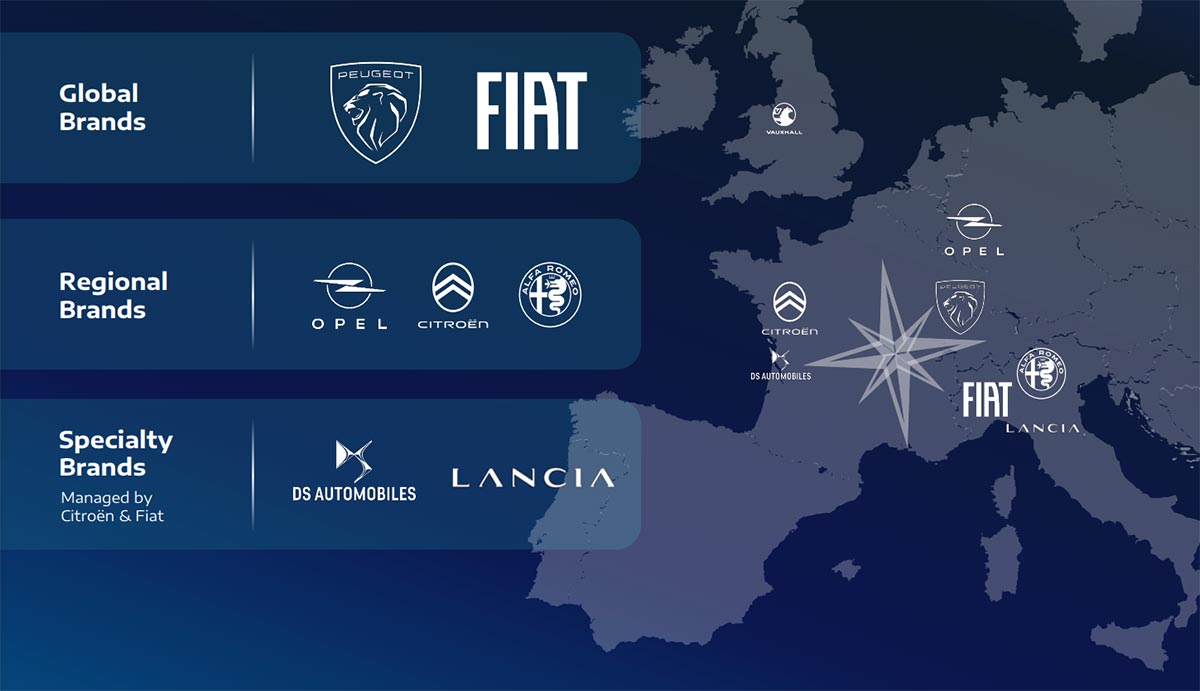
During the presentation of the FastLane 2030 plan, Antonio Filosa highlighted four global brands: Fiat, Jeep, RAM, and Peugeot. In Europe, the strategic quartet consists of Peugeot, Fiat, Opel, and Citroën, while Lancia is now managed by Fiat and DS by Citroën. Alfa Romeo and Maserati, for their part, are set to evolve as standalone brands.
Borders That Have Become Blurred
The problem is that, in recent years, the positioning of Stellantis's mass-market brands has become much more similar. Fiat Grande Panda and the Citroën C3 share the same technical platform. Fiat Grizzly, the Citroën C3 Aircross and the Opel Frontera are in the same class, while the Peugeot 3008 and the Opel Grandland are also very similar.
Added to this is the upcoming E-Car project, which is to be a joint venture between Fiat, Citroën, and Opel. Under these circumstances, it’s hard to understand what truly sets each brand apart beyond its country of origin.
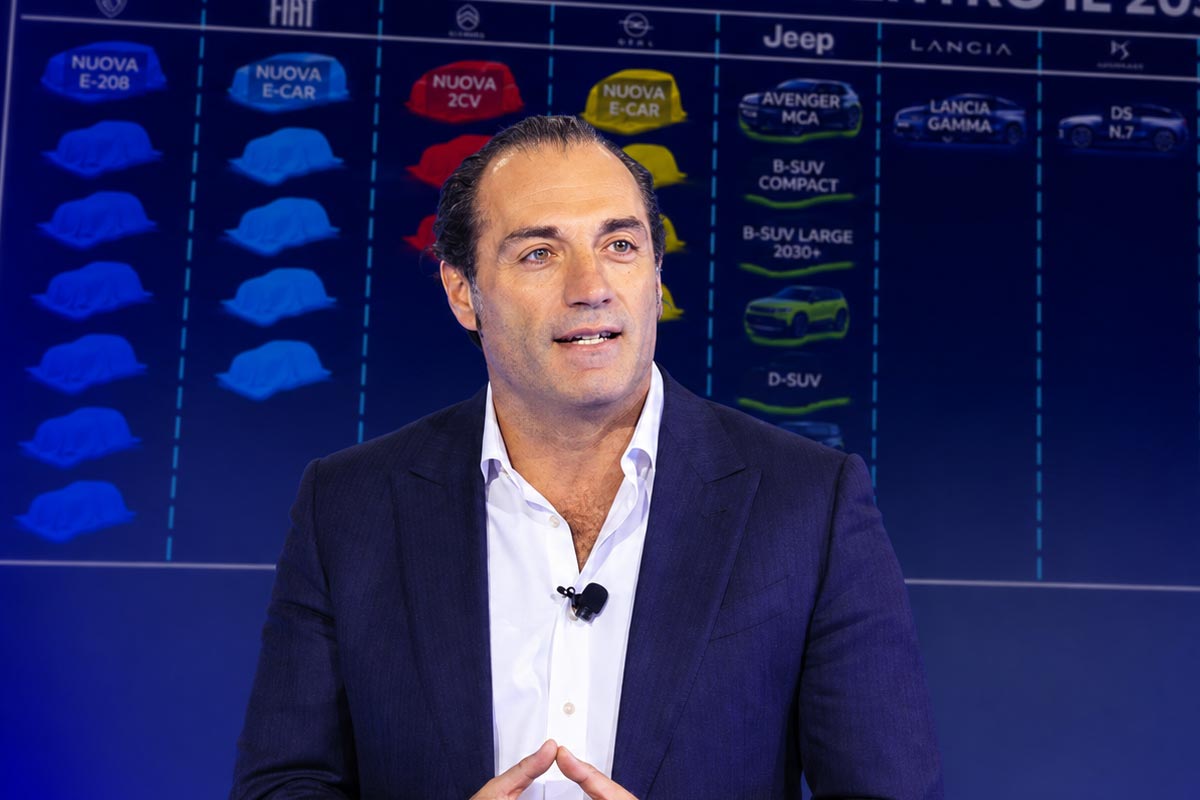
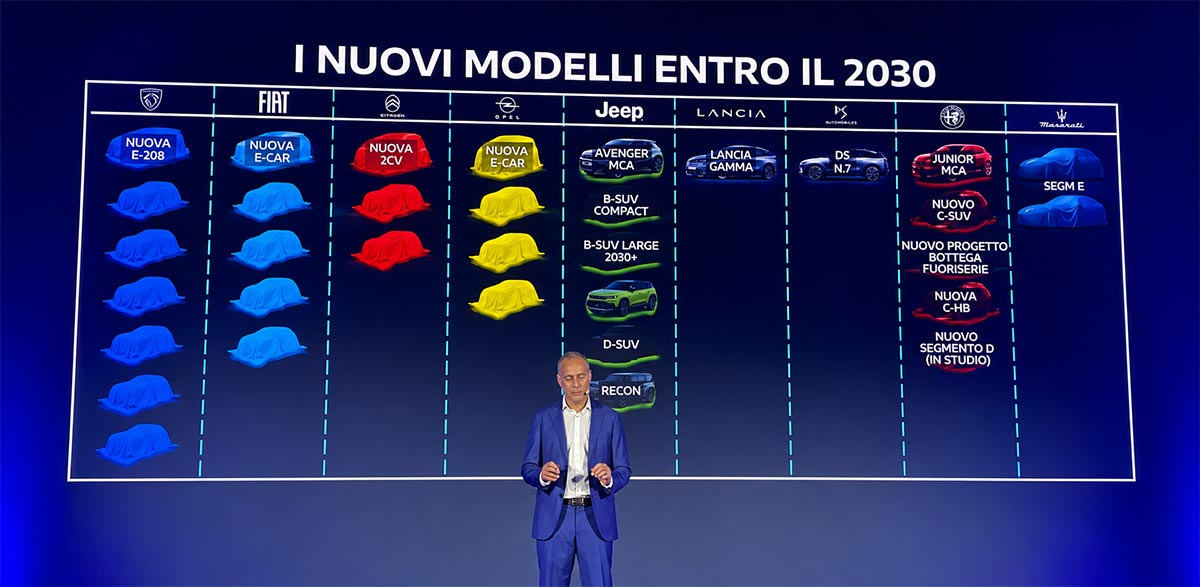
However, a recently unveiled internal presentation offers a first clue. It reveals a lineup of seven models for Peugeot, five for Fiat, four for Opel, and only three for Citroën. This disparity strongly suggests that the priorities are no longer quite the same.
Brazil may hold the answer
The real key to understanding the situation might ultimately come from… Brazil. In an interview with AutoData, Herlander Zola, president of Stellantis South America, acknowledged that the strategy launched in 2021 for Peugeot and Citroën in Brazil had not met its targets. The group is therefore working on a much more assertive repositioning.
The idea is simple: Peugeot will have to position itself in a segment above Fiat, while Citroën will occupy the segment below, with products geared more toward affordability. «I’d rather sell fewer units, but with a balanced approach and without losses, than sell a lot while losing money,» the executive summarizes. This approach is primarily aimed at avoiding overlap with Fiat, which remains Stellantis’s most important brand in South America. Peugeot and Citroën will now have to operate as complementary brands rather than competitors.
This repositioning could also be supported by a strengthened partnership between Stellantis and the Chinese automaker Dongfeng. The two groups are already working on a new generation of electrified vehicles for China and are also exploring opportunities for collaboration in Europe. But these discussions also involve South America.
Herlander Zola confirmed that, eventually, Peugeot or Citroën models developed as part of this partnership with Dongfeng could be sold in Brazil. No timeline has been set, but the executive believes that this alliance will provide the means to «reposition Peugeot and Citroën in a different way» while improving their competitiveness.
While this strategy is currently being discussed in relation to the South American market, it could well reflect a broader approach within Stellantis. The directions outlined in the FastLane 2030 plan, the model lineups in the works, and statements from Brazil all seem to tell the same story: Peugeot is stepping up its game, Fiat is maintaining its role as a mainstream pillar, while Citroën is moving toward a more accessible lineup.
 English
  French
  Italian
  Spanish
  German
  Japanese
  Dutch
Dutch
It's a shame to drag Citroën down like this. It's the only brand in the group with a good global image! Pigot has become very overrated, and Fiat—outside of South America—still has a decent image. As for Lancia, Alfa, or DS, they're a lost cause. .
On what basis is Citroën the only brand in the group with a strong global image? It is far from being one of the group’s best-selling brands and was recently withdrawn from Australia, one of the last major global markets where it was still present…
Oh, really? Does Citroën have a good global image? Then explain to us why sales aren't as «good» in that case, given that the brand is essentially focused on Europe.
Sales and image… That explains why Porsche sells fewer cars than Citroën, even though, image-wise, they’re in a league of their own!
Citroën’s global image is very distinctive and linked above all to its distinctive older models. But the facts are clear: the brand is consequently much better known than Pigot or Dodge. And I’m not talking about DS or even Lancia (even though I’m a fan, I know that Lancia is virtually unknown worldwide because it has always been far too focused on Italy).
It's a real shame to turn Citroën into something like Dacia.
Because Porsche is, at its core, a sports car manufacturer? A specialized premium brand? Comparing Porsche and Citroën is ridiculous.
Oh, and Porsche has an international reputation that the chevron brand doesn't have.
Citroën's "Dacia" models were the 2CV, Visa, LNA, Axel, and AX. Citroën wasn't just about the DS or the CX.
As for the comparison with Lancia, see Porsche.
There is nothing ‘awful’ about Cit’s positioning because it is IDENTICAL to what it has been in the past.
All brands share the same technical foundation, so they cannot be placed in different segments.
It seems to me that Citroën is already a step behind Peugeot in terms of build quality. Then again, they share everything—chassis, engines, etc.
To stand out, Fiat needs at least the return of the FireFly engines. Let’s leave the PureTech engines to the French brands—that way, the brands can differentiate themselves.
When it comes to electric cars, it’s a shame to see the same motors, chassis, multimedia systems, cheap plastics, and buttons used across the board (Alfa Junior, Lancia, Fiat and Abarth 600e, Peugeot e-208, etc.)
I bought a 508 sedan for 13,000 euros, but it’s been nothing but problems. Now it’s costing me 26,380 euros at Peugeot. This is crap, and yet Peugeot knows about the problems but doesn’t care. It’s shameful.
Stellantis will have to reposition its brands in a completely different way.
Citroën and Peugeot, on the one hand, with their own in-house development, and FIAT/Abarth, on the other, with their own in-house development. Opel can then take elements from both and put its own unique spin on them.
Maserati, Alfa Romeo, and Lancia are to be completely spun off and will continue to operate under the Ferrari umbrella.
Stellantis has gold in its hands, but lacks the craftsmanship to turn it into jewelry.
First, you should define the segments you want to target and identify the competing brands, then assign your own manufacturer brands to them and stick to this strategy consistently. For example: Alfa Romeo vs. BMW, Peugeot vs. Mercedes, Citroën vs. Audi, Opel vs. Volvo, Maserati vs. Porsche, and Fiat vs. Škoda. And then these brands must be equipped with features that allow them to stand out—for example, special Alfa engines, technical solutions unique to Citroën, comfort features that Peugeot particularly emphasizes, or simple, clever solutions that make Fiat something special.
Very well said
How can you create a hierarchy when they share absolutely EVERYTHING?
The same platforms, the same chassis, the same powertrains available in the same power ratings? Even the styling is similar.
This ranking is ridiculous, given that they share platforms—especially since, in Europe, each brand is strong in different markets.
Yeah, it’s hard to make sense of it, but they could do something about it if they wanted to. We’ve seen the Bravo/Brava, the Alfa 145/146, and the Delta II—they share the same technical platform as the GTV and the Fiat Coupé, but they don’t look alike at all, and each has its own style.
Hmm... do you really think a C4 and a 600 look alike? Sure, the C5 AC and Grandland on one hand, or the C3 AC, Frontera, and Grizly on the other, are practically clones (only the exterior body panels differ), but an Avenger and a Mokka don’t look anything alike.
I’m renting the Alfa Romeo Junior Ibrida again in Italy. It’s practically the same car as the Fiat 600 hybrid that I also rented two months ago. The suspension is too soft, the steering is imprecise, and if you brake a little too hard, the car dives (more than usual); the plastics feel cheap, and it has the same multimedia screen. I think this Junior Ibrida is unworthy of Alfa Romeo; a Giulietta is 100 times better in every way. Alfa Romeo is taking a step backward with cars like the Junior (except for the Veloce version).
Thank you, PSA and Tavares.
You're right—you're absolutely correct. Savvy buyers know that, beneath the surface, these brands all share common components, chassis, and engines. Only the exterior and interior designs are different.
This “rebranding and relaunch strategy” is just another way of throwing money at outdated European brands that the world no longer wants.
And above all, if Peugeot moves upmarket relative to Fiat and Citroën, then DS and Lancia will no longer be of any interest…
Clearly, the goal is to sideline DS and Lancia.
Moving upmarket doesn't mean becoming a premium brand. Peugeot will simply be a bit more upscale than Fiat and Citroën, but it won't be on the same level as the BAMs, for example.
Good afternoon, everyone!
Zola said this because Peugeot has always been a resounding failure in our market, and this is Stellantis's latest desperate attempt to save the brand here, given that it is currently completely squeezed between Fiat and Jeep.
I think it would be better if Peugeot actually left South America.
Citroën already occupies the entry-level segment, Fiat leads in sales volume, Jeep covers the SUV market, Ram rounds out the lineup with its pickup trucks, and Leapmotor has entered the market with electrified models. These five brands are already highly integrated.
It would be smarter and more profitable to invest here in a premium brand like Alfa Romeo or Lancia.
It's a shame they didn't keep the Italian cars' original engines, which were really good—after all, Italian car enthusiasts buy these cars for their original engines, not those lousy Peugeot PureTech engines and the like.
Not just enthusiasts. Anyone with even a basic understanding of the subject.
If Alfa Romeo, along with Fiat and Lancia, continue to use these uninspiring engines, these brands will become a thing of the past. An Italian car needs more than just a pretty design.
.
Poor old Citroën
My first car was a 1939 Avant Traction; my last and favorite is a 2015 Grand Picasso.
Both were relatively troublesome but also lovable, comfortable, and economical. Like beautiful ladies, I could happily live with them. Vive la différence! Mike. Xxx
Finally, some coherent thinking.
Ideally
Peugeot/Chrysler – upper mainstream – VW or Hyundai
FIAT – sub-premium small cars – MINI
Citroën – entry-level – Dacia
Dodge/Vauxhall/Opel – upper mainstream sporty – Cupra
JEEP – a premium SUV, while other brands could focus on CUVs, leaving JEEP to position itself as ‘the off-road brand.’.
Alfa – entry-level premium sports cars – Lotus and Alpine
Lancia – premium – high-end Mercedes and Bentley.
Brazil is a special case and cannot be held up as an example. In Europe, Fiat is present only in the small car and light commercial vehicle segments, and its brand image is very weak. If Brazil is their model, we might as well shut down Alfa, Lancia, DS, and Maserati right away. Still, I get the impression that this team is superficial—very superficial—at least when it comes to communication.
You can shuffle the brands around however you like. The question now is how—or rather, whether—buyers will buy into it. It takes decades to establish a market position; right now, it’s a matter of survival. One goes under, while another survives at its expense. I very much doubt that there’s still enough time and money left to play the positioning game.
I bought a Fiat Grande Panda La Prima Electric, and I regret it. I’m on a 3-year lease. It’s not even a year old and already has several safety recalls. The battery range is decreasing. And since yesterday, I can’t charge it anymore, and the mechanic doesn’t know why, so I’m stuck without a car. Thanks, Stellantis
Citroën has never really sought to compete with (primarily German) brands, but has instead focused on offering a comfortable alternative.
It saw Renault as its only competitor.
It was and still is, just like SAAB and Alfa Romeo, a brand for enthusiasts (and connoisseurs?).
Peugeot was and is known as ‘the French VW’... a car for the people.
Nothing "premium" or "high-end"—which is a ridiculous way of putting it anyway.
The ELK brand has its own target audience, followers, and fans.
A Mercedes driver wouldn't want to be found dead in a FIAT, and Ford drivers won't buy a Chevrolet.