

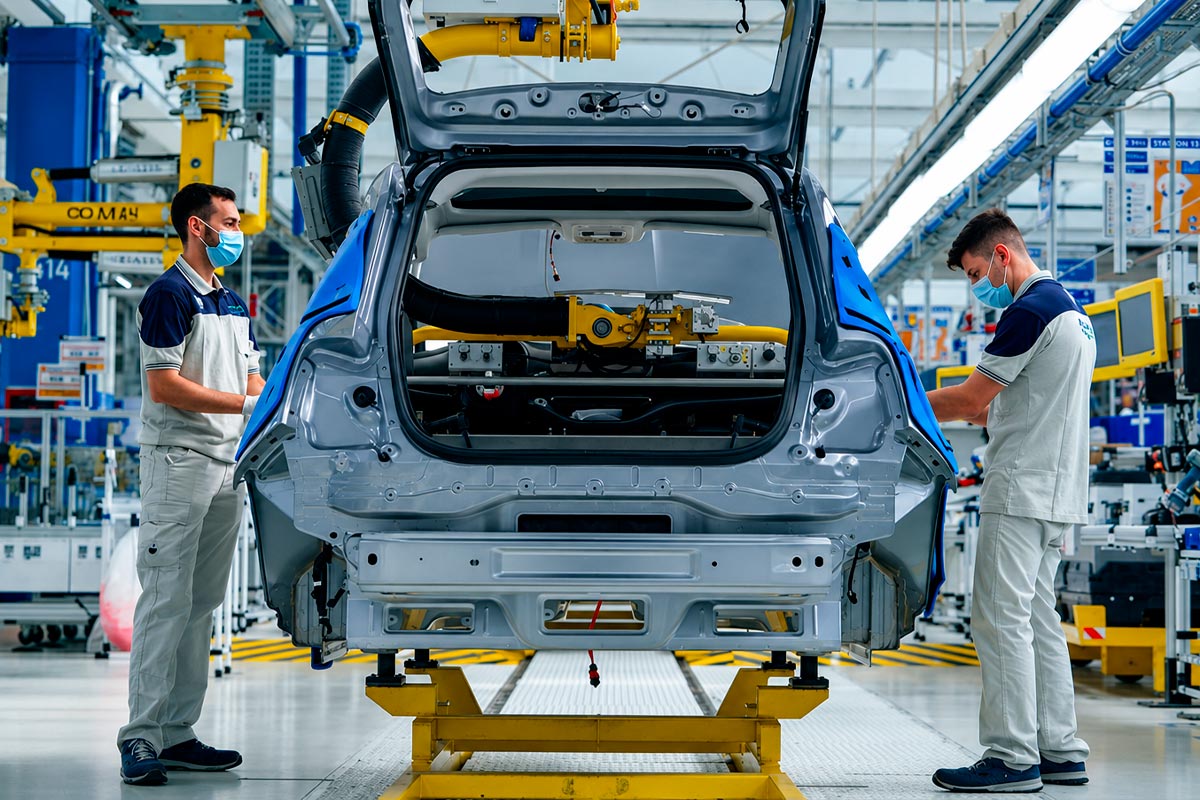
While Stellantis Although it has seen an increase in sales on the Italian market, the atmosphere remains particularly tense at Mirafiori. The Turin plant, which was supposed to get back on track thanks to the new Fiat 500 hybrid, is once again going through a period of uncertainty. Between weeks of downtime, extended vacations, and reduced production volumes, the employees interviewed by the local media outlet Torino Cronaca have drawn a troubling conclusion: many fear the return of short-time work.
Just a few weeks ago, we were already discussing the first warning signs. Production targets seemed difficult to meet, and several unions were already calling for the introduction of a second model to secure the plant’s industrial future. Accounts gathered outside the workshops now show that these concerns have become widespread throughout the factory.
«We realized that something was wrong»
At Gate 2 of the plant, during the shift change, several employees agreed to speak with reporters. Many pointed out that the Fiat 500 Hybrid—which is supposed to revitalize Mirafiori—is based on a model that has been around for several years. «Yes, there’s a new engine for the 500 Hybrid, but the model is already more than six years old,» explains one employee. «We’ve always said that wouldn’t be enough.»
Some people thought that production difficulties wouldn’t arise until the end of the year. In reality, things happened much sooner. The number of weeks of downtime increased, additional long weekends were added to the calendar, and the summer vacation was gradually extended.
«When we were told that we wouldn’t be working on Saturdays, that was the first warning sign,» says another employee. «Then came the long weekends and weeks-long closures. That’s when we realized something was wrong.»
«The nightmare of short-time work is back»
What worries employees the most is not just the sales figures for the Fiat 500 Hybrid. Many are particularly concerned about a widespread return to short-time work, which has already affected Mirafiori in recent years.
«We had hoped that this year would finally allow us to emerge from the nightmare of furloughs. Today, it feels like it’s knocking on our door again.»
Another worker sums up the general sentiment: «We’re very worried. A fourth week of shutdown has been announced for the summer. A situation like this would never happen with a product that actually sells. » For many employees, the lack of ramp-up is the main problem. When a new model is launched, factories typically operate with overtime and Saturday shifts. At Mirafiori, exactly the opposite is happening.”.
Young Temporary Workers Face Uncertainty
Concerns center particularly on the many temporary workers hired in recent months. Several contracts are set to expire at the end of July, and no one knows whether they will be renewed. One young employee explains that he had already anticipated this possibility when he was hired. «I know how the job market works these days. If things don’t work out here, I’ll have to find something else.»
Others are even more fatalistic. «We’re all worried because jobs are hard to come by,» explains a temporary worker. «We’re afraid there will be another round of furloughs.»
Even the longest-tenured employees share this sentiment. One employee who has been with the company for nearly thirty years believes that the factory has «changed a lot—mostly for the worse.» Another, who is about to retire, says he is especially concerned for the younger generations. «I’ll be retiring soon. But when it comes to the young people, yes, I’m very concerned.»
«Without another model, this won't be enough»
The message that comes up most often in the testimonials is that of a second model. For many employees, the Fiat 500 Hybrid alone cannot secure Mirafiori’s future. «Without another model, the young people who have just been hired won’t be able to stay on.»
Some go even further. One employee says the drop in production volumes comes as no surprise: «When the new Fiat 500 came out, we thought we’d be producing a lot. But the reality is that volumes are constantly falling. There are no new models here. » One of them goes so far as to mention the risk of a gradual closure of the plant: «It’s a matter of math. In five years, a large part of my generation will be gone.»
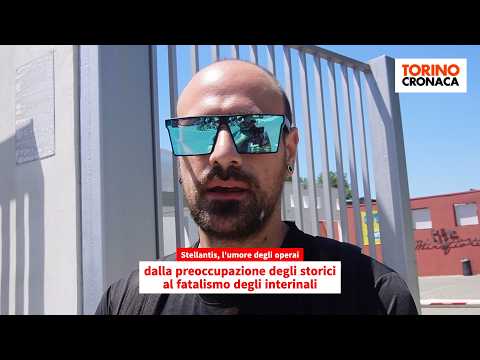
The unions are now calling for an urgent meeting with Stellantis to get answers regarding hiring, production volumes, and industrial plans for Mirafiori. Because behind the sales figures and production targets, it is above all the future of several hundred young employees that is currently causing concern among workers at the Fiat 500 plant.
 English
  French
  Italian
  Spanish
  German
  Japanese
  Dutch
Dutch
Who's surprised?
Tavares did everything he could to kill off the 500 and replace the rest of the lineup with rebadged Peugeots. Obviously, Italian production is suffering. How could it be any other way?
My personal opinion is that the 500 quickly became outdated in terms of battery life (range) and failed to offer a competitive range-to-price ratio. The hybrid powertrain is making a comeback, but ultimately, for €20,000 in the A-segment, customers are paradoxically turning… toward electric vehicles. The 500 needs to make a comeback with either a true hybrid (capable of truly driving 100 % on electric power) or a truly competitive 100 % all-electric version (with a larger, less expensive battery).
It's true, the 500 was just right in 2020… but already too expensive.
Unless I'm mistaken, it wasn't Tavares who wanted only the electric 500; I've heard him say that several times.
He was the one who wanted a hybrid, after all!
Nevertheless, the 500 did well for three years… despite its price.
Unsurprisingly, in 2024, the EV market was evolving rapidly; it had already been completely outpaced by the competition, and Tavares was critical of its production costs.
The all-electric 500e was indeed a decision made by FCA, carried forward by Stellantis, which—at the time of the 600e’s launch—had clearly stated that they did not want to produce any internal combustion engine models, only electric ones. I still remember Fiat’s Head of Product telling me, «We know how to do it, but we don’t want to.»
There was an «all-electric» trend in the air… driven by the EU.
There were no real incentives like there were in China, and oil prices remained extremely low for a very long time. Since EVs were neither mature nor affordable, why would people have switched over any faster?
Tavares felt betrayed by the EU’s initial announcements… Thank goodness PSA’s platforms were multi-energy!
Yes, they did explain to me that they were counting on purchase incentives similar to those in France throughout Europe (which didn’t happen) and over a longer period (which didn’t happen either). But then again, launching a new product based on subsidies is always very risky…
«Unless I'm mistaken, it wasn't Tavares who wanted only the electric 500; I've heard him say that several times.»
No, the decision was made before the merger. It was Olivier François who had mentioned it.
But after the creation of Stellantis, Tavares was responsible for the entire group, including both the former FCA and former PSA divisions. The decision not to launch the 500 hybrid sooner was also his fault. You have to adapt to market realities.
«Carlos Tavares confirms that the new Fiat 500 hybrid will arrive sooner than expected»
https://www.italpassion.fr/fiat/carlos-tavares-confirme-que-la-nouvelle-fiat-500-hybride-arrivera-plus-tot-que-prevu/
It was 2024, which means they'd been working on it for a while.
The concept for the electric 500 100 % was originally developed by FCA.
It's easy to criticize the electric Fiat 500. Sure, it's too expensive, but it's a lot of fun to drive, has a great build quality, and is an ideal city car. Should they put in a bigger battery?
Apparently, this is a problem for all small cars (Alfa Junior, Ypsilon HF, Alpine A 290, Renault 5 E-Tech, etc.).
As for the Fiat 500 hybrid, I can't wait to drive it.
Produce another car at Mirafiori? Yes, but which one?
Perhaps we should avoid systematically moving production to Poland in order to increase production in Italy. But that’s the Tavares legacy.
Personally, I’m not criticizing either the electric 500 or the hybrid 500—I liked both of them. I think—and this is just my personal opinion—that the electric 500 simply has a very poor range-to-price ratio, and the 500 Hybrid, in the A-segment, may now be out of step with the times, since in this segment, people might be looking for electric cars that are less expensive…
There’s a pricing issue with the Fiat 500e—that much is clear. As for range, I don’t know of any small car with good range. I understand that this can be a barrier to purchase, but it’s the same for all the competition, starting with the Renault 5 E-Tech.
On the other hand, I believe hybrid cars are still relevant in the market, especially since the 500 Hybrid is competitively priced.
I’d also like to add that Renault is releasing the Twingo E-tech—which is certainly cute—with a 27.5-kW battery.
In other words, this new Twingo E-Tech is unsuitable for anything other than city driving or short trips.
Apparently, city cars and compact cars don't have enough space to fit a battery that offers a reasonable range for highway driving or slightly longer trips.
Unless I'm mistaken, it's worse for the first models of the electric 500, and they're even more expensive.
@Stanislas
It's TOTALLY impossible to say that this is the Tavares legacy.
That's FCA's 100 % legacy!
You're writing alternate history!
Tavares' legacy is much, much worse. Take the DS N8, for example. In the first half of this year, it sold only about 2,000 units!!!!!
It's fun to switch from the Fiat 500 to the DS No. 8. 🫢
2,000 copies in a semester… that’s not so bad, especially since there have already been some improvements.
Although it was a bold decision to launch the 500 as an all-electric vehicle, it made sense given the availability of EU subsidies at the time.
Its initial sales figures were exceptionally strong. There were even plans to increase production to 100,000 units a year.
When the governments cut the subsidies, Tavares failed to adapt, and has done nothing to address the worsening situation of the 500e.
2,000 units in a semester is actually a massive disaster for a luxury car. It’s worse than the Lancia Thesis case.
Even Maserati sold more units of the older, more expensive Grecale.
Selling 2,000 units after 2020 in the automotive industry, in the luxury segment… is that a fiasco???
Honestly, I don't know.
Does the A390 perform better?
Be careful—these aren't BAMs… you have to compare like with like.
As for the DS No. 8, they've had production delays and some teething problems; everything's been sorted out with improvements… so let's wait and see!
Especially since the DS No. 8 is an upgraded version of the e-5008, sharing three-quarters of its components… Since the e-5008 has been a real success, this is great for synergy—not to mention the other clones.
It has its advantages!
I'll write here, because I can't reply to the comment below.
The DS N8 is a premium car, not a luxury car (my mistake in the original comment), and objectively speaking, 2,000 units is a terrible result for a premium car, whether it's an EV or not.
I wouldn't call the A390 comparable, since it's more expensive and caters to a more niche market than the «mainstream» premium DS N8.
The DS No. 8 starts at 60 k€ and goes up to 75 k€.
The Alpine A390 starts at 67 k€ and goes up to 78 k€.
One focuses on comfort and build quality, while the other has a sporty feel… they’re complementary offerings, but their prices are fairly similar.
How many DS 9s did they sell per quarter previously?
And neither of them is doing very well, but I’d say the A390 has the edge.
So, since the DS9 was such a massive commercial flop—to the point that they discontinued it after just four years—does that mean the DS N8 is also bound to fail?
Two models in the launch phase that haven't been in production for a full year.
It's far too early to take stock of the situation.
There's an unprecedented shift toward higher-end models in the French EV market!
I agree. For a long time during the FCA era, all city cars were manufactured in Poland—the Fiat 500, Fiat Panda, Ypsilon, and so on. It’s only very recently that production of the 500 and the Panda was moved back to Italy. An economic mistake. Since profit margins are very low on these small cars, they’re made even more vulnerable by the fact that production costs in Italy are higher than in Poland. PSA, VW, Renault—no one has been manufacturing in France or Germany for a long time now. It’s more profitable to manufacture higher-margin models in the premium segments locally than city cars…
A Citroën C1 or Peugeot 108 for Mirafiori—it wouldn't be complicated and would boost sales a bit
Exactly, @Polo.
There are still many synergies to be realized at Stellantis.
I think that's the plan, but we'll have to wait until the end of the product cycles for FCA and PSA models.
Poland is no longer Fiat's "Eldorado." Today, a large portion of production takes place in Kenitra.
Meanwhile, the factories in Serbia, Morocco, and Poland do not have these problems.
They received the latest updates and investments.
Stellantis is a follower when it comes to major innovations, unlike a company like Tesla in the electric vehicle sector.
Stellantis is all about costs, costs, costs—there’s almost nothing Italian left in Stellantis.
But when you look back over the last 20 years, many Fiats were no longer produced in Italy but rather in Serbia, Turkey, Poland… so producing a Fiat in Italy is still quite a gamble.
Italy and France face somewhat similar problems… Social protections come at a cost!
Toyota manufactures successfully in France. Dongfeng is going to do the same. It seems that social protections aren't an issue for them.
Personally, I'm leaning toward the "too Gouton" shareholder theory.
Toyota was able to establish itself thanks to massive subsidies at the time.
If DongFeng is doing this, it's to avoid import taxes!
Corporate taxes drive manufacturers away even under normal circumstances… and the unions do the rest.
With completely unrealistic prices, they ended up killing one of their golden geese!
The 500 is outdated… No matter which model!
Competing EVs have made far too much progress in the past six years in terms of value for money.
The latest hybrid with an Italian engine (thank goodness, otherwise…) is a bust!
That makes sense!
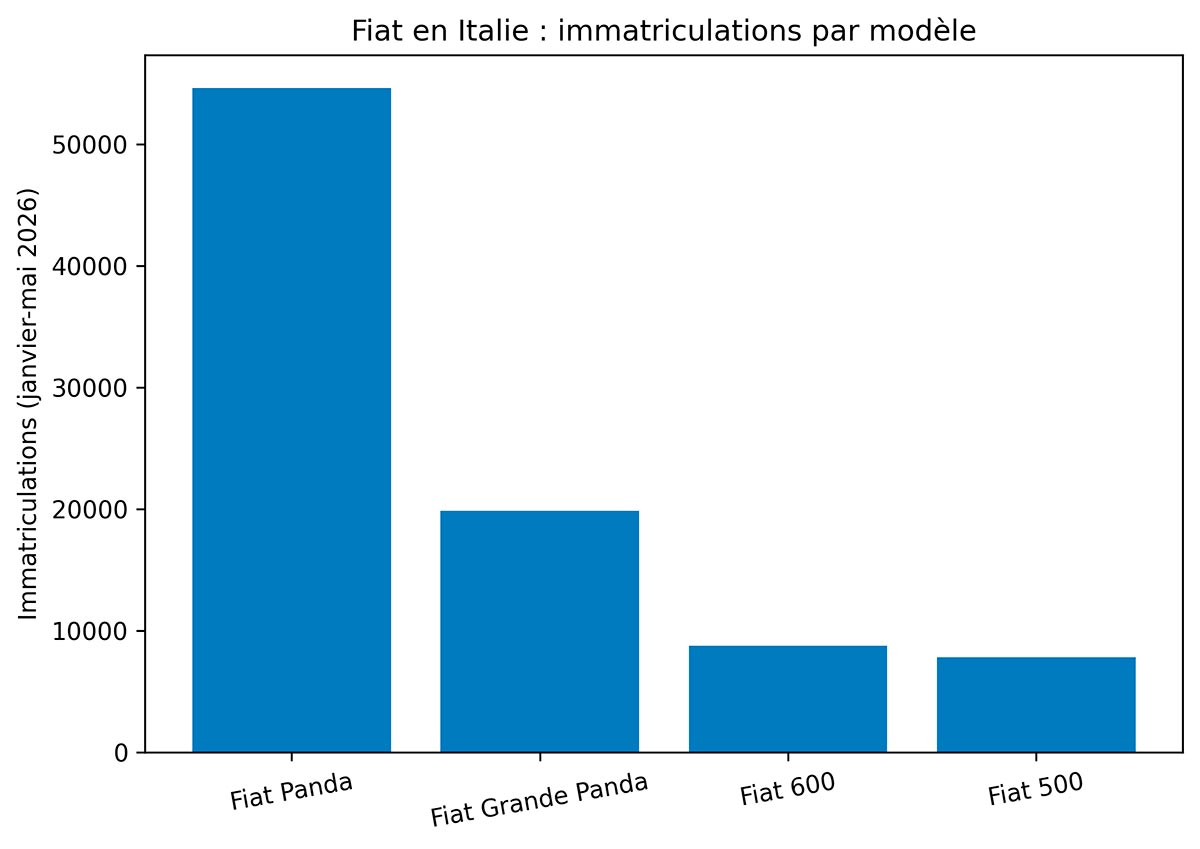
On the other hand, the giant panda is thriving all over the world.
They mishandled things with their battery supplier, Samsung, which has kept the battery price at around 10,000 to 12,000 € from the start, which is weighing down the model.
Should we terminate the contract… or switch to a different model?
On the other hand, the current 500 will be 7 years old next year… Retirement age for a model.
It happens—CATL batteries (from the new CATL/Stellantis plant in Spain) are expected in 2027… but then again, the new model isn’t scheduled to come out until 2030… it’s like the hybrid—it’s just a stopgap measure.
Thanks for this information, @Alexandre Filluzeau 👍
Although it was a bold decision to launch the 500 as an all-electric vehicle, it made sense given the availability of EU subsidies at the time.
Its initial sales figures were exceptionally strong. There were even plans to increase production to 100,000 units a year.
When the governments cut the subsidies, Tavares failed to adapt, and has done nothing to address the worsening situation of the 500e.
2,000 units in a semester is actually a massive disaster for a luxury car. It's worse than the Lancia Thesis case.
Even Maserati sold more units of the older, more expensive Grecale.
At the very least, we need LFP batteries.
Or even an upgrade of the GMPs and the platform.
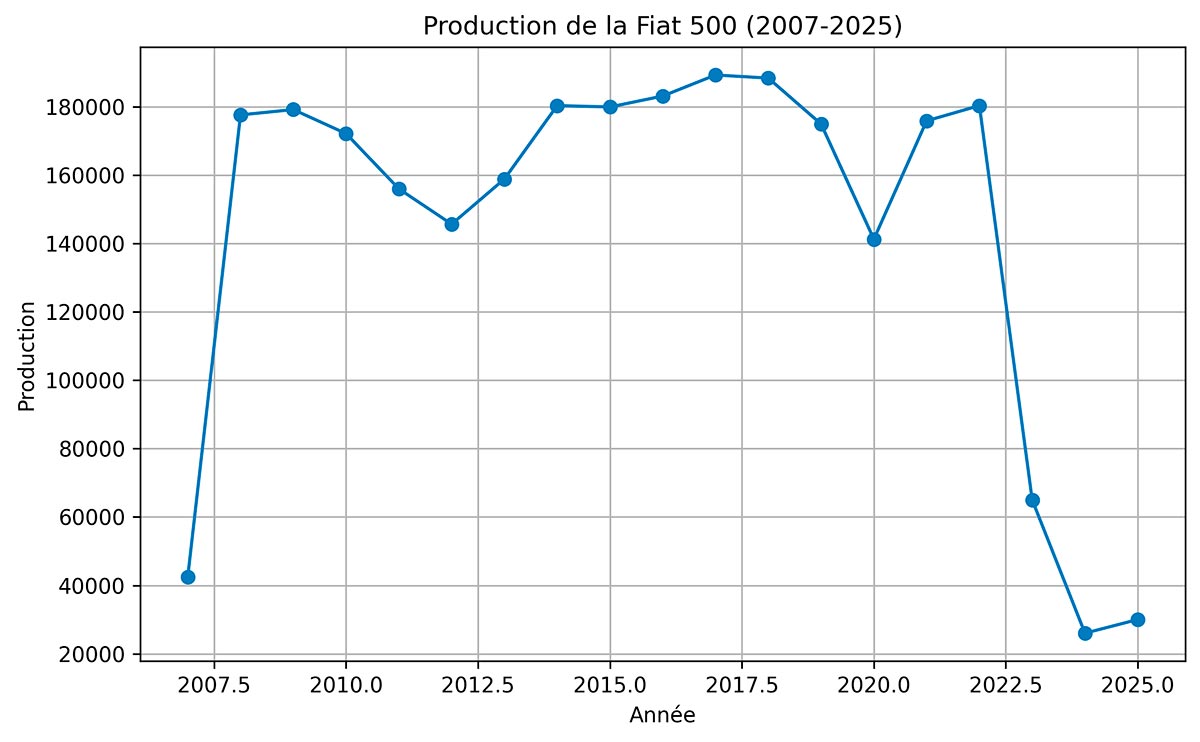
Stellantis is going nowhere—engine problems, poor sales. I own a Stellantis product myself and am not satisfied with it; it’s costing me a few hundred euros. As the graph shows, sales have been declining since 07to 2022, the well-selling 500 was a breeze—I used to see fully loaded trailers driving on the highway every day, but now I rarely see a trailer carrying Stellantis products. They still have the Ducato, which is doing well—let that be their salvation. Let’s support the people in the factories, both in Italy and in...
In short, for the umpteenth time, Stellantis, FCA, and Fiat (it’s all the same) are making mistakes, fumbling, and lack any strategic sense or vision. In the past, this might have been acceptable because there weren’t really any external competitors in Europe. Today, mistakes like these are fatal. With Tesla offering unbeatable value for money and the Chinese having vast, unlimited capacity, European automakers are in very, very deep trouble!
We weren't supposed to have a battery factory in Italy in addition to the one that's «operational» in France and the other one in Germany, which also won't
not during the day.
For these batteries, we have no choice but to seek assistance from Chinese manufacturers because we don’t have the technology to produce them ourselves. These batteries are unconventional because they use NMC rather than LFP.
«FIAT» has long been associated with »500» as well...almost a «single-model» brand… electric… alternatively (out of necessity) as a hybrid… various model »variants» (including the «fun» so-called «convertible»—(roll-top roof)…. it always remained «500.» Meanwhile, others (in the EU, from Dacia to VW, as well as Chinese, Korean, and Japanese manufacturers) have shown how to build contemporary (city) minicars……. Hopes are now pinned on the «modern» Panda….even in this segment, the competition has long since offered alternatives……….so the hopes of Fiat’s Italian employees are understandably fading……
In Serbia, no Serb will work for criminally low wages; that’s why there are workers from African countries working like slaves for Stelantis, and that’s why they work three shifts in Serbia.
Go back to gasoline
How surprising! Sorry, but trying to revive the 500 by sticking a hybrid piece of junk in it—which isn’t even a hybrid (just a marketing gimmick)—and selling it for the price of a GPanda… isn’t there something wrong with that? Let’s be clear: it’s been over 10 years since any serious investment was made in Italy.
Stellantis is only 5 years old… and just look where the few models that are doing well right now come from!
… It's a done deal—thanks, FCA!
They're rushing things there…