

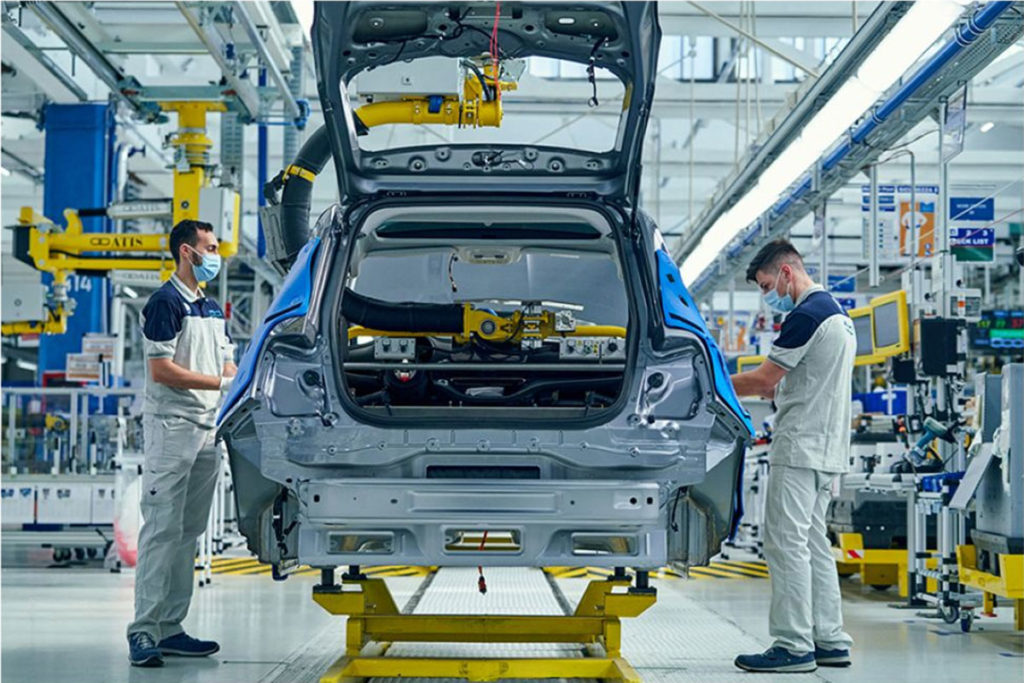
While Stellantis hoped to turn the page on a particularly difficult 2025 at Mirafiori with the launch of the new Fiat 500 hybrid, the bad news is once again piling up for the Turin plant. Between production slowdowns, scheduled closures and volumes well below announced targets, the scenario feared by the unions seems to be confirmed.
Just a few days after Emanuele Cappellano's cautious statements, Mirafiori is once again faced with production stoppages," says Mirafiori's Managing Director, Stellantis Europe, who admits that he doesn't know whether the goal of producing 100,000 Fiat 500 hybrids a year will be achieved.
A Fiat 500 hybrid that's not enough
When it was launched, the Fiat 500 hybrid was to become the symbol of Mirafiori's industrial renaissance. The model was supposed to restore volume to a plant that had seen production plummet in recent years after the difficulties encountered by the electric Fiat 500.
But the reality is far more complex. According to figures provided by the unions, the plant produced only around 15,000 vehicles over the last three months. At this rate, Mirafiori would be a long way from the 100,000 annual units the Group has repeatedly claimed. The most realistic estimates are now for around 70,000 cars a year.
A situation that confirms the concerns we raised at the end of May. At the time, Emanuele Cappellano explained that production was simply keeping pace with the level of orders received, suggesting that demand for the Fiat 500 hybrid was not strong enough to keep the plant running at full capacity.
Yet, latest registration figures show that the Fiat 500 is back in the spotlight in several European countries thanks to its new hybrid powertrain. In Germany, over 1,400 hybrids have already been registered since the start of the year. In France, more than 2,100 units have been registered. Encouraging results, but clearly not enough to guarantee Mirafiori's industrial future.
Production stoppages on the increase
Plant employees have already experienced several interruptions in recent weeks. After the June 2nd bridge, a new production stoppage was put in place to adapt production rates to market demand. A formula that has become familiar in the automotive industry, but which above all reflects the absence of sufficient volumes.
And it's not over yet. Stellantis has already announced several additional days of closure on June 24, 25 and 26, to coincide with St. John's Day, which is particularly important in Turin. A long summer break is also planned for August. Officially set at three weeks, it could even be extended to cover the whole month, according to several union sources.
Another revealing sign is that, contrary to what had been envisaged when the recovery plan was presented, the bodywork teams are not working on Saturdays. For union representatives, these decisions demonstrate that the promised increase in production rates has not been achieved.
Union anger rises to a new level
Faced with this situation, Fiom Piemonte has decided to return to the field of protest. On June 15, the union will hold a rally in front of the headquarters of the Piedmont Regional Council to raise questions with local institutions about the future of the Turin automotive industry. The message is clear: the Fiat 500 hybrid alone cannot ensure the future of a site as important as Mirafiori.
Employee representatives are now calling for concrete commitments concerning the arrival of a second model, new production lines and new investments. This demand is in line with the criticism levelled after Antonio Filosa's presentation of Stellantis' global plan, in which Mirafiori was virtually absent.
For the unions, the real problem is no longer just that of the Fiat 500 hybrid. It's about Turin's industrial future, and there's no guarantee that the new battery for the electric Fiat 500 due to arrive in 2027 will change anything.
 English
  French
  Italian
  Spanish
  German
  Japanese
  Dutch
Dutch
Who could have believed that a Fiat 500—a small car, to be sure, with less than 70 horsepower and a completely outdated mild-hybrid system—would work miracles?
It’s already a bigger miracle than those 600 Abarths, Juniors, and Ypsilons—not only are they unsellable, but once you own them… it’s impossible to get rid of them without taking a huge financial hit!
Fiat would be better off bringing its manufacturing back to Italy.
Stellantis plants in Poland, Serbia, Morocco, and elsewhere are operating at full capacity thanks to social and tax dumping, yet cars remain just as expensive—so why bring car production back to Western Europe?
Quite simply, all of this is nonsense, because Toyota—and now Hyundai—have easily proven that it’s very easy to manufacture in the EU, no matter which country you’re in. The Yaris is proof of that!
Where have the days gone when Fiat had a full range of cars, from small to large… So many bad decisions have been made—why not bring back the old 500? It had much better engines and a more attractive body. I think the new hybrid is a hazard on the road; it has absolutely no power or torque. Such a shame….
The only car I can see filling a production line «quickly»—meaning not before 2028—is the Lancia Delta… I hope they’ll have the sense to produce this «premium» sedan in Italy, in Turin.
Well, as for the Lancia Delta, we’ll see… since Fiat is in charge now… it might be rebranded as a «premium» Fiat model… I’ll ask about it when I get a chance to test drive the Lancia Gamma
Dealers don't want them as trade-ins, and car auctions give them away for free. You can pick one up for next to nothing—they're not worth a dime. So who on earth buys these cars that cost a fortune when new? The "save the planet" crowd—the first ones to jump on cruise ships??