

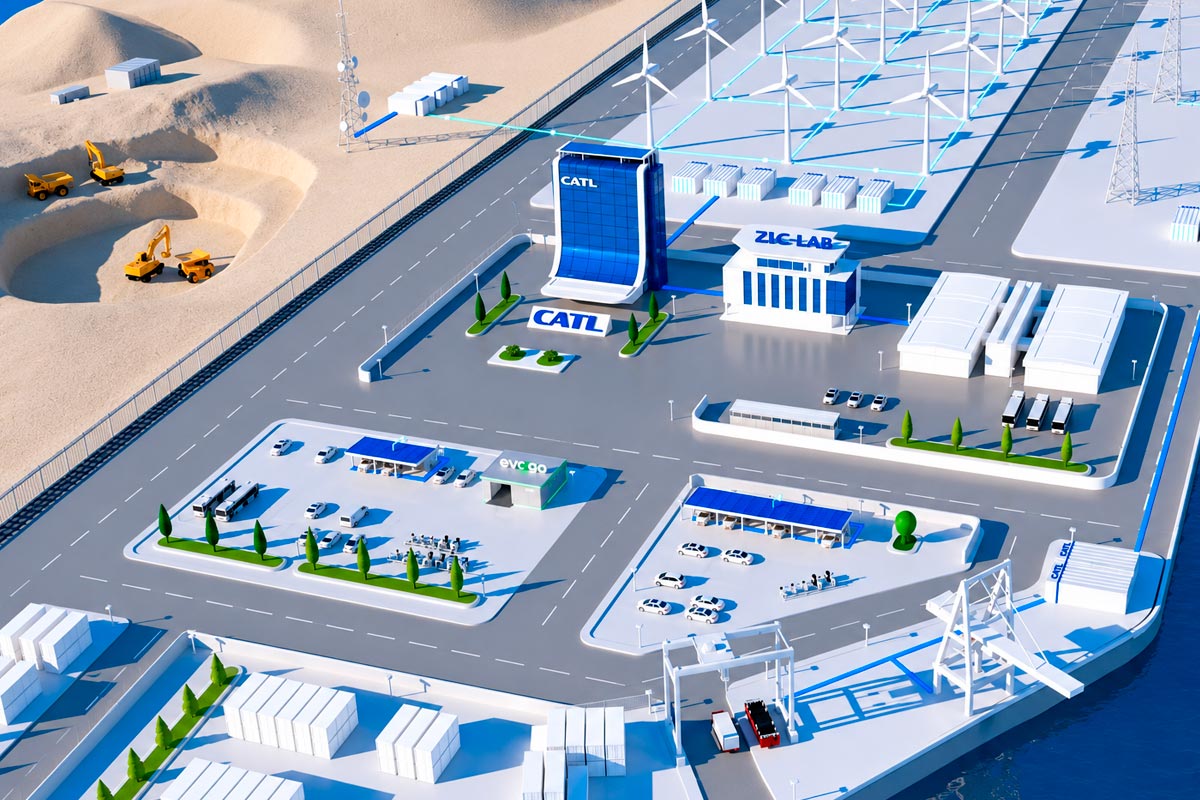
Just a few weeks ago, we were discussing the upcoming arrival of thousands of Chinese technicians at the construction site of the future battery gigafactory in Stellantis and CATL, near Zaragoza. This time, the project is entering a new phase. The first official figures have just been confirmed: 172 Chinese employees are already working at the site, and their numbers will gradually rise to a peak of 1,700 during construction.
This announcement comes as the government of Aragon has just granted final administrative approval for the project, paving the way to accelerate construction of this strategic plant, which will supply, among other things, The upcoming all-electric Fiat 500, starting in 2027.
The first Chinese experts are already hard at work
About 500 people are currently working on the construction site every day. Among them, 172 engineers, technicians, and managers from China are already working on design, industrial preparation, and project management. They are the first representatives from CATL, tasked with sharing the expertise the Chinese group has honed over many years. Their arrival is just the beginning. According to Jorge Azcón, president of the Aragon region, the number of Chinese workers will gradually increase as visas and work permits are obtained, reaching a maximum of 1,700 people during the most technically demanding phases of construction.
The arrival of this exceptional contingent requires special arrangements. The Aragonese authorities have confirmed that a temporary residential complex will be built right next to the gigafactory to house the Chinese workers for the duration of the construction project. The regional government emphasizes that all administrative procedures and labor laws will be followed, with the goal of ensuring a rapid ramp-up of construction without delaying the production schedule.
A Key Plant for Stellantis' European Cars
This project represents an investment of 4.1 billion euros and will have a production capacity of 50 GWh per year—the equivalent of approximately one million batteries annually once the plant is operating at full capacity. The joint venture Contemporary Star Energy (CSE), owned equally by Stellantis and CATL, will then train nearly 4,000 local employees to operate the site. Once operational, this plant will become one of Europe’s leading production centers for LFP batteries, a technology that is less expensive than NMC batteries and is now the preferred choice of Stellantis to make its electric vehicles more accessible.
For the group’s models, the stakes are high. In particular, this plant is set to supply batteries for the new electric Fiat 500, expected in 2027, as well as for other compact vehicles produced on Stellantis’ electric platforms (Opel, Leapmotor, etc.).
A Symbol of Europe's Industrial Transformation
Beyond the numbers, this massive influx of Chinese specialists illustrates the profound transformation currently taking place in the European automotive industry. After spending a long time trying to develop an independent battery supply chain with ACC, Stellantis is now relying on the expertise of global leader CATL to accelerate its transition to LFP batteries.
The timeline has also changed. While production was initially scheduled to begin in late 2026, the first units are now expected to roll off the assembly line in the first few months of 2027. If this schedule is followed, Figueruelas will quickly become one of Europe’s leading battery manufacturing hubs—a strategic site for Stellantis’s electric future… and for the next generation of the Fiat 500.
Today we are taking a decisive step toward making one of the most important industrial projects in the recent history of Aragón and Spain a reality: the designation of Contemporary Star Energy’s battery gigafactory as a PIGA (@StellantisES y @catl_official) in Figueruelas.
— Jorge Azcón (@Jorge_Azcon) July 27, 2026
One… pic.twitter.com/HS0tMvxX5v
 English
  French
  Italian
  Spanish
  German
  Japanese
  Dutch
Dutch