

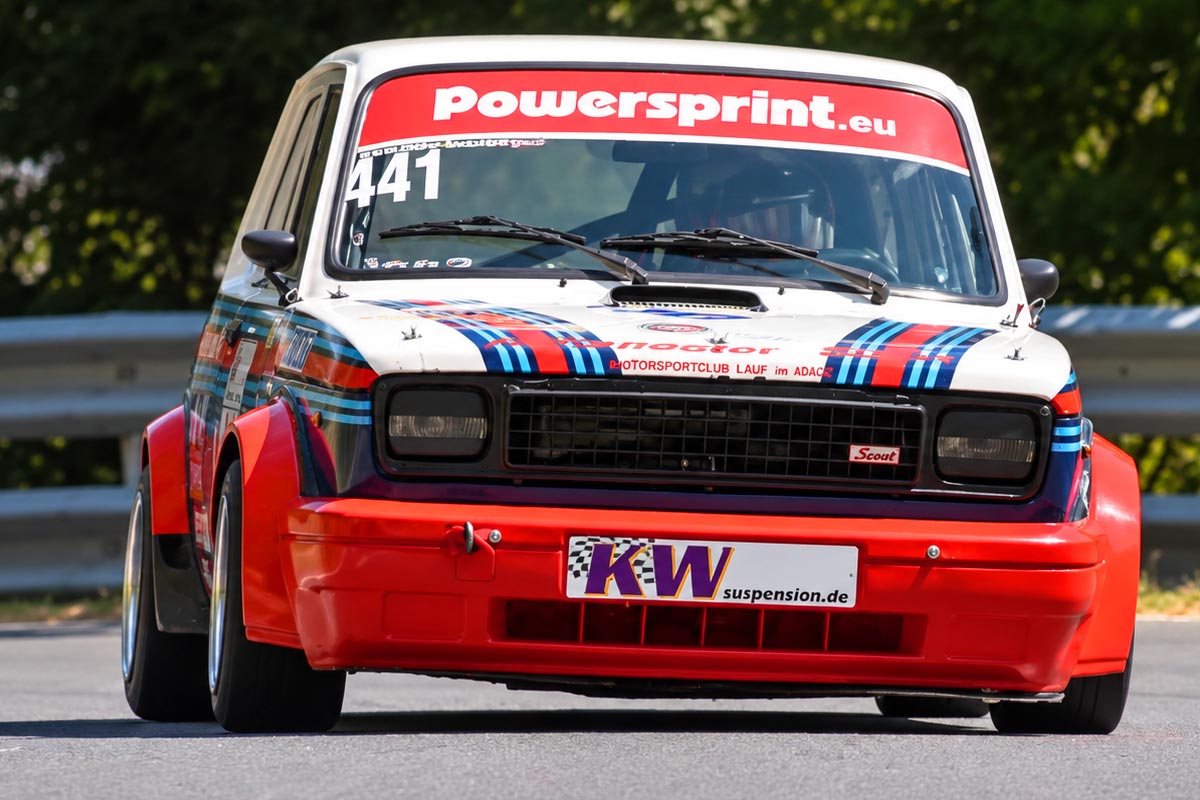
On Italpassion, we often talk about extremely powerful hillclimb race cars, powered by mind-blowing engines and glued to the ground by extreme aerodynamic modifications. But the opposite also exists, and today’s model could be the perfect Italian example of the “Light is right” so dear to Colin Chapman.
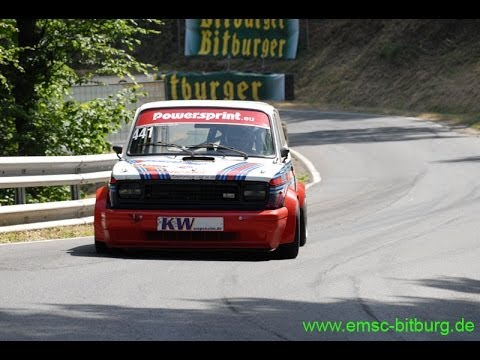
But even though the car is Italian, it’s in Germany that it really shines. Jürgen Heßberger’s Fiat 127 Sport Martini Racing has been dominating German hill climbs for decades, taking on generation after generation of Volkswagen Polos, Audi 50s, and other heavily modified small cars. Its engine is nothing like a modern prototype: a naturally aspirated 1,150 cm³ Fiat four-cylinder with an eight-valve cylinder head and a body design dating back to the early 1980s.
A «virus» caught in 1985
Jürgen Heßberger was born in 1963 in Nuremberg. In his day-to-day life, he is a master painter. But since 1985, another activity has played a significant role in his life: auto racing. In an interview published in 2011, he recounted that a colleague had once taken him to a car race. He then tried his hand at a slalom race and quickly achieved good results. He was hooked.
He got his start behind the wheel of a Fiat Ritmo Abarth 125 TC, before going on to specialize in small-displacement cars. His career then took him to an Autobianchi A112 Abarth 1000, with which he was already building a solid record of achievements in slalom and hillclimb racing.His website lists 26 class victories and 25 second-place finishes in slalom races during this period, as well as several titles in the DMV/RKB championships. In hillclimbing, he notably became the Bianchi Bergpokal champion in 1991, but his most famous achievement was yet to come.
From spare parts to the "bombinette" in Martini livery
The Fiat 127 Sport driven by Heßberger is marked as a 1980 model year, so it is a Series 2, produced between 1977 and 1982. However, the history of his race car truly began in 1994 when he bought it as a « Rohkarosse«, a bare chassis. It has no engine and not even a seat.”.
A car is not a Fiat not a production car gradually modified by a tuner, but a handcrafted vehicle that Heßberger builds himself, piece by piece. This characteristic is fundamental to understanding the relationship between the driver and his car.
The category rules require that the stock engine and body remain unchanged. The side mirrors, headlights, and windshield wipers must also remain stock. However, the windows, steering, suspension, wheels, and tires may be modified for competition. This is how the 127 gradually took shape, a car that would accompany Heßberger for several decades. Starting in 2005, his little race car adopted its famous livery inspired by Martini Racing, reviving Lancia’s glory days in endurance racing and rallying.
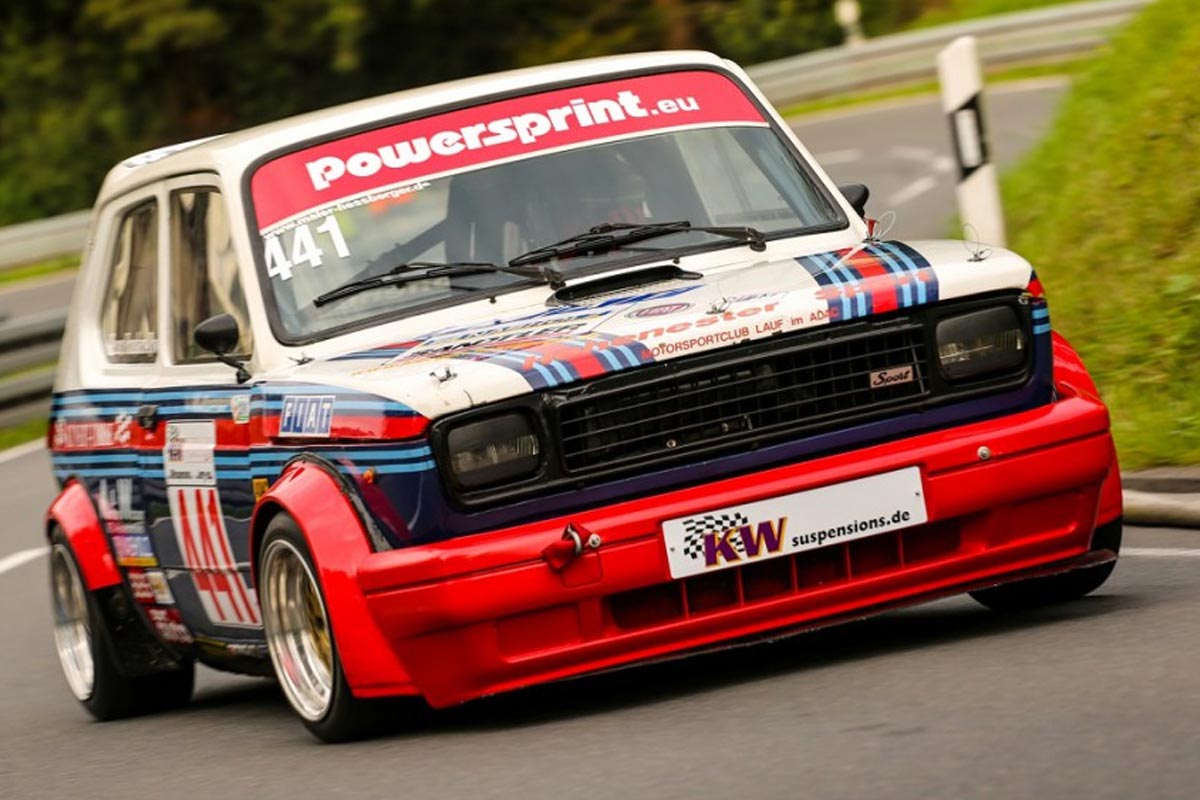
The basic design is relatively simple: a front-wheel-drive Fiat 127 Sport with widened tracks and a completely redesigned suspension geometry. Mechanically, the Fiat 127 Series 2 was equipped with a 903 cm³ engine and later a 1,049 cm³ engine producing 50 ch, while the famous 127 Sport, released in 1978, was equipped with a 1,049 cm³ engine tuned to 70 ch. The displacement here is increased to 1,150 cm³ in an eight-valve configuration. Official documents explicitly identify it as a 1,150 cm³ Fiat 127 Sport Martini Racing without a 16-valve cylinder head. The project was brought to life thanks to the expertise of Hans Josef «Zucki» Zuckermeier of Zucki Motorsport, a specialist in rally and rallycross.
Attention to detail and strategic management, rather than an arms race
It is precisely this technical choice that makes the project so interesting. Over the years, the small-displacement category has seen the emergence of increasingly powerful 16-valve engines. The Volkswagen Polo and other competitors benefit from technology that allows them to generate more power at high RPMs.
Heßberger, however, remains loyal to his eight-valve engine. In his view, the engine has already nearly reached the limits of its development, with the remaining potential for improvement lying in the cylinder head. As a concession to modernity, he had a new electronic control unit from an Audi A6 installed in 2011!
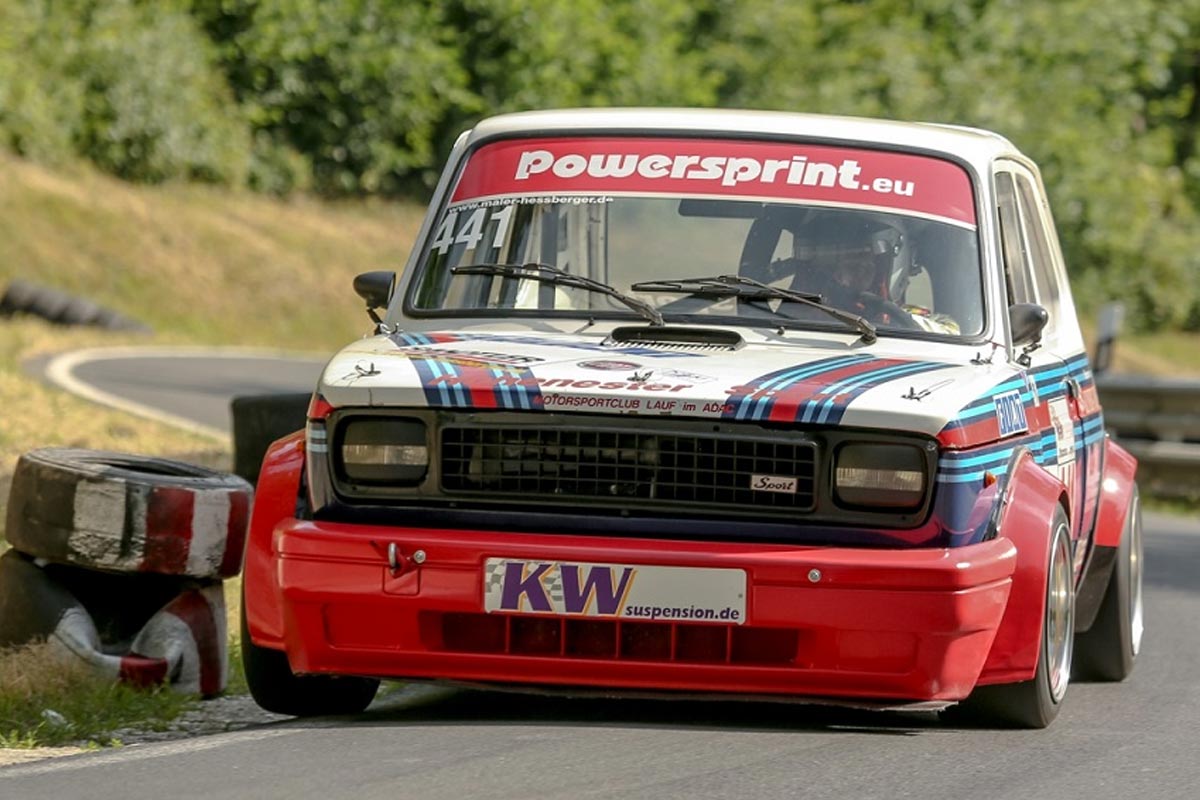
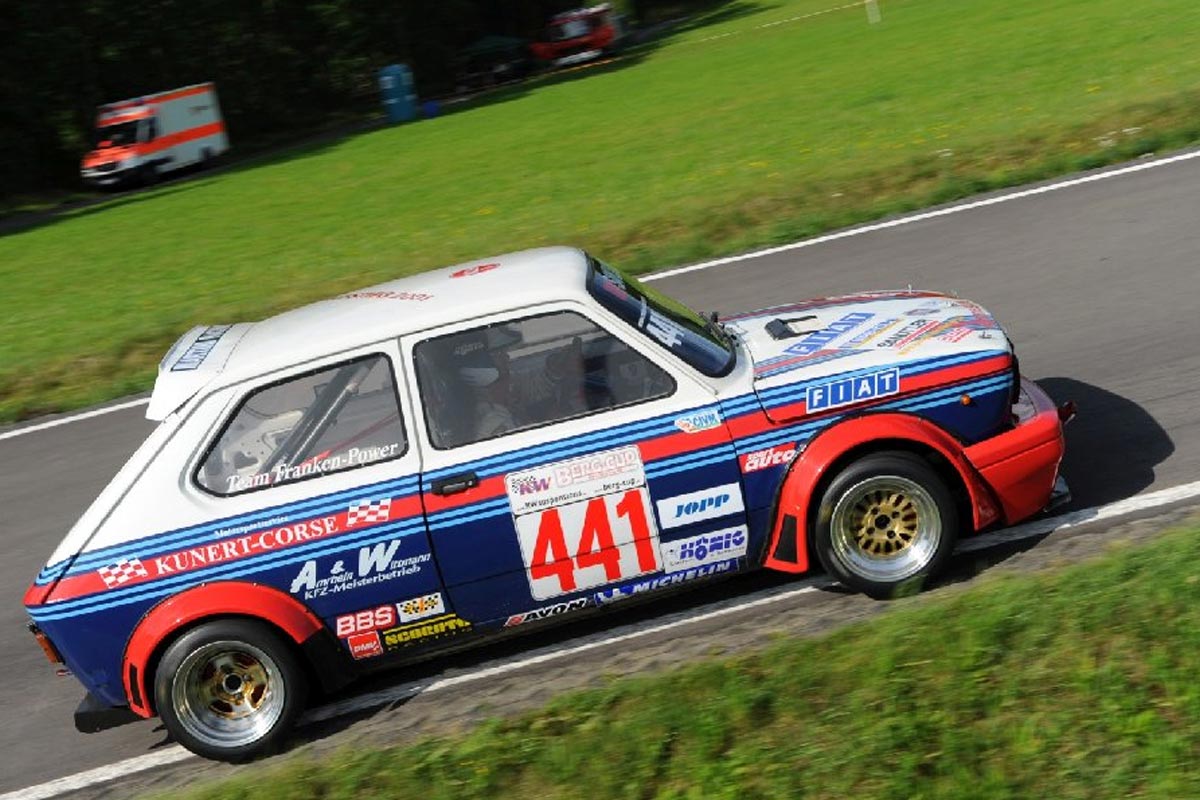
Exact power figures were never formally disclosed, but he provided very telling insights into how it stacks up against the 16-valve models, which can deliver about 40 chevaux more on fast stretches. His Fiat 127 therefore has to make up for it in every other area: braking, traction, agility, precision, and the ability to make the most of every meter of the road. Estimates range from 110 to 130 ch for his little speedster.
German hillclimbs also feature very different course layouts: some are very fast with long stretches driven at full throttle, while others are very twisty and require repeated acceleration. Heßberger therefore systematically adjusts the transmission, taking the gearbox apart eight to nine times a year. The gear ratios are modified according to the configuration of each race. His driving philosophy is simple: keep the line as clean as possible and keep the engine within its optimal RPM range.
Titles and Growing Local Popularity
The 127 had its first major success in 1999, when Jürgen became the German class champion in the DMSB BergpokalTouring Car, the Coupe de la Montagne for passenger cars. Its official website also lists a Fiat-Lancia Sportpokal title in 2002 and 2003, as well as numerous regional and national titles.
The 127 has become, above all, a benchmark for the KW Berg-Cup 8V Trophy. This in-house trophy showcases traditional engineering and pure driving skill by rewarding the best drivers competing with so-called «classic» engines featuring two valves per cylinder. In the Group H / E1 displacement classes (heavily modified production cars), the regulations allow for highly advanced modern mechanical configurations: 16-valve (16V) engines, multi-valve cylinder heads, and sequential gearboxes. To prevent independent or historic drivers using vintage engines from being completely excluded from the trophy competition, this subcategory was established. Heßberger won the title in 2005, 2006, 2007, 2008, and 2014. He also finished third in the overall standings of the KW Berg-Cup in 2005.
The story of this 127 also includes an anecdote that has absolutely nothing to do with the world of auto racing. As a fan of 1. FC Nürnberg, his city’s major soccer club, he was invited in May 2005 to the club’s training center at Valznerweiher with his Fiat 127 Sport Group H. All the players, as well as coach Klaus Augenthaler, signed the car’s roof!
2019: The end of a first chapter, but the 127 hasn't said its last word
After more than twenty years of competition, the 127 suffered a major setback following an accident in Mickhausen in 2019.The car had to be rebuilt, forcing the driver to start from scratch with a new body, while the team rebuilt the mechanical setup. In 2022, Heßberger returned to competition. The list of achievements published on his website ends that year, but the story is still unfolding.
The proof is that, in 2024 and 2025, we find our hero of the day competing in the under-1,150 cm³ class. As soon as the Fiat 127’s transmission proved reliable, it claimed nearly every podium finish in its class.Due to the sometimes limited field in its exact displacement class (1,150 cm³), several of its results were combined with those of the higher class. Even when up against more powerful models (such as the 1.4L VW Polo or Scirocco), it regularly managed to break into the Top 5 of the overall rankings for 8-valve cars.
In 2026, Jürgen Heßberger was still competing in his trusty 127 Sport Martini-Racing. More than thirty years after purchasing the bare chassis, the concept remains the same: a small Fiat with an eight-valve engine, tuned to the max, refined race after race, and driven by a driver who knows every detail of how it works. During the major rounds of the KW Berg-Cup at the end of the season (notably at Hauenstein), Heßberger even clinched the victory in his class—at age 63!
A lifelong passion—and a devotion to cars that commands respect!
Heßberger has always worked on his car himself, often in the evenings after his job as a painter or on weekends when there were no races. He learned how to disassemble and rebuild his engines and transmissions with the help of mechanics and specialists. He continues to refine his engine even though he knows that his eight-valve engine cannot compete with the raw power of the most modern 16-valve engines.
The regulations have changed, competitors have adopted 16-valve engines, electronics have advanced, and the car itself was rebuilt after an accident, but the project has remained remarkably faithful to its original concept: getting the most out of a small, front-wheel-drive Fiat.
The cumulative statistics to date are impressive: 82 class wins and 91 second-place finishes in hill climbs, not only in Germany but also in Hungary, Italy, France, Luxembourg, and Austria. And it’s not over yet!

 English
  French
  Italian
  Spanish
  German
  Japanese
  Dutch
Dutch