

A few months after selling Italdesign, could the Volkswagen Group part ways with other Italian gems? The idea still seemed unimaginable just a few years ago. However, according to several reports published by the Financial Times, the names of Lamborghini and Ducati are reportedly once again being considered internally as assets that could be monetized or sold to finance the German automaker’s sweeping transformation.
For the Italian automotive industry, the significance would be immense. Following the design studio that gave rise to the Fiat Panda, the Lancia Delta, and the Volkswagen Golf, two of the most iconic «Made in Italy» brands are now at the center of speculation.
After Italdesign, a new chapter could begin
Last spring, Volkswagen had already surprised everyone by selling a majority stake in Italdesign to the Indian multinational UST. Officially, nothing was supposed to change: the headquarters would remain in Turin, the teams would stay in place, and the company’s Italian identity would be preserved. But this sale also showed that the German group no longer hesitated to restructure its business portfolio to finance its transformation.
Today, the situation is much more tense. Volkswagen is preparing a sweeping restructuring plan that could result in up to 100,000 job cuts and the closure of several German plants. At the same time, the automaker must continue to invest tens of billions of euros in electric vehicles, batteries, software, and autonomous driving.
The recent sale of 51 % by Everllence, a company specializing in marine and industrial engines, has already brought in approximately 7.4 billion euros. But according to analysts, a large portion of that amount could be absorbed by restructuring costs.
Lamborghini and Ducati are back in the spotlight
Several of the group's assets are reappearing in the scenarios analyzed by analysts and financial advisors. Among them are, of course, Lamborghini and Ducati, two particularly profitable Italian brands. The former generates some of the highest profit margins in the automotive industry, while the Bologna-based motorcycle manufacturer enjoys an extremely strong brand image and a loyal customer base.
As for Lamborghini, some have been speculating for several years about the possibility of a separate initial public offering. This move would allow the Volkswagen Group to raise cash while potentially retaining a stake in the company. Ducati, for its part, has already come close to changing ownership.
Ducati had already been put up for sale
As a reminder, in 2017, Volkswagen had launched a process to sell Ducati in order to finance its shift toward electrification following Dieselgate. Several bidders had expressed interest, including Investindustrial, Bain Capital, and the Benetton family. The offers reportedly hovered around 1.5 billion euros. But the project was ultimately put on hold. German unions, which wield significant influence on Volkswagen’s supervisory board, had opposed the sale. There were also disagreements between Volkswagen and Audi, which has controlled Ducati since 2012.
Nine years later, the situation is very different. Pressure from China has intensified significantly, investment in electric vehicles is skyrocketing, and Volkswagen’s stock price has fallen sharply since Oliver Blume took the helm of the company.
A hypothesis that is still far from being confirmed
At this stage, no decision has been made, and Volkswagen has not confirmed any plans to sell. Other options are also being explored, including opening up certain businesses related to batteries, software, and autonomous driving to outside investors.
But the mere fact that Lamborghini and Ducati regularly come up in discussions illustrates the scale of the challenges facing Europe’s leading automaker. After Italdesign, the idea that Lamborghini or Ducati might one day leave the Volkswagen group is no longer entirely unthinkable.
 English
  French
  Italian
  Spanish
  German
  Japanese
  Dutch
Dutch
They need cash—it's a matter of survival—so it makes perfect sense. Although I would guess that, with the competition also looking for cash, it would make more sense to take both brands public.
One to watch closely. After all, Bugatti hasn't been part of the VAG group for a few years now and seems to be doing just fine (the factory is even expanding).
What's happening at VW isn't all that different from what's happening at Renault, Stellantis, Ford, Nissan, and other automakers.
Some people forget this… on purpose?
But since 2020, the global automotive industry hasn't been doing well!
This is a significant decline observed everywhere, 9 times out of 10.
Yeah, finally, please! Better dead than VW.
Dummschwätzer
Not just that—Bentley is on the list, too.
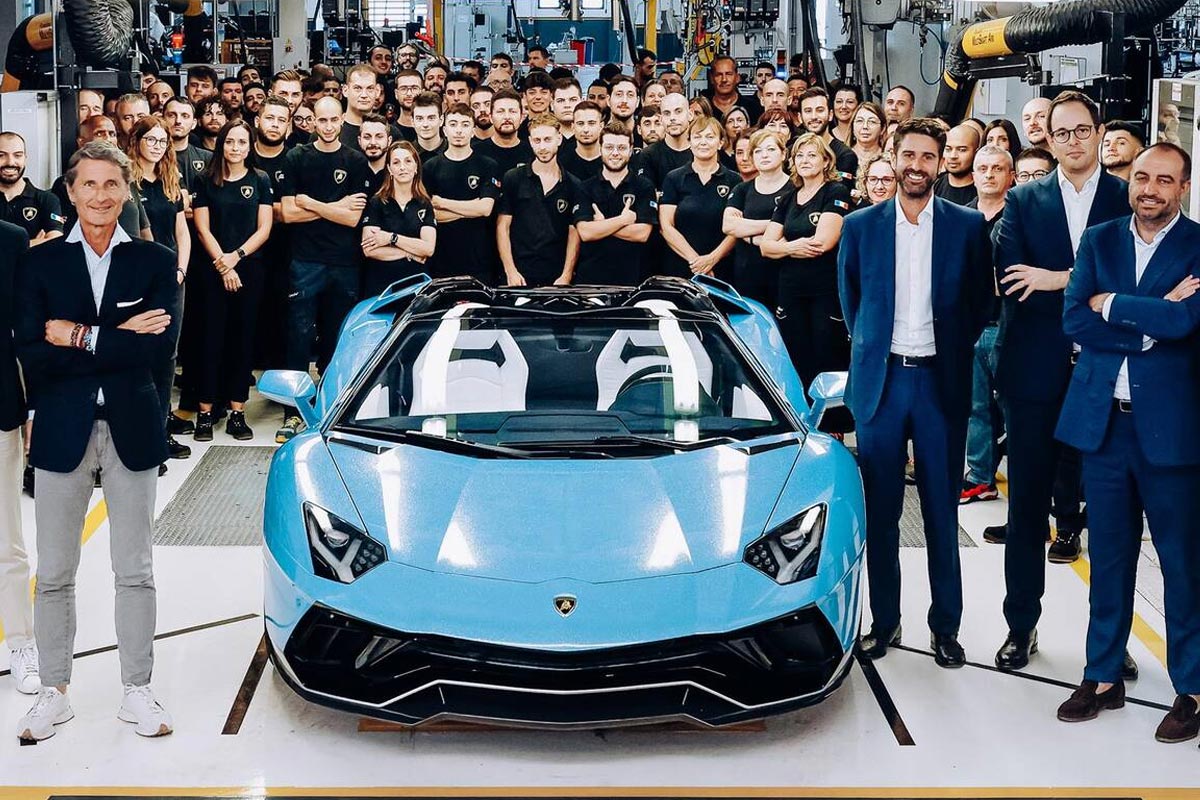
In the photo, the gap between the executives (who are «taking over» the vehicle) and the workers in the background is jarring. Well, at least the workers are in the photo, unlike at Stellantis…
Sorry, Scrudic, I posted under your comment, but I didn't mean to 🫣
Lamborghini has been part of Audi for over 30 years now and has become a real gem. The Lamborghini brand develops powertrains and engines, and has made a name for itself in the field of bodywork using CFRP. You don't just sell something like that.
From a business perspective, in tough times I have to cut back on expensive hobbies that might pay off in two or three years. Maybe. Take, for example, the Formula 1 activities. The company is talking about plant closures and cutting 100,000 jobs! What on earth is going on at VW and Audi????
There’s no shortage of companies capable of taking over Lamborghini, and this isn’t the first time the brand has changed hands. Perhaps this will finally bring the reliability that the brand has always lacked.
They should hire Tavares to turn the company around! 😉. You have to admit that VW's corporate stagnation is a serious problem. There are too many executives in that company who aren't doing anything.