

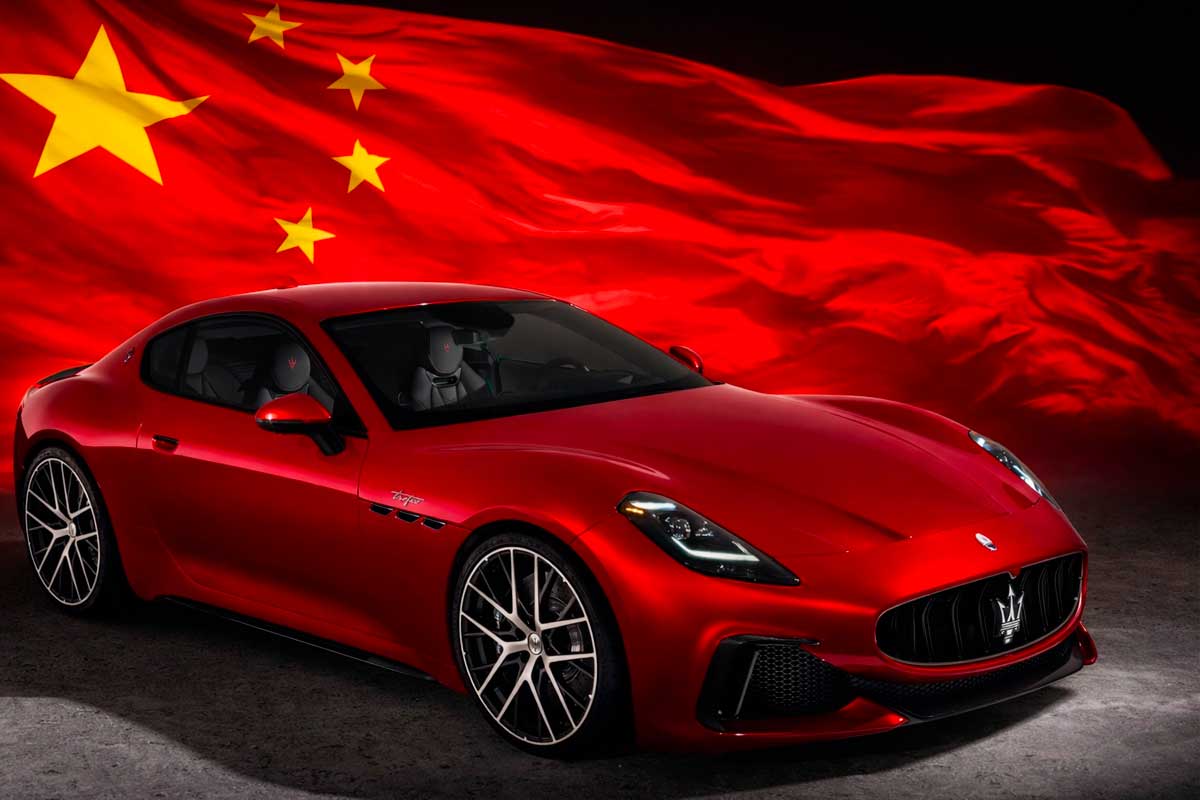
According to several corroborating sources, Stellantis is said to be in discreet talks with Chinese carmakers to strengthen its European activities. Among the scenarios discussed: the entry of Asian investors into the capital of some of the Group's brands. And one in particular is attracting a great deal of attention: Maserati.
The information, revealed by Bloomberg and picked up by Reuters, illustrates the strategic tensions facing the Italo-Franco-American group in Europe, between costly energy transition, Chinese competition and industrial overcapacity.
Discussions with Xiaomi and XPeng
According to available information, Stellantis executives have met with representatives of several Chinese manufacturers, including Xiaomi and XPeng. The aim of these discussions is to explore different forms of cooperation around the Group's European activities.
Options under consideration include direct investment in Stellantis' European operations, access to certain production capacities on the continent... but also the acquisition of stakes in certain brands.
It's against this backdrop that Maserati's name comes up in discussions. Sources are talking about the possibility of Chinese partners buying a stake in the Italian luxury carmaker, a prospect which, if confirmed, would represent a major turning point in the brand's history.
For the time being, discussions remain preliminary and there is no guarantee that they will lead to a concrete agreement. Stellantis reacted cautiously, simply stating that it is normal for a global group to regularly exchange views with various players in the automotive industry.
Europe, Stellantis' Achilles heel
If these discussions do take place, they are taking place against a particularly delicate backdrop for Stellantis in the European market. The group has to contend with increasingly stiff competition, particularly from Chinese manufacturers who are making rapid progress in the electric sector with competitive products.
At the same time, the transition to electric vehicles represents a colossal investment. Stellantis recently announced more than 22 billion euros in exceptional charges in particular due to the review of certain electrical projects and the abandonment of battery factories.
Added to this is a structural problem: industrial overcapacity in Europe. Today, many plants are producing less than their potential, while demand remains uncertain and the price war rages on.
In this context, the idea of bringing in industrial partners capable of contributing capital, technology and additional production volumes may appear to be a pragmatic solution.
A strategic opportunity for Chinese manufacturers
For Chinese groups, such a partnership would also represent a major strategic opportunity.
Manufacturers such as Xiaomi and XPeng have a significant lead in certain technologies, notably on-board software and the digital ecosystem for electric vehicles. By teaming up with Stellantis, they could accelerate their presence in Europe, a market that has become crucial against the backdrop of price wars on the Chinese market.
Access to the Group's European factories would also be a considerable advantage for bypassing trade barriers and producing directly on the continent. This logic is already in evidence with Stellantis partner Leapmotor, which is to produce some of the Group's models in Europe. at a Group plant in Spain.
A different strategy in Europe and the United States
These strategic reflections also illustrate the growing divergence between Stellantis' European and North American activities.
In the United States, the Group is investing heavily to relaunch its brands and renew its product ranges. Nearly $13 billion has been committed to support Jeep and Ram, two particularly profitable brands.
Europe, on the other hand, appears today to be a more complex market, with lower margins, demanding regulations and intense competition. Some of the scenarios studied even suggest a more pronounced operational separation between European and American activities, although Stellantis has categorically denied any idea of splitting up the Group.
Carlos Tavares' prophecy coming true?
These discussions also echo a landmark statement by the former CEO of Stellantis, Carlos Tavares, a few months after his departure from the Group.
In his view, Europe was in danger of «handing over its automotive industry to the Chinese». He mentioned a scenario where certain European plants, weakened by the energy transition and international competition, could end up being bought out by Chinese investors.
The former executive even described an explosive situation: plant closures, social tensions and, finally, the takeover of industrial sites by Asian groups promising to preserve jobs.
At the time, these comments were considered alarmist. Today, however, the idea of Chinese manufacturers investing directly in European brands or industrial capacities seems far less theoretical.
Maserati, symbol of a possible changeover
If Maserati were ever to open its capital to Chinese investors, the symbolism would be powerful. The brand with the trident represents one of the icons of Italian motoring. But in recent years, its sales performance has been disappointing, despite the launch of new models and the ambition to reposition itself in the luxury segment.
In a group as vast as Stellantis, Maserati remains a brand apart: prestigious but economically fragile. The arrival of a partner capable of providing capital and technology could appear as a solution to secure its future... or as a sign of a profound shift in the balance of the European automotive industry.
Stellantis' forthcoming strategic announcements, expected at the Group's Investor Day in the USA in May, could provide further details on the direction the Group will really take.
One thing is certain: the idea of a European automotive industry increasingly linked to Chinese manufacturers is no longer just a theoretical scenario. It is now at the heart of the strategic thinking of major groups.
 English
  French
  Italian
  Spanish
  German
  Japanese
  Dutch
Dutch
That was Tavares' goal right from the start, to sink the European brands so that they could be bought up for a pittance by the Chinese!
He's a traitor to European sovereignty!
No investigative journalist is looking into it?
PS: I'm not aiming at ItalPassion, which does a great job, it's really an open question.
No, that's an exaggeration, Tavares is the CEO not the owner of Stellantis, it's the group's board of directors that has the final say, don't say things you don't know. .
While the solution is to let Ferrari take back the reins so that customers can regain confidence... in short, we're in the middle of a frenzy.
I think we have to stop blaming everything on him. Okay, he's made some disastrous decisions over the long term. But the situation of certain brands, particularly Italian brands, dates from well before the merger and Tavares. The ex-FCA is paying a heavy price for the inaction of its former managers.
Tavares has good back!!!
He sounded the alarm, nuance! It's a warning.
Once again, Potté's bogus arguments.
He lives in an imaginary world.
On the other hand, Filosa's intentions worry me!
If Stellantis wants to open up Maserati's capital to the Chinese, why did he reintegrate the brand into the Group's accounts and not spin it off?
Then there's what they don't want to show in quarterly reports and what they can show to potential investors. After that, I remain sceptical because Maserati has already tried the electric experiment without success...
Grande Filosa some said...
Uh... who?
Clearly, it's off to a very bad start...
When people said Grande Tavares and PSA, we saw the result, or rather the as-yet-unknown disaster in the automotive poiunt that keys has become a benchmark for everything you shouldn't do.
Who said that?
Some said Grande Tavares and we saw the result!
The pragmatic solution when you're the reference shareholder of a company in which you have confidence and which has made the family fortune, even very recently, is to invest in teams and technologies to improve products and beat the competition.
Once the Chinese copied Europe and now they are buying it up piece by piece. It is terrible and sad how Europe allows itself to be dismantled, of its own free will. Shame
As long as it doesn't return to the Ferrari umbrella by voluntarily limiting its number of cars, this won't change Maserati's problem.
Well, thanks to whom? During FCA's time, investment in Maserati was halted or even switched to electricity. Tavares in his great goodness did nothing 😀to stop it. .
Stellantis is 7 brands too many, that's all...
Before the merger, there were rumors of sales (with Alfa) to the Chinese. It's not new.
After that, it had seemed predictable for a while. The fact that Maserati is striving to keep the Giorgio and make it evolve means that, in the event of a sale, the intellectual property on the platform can be transferred. If Maserati were to use the STLA Large, the new buyer would have to pay royalties to Stellantis. This facilitates the sale... as does the transfer of all production to Modena. The factory can be sold with it. And no need to share lines with Stellantis...
This would be the moment for them to realize that they can no longer afford to renew their ranges and that they need outside help. If Alfa belonged to the Chinese, we'd have had a new Stelvio a long time ago and a complete range. Current renewal of the rare models is so slow that customers are looking elsewhere. The Pandina is about to turn 14-15!
As for Maserati, when I come across a Grecale, I think that its lines are so banal that it couldn't even be badged by a Chinese brand, since they're so far ahead in terms of design too.
It would be the beginning of the end if the Chinese bought or acquired a stake in Maserati.
What's next? Would other Italian brands follow?
It's shocking enough to see Leapmotor in a Motorvillage dealership.
This information is totally false. Maserati and Alfa Romeo have joined forces to create the BOTTEGAFUORISERIE group.
Where does this false rumour come from?
This false rumor comes from Reuters and Bloomberg, it's written in the article!
Apart from Ferrari, no one will be able to take Maserati back to the top!
There's no point in Maserati being bought by a Chinese manufacturer, they don't know how to make a V8. It's really making a mockery of the brand's destiny.
Nobody's going to want a Maserati by Xpeng or Xiaomi, no matter how good it is.
Which Chinese manufacturer might be interested in DS, a young, artificial brand with no real history on which to build desire?
At a pinch, Lancia could be of interest, but with no disrespect to our Italian friends, the brand's value can't be worth much...
When you see the design of Roewe (ex Rover) and Lotus, you have to wonder if it's worth the risk of further tarnishing brands that are already in bad shape.
When you see the design of Roewe (ex Rover) and Lotus, you have to wonder if it's worth the risk of further tarnishing brands that are already in bad shape.
At a pinch, Lancia could be of interest, but with no disrespect to our Italian friends, the brand's value can't be worth much...