

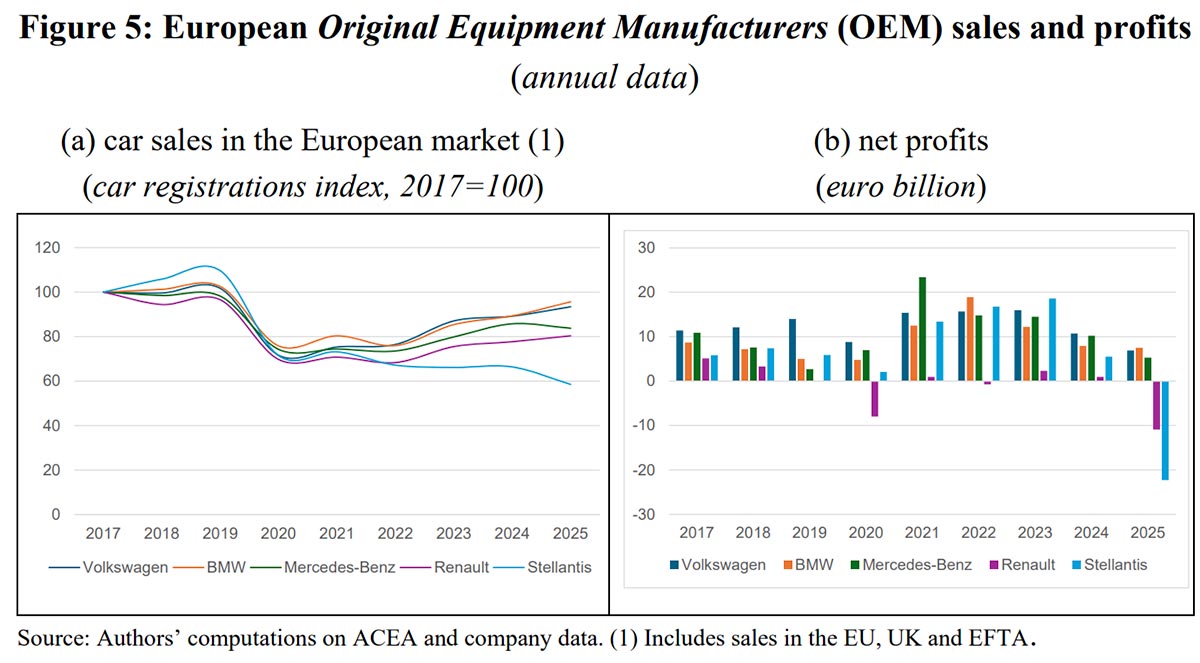
For decades, European automakers have dominated the global automotive industry thanks to their mechanical expertise, prestigious brands, and capacity for innovation. Today, that model is being called into question. According to a recent study by the Bank of Italy, the crisis currently facing Stellantis, Volkswagen, Mercedes-Benz, BMW, and Renault is by no means just a temporary economic slowdown: it reflects a profound shift in the global automotive industry in China’s favor.
A Europe that has never regained its pre-COVID momentum
The first observation is clear-cut. While the Chinese market has already surpassed its pre-pandemic levels, Europe continues to lag behind. In 2025, new vehicle registrations in the European Union will still be 17 % lower than in 2019. Even the United States, though also affected by the crisis, has limited its decline to 4 %.
Why such a difference? Car prices have risen sharply since the pandemic due to supply shortages, energy costs, and new regulations. Automakers have gradually phased out entry-level models in favor of more profitable vehicles, often SUVs or more expensive electric models. As a result, buying a new car has become much more difficult for some European consumers.
China is reaping the rewards of a strategy that began 20 years ago
Unlike Europe, China did not improvise its transition to electric vehicles. Beijing began investing heavily in this sector as early as the early 2000s, well before electric vehicles became a global priority. The government has supported the entire industry through preferential loans, discounted land, low-cost energy, and significant investments in batteries.
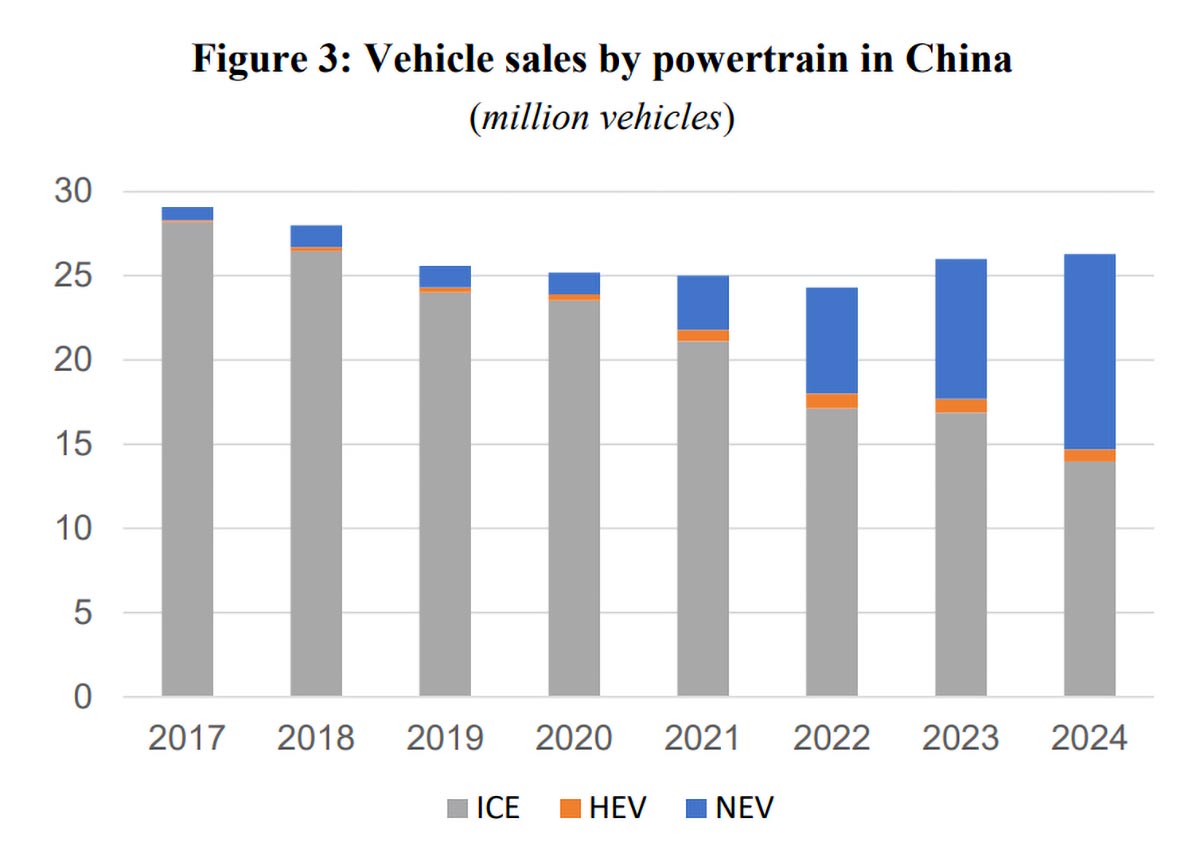
The results are spectacular. Sales of electric cars have risen from about 1.3 million units in 2020 to nearly 14 million in 2025. Now, one out of every two new cars sold in China is electric, and the country accounts for nearly two-thirds of global electric vehicle sales.
The Decisive Advantage: Batteries… and Costs
The true strength of Chinese automakers does not lie solely in government subsidies. It lies in their control over the entire battery production chain, from raw materials to final assembly. This vertical integration allows them to produce batteries at a cost up to 45 % lower than their European competitors. However, batteries account for about 40 % of an electric car’s value. Even European tariffs are not enough to close such a competitiveness gap. Added to this is another strategic advantage: Chinese manufacturers are about two to three years ahead in the development of onboard software. At a time when vehicles are becoming veritable computers on wheels, this technological lag weighs heavily on Western manufacturers.
Stellantis, Volkswagen, Renault, and Others Caught in a Bind
For large European corporations, the challenge is immense because they have to fight several battles at once.
They must finance the development of new electric platforms while continuing to make their internal combustion engines profitable. They are also forced to maintain gasoline, diesel, hybrid, and electric lineups simultaneously in order to meet the very different expectations of global markets. Finally, they must invest heavily in software, an area where they are several years behind.
According to economists at the Bank of Italy, no European automaker has yet managed to address all three of these challenges simultaneously. While this strategy of gradual transition has certainly allowed European automakers to maintain their profit margins in recent years, it has also caused them to lose ground in the most affordable segments, which have been rapidly taken over by Chinese brands.
Alliances That Have Become Indispensable
Faced with this situation, several European automakers have chosen to partner with Chinese groups rather than compete against them alone. Volkswagen has extended its joint venture with SAIC through 2040. Stellantis has acquired a stake in Leapmotor to accelerate its push into electric vehicles and is also collaborating with Dongfeng. Renault, for its part, has formed a partnership with Geely. These alliances reflect a new reality: Europe is now looking to China for some of the technologies that once made it strong.
The world map is changing
This upheaval is also evident in international trade. By 2025, China had become the world’s leading exporter of automobiles, with more than 7 million vehicles exported, compared with fewer than 1 million in 2019. At the same time, European automakers are gradually losing market share, even in their traditional markets.
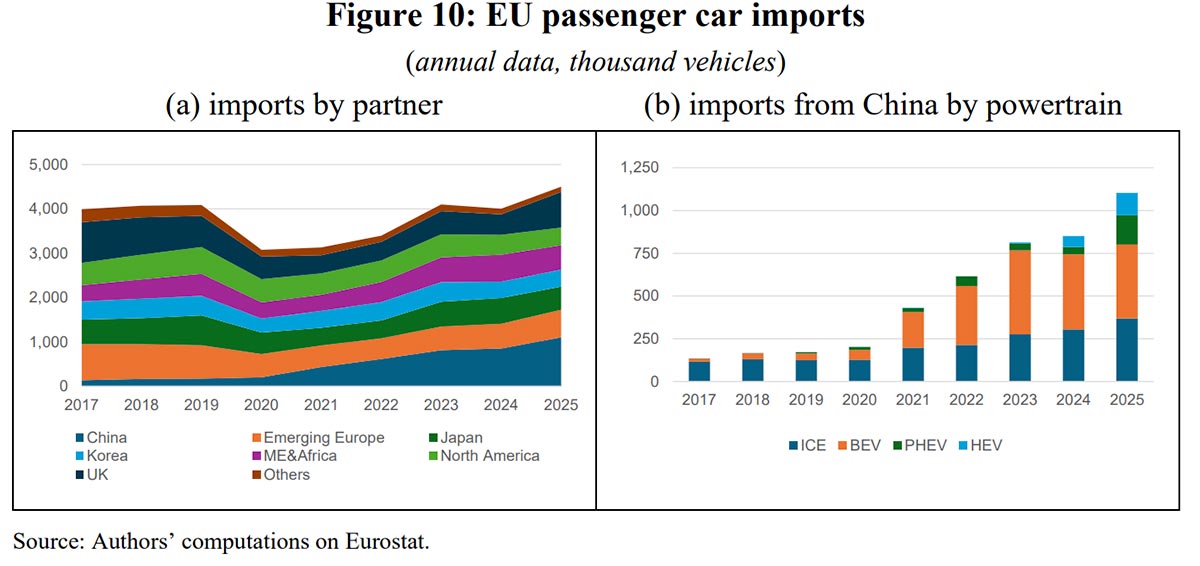
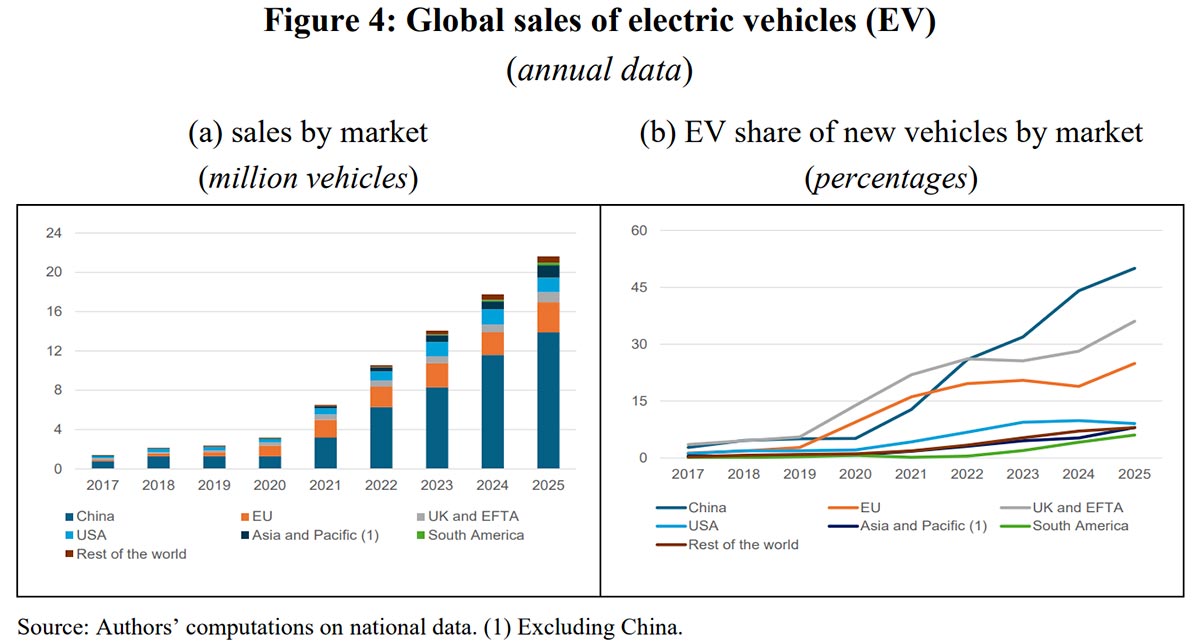
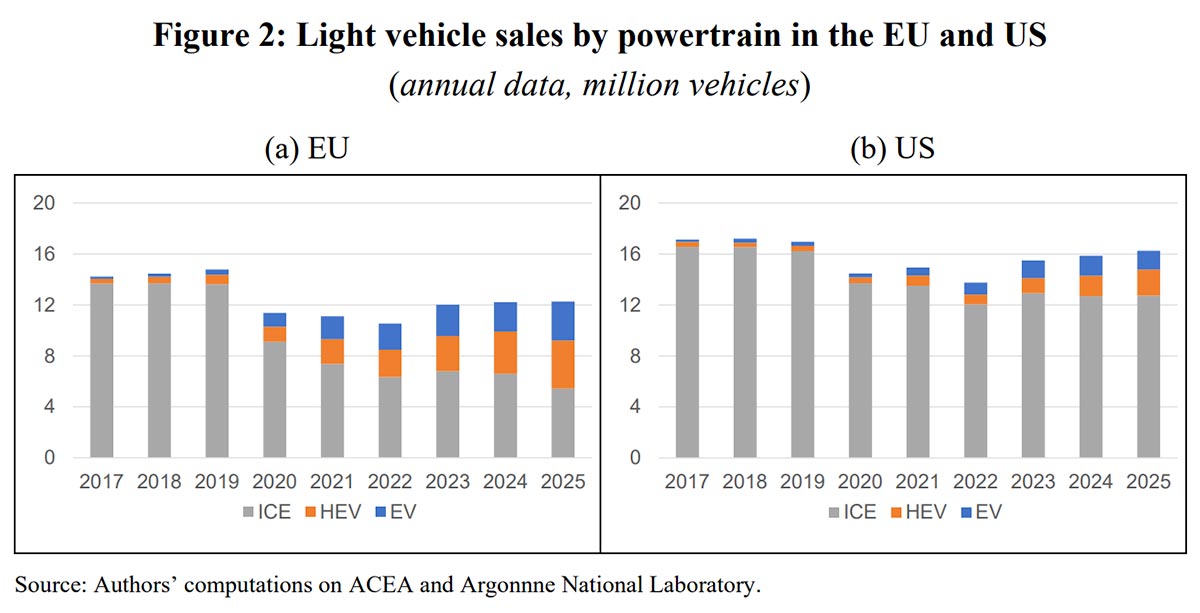
According to the Bank of Italy, this development goes far beyond the simple framework of commercial competition. The industrial, environmental, and trade policies of China, Europe, and the United States are increasingly diverging, fragmenting the global automotive market into several major regional ecosystems. This new landscape makes investments more complex and increases costs for international automakers.
In other words, the battle being waged today is no longer just between automakers. It is now a clash between two industrial models. And, for now, it is indeed China that is setting the pace.
Source : Bank of Italy
 English
  French
  Italian
  Spanish
  German
  Japanese
  Dutch
Dutch
In this «report,» once again, the mistake is made of describing the Europe-China rivalry as if it were taking place on equal terms. History shows that dictatorships can be very efficient in various fields, especially in the economic and industrial spheres.
Even in Europe, there are those who have tried to emulate today’s China—that is to say: a single-party system, the complete suppression of labor and human rights, a non-existent press freedom, labor camps for dissidents, and direct state intervention in the economy.
European automakers aren't competitive when it comes to electric cars—it's as simple as that. Chinese electric cars offer more for less.
I got into a BYD taxi recently and thought the car was pretty good—the taxi driver told me it was unbeatable value and had good range.
Get in an Xpeng—you're going to be blown away. I got in a G9… it was a real eye-opener.
Yeah, it looks good. Personally, I would never buy a Chinese car, but I understand why some people do if they want an affordable electric car.