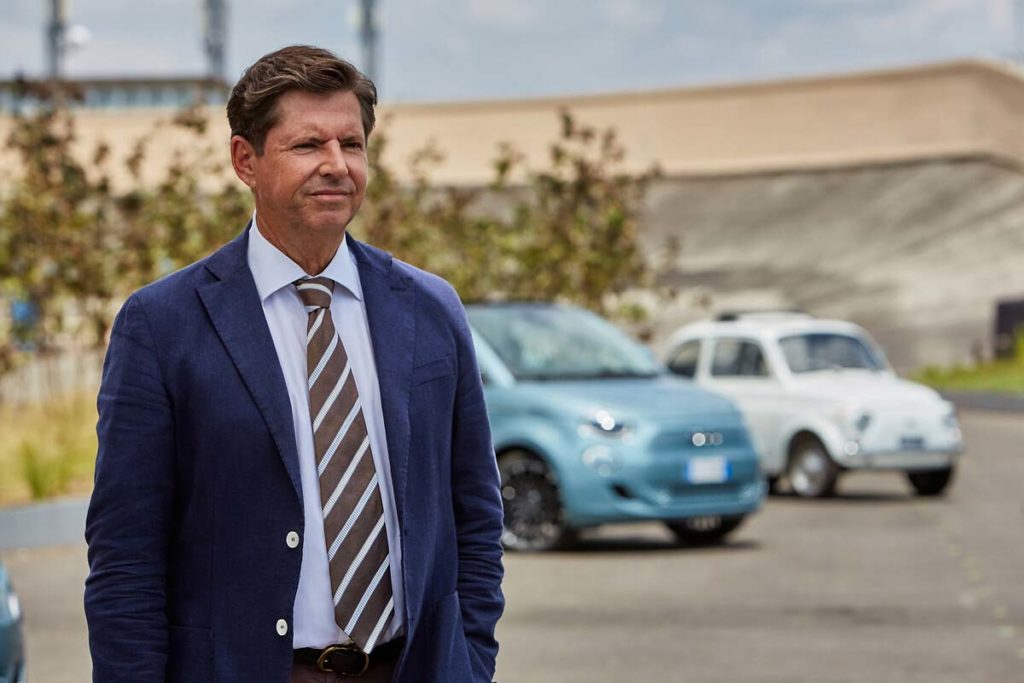
Currently at the helm of Fiat, Olivier François is often cited as one of the architects of the Italian brand’s revival. Yet nothing predestined him to become one of the most influential executives in the European automotive industry. In an in-depth interview with Autocar, Fiat’s CEO reflects on his unconventional career path—marked by several moments when his career could have come to an abrupt end—as well as his vision for the brand’s future.
A music lover who wasn't destined for a career in the automotive industry
Before becoming the CEO of Fiat, Olivier François was far from being an automotive expert. His world was more about music and culture. Married to Italian singer Arianna Bergamaschi—a close friend of singer Shaggy and even involved in organizing the first-ever concert at the Vatican—he admits that he knew little about automotive marketing when he began his career in the industry.
His first major assignment came in 2001, when he took over as head of Citroën Italy. At the time, the Citroën C2 and C3 had significant sales potential but were struggling to win over customers. Olivier François then decided to focus on marketing campaigns specifically designed for the Italian market—a strategy that surprised his superiors.
The early days were difficult, however. Nine months after taking the job, his superiors summoned him to Paris because the targets had not been met. It seemed he was about to be fired. In the end, a turn of events saved the day: Citroën’s market share in Italy narrowly exceeded the set target. A few years later, the brand even reached a 7.4 % market share—a level that Olivier François himself described as «crazy.».
«Fiat wasn't a great place to work»
His achievements quickly caught the attention of the Fiat Group. However, when he was approached, he was very hesitant. «I had two major concerns,» he says. The first was whether they were simply trying to push him out of his position at Citroën. The second concerned Fiat directly.
«Fiat wasn’t a great place to work because the company was struggling. That might not sound politically correct today, but it was the truth. It was a very dark period.»
At that time, the Italian group was indeed going through one of the most difficult periods in its history. Several brands were struggling, and financial resources were limited. That’s when Sergio Marchionne stepped in. Olivier François didn’t even know the man who would become one of the automotive industry’s most iconic leaders. The job interview took an unexpected turn when Sergio Marchionne brought up a topic far removed from cars: poetry.
Olivier François had published a collection of poems, a fact he kept quiet from his employers. Sergio Marchionne, however, discovered this passion and used it to establish an immediate connection with the future executive.
The Nearly Impossible Mission to Save Lancia
Marchionne then put him in charge of Lancia—a task that felt more like a sentence than a promotion. «Lancia was supposed to disappear,» Olivier François admits today.
Upon his arrival, he envisioned reviving the brand with iconic models such as a new Delta Integrale or a new Stratos. His proposals were met with a frosty reception. The group’s finances did not allow for such projects. The executive gradually came to understand that his true mission was not to restore Lancia to its former glory, but simply to ensure its survival.
The result is well known: the brand refocused on models based on Fiat and Chrysler designs. This strategy was criticized by many enthusiasts, but it ultimately allowed Lancia to survive to this day. «You never get credit for saving a brand,» he explains. «But in my case, it was destined to disappear.»
Chrysler: A $64 Million Gamble
After Lancia, Sergio Marchionne entrusted him with a new challenge: Chrysler. The situation was dire. The lineup was shrinking, several models had just been discontinued, and the brand had only $64 million to turn itself around.
Olivier François then made a bold decision. He allocated $20 million to a Super Bowl commercial featuring Eminem and used the remaining $44 million to redesign the Chrysler Sebring, which was renamed the Chrysler 200. The gamble paid off. Sales skyrocketed, increasing by 6,000 units between the Sebring’s final year and the Chrysler 200’s first full year. As for the commercial, it won an Emmy Award. This success significantly bolstered his credibility with Sergio Marchionne.
Joining Fiat and the Discontinuation of the Punto
In 2011, Olivier François finally took the helm at Fiat. Upon his arrival, he presented his vision for the brand’s future. One of his first decisions was particularly controversial: halting development of the next-generation Punto even though its launch was already imminent.
In his view, the project lacks personality and doesn’t address any specific need. «When someone tells me they’re going to launch a new car, I always ask them why. If this car didn’t exist, why would it need to be invented?» This philosophy gradually became Fiat’s guiding principle: to offer simple, accessible, and instantly recognizable vehicles.
A Decade of Waiting Before the Revival
Despite his vision, Olivier François struggled for many years with FCA’s financial constraints. Every time he presented a new project, the investments went elsewhere—to Jeep, Dodge, or Ram. These were choices he now recognizes as rational, but they continually set Fiat’s ambitions back.
During the 2010s, the brand survived mainly thanks to the Panda and 500. The 500X, 500L, and Tipo enjoyed some sporadic success but fell far short of fundamentally transforming the automaker’s image. «I waited and waited some more,» he sums up.
The real turning point came with the creation of Stellantis in 2021. For the first time in a long while, Fiat has the resources needed to bring to life the projects conceived a decade earlier. Olivier François is quick to praise the role Carlos Tavares played in this transformation. According to him, the current models are a direct result of the ideas Tavares had presented as early as 2011. The difference is that they now benefit from the Stellantis Group’s platforms and technologies.
The news Fiat Grande Panda perfectly symbolizes this rebirth. It is accompanied by the return of a Fiat 500 thermal, a highly anticipated decision following the commercial challenges faced by the 500e electric model. The executive acknowledges some scheduling errors, particularly model unveilings that were rushed, but remains convinced that the current strategy is the right one.
«Prosperity is coming»
Now approaching 65, Olivier François admits that the thought of retirement sometimes crosses his mind. However, he has no plans to leave his position anytime soon. After more than a decade of waiting for the right moment, he believes that Fiat is finally ready to reap the rewards of his work.
The Grande Panda has now been launched, new family models inspired by the Panda spirit are in the works, and the brand finally has the industrial resources needed to bring its vision to life. «I grew up in a time of scarcity,» he explains. Today, he finally sees what he describes as an oasis emerging after many long years of restrictions. And while he remains cautious, the Fiat CEO is convinced that the best is yet to come: «Most people don’t see it coming yet, but it’s coming. Let me enjoy it.»
 English
  French
  Italian
  Spanish
  German
  Japanese
  Dutch
Dutch
It’s still a scary track record, though—he oversaw the near-collapse of Lancia and Chrysler, and then Fiat was heading down the same path in Europe, but the merger with PSA saved it because, if you read between the lines, FCA wasn’t investing in its platforms!
That's completely false, because Giorgio and others prove the opposite.
It is FCA that is saving PSA from inevitable bankruptcy using taxpayer money and funds from Dongfeng.
The one that also brought liquidity back into the deal was FCA, because PSA had spent a fortune on Opel/Vauxhall, and the engines were already causing problems—even though Tavares did everything he could to cover up the matter with Macron’s complicity.
Totally wrong. FCA was looking for a partner capable of sharing platforms, engines, and technologies that FCA lacked. Discussions with Renault came to an end when Elkann realized that the French government would be a difficult shareholder, and he then spoke with Robert Peugeot and Carlos Tavares. This is why the new FIATs, Alfas, and Lancias are based on PSA models: the 208, 2008, C3, and C3 Aircross. François is right to say that without the merger, FIAT would have been unable to launch new cars that met EU regulations.
Giorgio is in trouble—the Giulia isn't selling because they forgot about the station wagon, and the Stelvio isn't doing any better. Just for the record, Peugeot sells three times as many 3008s as Tonales!
PSA was in very good shape at the time of the merger; it was PSA that provided the cash that was distributed to shareholders, and the acquisition of Opel had already been written off by that time.
Today in Europe, the best-selling models from Fiat, Alfa, Jeep, and Lancia are all built on platforms from PSA!
At the same time, it's not hard since all the new models are based on PSA platforms lol
New product + entry-level = wow, it's selling better than the high-end models…
He was assigned a brand that the board likely wanted to shut down, and he managed to keep it afloat by coming up with special editions that were perfectly tailored to the customer base.
Fredo is right, but since you're all so good, go ahead and do the work—I'll provide feedback afterward… Good luck—try getting someone in Europe to do the work… Hugs
Personally, I think he's terrible… we need to replace him… he's a whiner
I agree. Oliver Francois—how much more French can it get?—isn't inspiring people. There's too much hierarchy and formality. If you want to impress me, get Alfa Romeo back on track. It's very easy to figure out how, but probably hard to do with Paris breathing down your neck.
Does that surprise you? It doesn't surprise me.
Unfortunately, canceling the Punto replacement only accelerated Fiat's decline.
FIAT’s problem was the 2008 crisis, during which it nearly went bankrupt, and the Agnelli family sold off many of its non-automotive assets—primarily New Holland, Magneti, and the motorhomes that saved them—but it was a close call, because on top of that, they were in the midst of a succession battle and a family feud… nothing could be more toxic.
Olivier François… don’t make me laugh. This guy is a disgrace as a leader—like, sadly, so many others who just sit back and take it. But you have to admit, their job isn’t necessarily easy, stuck as they often are with annoying shareholders😳
Garbage manager. The main cause of Fiat's decline. Where are Garuzzo or Valletta when we need them? Fire this French empty suit yesterday.
An unbearably incompetent person, and he still wants to stay. He probably doesn't even know why himself!
You're all picking on that poor man…
Come on, do you know of even one good executive at Stellantis?