

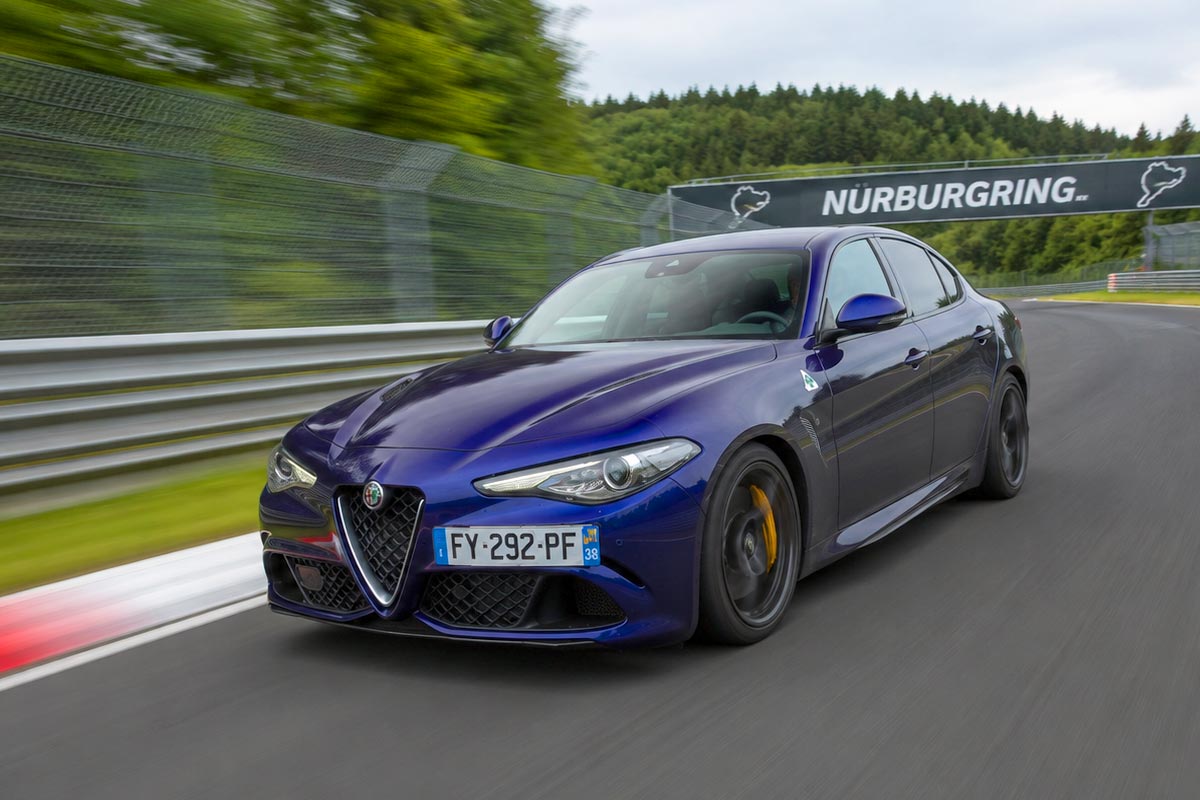
L'Alfa Romeo Giulia The Quadrifoglio is already considered by many to be one of the best sports sedans of its generation. But what happens when you replace its famous ZF eight-speed automatic transmission with a six-speed manual? That’s exactly what race car driver and automotive videographer Misha Charoudin set out to discover during a full lap of the Nordschleife behind the wheel of a very special model.
A Giulia Quadrifoglio Like No Other
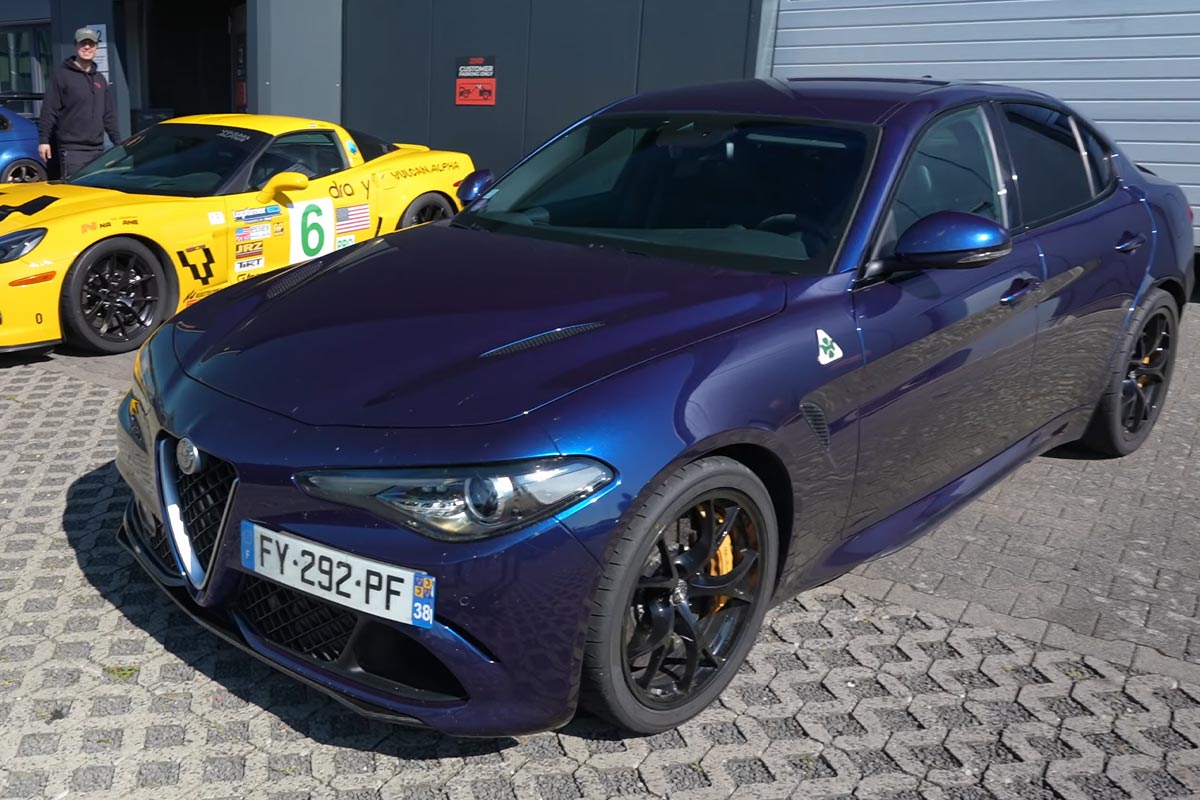
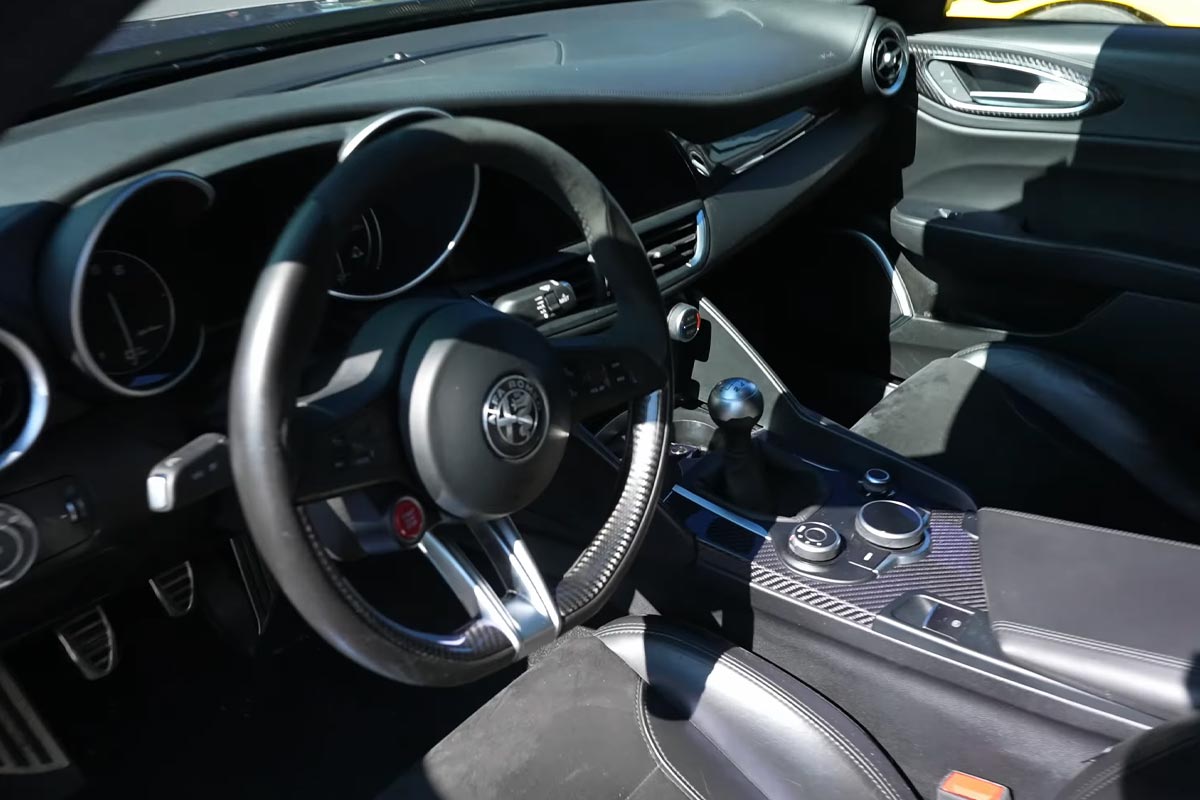
The test car retains most of its original configuration. Under the hood, it still features the Quadrifoglio’s 2.9-liter twin-turbo V6 engine, paired with a rear-wheel-drive transmission. The modifications are relatively limited: Yokohama AD09 semi-slick tires, upgraded brakes, a slightly revised differential, and, most notably, a manual transmission—a feature that has become extremely rare in modern sports cars. From the very first few kilometers, Misha Charoudin was won over. Having already driven several Giulia Quadrifoglio models equipped with steering wheel-mounted paddle shifters, he says this manual version completely transforms the driving experience. In his view, the car even seems to deliver more torque than the automatic version, largely due to the absence of certain torque limitations found in the automatic transmission.
«One of the best sports sedans ever built»
He makes no secret of his admiration for the Giulia. Even before hitting the track, he explains that he already considers the model one of the best sports sedans ever produced. And after just a few turns on the Nürburgring, his enthusiasm only grows. What particularly impresses him is the overall balance of the chassis. The steering feels extremely responsive to him, and the rear axle is particularly well-behaved despite the V6«s power. Several times during the lap, he highlights the car’s ability to pivot naturally through corners while maintaining excellent traction. On certain fast sections of the Nordschleife, he’s even content to stay in third gear thanks to the engine’s generous power delivery. »Lots of torque, perfect gear ratios,” he sums up enthusiastically.
A Few Limits on the Track
However, not everything is perfect. While the Giulia handles the bumps and compressions of the Nürburgring particularly well, Charoudin feels that the stock suspension becomes a little too soft when the semi-slick tires start to generate more grip.
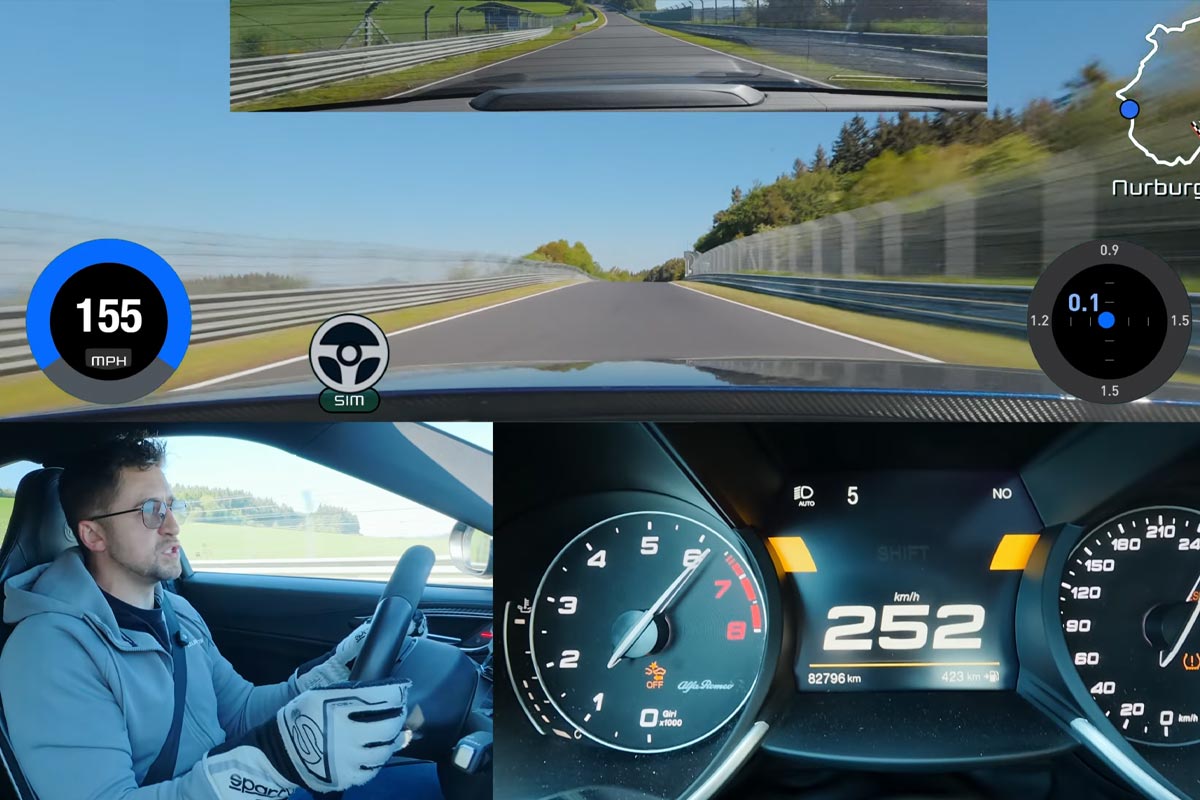
In particular, he notes fairly pronounced body roll in slow corners and some dramatic reactions from the front end during load transfers. For everyday driving, however, he considers this trade-off to be very reasonable. In his view, installing a more aggressive suspension would improve track performance but would sacrifice some of the versatility that is precisely what makes the Giulia so appealing.
The Giulia over a BMW M3?
Throughout the test drive, one comparison keeps coming up: the BMW M3. Without hesitation, Misha Charoudin says he prefers the Italian sedan. He highlights the steering feel, the chassis balance, and the interior and exterior design of the’Alfa Romeo. In fact, the experience is so compelling that he admits he is seriously considering buying a Giulia as his next personal vehicle. Interestingly, it wouldn’t be a Quadrifoglio but rather a 2.0-liter four-cylinder version that he might modify to compete in the NLS endurance races held at the Nürburgring.
Favorite
In the end, the verdict is clear. Misha Charoudin calls the car «fantastic» and explains that he likes this manual version even more than the Giulia Quadrifoglio models with paddle shifters that he’s driven before. For him, this transmission restores a mechanical and emotional dimension that perfectly matches the character of the Italian sedan. This is a conclusion that Alfisti will certainly share. For while the Giulia Quadrifoglio is already a benchmark in its standard configuration, this rare conversion to a manual transmission seems to reveal even more of the potential of a chassis that many already consider one of the best in its class.

 English
  French
  Italian
  Spanish
  German
  Japanese
  Dutch
Dutch
In any case, aside from the M3, the Giulia doesn't have
There hasn't really been any competition since the Kia Stinger was discontinued.
A must-buy and a must-keep (for those who can, of course). This is the absolute best of the best.
The next Giulia might be a bit of a dud.
A semi or a total piece of crap.
The one she kept in her collection is the famous manual transmission version
This Giulia with a manual transmission isn't a conversion; it came that way from the factory. Most Giulias have the well-known ZF8 automatic transmission. The manual version is therefore a rarity that will set you back a pretty penny if you want one.
Everyone who has driven the Giulia Quadrifoglio and the M3 Competition agrees that the Alfa Romeo offers a far superior driving experience and more driving pleasure. The best sports sedan on the market hasn’t achieved the commercial success it deserves.
I’d say Marchionne was out of his mind, just like Lysander, thinking he could sell a completely unrealistic number of units. This kind of product isn’t meant to be sold in large volumes, and when you announce sales figures worthy of a Mito… It’s just that mushrooms 🍄 are super tough!
Just to get it moving! They put a Ferrari engine in it!!! BMW engine!!!
I'd rather have a Cadillac CT4-V Blackwing with a manual transmission.
I have an Alfa Giulia. It's way better than the M3—it's the benchmark.