

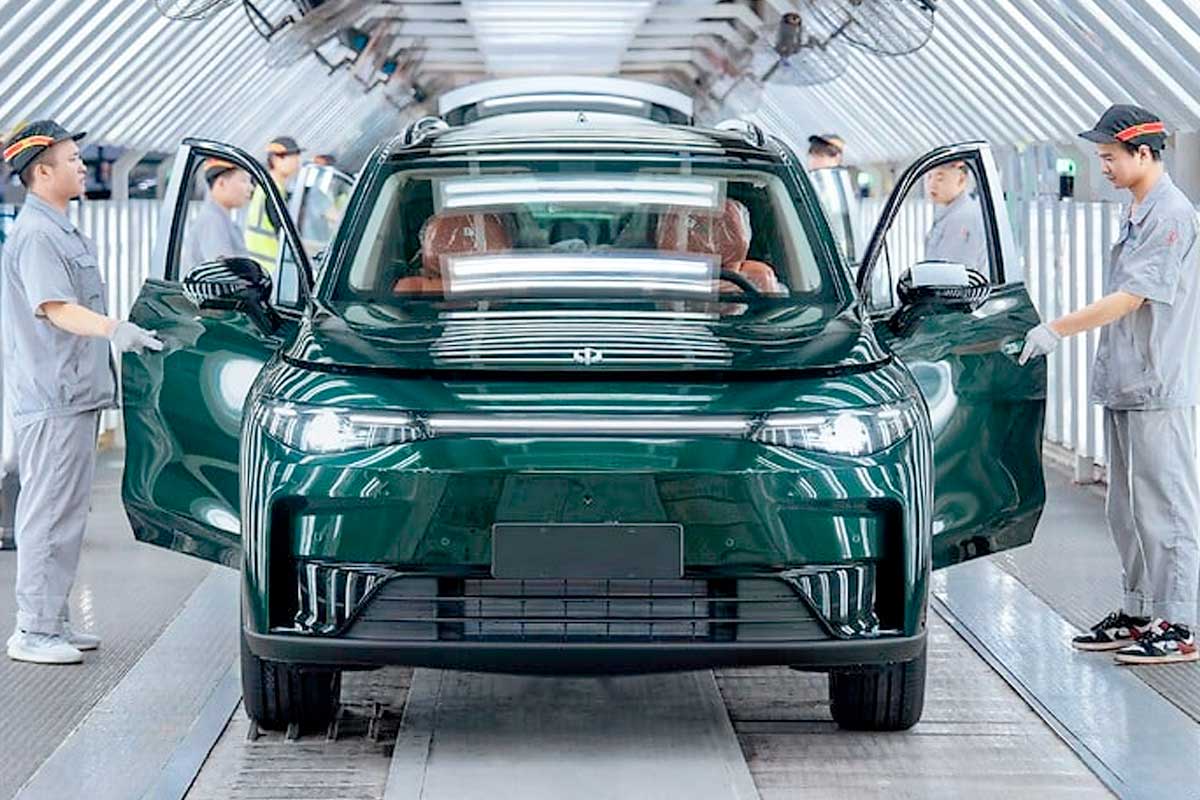
When Stellantis announced its €1.5 billion investment in Leapmotor at the end of 2023, many saw the deal as a risky gamble. Carlos Tavares himself had long warned of the growing power of Chinese automakers. Yet, barely two years later, this alliance now appears to be one of the most intelligent strategic decisions taken by the Franco-Italian-American automotive group.
After the first very solid results published by Leapmotor a few weeks ago, new information revealed by Italian media Milano Finanza confirms one thing: the Stellantis-Leapmotor joint venture is already working much better than expected.
A joint venture already worth over a billion euros
According to financial documents consulted by Milano Finanza, the real operational structure of the alliance is not in the Netherlands, where the holding company Leapmotor International BV, 51 % of which is owned by Stellantis, is located, but in Turin, Italy, at the historic Mirafiori site. The Italian company Leapmotor International Business, based on Via Plava in Turin, oversees all industrial, commercial and distribution activities for the Chinese brand outside China. And the figures for the first full year of activity are already impressive.
In 2025, the joint venture generated over one billion euros in sales, with exactly 1.044 billion euros in total production and 809 million euros in revenues. This represents a spectacular increase of 462 % compared with 2024, a year in which activity only really began at the end of September. Above all, this growth is not being achieved at a loss.
Already profitable after just one year in business
This is probably the most striking aspect of these results: the Stellantis-Leapmotor joint venture is already highly profitable.
Net profit reached 44 million euros in 2025, compared with just 3.9 million euros the previous year. Pre-tax profit even climbed to 56 million euros. A remarkable performance for a company still in the midst of an international expansion phase, which nevertheless continues to invest heavily in its sales network, guarantees and the development of foreign markets.
This rapid profitability confirms the initial signals sent out recently by Leapmotor itself. A few weeks ago, the Chinese automaker announced its first annual profit since its creation, with 540 million yuan in earnings (around 70 million euros) and nearly 600,000 vehicles to be delivered worldwide by 2025. Behind these results lies an extremely rapid rise in sales.
Over 50,000 cars sold outside China
In 2025, the joint venture sold over 52,000 Leapmotor cars worldwide, including almost 43,000 in Europe. By comparison, only 7,291 vehicles were sold in 2024. That's barely less than Alfa Romeo, if you want a comparison.
The sales network has also exploded, and now exceeds 850 points of sale worldwide. Here again, Stellantis plays a central role. Three models are currently driving this growth. The T03 small electric city car has sold over 23,000 units, while the C10 SUV has topped the 20,000 mark. More recently, the new B10 compact SUV has already achieved almost 9,000 sales. Financial figures also show strong cash generation. Cash and cash equivalents have risen from 47 to almost 294 million euros in just twelve months. Inventories have also risen sharply.
Turin at the heart of Stellantis' Chinese strategy
One of the most surprising aspects of this new organization is the role once again played by Turin. While many feared a loss of Italian industrial influence at Stellantis, the joint venture with Leapmotor finally places Mirafiori at the center of the Chinese manufacturer's international operations outside China.
The Italian structure already manages several European subsidiaries, with branches opened in France, Portugal, the UK and the Netherlands. For 2025, an additional Spanish subsidiary has also been set up to prepare local industrialization of future Leapmotor models. In particular, the B10 SUV is due to be produced at the Stellantis plant in Zaragoza from 2026, while the Madrid site could also play an important role in the Chinese brand's industrial expansion in Europe.
This alliance could now serve as a model for the Group's future. Antonio Filosa, Carlos Tavares' successor, could set up industrial partnerships along similar lines with Asian groups. The idea is simple: Chinese automakers bring competitive electric platforms and lower costs, while Stellantis provides its global network, factories and commercial presence in Europe and North America.
In any case, two years after the announcement of this alliance, the figures are beginning to speak for themselves: what looked like a risky gamble now appears to be one of the automotive group's most profitable and strategic operations.
 English
  French
  Italian
  Spanish
  German
  Japanese
  Dutch
Dutch
Good news. If it saves the group's furniture, it's a good thing.
Good news too for the location of Stellantis' Chinese activities in Turin. We'll have to make sure that Stellantis doesn't offload everything bit by bit to Leapmotors. On the one hand, jobs will be preserved, and the government and unions will be happy. But on the other, the Italian part of the group will be gutted. If everything is to be designed in Sochaux and Detroit, we'll end up with empty shells. Just like the situation at Opel's Russelsheim plant.
«We'll have to make sure that Stellantis doesn't offload everything bit by bit to Leapmotors.»
We?
STLA relies heavily on the United States. As a result, Leapmotor will remain a label, not a threat.
Toyota has been manufacturing a large number of vehicles in Europe for many years, but with its own factories.
We thought they were going to eat us. European manufacturers were still masters of their markets. This is something else. We're giving away the remnants of our family jewels.