

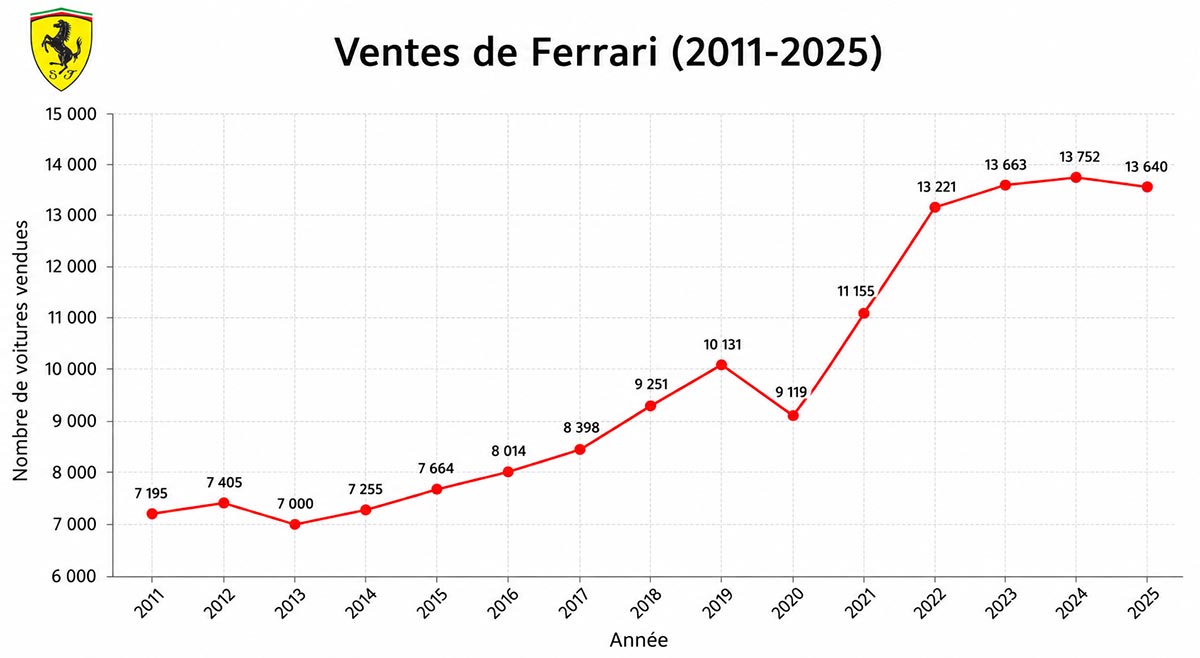
After a year in 2025 marked by a slight decline, the first six months of 2026 confirm an unexpected trend: Ferrari is no longer growing. Across the twelve markets we track, the brand recorded 4,857 registrations between January and June—nearly the same level as during the same period in 2025. With a difference of only about 30 cars, the volumes are identical. After nearly doubling its registrations over the course of a decade, Ferrari appears to have reached a threshold that the brand no longer really seeks to exceed.
A more comprehensive lineup than ever before
What makes this stability particularly surprising is that Ferrari has probably never offered such a wide range of models.
Today, sales are driven primarily by four models. The Purosangue, the first V12 SUV in the brand's history, continues to appeal to a very broad customer base. The 12Cilindri has established itself as the premier V12-powered GT, while the 296 remains the «affordable» sports car in the lineup thanks to its hybrid V6. Finally, the Roma is gradually winding down her career, replaced by the’Amalfi, which is starting to appear in vehicle registrations.
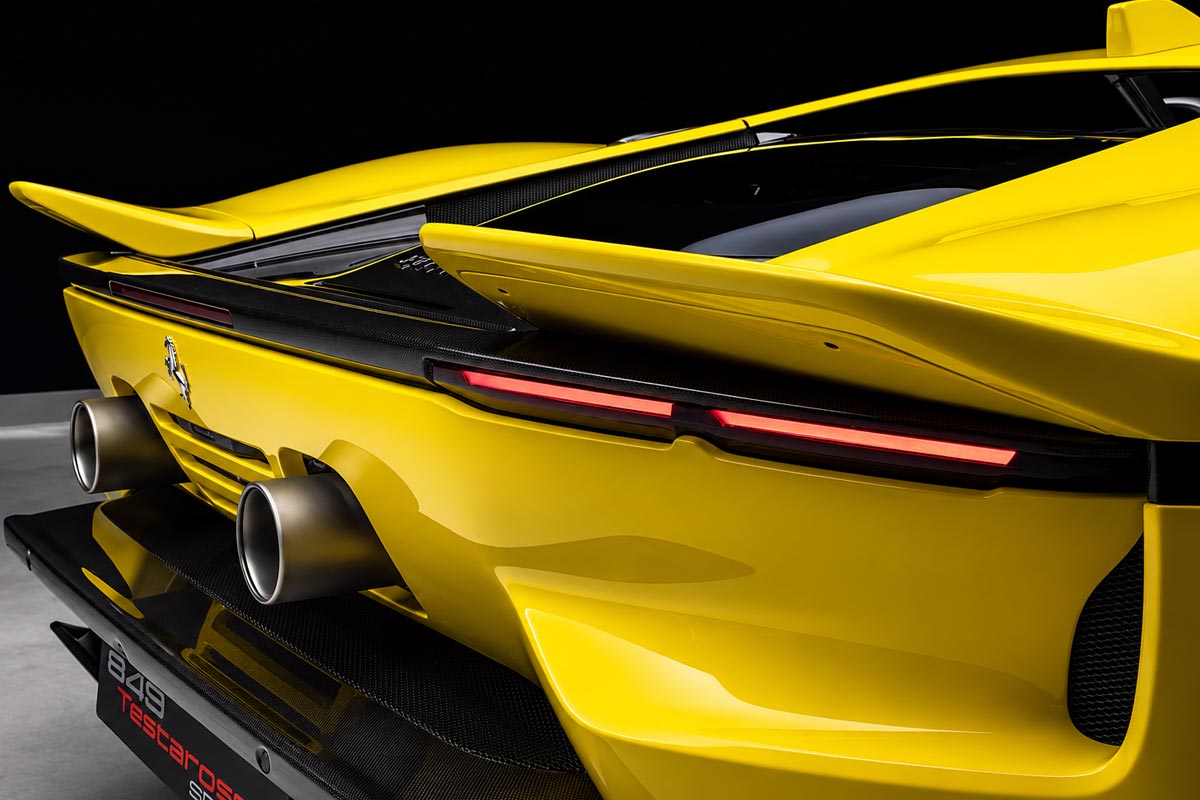
The SF90 is also continuing her career on a smaller scale, while her replacement, the new 849 Testarossa, has been appearing in the statistics for the first time since March–April.
Differences That Are Difficult to Explain by Country
The United States remains by far the world’s largest market, with 1,655 registrations in the first half of the year (+3 %). Japan also confirmed its strong momentum (+19 %), as did Italy (+32 %) and Spain (+18 %).
Conversely, several European markets are surprising. Germany is down slightly (-5 %), while France has plummeted by 37 %, with only 113 registrations. Even more surprising is that the French market is performing worse than in the first half of 2025, but also worse than in 2024 and even 2023, despite having shown steady growth up to this point.
The United Kingdom continues to see a decline (-27.1 TP3T), a trend that remains consistent with tax changes affecting high-net-worth foreign residents, a topic that We have already explained in detail. In contrast, the declines observed in the Netherlands (-40 1Q3Q) and Austria (-41 1Q3Q) are much more difficult to interpret.
Ferrari Now Prioritizes Value Over Volume
Ultimately, this stabilization is nothing to worry about for Ferrari. For several years now, management has stated that it intends to prioritize profitability over volume growth. Customization, through the Tailor Made program, now plays a central role in Maranello’s strategy. In other words, selling the same number of cars—but at much higher prices thanks to options and customizations—is now more appealing than trying to set a new record for new car registrations.
Ferraris bought as investments are probably not what we think they are
This snapshot of the market also offers insights for collectors. The models that currently account for the bulk of sales—the Purosangue, 12Cilindri, 296, Roma, Amalfi, and the new 849 Testarossa—are produced in relatively large volumes by Ferrari’s standards. Conversely, the models most likely to retain their value are the special editions, the Icona models, and limited-edition supercars. As is often the case with Ferrari, rarity remains the primary driver of value.
| Country | January–June 2026 | Evolution |
|---|---|---|
| United States | 1655 | 3% |
| Japan | 852 | 19% |
| Germany | 947 | -5% |
| Italy | 585 | 32% |
| United Kingdom | 316 | -27% |
| France | 113 | -37% |
| Australia | 88 | -12% |
| Belgium | 110 | -% |
| Netherlands | 39 | -40% |
| Spain | 70 | 18% |
| Austria | 27 | -41% |
| Luxembourg | 55 | -10% |
| 4857 | 0 |
 English
  French
  Italian
  Spanish
  German
  Japanese
  Dutch
Dutch