

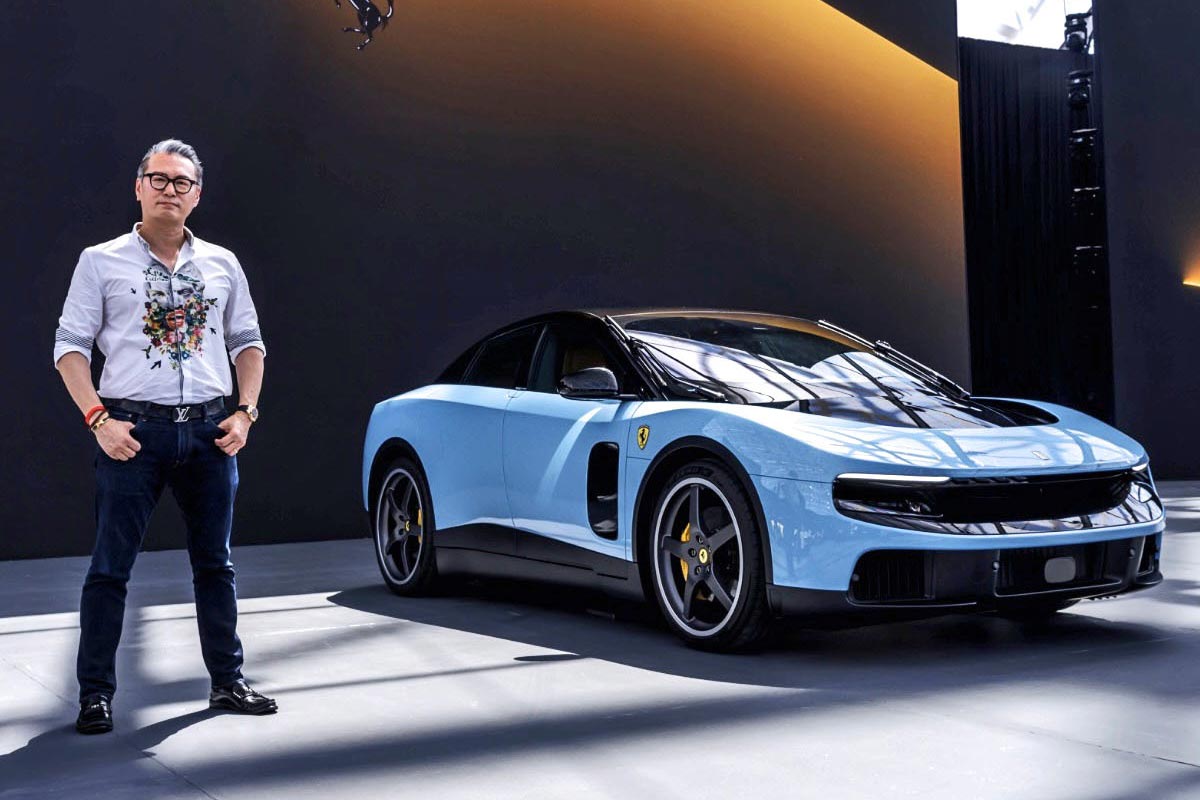
When Ferrari unveiled the Luce, With the launch of its first 100 % electric car, the Maranello-based manufacturer knew it was taking a risk. With its 1,050 hp, supercar-like performance, price in excess of €550,000 and design radically different from the rest of the range, this luxury electric sedan left no one indifferent.
But while there has already been much debate in Europe and the United States, it was interesting to observe the reaction of the country that now dominates the global electric vehicle market: China. And to say the least, the welcome given to the Ferrari Luce has been particularly cold.
A Ferrari that looks like... anything but a Ferrari
What's immediately striking about the Chinese reactions is that the criticisms are not primarily about performance or technology. It's primarily about design.
On China's social networking sites, many users are calling the car «ugly». Some even call it «ugly beyond imagination». Others say it looks more like a generic electric vehicle than a Ferrari.
The most frequent comparisons are revealing. A number of Internet users refer to an Apple product on wheels, a direct consequence of the involvement of the famous designer Jony Ive, formerly responsible for iPhone design. Others see it as a mix of Xiaomi, Apple Car or even some of the Chinese electric sedans already on the market.
One comment sums up this sentiment, which is finally shared the world over:
«If we replaced the Ferrari logo with an Apple logo, everything would become coherent.»
«It looks like a Chinese electric car... but more expensive».»
China is now accustomed to seeing new, futuristic electric models appear every month. Manufacturers such as BYD, Xiaomi, Nio and Zeekr have profoundly altered consumer expectations.
Many Chinese Internet users struggle to understand the positioning of the Ferrari Luce. Several comments claim that Chinese models already offer comparable performance at a fraction of the price. Some even quote BYD or the forthcoming Xiaomi YU7 GT directly, believing that these vehicles could «crush» the Ferrari on the performance/price front.
In the end, this reaction comes as no surprise. Ferrari is asking more than €550,000 for a car with a claimed range of 530 km, and whose acceleration rivals that of some Chinese electric sedans sold for five times less. In China, where the price war has been raging for several years, this difference is hard to justify on brand prestige alone.
The culture shock of going electric
Beyond the design, another criticism is regularly voiced: an electric Ferrari would be a contradiction in terms. Several comments refer to the model's lack of «soul». Some believe that Ferrari was born for circuits and combustion engines, not for producing silent electric vehicles.
One of the most widely shared comments sums up this vision:
«Apple was born for the general public. Ferrari was born for the track. The two philosophies are incompatible.»
Even among Chinese electric car customers, many consider that Ferrari is losing part of its DNA by abandoning the internal combustion engine. This is an interesting point, as it shows that attachment to Ferrari engines is not limited to Europe or the USA. Even in the country with the fastest adoption of electric cars, the Ferrari myth is still largely associated with the sound of the V8 or V12.
But it's not all bad news
A few more nuanced voices emerge, however. Some Internet users hail the car's interior as modern, elegant and particularly successful. In fact, several commented that the interior was far more attractive than the exterior.
Others point out that Ferrari customers don't just buy a specification sheet. For them, the Luce could appeal to a new category of affluent customers looking for an exclusive family car, capable of taking the kids to school or driving through town without attracting the attention of a traditional supercar. An Internet user sums up this idea:
«It could become the ideal family car for the ultra-rich.»
The same reaction on every continent
In the end, what emerges from the Chinese reactions is not a rejection of the electric car. Quite the contrary, in fact. China loves electric cars.
What's being dismissed here is an electric Ferrari that doesn't look Ferrari enough. Criticism rarely focuses on the 1,050 hp, the 122 kWh battery or the impressive performance claims made by the brand.
The real problem seems to lie elsewhere: in the eyes of many Chinese Internet users, the Luce looks more like an Apple concept, a large Chinese electric sedan or an exercise in futuristic styling than a descendant of the Ferraris that made generations of enthusiasts dream. The Italian brand has always sold an emotion, a dream and an identity. And yet, reading the reactions from China, it's precisely this identity that many found hard to find in the Luce.
 English
  French
  Italian
  Spanish
  German
  Japanese
  Dutch
Dutch
When even the Chinese tell you it's ugly...
È sempre una ferrari ed bellissima ne parlano male gli invidiosi
The design is nothing like a Ferrari, even on the street without the brand logo, you'd think it was a Chinese car. .
Elkann wanted it.
He's being very discreet, strangely enough...
As I was saying about Alfa Romeo, when this kind of brand switches from internal combustion to electric propulsion, it's already a revolutionary change: the appearance and specific features must stick as closely as possible to the brand's historical codes, even if the evolution is logical. The body is an essential part of Italy's automotive heritage, and innovation for innovation's sake makes no sense, but it does keep the weight down (it weighs almost 500kgs more than a GTC4Lusso). Respecting brand identity is important, as we're seeing with Lotus at the moment.
The Ferrari Luce isn't aimed at ferrarist customers. It should be seen in a different light, as a high-performance electric car with an original design.
It's not a Chinese car, but an Italian with a new look.
Those who criticize the Luce simply haven't understood who this car is designed for.
It's true that it's marketing genius to sell a model under a brand name that isn't intended for the brand's customers. The truth is that they screwed up on the platform, the «skateboard» architecture isn't suitable, and I'm delighted that the Maserati teams realized this and abandoned the STLA Large in favor of the Giorgio Evo. Hopefully, the Alfa Romeo teams will have the same insight.
When one of the main talking points in a review of a ‘Ferrari’ is how amazing the fan vents are—and how they twist and turn—then you know things have really gone off the rails.
What the hell is this piece of crap?.