

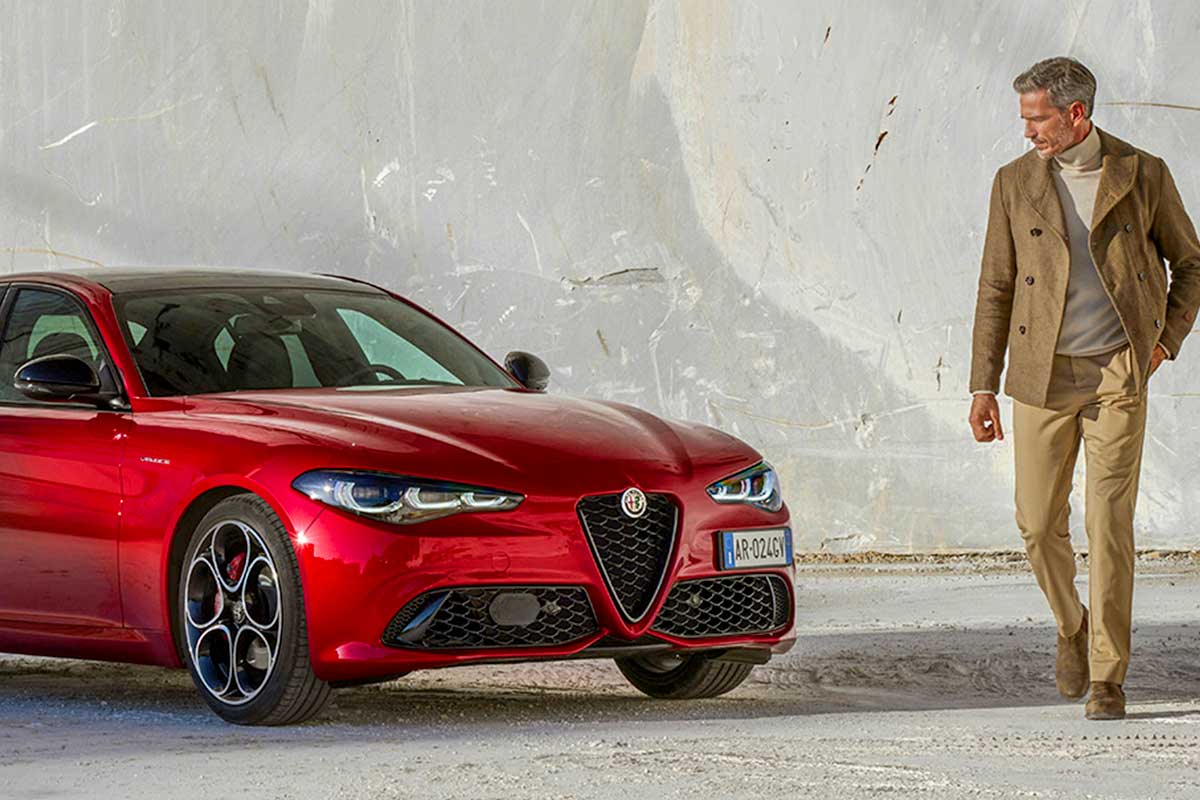
In 2025, Alfa Romeo can boast a return to positive momentum. The Italian brand recorded over 73,000 registrations worldwide, an increase of just over 20 % compared with 2024. Welcome growth for a manufacturer emerging from several difficult years. But behind this rebound lies a more surprising reality: today, driving an Alfa Romeo is almost like driving a rare car. Even rarer than a Porsche.
A confidential brand in the face of German giants
With 73,000 cars sold in 2025, Alfa Romeo remains an extremely discreet manufacturer worldwide. The comparison with its historic German rivals is stark.
BMW delivered around 2.17 million cars last year, Mercedes around 1.8 million, and Audi almost 1.6 million. The gap is no longer a mere delay: it's an abyss.
Even Porsche, considered a relatively exclusive manufacturer, is moving into another dimension. The Stuttgart-based brand sold almost 280,000 cars in 2025, almost four times as many as Alfa Romeo. The contrast becomes even more striking when you look at the individual models. The Porsche Cayenne, with over 80,000 units sold, alone exceeds the cumulative sales of the entire Alfa Romeo range, comprising the Junior, Tonale, Giulia and Stelvio.
In other words, owning an Alfa Romeo today means driving a much rarer car than most Porsche models.
Junior saves the year 2025
If Alfa Romeo is showing significant growth in 2025, it's thanks above all to one model: the Junior. The new B-SUV, launched in 2024, quickly found its audience. Within a year and a half, exceeded 60,000 orders, becoming the brand's only real sales driver.
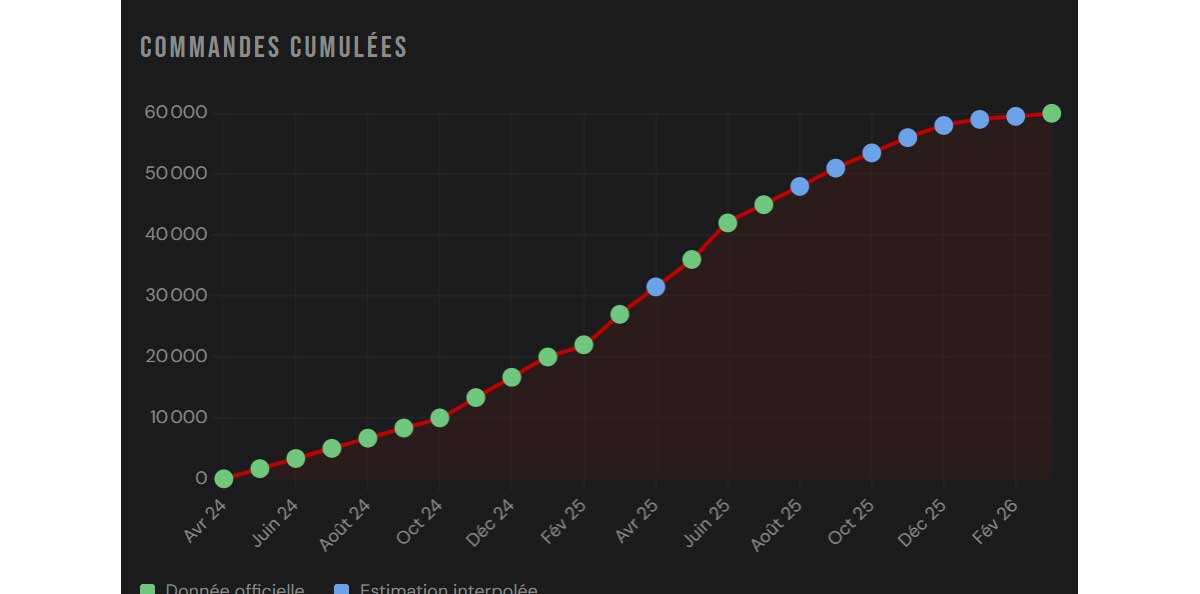
In fact, the Junior alone accounts for the overwhelming majority of the brand's sales. According to our estimates, of the 73,000 cars sold worldwide in 2025, around 45,000 will be linked to this single model, while the rest of the range shares the remaining volumes. A success that is helping Alfa Romeo to revive its growth... but also underscores its dependence on a single model.
Giulia and Stelvio, models at the end of the cycle
Indeed, the rest of the range is showing clear signs of running out of steam. The Giulia and Stelvio, launched in 2015 and 2016 respectively, are now approaching ten years in business. Initially, their replacements were due to arrive earlier, but hesitations surrounding Stellantis' electric strategy have postponed their renewal.
As a result, these two models will remain in the catalog until 2027, extending their careers well beyond the usual cycle in the premium segment. This is naturally reflected in sales, which are now limited to a few thousand units per year in several markets. Even if certain exclusive versions, such as the Quadrifoglio editions, continue to appeal to enthusiasts, their commercial weight remains very limited.
A brand that lives far from its historical records
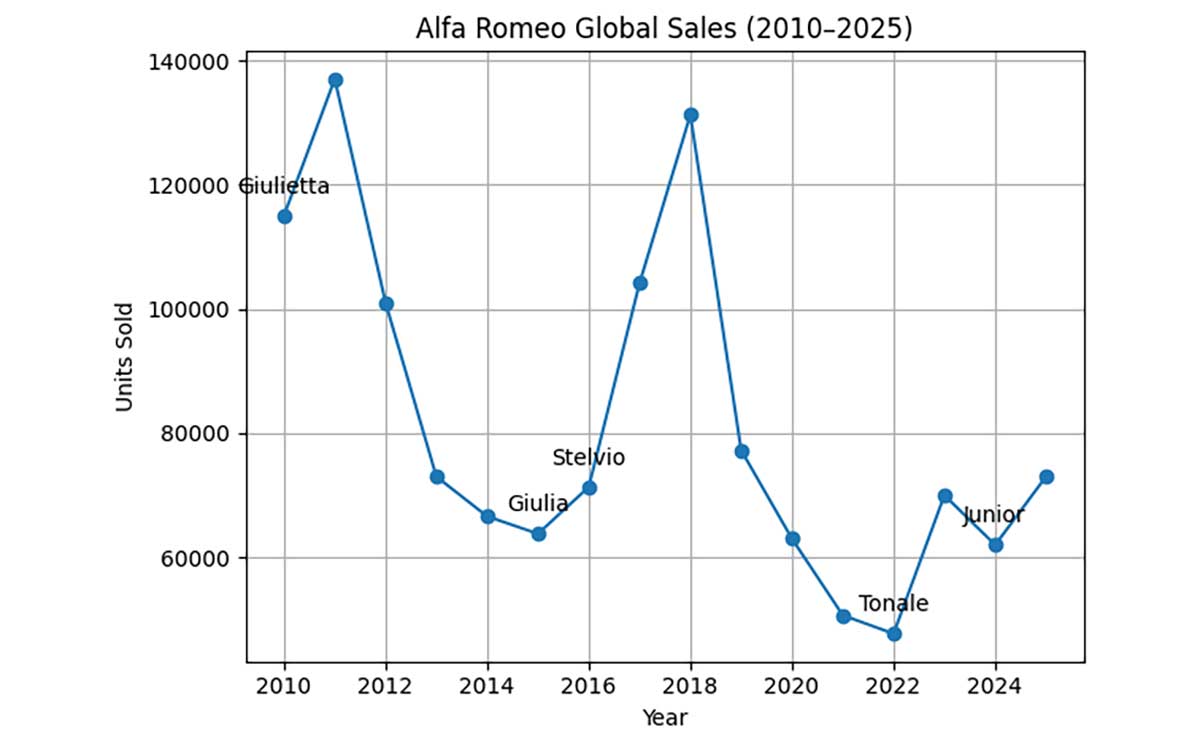
To appreciate the scale of the challenge, we need only look in the rear-view mirror. In 1990, Alfa Romeo set an all-time record with 223,643 cars sold worldwide. A level three times higher than today. Even more recently, the brand had enjoyed a spectacular rebound with the launch of the Giulia and Stelvio, with over 131,000 sales in 2018. But this momentum was never sustainable, and volumes quickly fell back. For more than a decade, Alfa Romeo has hovered around a ceiling of between 60,000 and 70,000 cars a year, proof that the brand is still struggling to truly change dimension.
Encouraging but fragile growth
For Alfa Romeo CEO Santo Ficili, the 2025 milestone is nonetheless an important one. According to him, this growth shows that ’Alfa Romeo is back in the race“, even if the objective is not limited to increasing volumes. The strategy is also to strengthen the brand's desirability and build customer loyalty.
The Junior has already attracted a new generation of buyers, while the restyled Tonale is set to consolidate the brand's presence in the compact SUV segment. And at the top of the range, the spectacular 33 Stradale continues to embody the brand's emotional, artisanal dimension.
But for Alfa Romeo to truly change scale, one challenge remains: to exceed the 100,000 annual sales mark on a sustained basis. In the meantime, driving an Alfa Romeo has become an almost rare privilege. And paradoxically, this makes the Biscione models more exclusive than many a Porsche.
 English
  French
  Italian
  Spanish
  Portuguese
  German
  Japanese
  Turkish
  Dutch
Dutch
Rarer means more exclusive.
However, compared to sales when the Giulietta was introduced in 2010-2011, between 120,000 and 138,000 units, or even in 2018 (probably Giulia + Stelvio, 130,000 units), current sales are modest.
This tends to prove that Alfa Romeo, which only offers SUVs apart from the Giulia, doesn't offer models that appeal enough, and that's a mistake.