

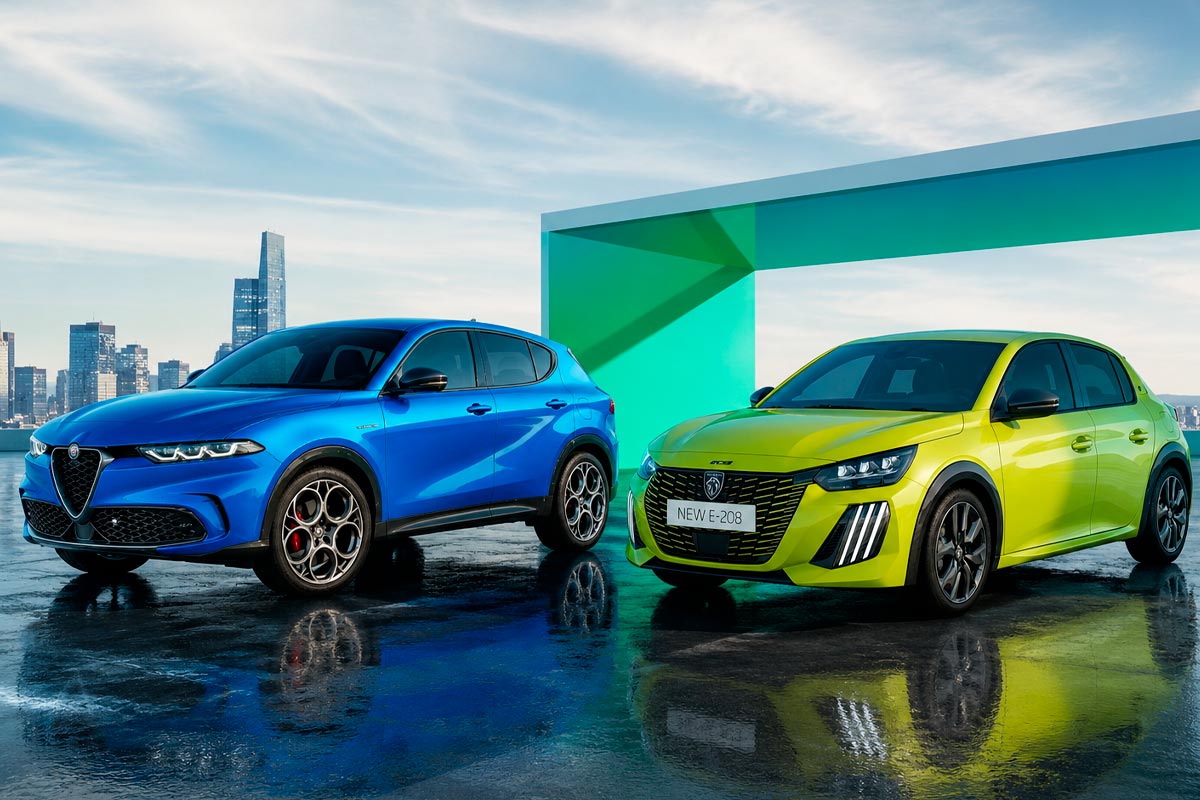
May 2026 will undoubtedly go down as one of the busiest months in recent years for Stellantis when it comes to recalls in Europe. In the space of just a few days, the automotive group had to launch two major campaigns affecting two very different models: the Peugeot 208 and the Alfa Romeo Tonale. These two vehicles alone account for over 650,000 affected cars across the continent.
Behind these recalls, however, lie two completely opposite problems: on the one hand, a horn deemed too weak to comply with European regulations, and on the other, a possible engine defect that could even cause a fire.
More than 612,000 Peugeot 208 recalled... for a weak horn
The information comes directly from Germany, via the Kraftfahrt-Bundesamt (KBA), the German federal authority responsible for road safety. According to documents published on May 18, 2026, Peugeot must recall 612,196 examples of the Peugeot 208 produced between September 2019 and July 2022.
The problem may seem almost anecdotal at first: the horn doesn't comply with the minimum noise level imposed by European regulations. When tested, some cars were found to have only 84 decibels, whereas the standard requires a minimum of 87 decibels.
But behind this simple discrepancy of a few decibels lies a far more complex industrial reality. According to explanations provided by Peugeot to the German press, the problem is not directly due to the horn itself, but to its location in the vehicle. Too little space around the horn could reduce its acoustic power. In practical terms, this means that in dangerous situations, some road users may not be able to hear the horn properly. To correct the problem, owners will be invited to visit a workshop to replace the horn with a more powerful version.
Alfa Romeo Tonale faces a much bigger problem
While the campaign for the Peugeot 208 is essentially regulatory, the one for the Alfa Romeo Tonale is of a completely different nature. A few days ago, we have already mentioned this major reminder launched by Stellantis on the Italian SUV. European authorities have officially reported a potentially critical defect on Tonale hybrid 160hp models equipped with the 1.5L GSE T4 DOHC petrol engine.
More than 33,000 units produced between February 2022 and February 2026 are affected. According to the official notification, abnormal combustion could lead to excessive temperatures and pressures inside the engine. In the most serious cases, this could lead to the deformation or even rupture of a connecting rod. The risk is particularly serious, since the authorities explicitly mention the possibility of a fire starting while driving.
This time, it's not just a matter of replacing a peripheral part or updating the software. The problem directly affects the engine's internal components, which could require major mechanical intervention in the Alfa Romeo network.
Two recalls, one observation for Stellantis
Taken separately, these two recalls tell us a great deal about the challenges facing today's major automotive groups. But taken together over such a short period of time, they illustrate above all the extent to which massive industrialization and platform standardization can amplify the slightest technical problem.
Today, a single component fault can instantly affect hundreds of thousands of vehicles in several countries. Groups like Stellantis now pool engines, platforms, software and suppliers across several brands to cut costs and finance electrification. The downside of this strategy becomes apparent precisely during campaigns like these. For Stellantis, the month of May 2026 is a further demonstration of this: over 650,000 vehicles recalled in Europe for just two models, with radically different consequences.
 English
  French
  Italian
  Spanish
  German
  Japanese
  Dutch
Dutch
Ouch... 4 full years of production before realizing it?
What's more, you'll have to take your Tonale back to the Stellantis network, which in France is mostly made up of former Peugeot or Citroën dealerships. Mechanics (whose skills are already plummeting) will have to work on an engine block they know little or nothing about...
This reassures me in my opinion: only the Giulia and Stelvio are worth buying.
I totally agree, just like the Maseratis, but it's better to find an independent garage for a serious follow-up.