

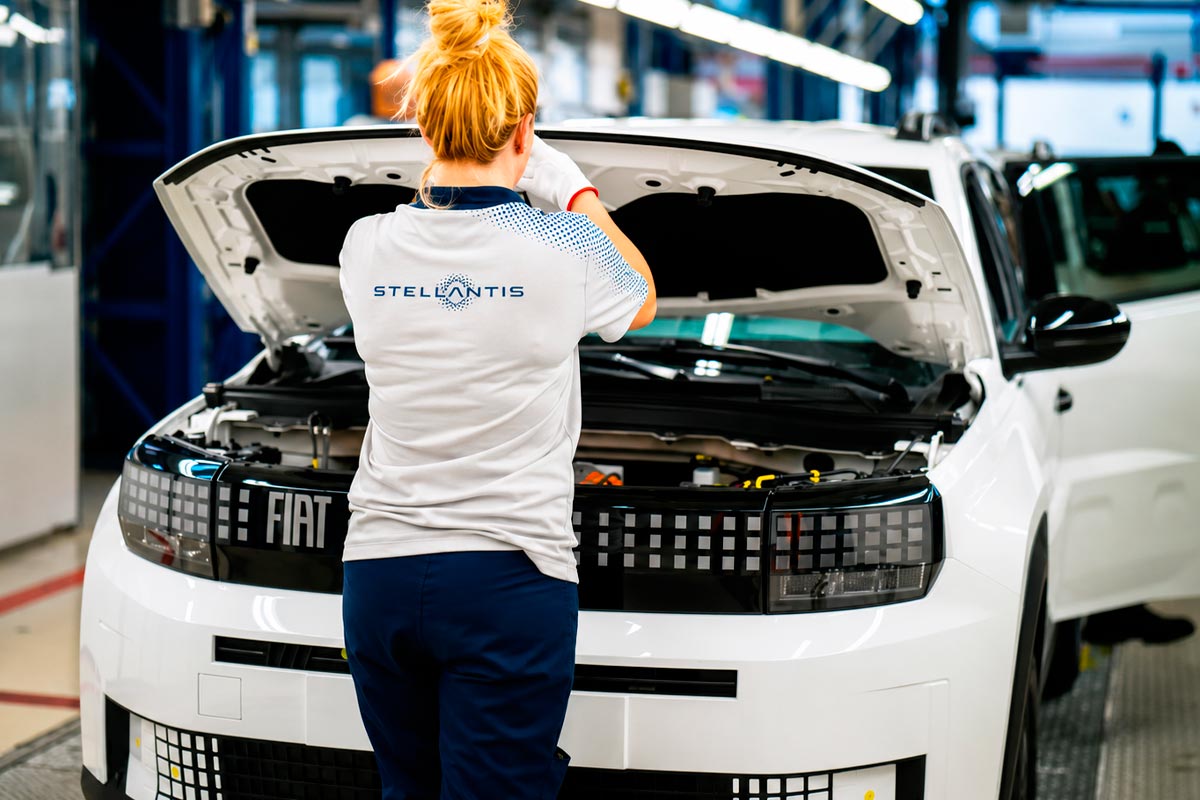
There is something symbolic about what is currently happening at Stellantis. On the one hand, the historic Mirafiori plant in Turin—the birthplace of Fiat—is experiencing a string of production shutdowns. On the other hand, the Serbian plant in Kragujevac is now operating on weekends, with 12-hour shifts, to meet the sharply rising demand for the Fiat Grande Panda. Two plants, two Fiats, but above all, two completely opposite industrial realities.
Mirafiori is still struggling to get back on track
When Stellantis relaunched the Fiat 500 hybrid at Mirafiori in late 2025, the goal was clear: to breathe new life into the Turin plant and return to a production rate of close to 100,000 cars per year, including both hybrid and electric models.
A few months later, the reality is more complicated. After a first quarter of about 15,000 Fiat 500 Despite this, the plant continues to face regular disruptions.
In late June, Stellantis even announced an additional week of summer shutdown, from July 27 to 31, on top of the usual three-week shutdown in August. Officially, the automaker cited supply chain issues, particularly regarding engines, bumpers, and certain sensors. Suppliers are reportedly struggling to keep up with the ramp-up of production for the new 500 Hybrid.
The unions, however, offer another explanation. According to them, these repeated production stoppages also reflect demand that is lower than expected. In fact, the daily production rate has dropped from 430 to 400 vehicles, while days without production have become almost routine. On Monday, July 13, the body shops were once again at a standstill. FIOM continues to call for the introduction of a new model to secure the plant’s future—or even a second production line capable of keeping workers employed until the arrival of the future Fiat 500, expected around 2030.
In Serbia, the Grande Panda is a game-changer
While Turin is slowing down, Kragujevac is picking up the pace. Stellantis’s Serbian plant is now operating on Saturdays and Sundays with 12-hour shifts to meet the strong demand for the Fiat Grande Panda and its cousin, the Citroën ë-C3. According to several local media outlets, between 500 and 800 additional employees have been brought on board to ensure this continuous production.
The plant currently employs about 4,500 people, including nearly 1,000 workers from many countries, notably Italy, Spain, Turkey, Morocco, India, Pakistan, and Nepal. This international workforce underscores Stellantis’s significant need to maintain the plant’s ramp-up.
The two models produced in Kragujevac share the Smart Car platform. The Fiat Grande Panda It is assembled there in gasoline, hybrid, and electric versions, while the Citroën ë-C3 is produced exclusively as an electric vehicle. This shared architecture allows the plant to quickly adjust its production volumes based on demand.
Two factories, two paths
The contrast is striking. In Turin, Stellantis is still searching for the right formula to revive one of the brand’s icons—the Fiat 500—whose production ramp-up is proceeding more slowly than expected. In Serbia, by contrast, the group must increase working hours to keep up with the commercial success of the Grande Panda.
Projections cited by several Serbian media outlets suggest a capacity that could eventually reach 150,000 vehicles per year, although Stellantis has never officially confirmed this target. One thing, however, is already clear: in the first four months of 2026, exports from Kragujevac surged to approximately 1.13 billion euros, nearly two and a half times more than a year earlier.
 English
  French
  Italian
  Spanish
  German
  Japanese
  Dutch
Dutch
The Italians have already plundered French companies to supply their factories (DS7, DS8, automatic transmissions, and now the 2CV!)
Nothing new—when Aulnay and Poissy were shutting down while Kenitra was running at full capacity, it didn't bother you!
Yeah, well, this isn't PeugeotPassion or CitroënPassion here x)
That's true, but do you think it would have turned out any differently?
Just build that Citroën 2CV already
No Serbs want to work for Stellantis since they offer €800 a month for working 6 days a week, while the national average is €1,200…
We were forced to go to Nepal and South Africa to recruit workers (clearly unskilled) by offering them 600/€ …
And yes, the platform and the «former PSA» powertrains are helping FIAT (on the European market) 😮
Back when there was the so-called «Eastern Bloc,» here in Western Europe we were able to produce cars seven days a week—beautiful cars, technologically ahead of the rest—at prices 30% cheaper than today, even when accounting for inflation. Italy produced 1.5 million cars per year, despite having significant production costs (energy, labor, working conditions, etc.). I’d like to know what’s happened since then. How did we end up here? Oh yes, Europe has had a hand in it in the meantime… Will factories in Ukraine soon be under bombardment?