

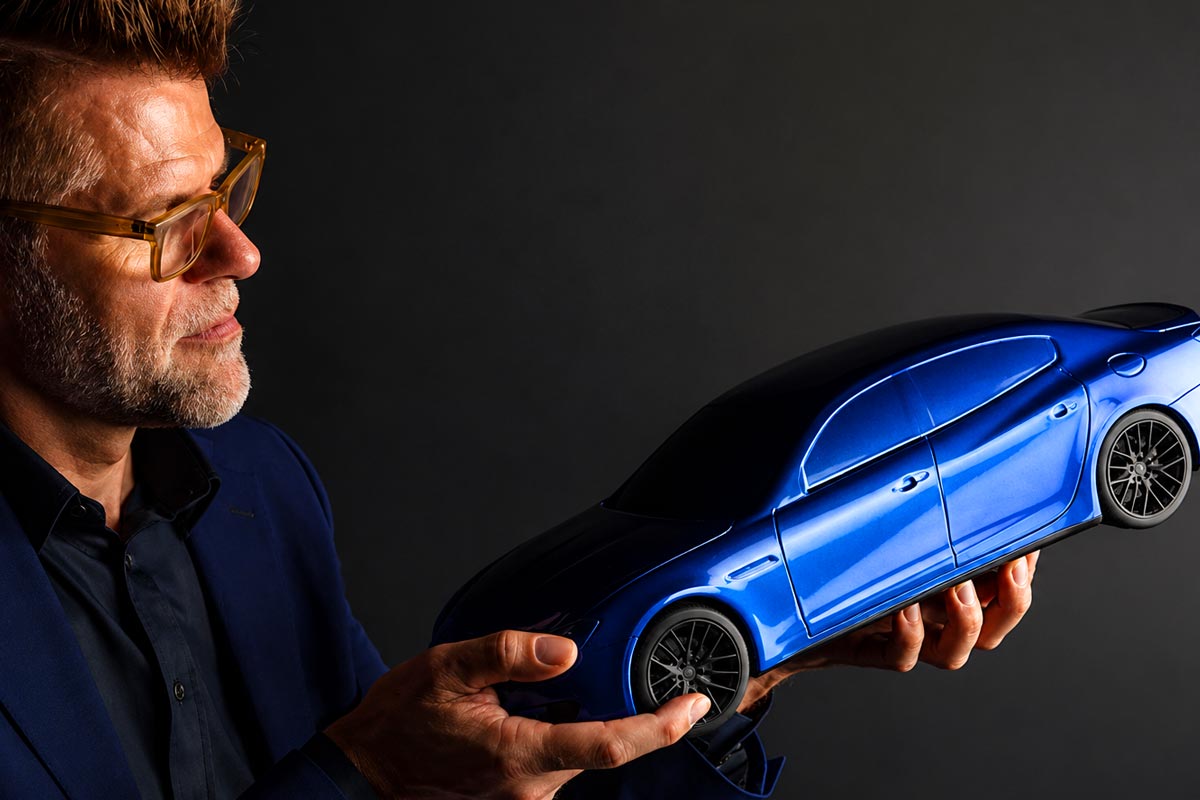
When he took over as head of design for the Italian brands in 2015, Klaus Busse was faced with a question as simple as it was daunting: what makes a design truly Italian? Rather than relying solely on his own interpretation, the current head of design at Maserati went to ask the question of one of the people who could hardly be better qualified to answer it: Giorgetto Giugiaro.
In a lengthy interview with the podcast Chapter Talks — Design, Klaus Busse recounts this conversation and the Italian master’s response, which was disconcerting to say the least. It was a response that ultimately had a profound influence on his perspective on Maserati and, more broadly, on Italian automotive design.
From Germany and the United States to Maserati
There’s something unique about this story, since Klaus Busse isn’t Italian. Born in Germany, he spent a significant part of his career at Mercedes-Benz starting in 1995 before moving to the United States in 2005 to join Chrysler and FCA. In 2015, he took over as head of design at Maserati.
Busse explains that he learned what he calls «the true art of automotive design» at Mercedes. His time in the United States then taught him another discipline: the cultural storytelling, in other words, an object’s ability to convey and represent the culture from which it originates.
When he was offered the chance to lead the design efforts for Italian brands, one thing became clear to him: he didn’t want to create German or American design in Italy. He wanted to understand what it truly meant to create Italian design. One problem remained: how to define it?
Klaus Busse asks Giorgetto Giugiaro the question
Kaus Busse didn’t want to base this definition solely on his own intuition. So he decided to turn to Giorgetto Giugiaro. This choice was, of course, by no means trivial. In the interview, Maserati’s head of design described him as likely one of the most important automotive designers in history. From the Volkswagen Golf, Fiat Panda, and Lotus Esprit to several Maseratis, Giugiaro’s career spans decades of automotive design.
Kaus Busse therefore asked him the question point-blank: What is Italian design? Giugiaro’s initial reaction threw him off balance. The Italian designer burst out laughing before replying, in essence, that «Italian design doesn’t exist.».
A surprising answer, to say the least, when one considers the global influence of Italian auto design. But Giorgetto Giugiaro continues his line of reasoning: he has always sought to create «the best» of what was possible at any given moment. And for him, that is precisely what Italian design is all about.
The «secret» is supposedly not to be afraid to change everything
Kaus Busse takes away from this exchange a philosophy that is far more interesting than an aesthetic formula. Italian design, then, is not a collection of forms, proportions, or details to be reproduced from generation to generation. Rather, it consists of drawing on all the possibilities available at a given time—culture, the designer’s tools, as well as new technologies and technical advances—and then combining them to create what seems to be the best possible response at that moment.
To explain this difference, Kaus Busse contrasts this philosophy with the more evolutionary approach he experienced at Mercedes. He explains that during the unveiling of a new SL, previous generations might be brought together to demonstrate the model’s continuity and its progression toward a form of perfection.
Italy would be capable of much more radical behavior. Kaus Busse cites the transition from the 1960s to the 1970s as an example. After producing some of the most admired sculptural car bodies of their time, Italian designers did not hesitate to shift toward the wedge design, characterized by taut lines and much sharper edges, once technology and society made it possible to explore this new direction.
So just because you did something magnificent yesterday doesn’t mean you can’t do something completely different tomorrow. For Kaus Busse, this «boldness»—this courage to set out anew toward a fresh idea—is deeply rooted in Italian culture.
A philosophy that Maserati applies today
This reflection also provides a better understanding of the aesthetic language that Klaus Busse seeks to imbue in contemporary Maseratis.
The designer identifies three forces capable of transforming design: technology, creative tools, and societal change. In particular, he gives a very concrete historical example. In the 1950s, flat side windows dictated certain shapes for car bodies. The advent of curved glass then offered greater freedom. Where others might have stuck with the same proportions out of habit, the Italians took advantage of this technical possibility to radically change their silhouettes.
This philosophy is reflected today at Maserati in a commitment to avoiding gimmicks. According to Busse, a sports car does not need to be laden with outward signs of aggression to demonstrate its performance. In particular, he criticizes fake exhaust pipes and large, decorative air intakes used merely as design elements.
The MC20 This model is a particularly good example of this approach. Maserati could easily have added more air intakes and a large rear wing to visually emphasize its status as a supercar. Instead, the design team took the opposite approach: refining the aerodynamics so that the body itself would fulfill this function and minimizing visible air intakes as much as possible.
And tomorrow?
This philosophy could become even more relevant in the coming years. When asked about the future of the automobile by 2035 or 2036, Klaus Busse envisions a landscape profoundly transformed by autonomous driving. Without drivers, certain elements that are indispensable today might become obsolete: the grille with the shift to electric power, but also, eventually, headlights as we know them. Cars might then prioritize interior space and end up adopting designs that look increasingly similar to one another.
A luxury brand like Maserati, on the other hand, must add something far less rational: dreams and emotion. Even in a future where technical constraints might cause cars to look alike, Klaus Busse believes that Maserati will need to continue to express mechanics and emotion through its exterior design rather than simply focusing on available space.

 English
  French
  Italian
  Spanish
  German
  Japanese
  Dutch
Dutch
I’m not impressed by Klaus Busse. He seems like a very nice person, but I can’t quite make sense of his resume. He’s worked for the biggest names in automotive design, like Mercedes and Alfa Romeo, but I don’t know which cars he was responsible for.