

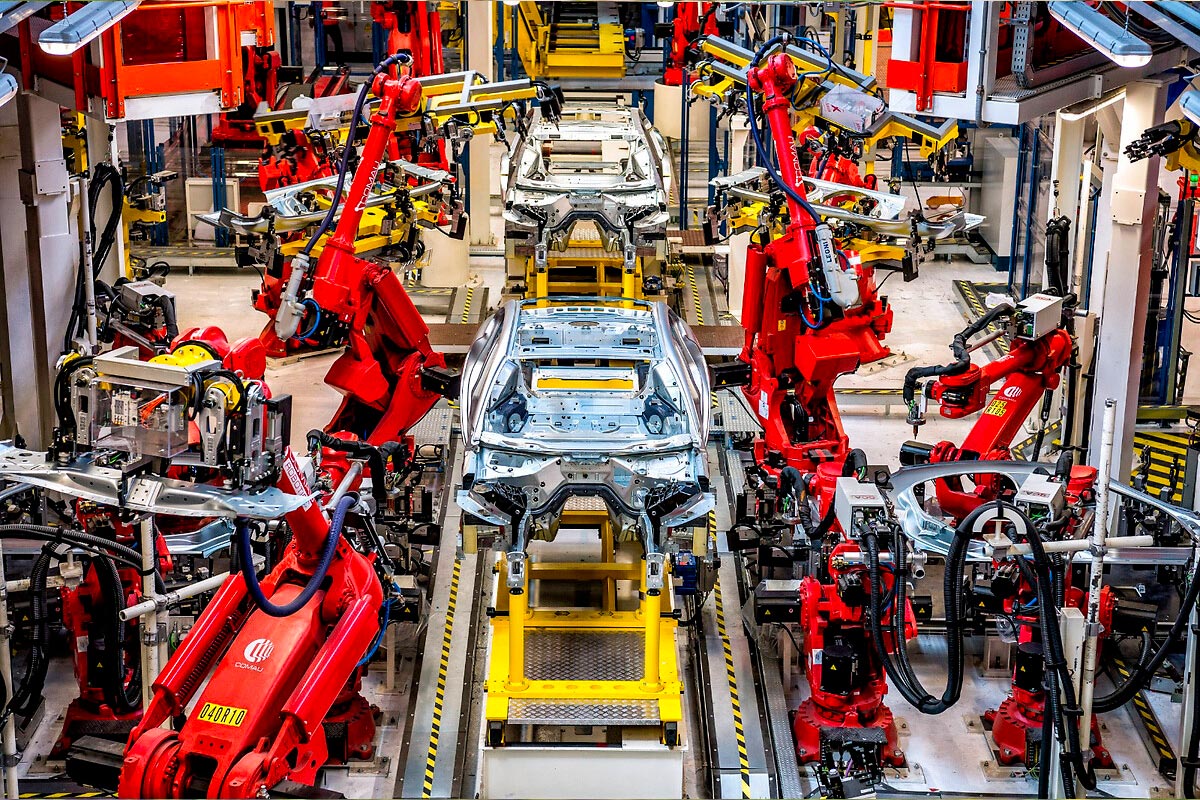
The idea that has been mooted for several months is now taking on a much more concrete form. With just a few weeks to go before the presentation of its new industrial plan, the Stellantis is actively working on a sensitive scenario: divesting or sharing some of its European plants. A decision with far-reaching consequences, directly affecting France, Italy, Spain and Germany.
Unmanageable overcapacity
The problem has now been clearly identified internally: the Group's European plants are producing well below their actual capacity. According to information circulating behind the scenes, this surplus is the equivalent of four industrial sites.
This situation can be explained by several factors. On the one hand, automotive demand is still below pre-pandemic levels. On the other, the transition to electric vehicles is slowing down industrial cycles, complicating investments and delaying certain model launches. Against this backdrop, the management team led by Antonio Filosa and supervised by John Elkann is exploring several options: downsizing, pooling capacities... or opening the door to external partners.
Cassino, Rennes, Madrid... and a German site in our sights
Among the plants concerned, several names are being bandied about. In Italy, the Cassino site appears to be one of the most vulnerable, already a symbol of falling production in recent months. In France, the Rennes plant is also mentioned, as is the Madrid plant in Spain, as well as a site in Germany (Rüsselsheim?).
The idea is not necessarily to close these plants, but rather to make them work differently. In particular, Stellantis is considering sharing its production lines with other manufacturers, in order to increase their utilization rate and make profitable use of currently under-utilized infrastructures. But another, more radical hypothesis remains on the table: the outright sale of certain sites.
Discussions already underway with China's Dongfeng
What was only a hypothesis is gradually becoming an industrial reality. Discussions have already begun with Dongfeng Motor Corporation, the Group's long-standing partner. Delegations from the Chinese automaker recently visited several sites in Europe, including Rennes and Madrid, as well as plants in Italy and Germany. The aim: to assess the possibility of joint production, both for the European market and for other regions.
In addition to Dongfeng, other Chinese automakers are also said to be interested. Stellantis could thus multiply agreements, site by site, depending on industrial opportunities and local constraints.
Between industrial stakes and political pressure
This issue goes far beyond the industrial framework. In France, as in Italy, the issue is highly political. In Paris, the possibility of Chinese groups producing in historic factories could quickly become a sensitive issue, particularly in the run-up to elections. In Italy, the tone is slightly different. The government was more open, as long as jobs are preserved.
The Minister of Industry has already hinted that foreign investors might be welcome to support domestic production, particularly at troubled sites such as Cassino. But tension is mounting among the unions. FIOM-CGIL is calling for immediate dialogue with the government and the manufacturer, before any official announcement is made. In parallel with these discussions, voluntary redundancy plans are multiplying.
Over 1,000 departures
Since the beginning of the year, over 1,000 departures have already been announced at several Italian plants. The Melfi site alone is affected by several hundred additional departures, following those already recorded in 2025. Other sites such as Pomigliano, Mirafiori, Atessa and Termoli are also affected. Officially, it's a question of adjusting the workforce. But in reality, it illustrates an in-depth transformation of the Group's industrial model.
This transformation will involve cutting costs, adapting to new engines... and potentially redefining the role of European plants.
Strategic plan due May 21
Not all decisions have yet been made. The matter remains at a preliminary stage, and several scenarios are still being studied. But one thing is certain: on May 21, at the Capital Markets Day, Stellantis will be asked to clarify its strategy. Between maintaining sites, industrial partnerships and possible divestments, the group is playing for its future in Europe.
As far as the Cassino plant is concerned, we're not sure. This plant, which was supposed to be the symbol of the Group's top-of-the-range cars (Alfa Romeo Giulia, Alfa Romeo Stelvio, Maserati Grecale), now faces a more than uncertain future.
 English
  French
  Italian
  Spanish
  German
  Japanese
  Dutch
Dutch
Viele europäische Autokäufer haben nach langer Markentreue die Nase voll von den Karren dieser Firma. Ständige Qualitätsprobleme und der Konzern stellt sich blöd.
Nie mehr wieder kaufe ich denen etwas ab. Sollen zusperren und den Markt denen überlassen, die wissen wie man gute Autos baut.
Wenn die Verantwortlichen von Stellantis der Meinung sind, in der Heimat Überkapazitäten zu haben, ist es verständlich, Standorte zu verlagern. Aber hätte Stellantis schon konsequent die Umstellung auf Elektromobilität fast vollständig vollzogen, hätte sich der westeuropäische Automarkt darauf eingestellt und heimische Arbeitsplätze gesichert.
Man kann nicht ständig mehr Autos herstellen, als verkauft werden können. Auch bei VW ist man inzwischen aufgewacht und wird zukünftig weniger produzieren. Wir schonen dadurch unsere Ressourcen und verringern den Energieverbrauch. Die Entscheidungsträger der Industrie hätten schon sehr viel früher erkennen müssen, daß jeder Markt irgendwann gesättigt ist. Die Menschen werden dadurch nicht ärmer, sondern reicher an freier Zeit. Arbeit darf nicht zum Selbstzweck werden! Bedenkt, jeder Arbeitsprozeß belastet unseren Lebensraum!
Sie müssen aber dann damit leben, dass freie Zeit auch weniger Wachstum generiert.
Woher dann ihre Rentenzahlungen kommen bleibt abzuwarten!
Da kommt doch kein Komma nach «plant»?!
Ich fühle mich als Kunde relativ stark verarscht. Fiat, Opel, Jeep, Alfa Romeo, Citroën....alle gleich und mit katastrophalen Qualitätsmängeln. Bei der Rohbau Qualität fängt es an, bei den Zulieferteilen geht es weiter und mit Rückrufen von Rückrufen hört es auf. Wann lernen die BWL-er endlich, dass Qualität Kunden anzieht und somit Geld verdient wird? Wohl nie, dann macht mal euren aufgeblasenen Konzern wieder schön so klein, dass er kontrolliert werden kann!
期待更多标致雪铁龙在北京车展的消息