

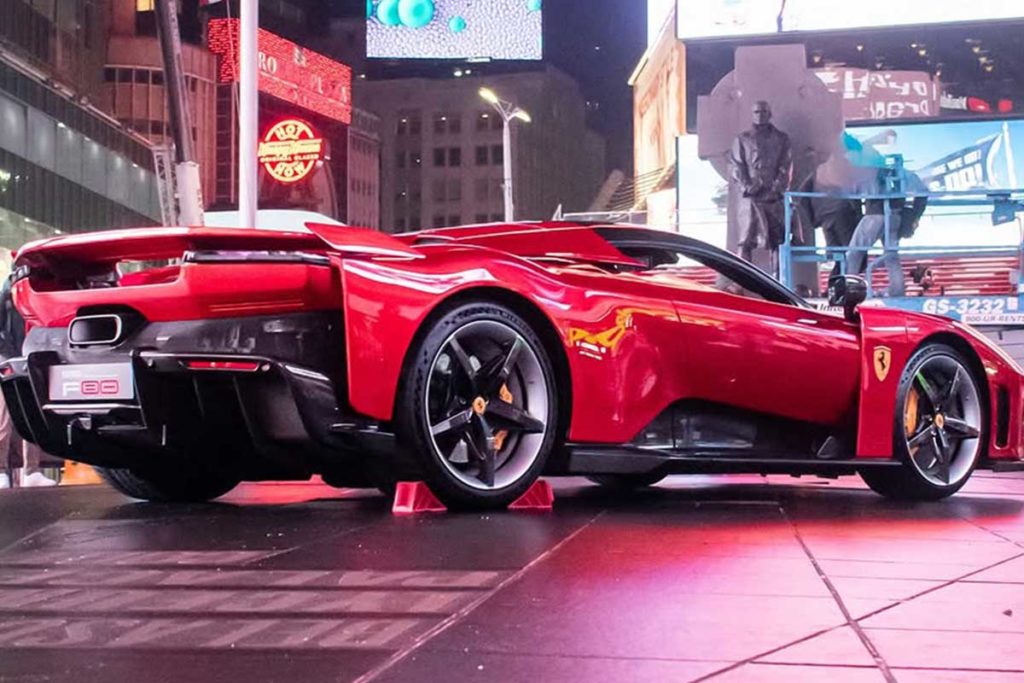
For several months now, a scenario hitherto unthinkable at Ferrari is taking shape. For the first time in a long time, the Prancing Horse brand may not sign up for another record year. It's a hypothesis that we raised several months ago, and which is now finding concrete expression in the most recent financial analyses. Behind this apparent slowdown, a much finer strategy seems to be taking shape, notably around the management of deliveries of the highly exclusive Ferrari F80.
Persistent weak signals on financial markets
Month after month, registration figures that we monitor closely all tell the same story. Ferrari is not collapsing, but momentum has clearly slowed in several key markets. The United States, the brand's largest market worldwide, is stagnating. Germany is in gradual decline. The UK is experiencing a spectacular fall. Certain secondary markets, such as Japan and Italy, continue to post respectable growth. Japan even confirmed its role as a safe haven. But these increases do not compensate, in volume terms, for the downturns observed in the major historical pillars. So the question arises: has Ferrari reached a voluntary ceiling, or are we witnessing a form of structural slowdown?
The hypothesis of an assumed ceiling makes sense on paper. Ferrari has never been in the race for volume. Its strategy is based on rarity, desirability and exceptional margins. But to see the United States, Germany and the United Kingdom falling back simultaneously raises questions. These are precisely the markets where margins are among the highest.
The Ferrari F80, the cornerstone of a more cautious strategy
This is where the Ferrari F80 comes in. Officially, nothing has changed. All 799 examples have been sold, at a starting price of around 3.6 million euros. The F80 alone represents around €3 billion in potential sales, almost half of Ferrari's annual sales of €6.67 billion in 2024. But according to several financial analysts, Ferrari has decided to review the delivery rate of this ultra-exclusive model. Not for lack of demand, but to smooth out revenues over a longer period. This information has now been confirmed by analysts, who point to a more gradual ramp-up than expected, spread out over the rest of the decade.
This choice is not insignificant. Delivering such a strategic model too quickly would concentrate a significant proportion of sales over a short period. Conversely, staggering deliveries would allow us to cushion potentially more difficult years, without ever giving the impression of a sudden slowdown.
Financial analysts lift the veil
This reading is now shared by several major institutions. In early December, Oddo BHF lowered its recommendation on Ferrari, explicitly citing a slower-than-expected roll-out of the F80. The broker lowered its delivery estimates for 2026 from 250 to 200 units, while extending the model's ramp-up to 2028. More revealing still, the analyst points out that this tactical management of deliveries could be a conscious choice to optimize financial results, rather than an imposed constraint. This analysis is reinforced by Morgan Stanley, which anticipates deliberately limited volume growth until 2030, as a means of preserving the brand and controlling economic cycles. Ferrari prefers to sacrifice a few points of short-term growth rather than expose its results to overly visible jolts.
A smoothing strategy rather than an admission of weakness
In this context, slowing down deliveries of the F80 appears less as a negative signal than as a strategic lever. Ferrari knows that the coming years will be more complex, with an uncertain macroeconomic context, the transition to electric vehicles and stock market valuations under scrutiny. Having a model capable of generating several billion euros in sales over a long period is a considerable asset. This would enable us to get through a year without record delivery volumes, as 2025 could be, without jeopardizing the Group's financial solidity or its long-term trajectory. Especially as the order book remains full until 2027, proving that demand is not the problem. After a decade of almost uninterrupted record-breaking years, Maranello seems to be entering a more controlled phase, where each model also becomes a financial steering tool.
 English
  French
  Italian
  Spanish
  Portuguese
  German
  Japanese
  Turkish
  Dutch
Dutch