
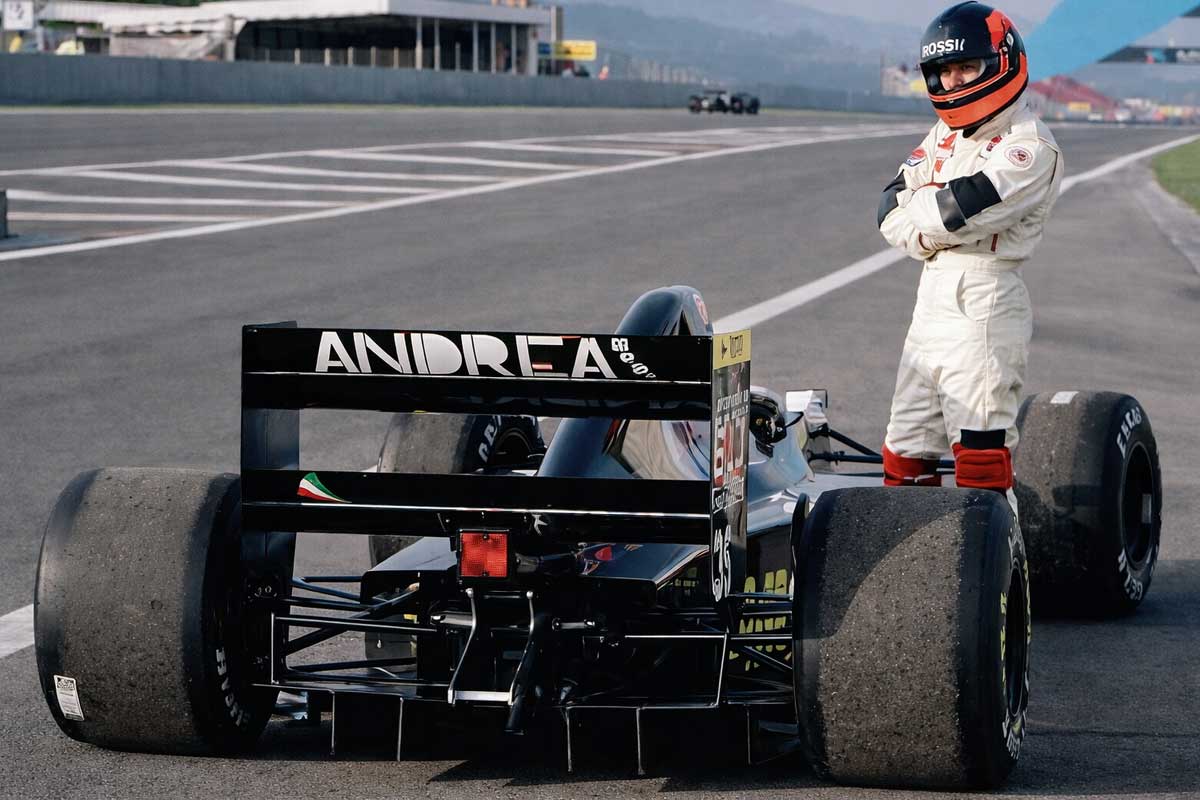
In the '80s, costs in F1 were not yet astronomical, and the rules of engagement were rather flexible, allowing smaller teams to try their luck. During the "money years", F1 attracted all kinds of sulphurous investors who, for a few million euros, could buy a team and recruit paying drivers with well-filled briefcases.
F1 has seen the likes of Van Rossem and his "Moneytron" team, named after his computerized stock market prediction system (which was actually a Ponzi scheme). Or Akira Akagi, owner of Leyton House, caught up in money laundering and false invoicing. We also reported on Lamborghini project financed by a Mexican GLAS consortium, whose owner vanished into thin air! Italian stables abounded at the end of the '80s (Life, Fondmental, Osella, etc.), but none could match Andrea Moda in terms of rockabilly.
A stable next to a shoe workshop
Present since 1987, the debt-ridden Coloni team was bought out at the end of 1991 by businessman Andrea Sassetti, who wanted to run it in 1992 under the banner of "Andrea Moda", his shoe company. The man, enigmatic (it was said that he had made his fortune in poker) and a complete novice in motor sport, was also the head of a chain of discotheques in Italy. Many questioned his ability to manage a team and his intentions. At the beginning of 1992, the new structure was set up... in one of Andrea Moda's shoe warehouses, next to a clothing workshop. A good start!
On his only visit to the premises, Perry McCarthy, the team's whipping boy, declared that he felt "more at home in a criminal den than in the headquarters of a Formula 1 racing team".". A far cry from Maranello or Woking indeed! Andrea Moda lacks the necessary equipment and borrows tools from other stables. A mechanic and a driver are also recruited from among the craftsmen at his shoe factory. A promotional brochure was also in circulation, with a "shadow of a naked woman playing the saxophone" on the cover - an odd way of communicating, I'm sure you'll agree...
False start in Kyalami
To start the 1992 season, the team upgrades the old Coloni C4 and buys two Judd V10 engines, used the previous year by Scuderia Italia. Italians Alex Caffi, formerly with Arrows, and Enrico Bertaggia are recruited as drivers. In South Africa, the opening round of the 1992 season, Sassetti stood out in the Kyalami paddock with his biker look and tinted glasses. The mechanics, also dressed all in black, had a strange look too.
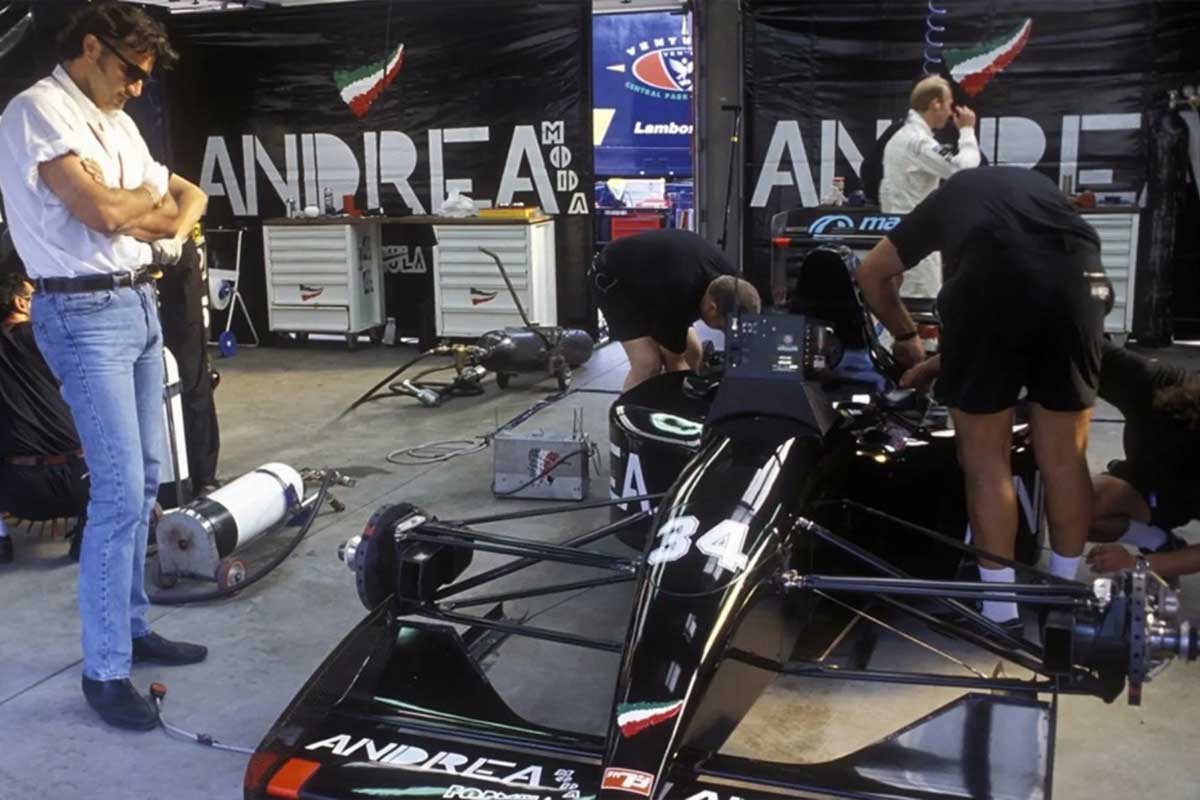
In accordance with the regulations, with 30 drivers eligible for qualifying, a pre-qualifying session was held on Friday morning to eliminate two drivers from the 32 entered. Andrea Moda, considered a new team, had to take part. The first controversy arose at the end of scrutineering: the stewards excluded Andrea Moda! Sassetti had declared Andrea Moda a new team, but the Concorde Agreement stipulated that a new team had to pay a deposit - which Sassetti had not done - and also present a new chassis.
As Andrea Moda is considered a "new manufacturer", the C4B is not considered a new car. In any case, the small Italian team is in no way fit to contest this Grand Prix. Only one car was available for Alex Caffi, and Enrico Bertaggia had to make do with a model "in the course of assembly", which probably never existed. The reality on the ground is unforgiving. On Thursday, Caffi took part in a practice session with the Coloni C4B, but only made half a lap around the track, his single-seater having fallen victim to a faulty battery.
Making ends meet
Two days after the South African Grand Prix, an agreement was reached with FISA, under which Andrea Moda was admitted on condition that it entered a new chassis. As the team had neither the means nor the time to design a new single-seater, at the end of 1991 it had turned to the British design office Simtek, founded in 1989 by engineer Nick Wirth and Max Mosley, the president of FISA. In 1990, Simtek had been working in secret on a single-seater for BMW, keen to enter F1. The project finally abandoned, Wirth sold the S192 project to Andrea Moda.
Nevertheless, the two single-seaters were never simultaneously ready for use, as the team did not have enough parts. As a result, the S921/2 is regarded as a mule car and a spare parts tank for the S921/1. What's more, it inherited defective parts from the first car, such as the steering column and suspension.
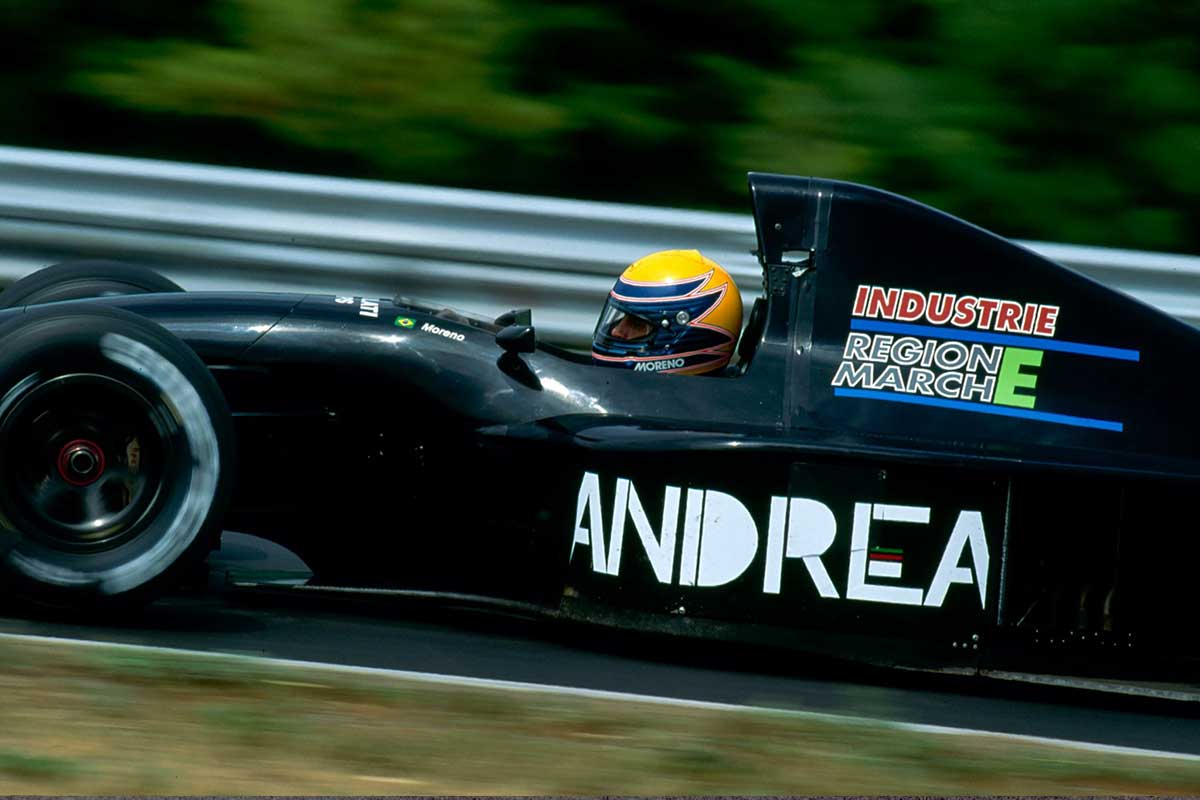
The team was nevertheless present in Mexico and avoided a $200,000 fine. The drivers also changed. Roberto Moreno was recruited, having been brutally ousted from Benetton at the end of 1991 to make way for the novice Michael Schumacher. After a few stints with Jordan and Minardi, the Brazilian, who had spent most of his career with small teams, was "the man for hopeless cases". The other recruit is Perry McCarthy, who brings no budget to the team, replacing Enrico Bertaggia. A test driver for Footwork Racing in 1991, McCarthy was helped by Jordan and Nigel Mansell's agent to secure a drive for Andrea Moda, but is not entitled to any salary. He even finances his own travels as a courier! But in Brazil, McCarthy doesn't have the necessary superlicence to race!
McCarthy the whipping boy
At the Interlagos pre-qualifiers, Roberto Moreno left the pits with twenty minutes to go. Observers described Andrea Sassetti's men as "disorganized, ridiculous and helpless". The Brazilian failed to finish 15 seconds behind the last qualifier. Enrico Bertaggia, who has found new sponsors to the tune of a million dollars, tries to make a comeback. Andrea Sassetti wants to sack McCarthy, but FISA refuses because the two driver changes authorized by the regulations have already been made. McCarthy became "the team's pariah": Sassetti tried to force him to resign by rarely letting him take to the track and by giving him unworthy equipment. McCarthy recounted that one of his mechanics had been a Minardi cook the previous year, and that he didn't understand anything about set-up. At the fourth round in Catalonia, the mechanics deliberately forgot him at the hotel, so that he was late for the qualifying session. He did manage to take to the track, but his engine broke as soon as he left the pits.
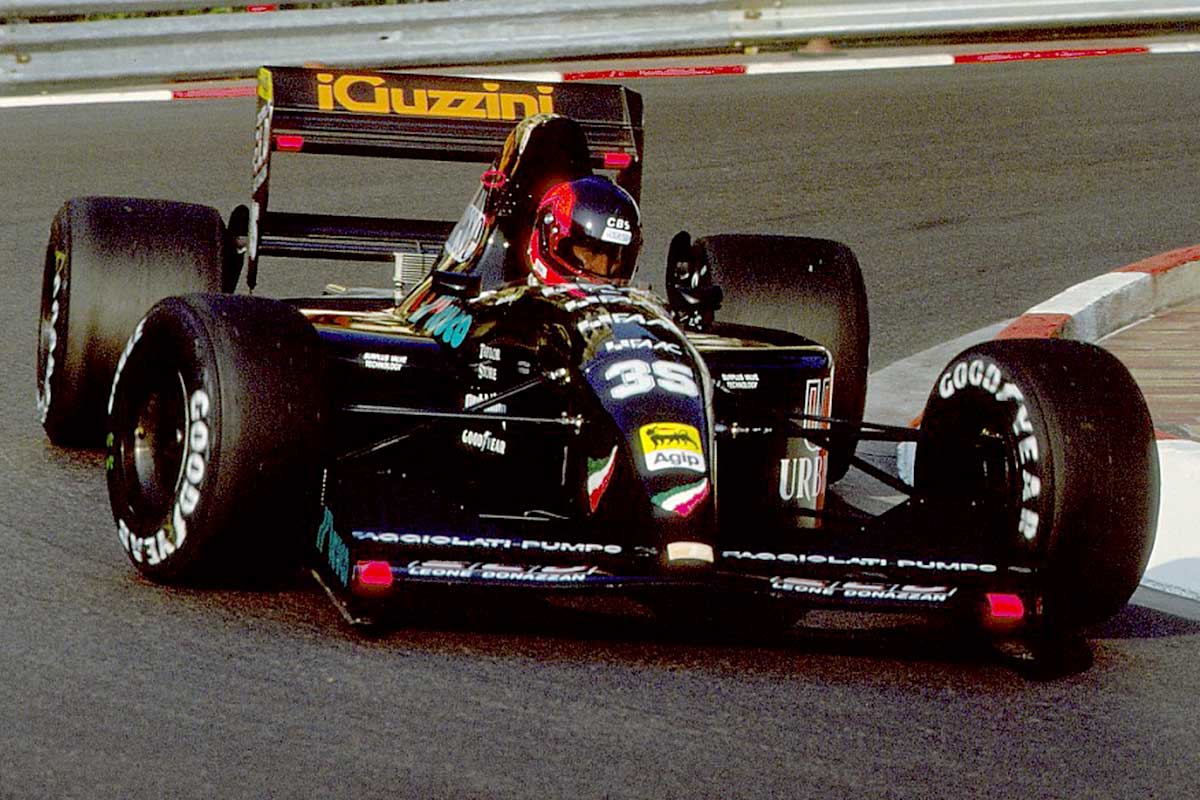
In Monaco, he drove an S921 whose bucket seat was unsuitable for his body. After three laps, he had to return to the pits to hand his car over to Roberto Moreno, as his own was not ready. McCarthy's brief appearance was seen as a mere alibi for the team not to be sanctioned.
A series of blunders
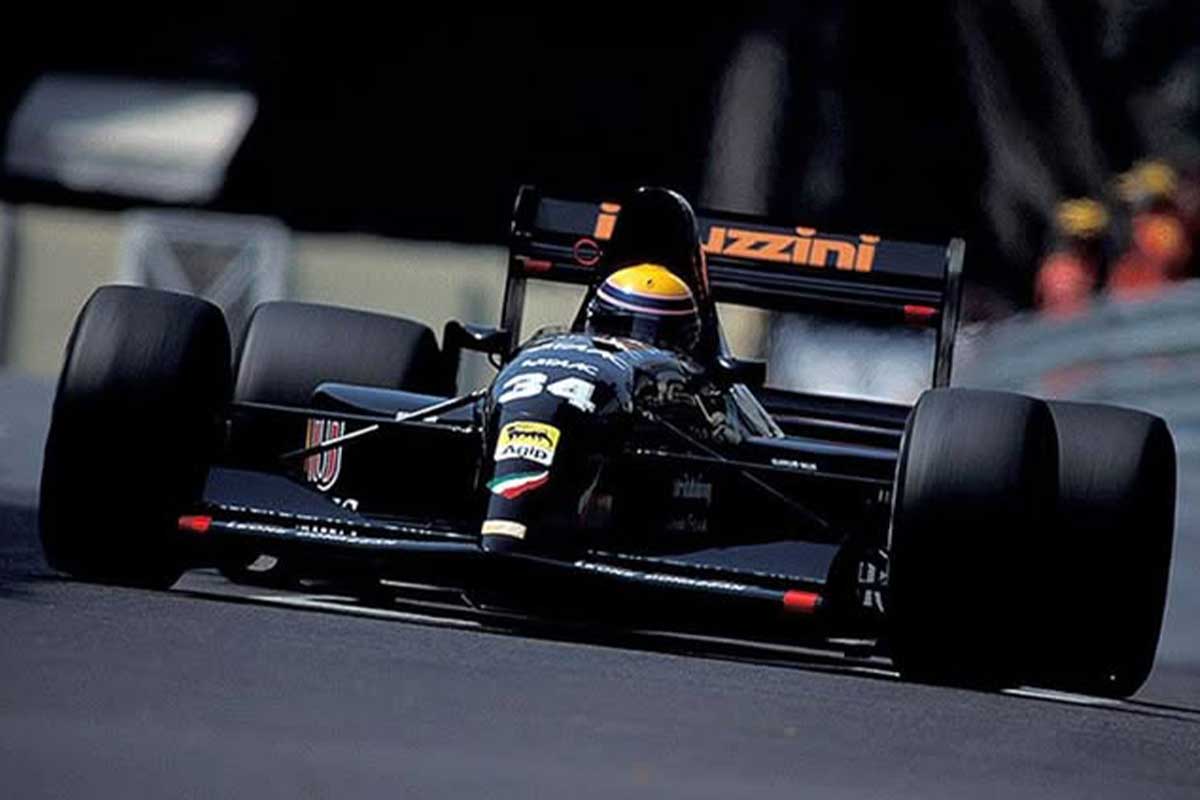
Moreno achieves a minor feat in the Principality, qualifying in twenty-sixth and last position for the race. He remained in last place until the eleventh lap, when he retired with a broken Judd engine. This would be the car's only race appearance! Shortly after the Monegasque event, when an arson attack ravaged one of his nightclubs, Sassetti, fleeing the flames, was shot at but escaped. Links are established between the Italian entrepreneur and the Mafia. Andrea Moda is now more often in the news for her antics than for her performances on the track.
In Canada, the team arrives without its Judd engines. Reason given? A thunderstorm had hit London and the captain had demanded that several crates of freight be unloaded for safety reasons. Finally, the British Brabham team, also powered by Judd, lent its spare engine.
A fortnight later, the French Grand Prix was affected by a road haulage strike. All the teams managed to reach the Magny-Cours circuit except Andrea Moda. Proof of the team's amateurism, Sassetti faxes Bernie Ecclestone instead of the circuit's official representatives. The team is fined $400,000. Some suspect Sassetti of deliberately skipping the French round in order to save money. This new scandal led to the resignation of several team staff members and the withdrawal of almost all the team's sponsors. Financially, the precipice was approaching.
At Silverstone for the British Grand Prix, McCarthy competed in pre-qualifying on used rain tires, while the track was dry, and Moreno ran out of petrol almost immediately, having forgotten to refuel. Two weeks later, at the Belgian Grand Prix, McCarthy took to the track...with the hull having undergone two FISA crash tests and lost all rigidity. What's more, his team had fitted him with a steering column broken by Moreno at the previous Grand Prix. The Briton only learned of this during the session, by radio...
F1 finally reacts
The Belgian event marks the end of the circus. On Friday, a bailiff came to seize equipment, Andrea Sassetti having failed to pay a supplier. At the end of the day, he battles with several mechanics over unpaid wages. Sassetti and the team's new sporting director, Sergio Zago, were subsequently arrested and charged with forgery before being released. Following the arrest, John Judd goes to the paddock because of unpaid bills. McCarthy, feeling that his life was no longer safe, left the stable.
The cup is full, as the image of F1 has been damaged by these unworthy antics. FISA announces the definitive exclusion of Andrea Moda, with immediate effect. The decision is based on an article of the sporting regulations that calls for the exclusion of a competitor "who does not manage his team in a manner compatible with the norms of the championship, or if he harms the reputation of the championship."
Last chance at Monza
However, three days later, on the sidelines of the Italian Grand Prix, Sassetti did not concede defeat. Ecclestone ordered that the paddock doors be closed to them. The sulphurous boss turned to the Monza court, arguing that the federal decision was unfair, since the Belgian courts had acquitted him. The magistrate agreed, and Andrea Moda entered the paddock with the support of the carabinieri. But the case did not end there. Big-money man Ecclestone met Sassetti and told him he wouldn't let Moreno race. Sassetti returns to the Monza judge, who this time declares himself incompetent. Andrea Moda packed up and disappeared for good.
What became of the characters in this story? Moreno bounced around a few more small teams before enjoying more success in CART. Perry McCarthy continued his career in endurance racing until the early 2000s, when he played the first Stig in Top Gear. As for Sassetti, he then persevered in Indycar, as a sponsor, before retiring. The shoe company went bankrupt in 2005. Ten years later, he was convicted by the Italian courts in another case of fraudulent bankruptcy. Last time I checked, he was still in business.
Andrea Moda, a completely out-of-the-box and ridiculous story, but one that also made up the charm of a bygone F1 era, which has given way to a highly formatted, professional and meticulous sport. You should also know that this crazy story has been the subject of a documentary on Prime Video: Andrea Moda Formula - La Scuderia Più Folle Di Sempre".
 English
  French
  Italian
  Spanish
  Portuguese
  German
  Japanese
  Turkish
  Dutch
Dutch