

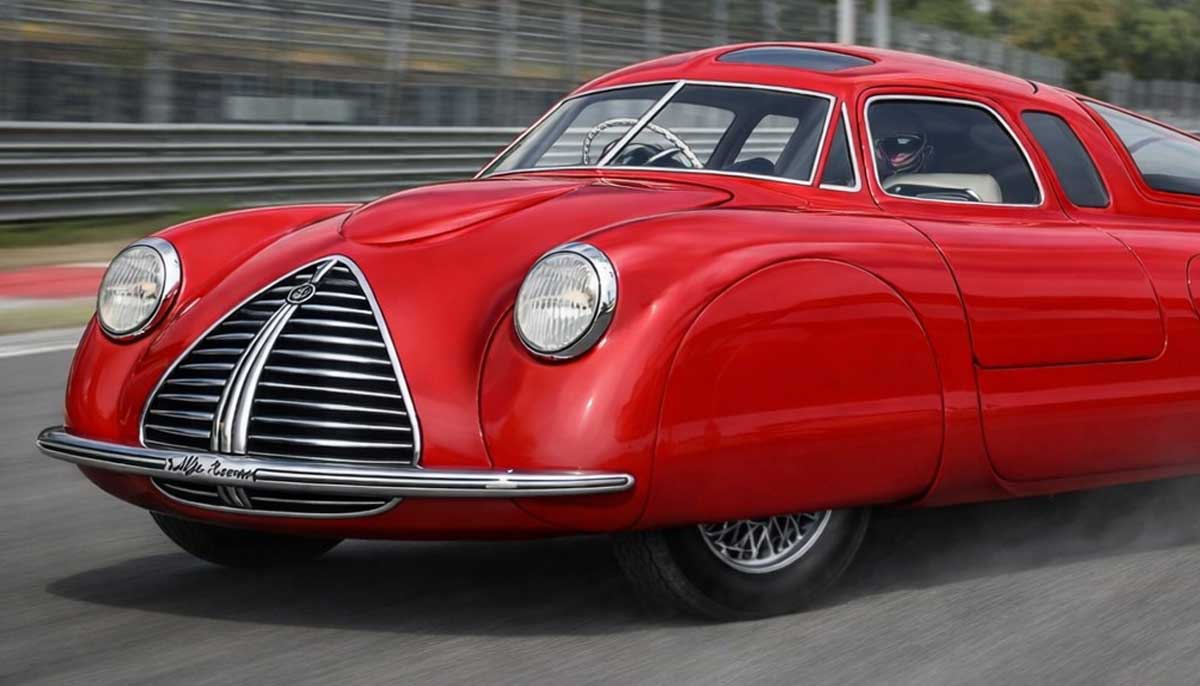
At the height of the Second World War, despite the constraints of the war economy, Alfa Romeo works on the Tipo 163 project, which was resolutely "futuristic" in its day: 16-cylinder mid-engine, all-glass aerodynamic bodywork, innovative suspension, hydraulic gearbox. The project was under the responsibility of Wifredo Ricart, who had started working for Alfa Romeo as a consultant in 1936, before moving up the ranks following the departure of Vittorio Jano.
This Tipo 163 was part of a wider range of innovative projects, including the Tipo 162 Grand Prix, a single-seater with a 16-cylinder engine, and the Tipo 162 Grand Prix, a single-seater with a 16-cylinder engine. the revolutionary Tipo 512Alfa Romeo's first mid-engined racing car. The two-seater 163 was intended for the three-liter sports car category. However, a small production run of 12 for the road was planned, possibly with a V12 engine. So what do these two Tipo 512 / Tipo 162 projects have to do with the Tipo 163? They formed the genetic heritage of the Tipo 163, so to speak: the engine came from the 162, the central engine concept and chassis design from the 512.
An incredible V16
The three-liter V16 engine designed for the Tipo 162 was fundamentally new, with square geometry (bore = stroke) and a short 62 mm stroke. For the first time at Alfa Romeo, a four-valve-per-cylinder engine was equipped with four gear-driven overhead camshafts in the center of the light-alloy engine block.
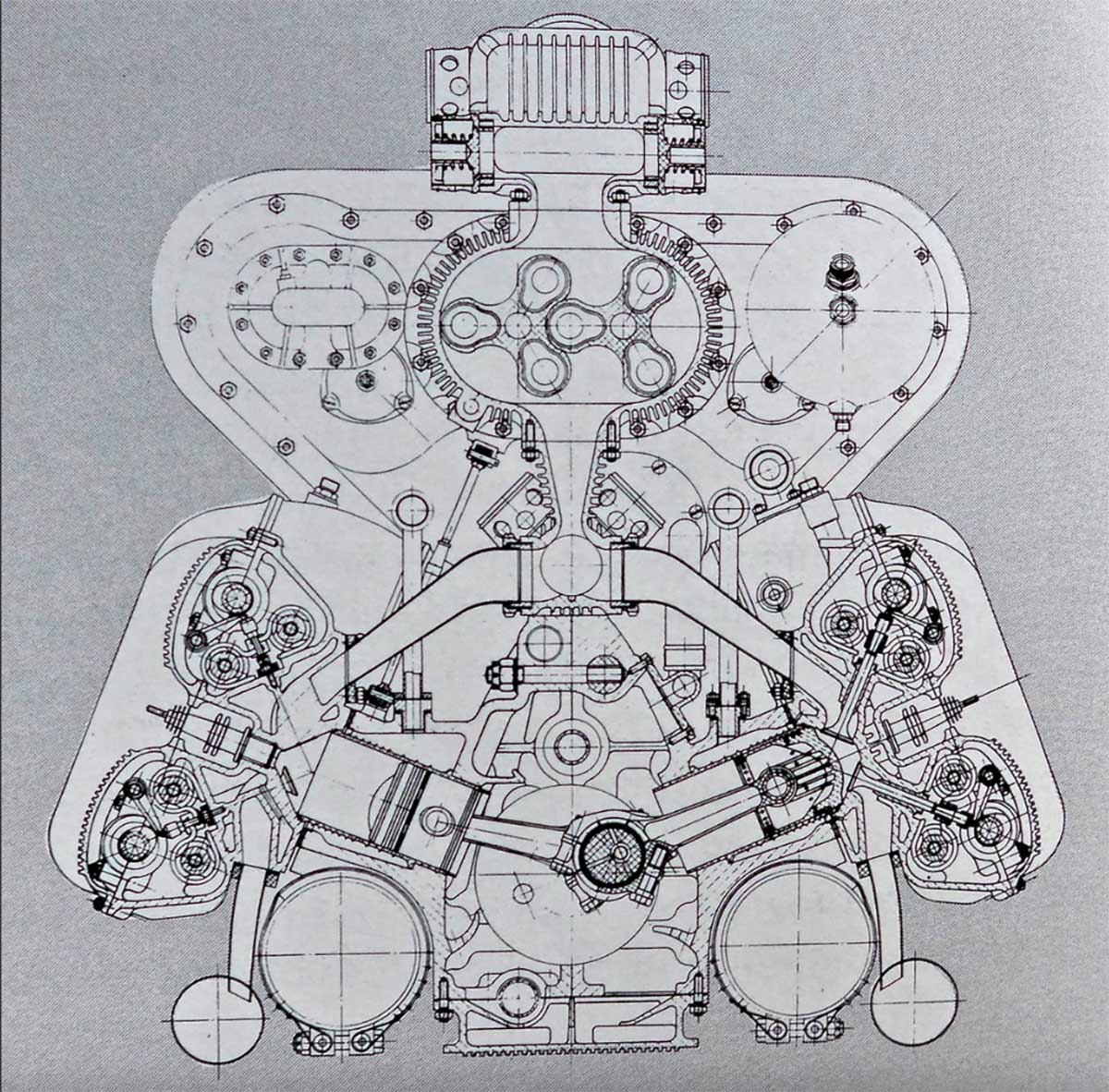
The 135-degree cylinder rake allowed for the organic integration of the complex turbocharger system: two low-pressure Roots turbochargers and one high-pressure turbocharger. two high-pressureThis was a world first for a technology originally used in aircraft engines. The engine ran on the test bench for the first time in 1940 and immediately developed 490 bhp at 7,800 rpm, setting a power record of 164 bhp/liter. However, for the 163 production model, this racing engine was designed without compression.
The look of a record-breaking car
A side view of the Tipo 163 immediately reveals a significant difference from the Tipo 512's chassis: the absence of supercharging allowed for a reduction in fuel tank volume. The 3-liter V16, positioned centrally behind the driver, delivered an uncompressed 190 hp at 7,450 rpm. Thanks to this layout, the 163 anticipated by several decades the chassis concept of the sports prototypes of the 60s and 70s. If the car looks stockier in profile, this is partly due to the vertical inclination of the front just in front of the wheels and a slightly greater overall height, linked to the upright driving position. Nevertheless, its styling really stood out, blending the streamline fashion codes typical of the '30s, a record-car profile with its streamlined wheels, and the aerodynamic features of the Le Mans sports cars that would appear twenty to thirty years later, such as the "longtail" seen on Matra cars and the Porsche 917.
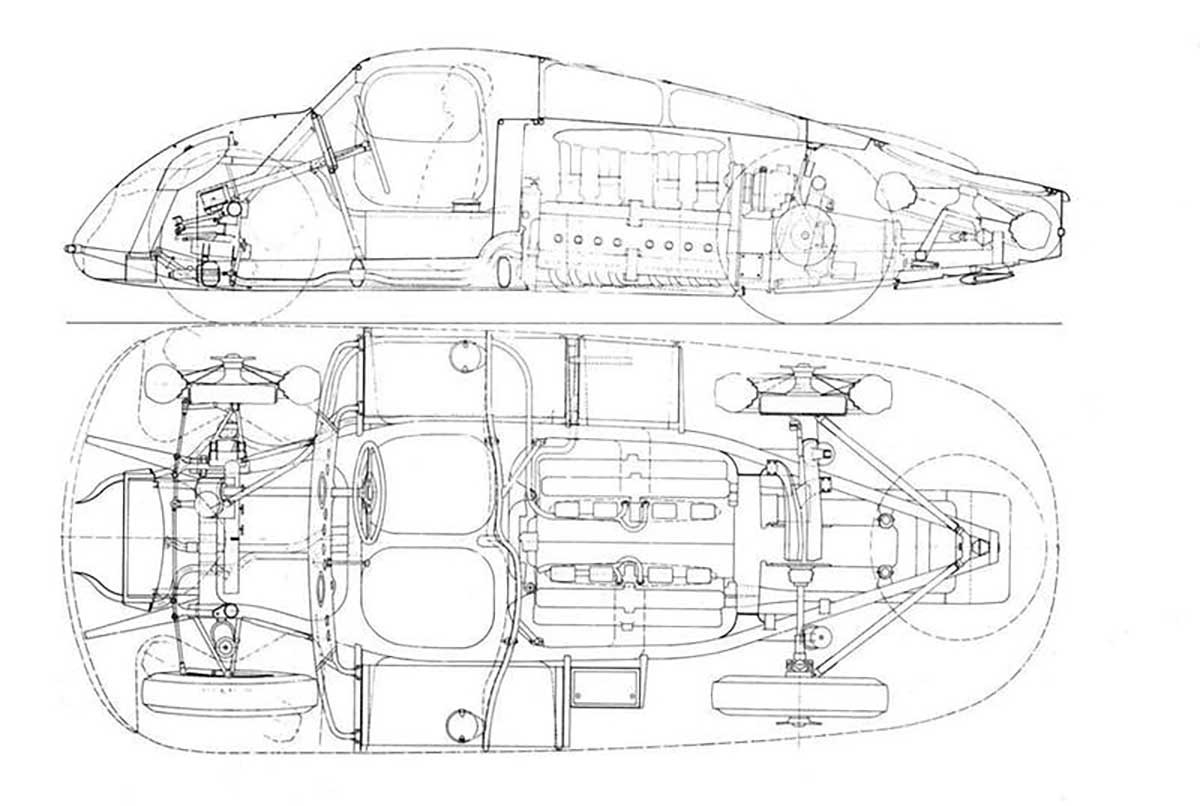
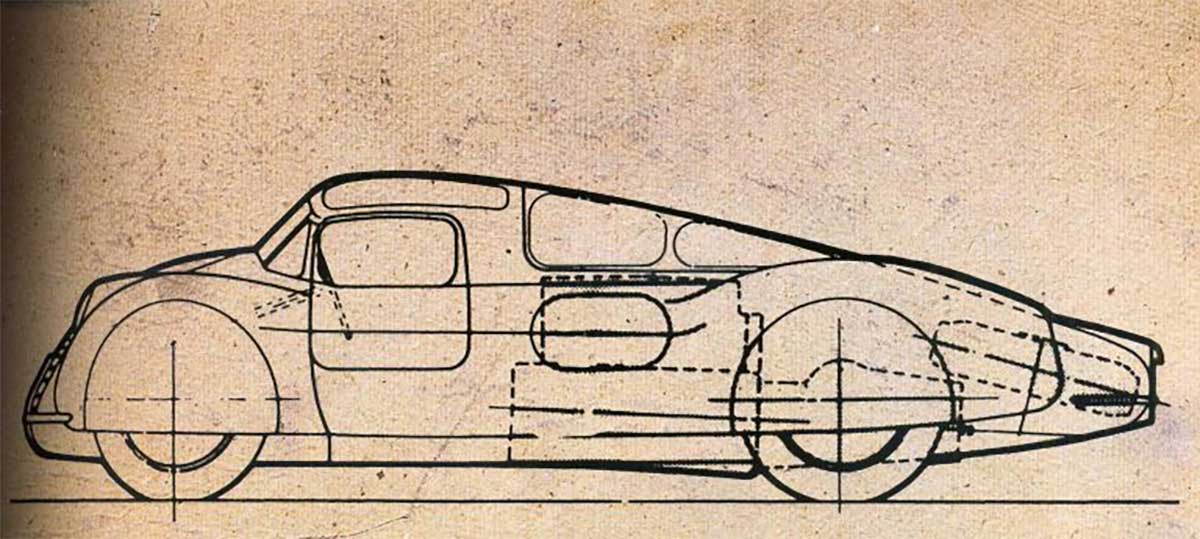
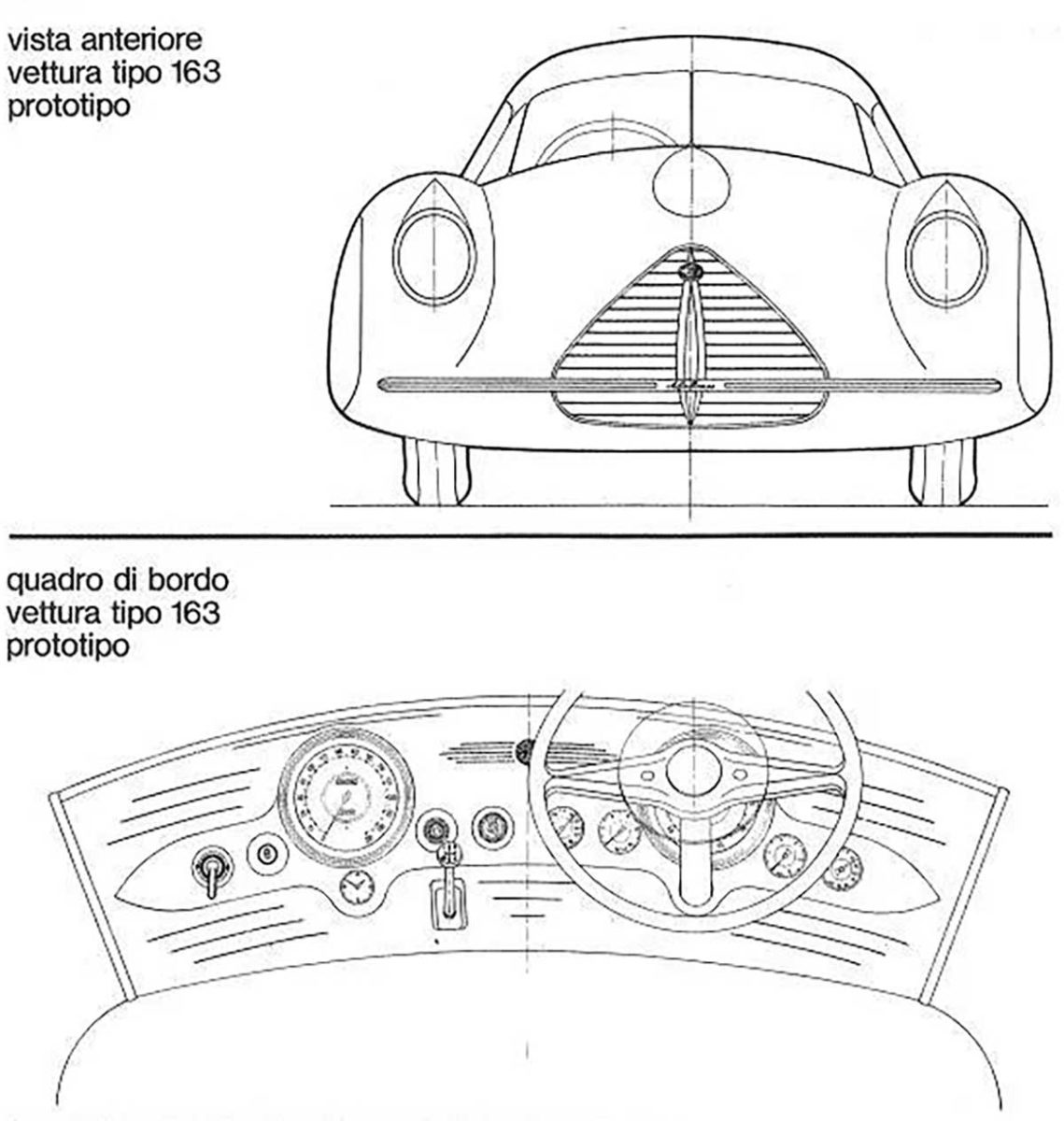
The overall layout of the Tipo 163 illustrates another difference with the Tipo 512: the De Dion rear axle is suspended by coil springs (the longitudinal torsion bars of the 512 were impossible due to the width of the 16-cylinder engine). The suspension arms, which converge towards the rear as on the 512, and the frame rails, which also converge, are clearly visible on the plans found in the archives. The front axle was also fitted with coil springs. Another notable mechanical innovation was the use of hydraulic gearshift with the lever on the dashboard, as in the "Gazzella" project conceived shortly afterwards.
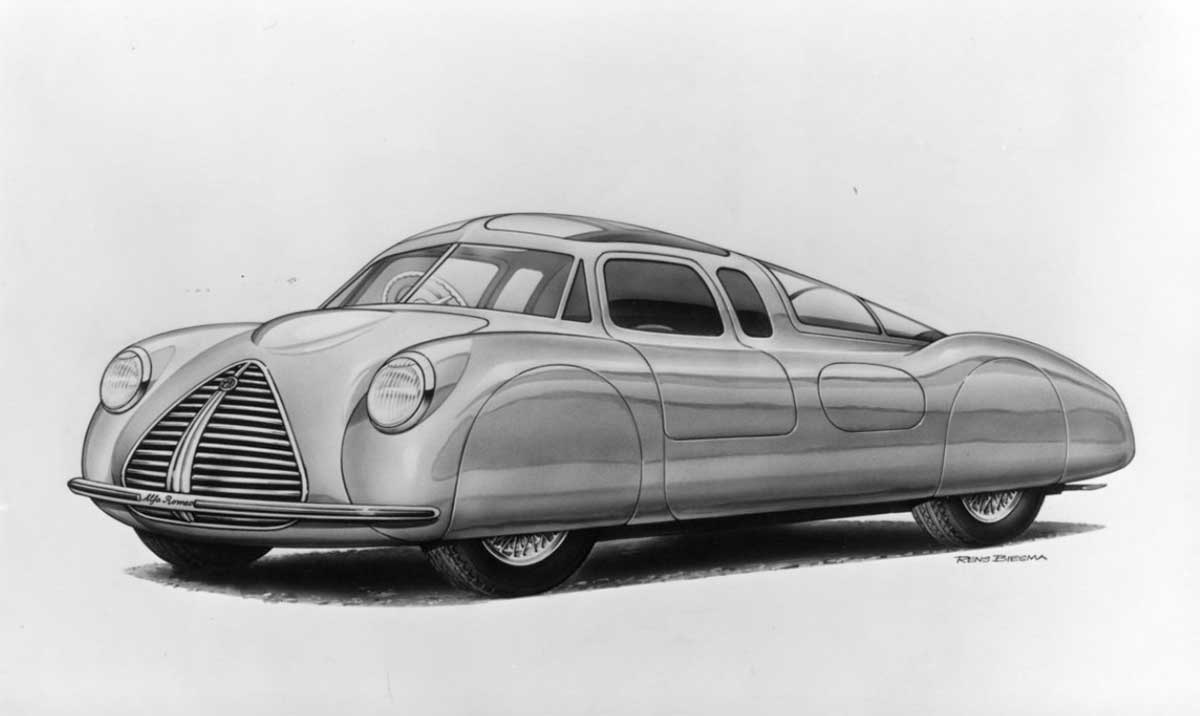
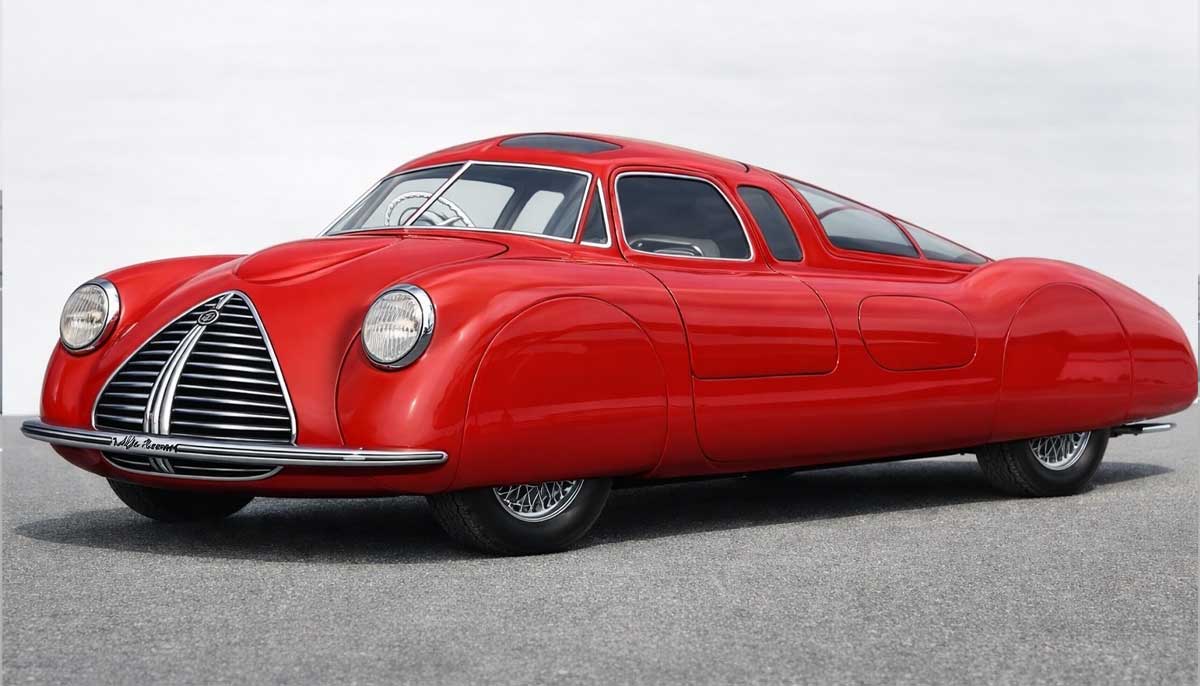
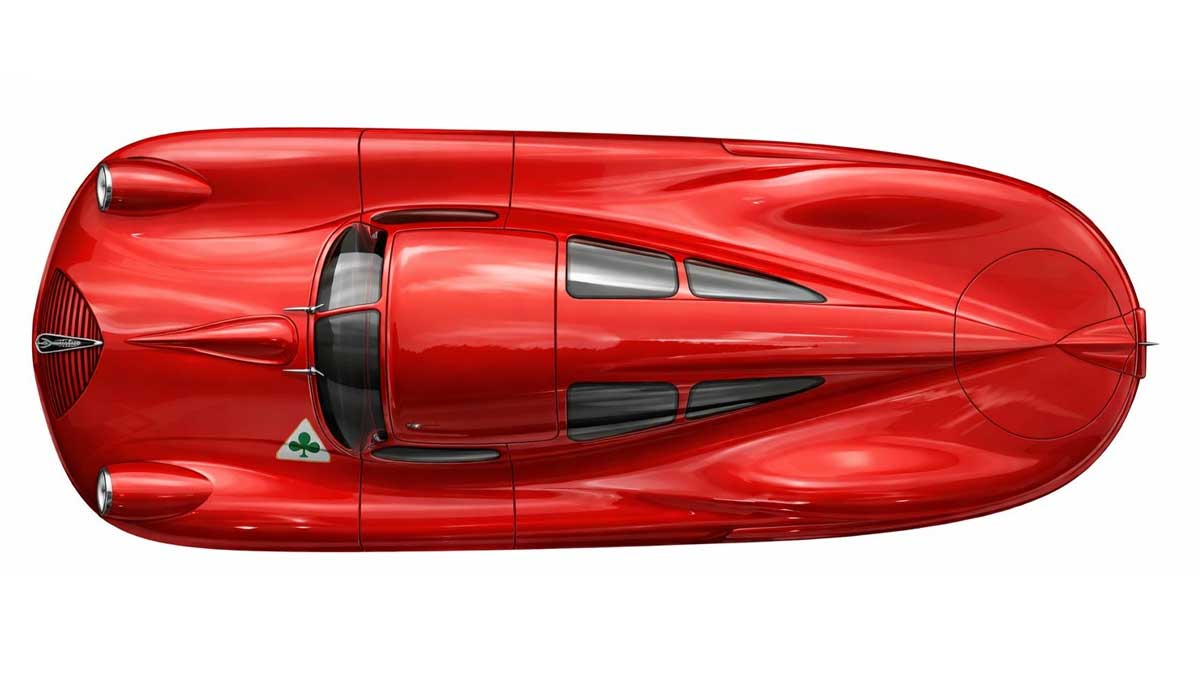
The body, entirely in elektron sheet metal, was probably designed by Gioacchino Colombo. It is wider at the front to accommodate the streamlined steering wheels. The pedals are positioned under the handlebars, with the radiator just in front (without the upper air intake designed to reduce lift, which would not become commonplace until later). Given the tapered front frame, the resulting sloping driving position was probably not very comfortable.
The throes of war
Production plans also included the assembly of a 12-cylinder derived from the S10 prototype, solely for small series production for sports customers. Towards the end of the war, however, the Milan plant was targeted by Allied air raids, as Alfa Romeo was then a major player in aircraft engine construction. The Italians took the precaution of transferring the development department to the remote Lake Orta region at the gateway to the Alps, taking with them the prototypes (162, 163) and parts already in production, which they hid in a villa. Some things were perhaps too well hidden: the chassis and prefabricated parts of the Tipo 163 disappeared after the war.
According to the archives, a prototype was partially assembled, and spare parts were also produced. As previously mentioned, the material was then stored at Lago d'Orta, and has unfortunately since disappeared. Rumors of a possible reappearance of the car have always proved unfounded. Thus, the first hypercar remained a ghost on circuits and roads. Would it have been completed without the war? How would it have behaved on the road? What top speed would it have achieved? All questions that will remain unanswered forever.
 English
  French
  Italian
  Spanish
  Portuguese
  German
  Japanese
  Turkish
  Dutch
Dutch
Alfa Romeo really is the brand with the greatest untapped potential...
A very interesting article in which we learn that the first supercar was not the Miura but this Alfa tipo 163 some twenty-five years earlier.
At the same time, it was still a long way from the aesthetic canons of what supercars were to become, whereas the Miura clearly defined the codes.
It's also worth noting that the first Gran Turismo was an Alfa back in the '30s.
A pioneering brand in many ways.
Does no-one proof read this?
Hello, articles are published in French and then automatically translated to make them accessible to as many people as possible. We make no secret of this, stating it clearly on the home page. There may therefore be translation errors, and I would ask our many non-French-speaking readers to bear with us.
Schöne Beschreibung schade dass der Typ nicht getestet wurde tolle Technik