

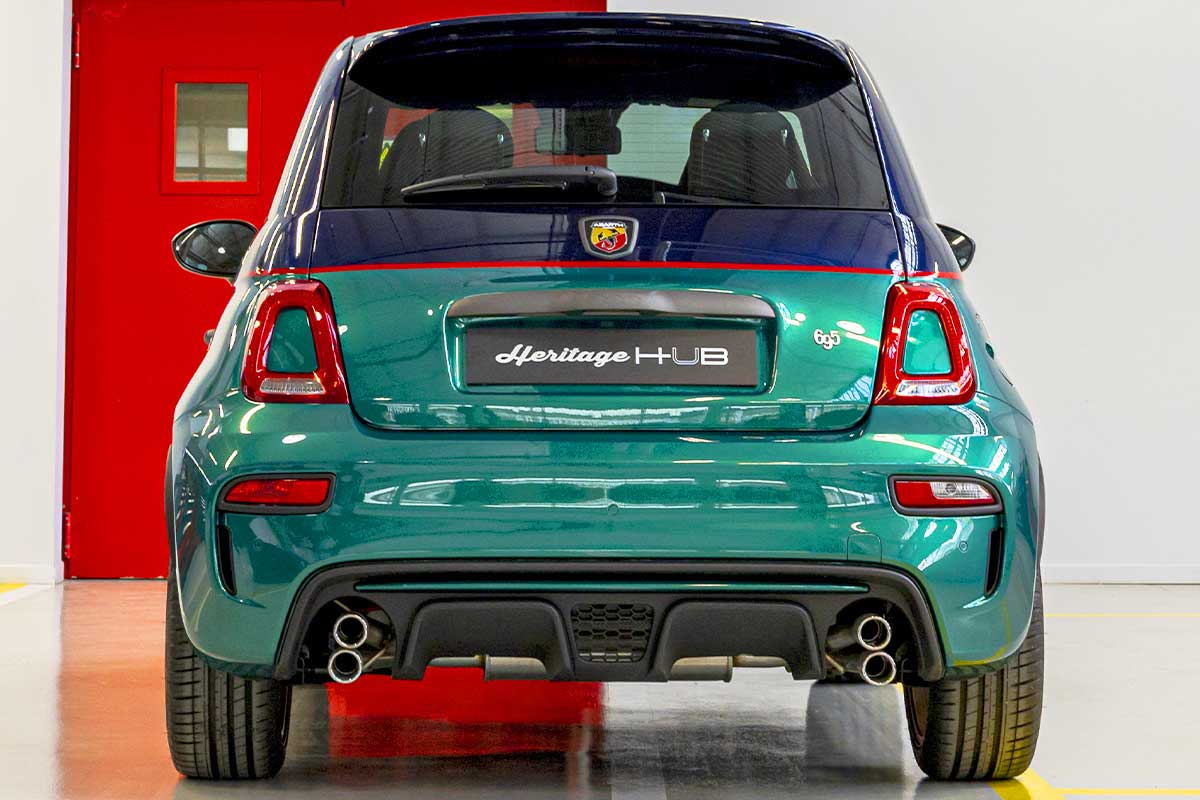
For several years now, Abarth has embarked on a radical transformation: abandoning the combustion engine to become an all-electric sports brand. On paper, the strategy seemed logical in a context of accelerating electrification of the automotive industry. But in reality, the market delivered a brutal verdict.
Today, the heads of Fiat and Abarth half-heartedly admit that this total transition to electric power has been a dead end. And the Scorpion brand is now seriously considering a return... to the internal combustion engine.
An electric 100 % range that's not finding its audience
At present, Abarth's European range consists of two models: the sporty versions of the Fiat 500 and the Fiat 600 SUV. Abarth 500e and Abarth 600e. Special feature: these two cars are exclusively electric.
The problem is simple: sales aren't keeping up. According to figures reported by British media outlet Autocar, Abarth sold just 291 cars in the UK in 2025, compared with 1027 in 2024, a year in which the mythical Abarth 595 thermal was still available. What's more, according to our information, in Italy, 104 Abarth 600e and 73 Abarth 500e were registered in the whole of 2025... Yes, not even 200 Abarths in the whole of Italy in 2025!
This stall is not an isolated one. Since the disappearance of the petrol-powered Abarth 595 and 695 in 2024, the brand has relied solely on the 500e and 600e, models whose price and lack of a combustion engine have put a large proportion of its long-standing customers off the market. This observation confirms what we already mentioned several months ago: Abarth's electric transition has resulted in a collapse in volumes and a loss of brand identity.
Enthusiasts call for the return of the internal combustion engine
The problem isn't just one of performance or sales figures. It also affects Abarth's very DNA.
The boss of Fiat and Abarth in Europe, Gaetano Thorel, now openly admits it. According to him, the brand's long-standing customers are not just looking for power. They also want the mechanical experience.
«When you talk to Abarth enthusiasts, it's not just a performance brand. It's a brand of preparation,» he explains.
Historically, Abarth owners like to modify their cars, optimize the engine, work on the mechanics. But with an electric car, all this becomes impossible.
«Electric Abarths are very capable, but an Abarthista can't get his hands in them,» admits Thorel. «So we're looking into the possibility of remaking a thermal Abarth... if we can give it the right DNA.»
In other words, the brand's management now understands that electrics don't entirely fit in with the culture of enthusiasts who have built the Scorpion's reputation.
A new Abarth could be born from the Grande Panda
In this context, a new project is beginning to take shape. According to Autocar, Abarth is already working on a sporty version of the Fiat Grande Panda.
The new Grande Panda is based on Stellantis' Smart platform, an architecture compatible with several types of powertrain: petrol, hybrid and electric. This base could therefore enable Abarth to return to more familiar territory. Although the project has not yet been officially validated for production, the idea of an Abarth Grande Panda is being studied internally.
When asked about this possibility, Gaetano Thorel remains cautious, but clearly leaves the door open. «We will certainly exploit the Abarth heritage in other models,» he confides.
Fiat is also talking about an original hybrid system inspired by the Grande Panda 4×4 concept, which would use a combustion engine at the front and an electric motor at the rear to provide extra power.
Even Stellantis recognizes the problem
Even more tellingly, the group's top management is also beginning to admit that the 100 % electric strategy is a problem for Abarth. Fiat and Abarth CEO Olivier François acknowledges that customers expect something different.
«For pure performance, electric cars are the best. But we also know that Abarth customers want the sound and the pure driving experience,» he explains.
This sentence perfectly sums up the brand's current dilemma. Electric performance may be impressive, but it doesn't reproduce the mechanical emotion for which the little Italian Abarths are renowned.
However, the return of thermal energy remains very complicated.
While the rhetoric may be changing at Abarth, the industrial and regulatory reality remains far more complex. Like as we explained at the end of 2025, the real obstacle is not technical, but regulatory. European standards on CO₂ emissions make it extremely difficult to market small thermal sports cars.
Even a hybrid city car like the new Fiat 500 already boasts around 120 g/km of CO₂, well above the average European target set around 81 g/km. Every gram in excess entails a penalty of €95 per car sold for the manufacturer.
Under these conditions, launching a modern thermal Abarth could entail penalties of several thousand euros per vehicle. A financial equation hardly compatible with the image of affordable sports cars that has always made the brand so successful.
Whatever happens, the recent statements by Abarth's management mark an important break. For several years, Stellantis firmly defended a vision in which small electric sports cars would naturally replace combustion-powered models. Today, however, his position is far more nuanced.
Management now recognizes that customers are not ready to abandon the internal combustion engine altogether, especially in a brand as emotional as Abarth. The future sporty Grande Panda could therefore become a strategic laboratory for the future of the Scorpion. It could also mark the first step towards a partial return to combustion engines.
 English
  French
  Italian
  Spanish
  Portuguese
  German
  Japanese
  Turkish
  Dutch
Dutch