

For several years, Stellantis embodied the cost-cutting carmaker. Rationalization, savings, optimization: under Carlos Tavares, financial discipline became the backbone of the group born of the merger between PSA and Fiat-Chrysler in 2021. But today, the rhetoric has changed radically. And, more importantly, so have the decisions. New CEO Antonio Filosa now openly acknowledges what many in the company have long been denouncing: the company has gone too far.
An excess of frugality
In several recent statements, Antonio Filosa admits that past strategy has weakened Stellantis in one key area: innovation. «We cut costs excessively. We laid off several engineers who were helping us develop innovative products», he explains.
This policy had a profound effect on the teams. Voluntary redundancy plans were multiplying, simulations of compensation packages were circulating regularly and, at certain French sites such as Poissy and Vélizy, financial offers to leave the company were posted every week. The internal atmosphere had deteriorated, while competitors were snapping up experienced profiles.
In the short term, profitability had improved. In the long term, however, product quality and capacity for innovation began to give cause for concern, particularly in the case of Italian brands where technological and emotional expectations are particularly high. Today, Stellantis is taking a step backwards.
Worldwide recruitment wave
The change began as soon as Filosa arrived. In the United States, some 2,500 engineers have already been rehired. In Europe, too, the machine is on the move again.
In France, the Group has promised 1,400 permanent hires, including 700 engineers, with recruitment already underway and due to be finalized by the end of the year. Over the next three months alone, some 120 R&D positions will be opened up between the Paris region and Sochaux, notably in data processing, artificial intelligence, electrification and electronics.
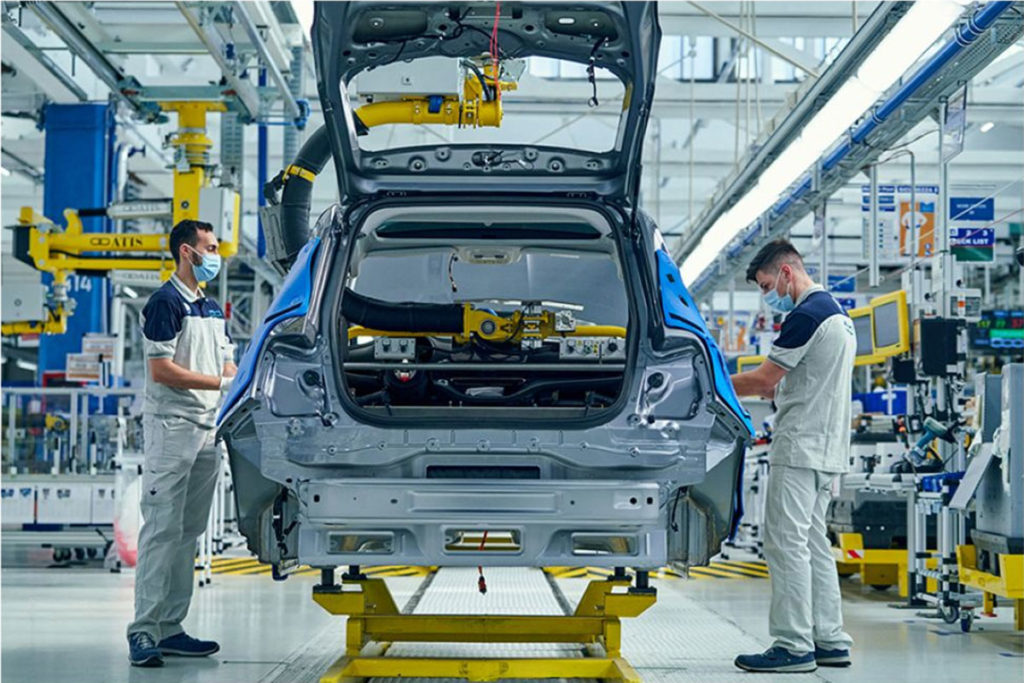
But the movement is also very visible in Italy. At Mirafiori, the return of the Fiat 500 hybrid has already led to some 400 new hires at the plant and over a hundred at the R&D center. At Atessa, a strategic hub for commercial vehicles, new qualified recruits are also being launched. Stellantis clearly wants to reconstitute its engineering teams in its historic bastions.
Italy back at the heart of our strategy
Change is about more than just hiring. Filosa wants to regionalize decision-making: each region must design its products to suit its customers. This approach is particularly well-suited to Italian brands, whose identity depends heavily on the local market. The Group has confirmed several major industrial programs in the peninsula: the return of the 500 hybrid to Turin, the Jeep Compass to Melfi, and the development of the future Lancia Gamma.
Stellantis is also announcing around 6 billion euros in purchases from Italian suppliers, as well as the strengthening of the Turin technical center. The aim is to rebuild a complete industrial ecosystem, not just assembly lines.
Sochaux, symbol of a global turnaround
During a visit to the historic Sochaux site in France, Antonio Filosa confirmed the creation of 1,400 jobs in France, divided between executive and managerial positions. An important message in a tense social context: the site currently employs 1,800 temporary workers, and more than half the permanent staff are over 50.
The group is therefore seeking to renew its skills while preparing for the technological transition, at a time when the European automotive industry is going through a delicate period. Stellantis lost 2.3 billion euros in the first half of 2025, while at the same time announcing 13 billion euros in investments in the United States, fuelling fears of an industrial imbalance.
Rebuilding after the Tavares era
The transition is profound. For years, an engineer was seen above all as a cost. Today, they are once again a strategic asset. The Group has some 250,000 employees and is now seeking to revive internal creativity, shorten development cycles and improve product quality: a crucial challenge for Italian brands whose image is largely based on technical and emotional perception.
After having embodied optimization to the extreme, Stellantis is attempting a new muse: becoming once again a manufacturer of engineers, capable of innovating from Turin, Sochaux or Detroit. It now remains to be seen whether this about-turn will be enough to restore confidence both internally and among customers, and above all to restore the Italian brands to the central role they claim in the Group.
 English
  French
  Italian
  Spanish
  Portuguese
  German
  Japanese
  Turkish
  Dutch
Dutch
Once again, Tavares has made a mess of everything. This guy will have been a destroyer, especially for Italian brands.
It's a shame we didn't land it sooner.
Let's hope the situation continues to improve.
Yeah, proof? Without Tavares, Italian brands would no longer exist in Europe! By 2020 there was little or nothing left in FCA Europe's pipeline. But it's clear that pulling out PSA clones in a hurry wasn't really the best solution. Especially with that damn puretoc 🤨
You're the one who's making assumptions, it's up to you to provide proof of what you're saying...
In short, Peugeot will soon have little to say in Stellantis, and my little finger tells me that the situation will improve.
Fiat could easily have based the 600 on the 500 and it would have been a much better model. I'll pass over the Puretech disasters and the electric platform solution, which is a complete mess (although the eMotors blocks seem to be of a high quality). Fiat should also have managed the development of the Panda/C3/Frontera in-house, instead of outsourcing it to subcontractors. The only consolation is that the Firefly engines are still available on the shelf, as is the Giorgio Evo platform.
In the meantime, the know-how has been lost...
What happened to Tavares' fervent supporters? You don't hear them much anymore...
Potté.
Why?
We heard you criticize Tavares from 2014 to 2023???
It's easy to say that now!
STELLANTIS SANK PEUGEOT BY TREATING LIKE DOGS THE OWNERS OF VEHICLES EQUIPPED WITH THE CRAPPY PURE TECH THIS POLICY WILL HAVE HAD A VERY NEGATIVE IMPACT COMMERCIALLY CUSTOMERS WHO HAVE ALWAYS BEEN LEMON PEUGEOT WENT TO SEE THE COMPETITION AND DISCOVERED THE ASIAN BRANDS TOYOTA HONDE KIA ECT ,and a customer who has gone elsewhere is a lost customer.
Hello. you forgot the 1 liter 5 HDi with its 7 mm timing chain that forces you to change the upper engine, a fiasco due to the engineers at central like the puretech. They've ruined the company
On this point, the 2 former groups agree. Since 2010 and 2015, FCA and PSA have only reduced their industrial and human investments! The consequences are plain to see: on the one hand, Fiat now has only the 500 as a «modern» vehicle, while Citroën, for example, no longer has any top-of-the-range models, replaced by Peugeots disguised as DSs, which technically offer nothing.
I've been driving around in Fiats for over 50 years. They are rubbish but they are my rubbish and I'll keep on buying them as long as the engine is Italian made/designed.
Mit dem Mentalität eines Buchhalters Tavares hat versucht der Stellantis zu becherschen! Da zu kommt noch ein tiefes Geschmack von der Nationalismus - in seinem Führungsteam sind nur Französen! Der Kreativität war für ihm unwichtig! Die Italener waren für ihm nur Belastung! So geht es nicht!
Wer kauft schon ein Fiat oder ein Stellantis Product, die Technik ist veraltet und Form ebenso. Es war einmal, schon lange her !!!
Stellt wieder verbrenner her warte auf GRANDLAND DIESEL ODER BENZINER!
Das wird ein Verkaufsschlager!!!
Eine Frage: welche Rolle spielt Opel in der Stellantis- Strategie, bei ca. 20% des Gesamtumsatzes?
Stellantis sollte wieder
Den Fiat Marea , Freemont und bei Lancia die Mittelklassen und Oberklassen beleben denn die Fahrzeuge waren gut und langlebig . Bei entsprechender Innovation könnten diese wieder Markführend werden . Und SUV und Fiat Fiorino als Allrad modelle eigenen Gewissen Marktanteil erreichen der einen Aufschwung darstellt.
Hello. you forgot the 1 liter 5 HDi with its 7 mm timing chain that forces you to change the upper engine, a fiasco due to the engineers at central like the puretech. They've ruined the company
Alfa und Fiat dürfen nicht vergessen werden. Top Marken, vorallem Alfa Romeo, einmal Alfa immer Alfa!
Toll, Alfa muss leben!