

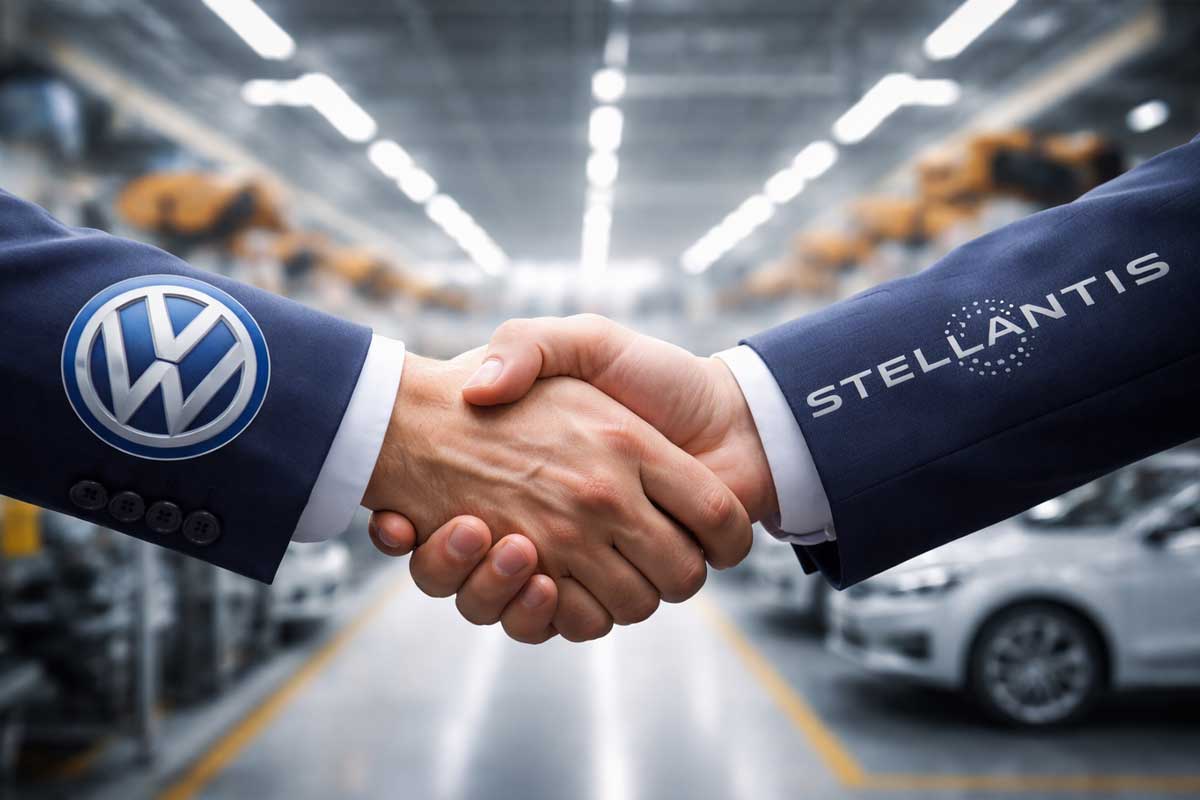
The European automotive industry is going through one of the most critical periods in its recent history. Between a more costly electric transition than expected, aggressive Asian competition and European regulations deemed too rigid, the warning signs are multiplying. This time, two of the sector's heavyweights, Volkswagen and Stellantiswho have decided to speak with one voice in an attempt to change course.
In an open letter published simultaneously in several major European media, the heads of the two groups, Oliver Blume and Antonio Filosa, set out a harsh diagnosis, but above all a strategy they believe is essential to safeguarding the industrial future of the Old Continent.
The automotive industry under constant pressure
The automotive industry accounts for around 8 % of the European Union's GDP and provides a livelihood for almost 13 million people. Yet never before has this ecosystem seemed so fragile. The heads of Volkswagen and Stellantis point to a fundamental paradox: nine out of ten cars sold by their groups in Europe are produced here, but these models now have to compete with imported models, subject to far less stringent social, environmental and regulatory constraints.
The transition to electric vehicles has amplified this imbalance. European consumers legitimately demand affordable electric cars, an essential condition for mass adoption of this technology. But the more prices have to come down, the greater the temptation to import key components, notably batteries, from Asia, where costs are much lower.
The battery and production cost trap
For Blume and Filosa, the battery is the very symbol of the European dilemma. Carmakers are investing billions to develop a local industry, but are coming up against a brutal economic reality: production in Europe is expensive. And yet, an affordable electric car does not stand up well to high value-added components manufactured locally. This mechanism creates a vicious circle. To remain competitive, manufacturers import. By importing, they weaken European industrial sovereignty. And by weakening this sovereignty, Europe becomes even more dependent on external suppliers, notably Chinese.
"Made in Europe
To break this deadlock, Volkswagen and Stellantis are proposing a clear strategy: to establish a genuine "Made in Europe" framework. The idea is not to close off the market, but to rebalance the rules of the game. Vehicles destined for the European market would have to meet precise local production criteria, integrating not only assembly, but also electric motors, battery cells and key electronic components. Models meeting these criteria would benefit from concrete advantages: priority access to public aid, purchase bonuses, even specific recognition in the calculation of CO₂ targets. An approach that would transform current financial penalties into incentives to invest on European soil.
European regulations deemed counter-productive
Antonio Filosa makes no secret his frustration with current European regulations. In his view, CO₂ emission reduction targets have been set on the basis of a faster transition than that actually observed on the market. The result: billions of euros tied up in anticipation of fines, to the detriment of productive investment. Stellantis, for example, has set aside almost half a billion euros for penalties relating to light commercial vehicles. These are sums which, according to Filosa, could be much better used to finance factories, hire engineers and develop new technologies. He therefore calls for a realistic revision of the targets, with more time given to European manufacturers.
Between the United States and Europe, two opposing visions
The contrast with the United States is striking. There, Stellantis invests massively, supported by a clear industrial policy and more transparent rules. In Europe, on the other hand, industrial overcapacity, weak demand and regulatory uncertainty ambitions. Antonio Filosa, however, maintains that the Group has not given up on the continent. Ten new models have recently been launched in Europe, and investments are continuing. But he warns that unless the regulatory framework is adjusted, growth potential will remain limited.
European industry at a crossroads
Blume and Filosa insist on one point: their proposal is not protectionist. The aim is not to erect barriers, but to strengthen Europe's resilience in strategic areas. At a time when technology and trade are becoming geopolitical weapons, Europe must choose whether to remain a mere market or once again become a genuine industrial power. The message is clear. Without a rapid response, Europe risks losing not only its competitiveness, but also its historic know-how.
 English
  French
  Italian
  Spanish
  Portuguese
  German
  Japanese
  Turkish
  Dutch
Dutch
Mouais... both are looking for money in return. And in Filosa's case, he's a hypocritical Trumpist who doesn't give a damn about Italy or Europe, as we've come to understand. He should have stayed in the States.
I hope you're wrong, Hans, but I'm afraid you're right.
Eerlijk, deze beide fabrikanten hebben de consument zo hard en massaal opgelicht dat ik er geen traan om zal laten als ze - na eerder Opel, Fiat etc, dat zijn gewoon gerebadgede peugeots- lekker verdwijnen. En ja, ik heb autos van beide stallen gereden en het was allemaal een grote bak ellende, daarnaast rijdt het ook allemaal voor geen ene meter.