


Just a few days after making it official a spectacular strategic reset, Stellantis is already facing a new storm, this time a legal one. In the United States, the automotive group could be the target of a shareholder class action after its share price plummeted following the announcement of 22 billion euros in exceptional charges linked in particular to electric vehicles. What was supposed to mark a new financial beginning now risks becoming a sensitive case before the American courts.
An investigation launched on Wall Street
US law firm Levi & Korsinsky has announced the opening of an investigation into whether Stellantis may have violated federal laws governing listed companies. Specifically, the lawyers are looking into whether the group had negative information on its activities, particularly electrification, which it may not have properly communicated to investors prior to the official announcement on February 6.
On that day, Stellantis admitted having overestimated the speed of adoption of electric vehicles and presented a massive accounting correction of over 22 billion euros. The Group also suspended its dividend for 2026 and indicated its intention to review its shareholder remuneration policy, confirming the scale of the strategic shift underway. But the reaction on financial markets was immediate and violent.
A historic fall in the share price
In Milan, Stellantis shares plunged by around 25 % in one session. But it was on Wall Street in particular that the shock took on spectacular proportions: on the New York Stock Exchange, the stock lost almost 28 % in a single day. Quite simply, this was the worst session in the company's history in the United States.
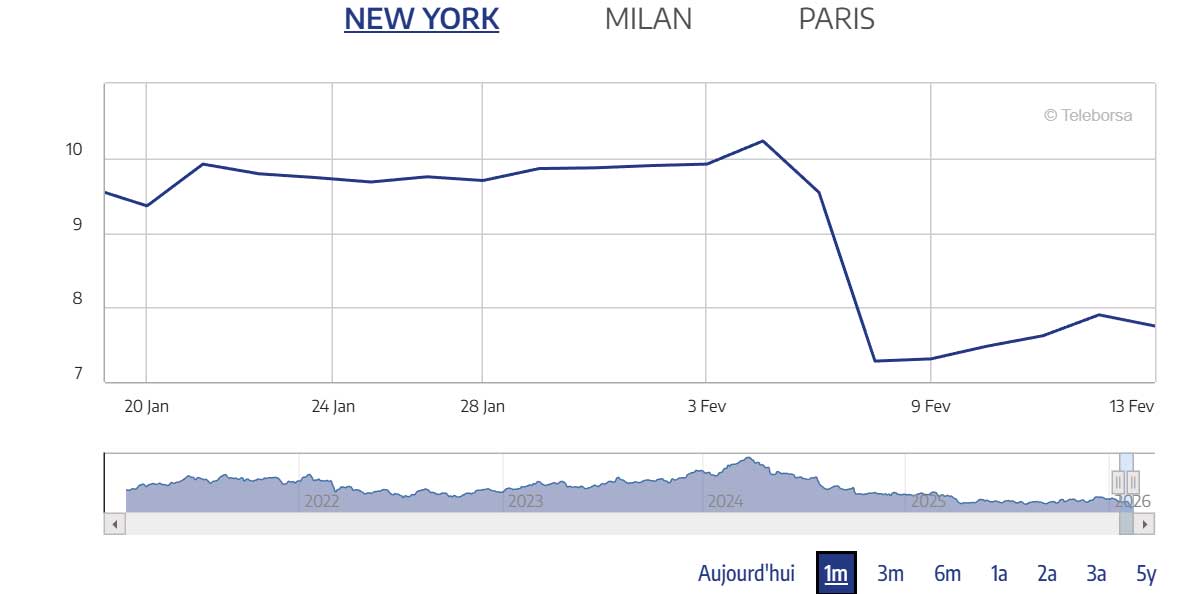
For American investors, this sharp fall raises a central question: were they properly informed of the Group's true situation prior to this announcement? It is precisely this point that the investigation must clarify. If the lawyers believe that Stellantis should have warned the market earlier of the deterioration in its prospects for electric vehicles, a class action could be launched to obtain financial compensation for the injured shareholders.
The judicial setback of a strategic reset
Ironically, this potential procedure is a direct result of the transparency strategy adopted by Stellantis. By concentrating all the corrections - asset write-downs, cancelled power projects and volume revisions - in a single package, the Group wanted to turn the page on previous years and start afresh on a realistic footing.
The automaker has now adopted a more pragmatic repositioning, giving a central role to hybrid and internal combustion powertrains, particularly in North America. This shift has already produced the first positive operational effects on volumes and deliveries.
But on the stock market, the psychological impact was brutal: publicly acknowledging a strategic error of this magnitude also means admitting that past expectations were too optimistic. And for some investors, this could constitute a failure of prior information.
In the short term, this investigation does not mean that Stellantis is guilty of any offence. It does, however, represent an additional legal and reputational risk for a group already engaged in a major industrial transformation.
 English
  French
  Italian
  Spanish
  Portuguese
  German
  Japanese
  Turkish
  Dutch
Dutch
Who was the great organizer for the Americans... not a certain Filosa?
Despite the decline in electrics, I'm confident about the future of stellantis. It's a good thing that we're going back to combustion engines for the time being. Especially in the USA.
The fact that stellantis has 14 brands is very positive, as it reduces R&D costs and reduces the number of segments, which harmonizes a large number of parts.
Once this stage is over, the stock will return to a very good level. Don't hesitate, there's still time to invest.