

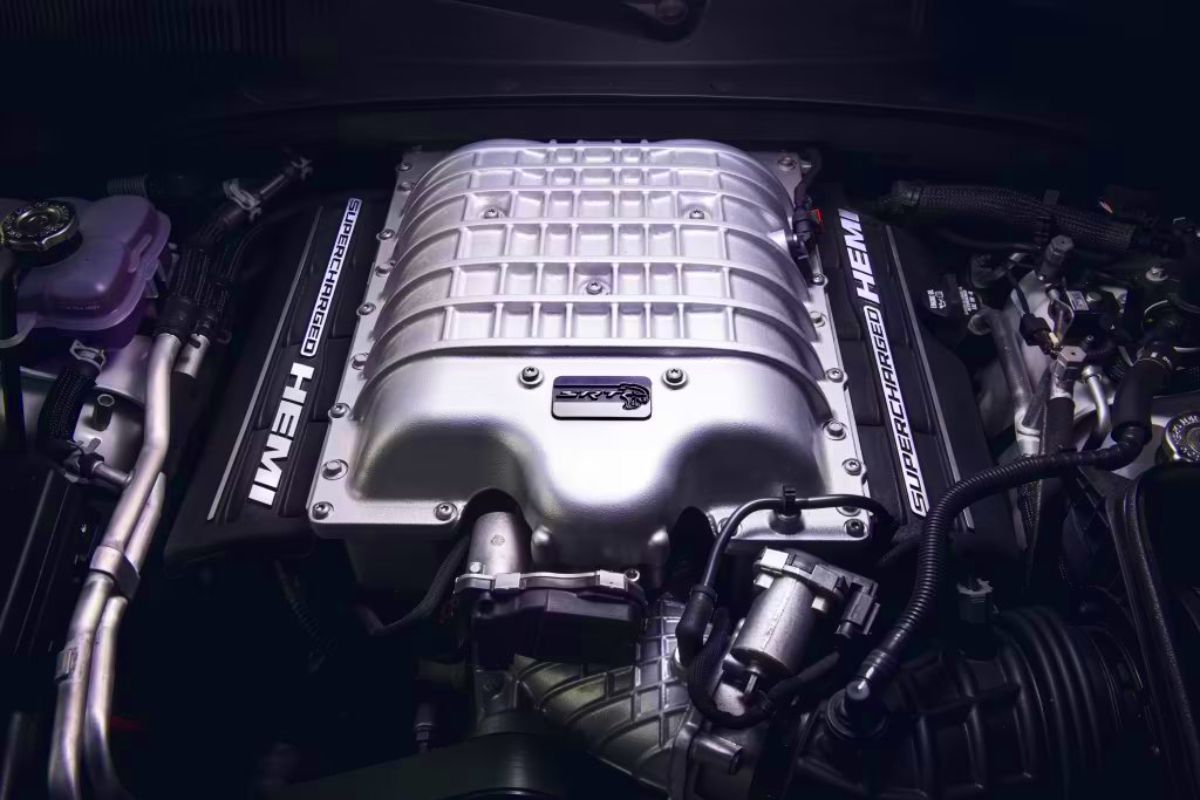
As the European automotive industry continues on its path towards accelerated electrification, a recent decision by Stellantis is a reminder that the global market is not moving at the same pace, nor in the same direction. In 2026, the automotive group plans to triple production of its V8 HEMI engines, with over 100,000 units expected, in order to meet what it describes as "record" demand, mainly in North America. A counter-current announcement, but perfectly indicative of a strategy that is now deeply regionalized.
The unexpected return of the V8 HEMI
The V8 HEMI engine seemed doomed. With the gradual disappearance of iconic models such as the Dodge Charger, Challenger and Durango, and the partial shutdown of production lines in Saltillo, Mexico, all the signs were that these naturally-aspirated engines were a thing of the past. However, market reality has caught up with theory. Faced with much stronger demand than expected, Stellantis decided to massively relaunch production of the 5.7 and 6.4-liter HEMI V8s. These engines, which have become rare in a sector obsessed with CO₂ grams, nevertheless continue to appeal to a loyal customer base, willing to pay dearly for models with a strong identity. For the Group, this is also an obvious profitability lever, with large-displacement combustion engines still offering very high margins.
US loosens regulatory stranglehold
This strategic shift did not come out of nowhere. It is part of a profoundly transformed political and legal context in the United States. Federal decisions taken under Donald Trump's administration, combined with several recent rulings, have weakened California's ability to impose its own environmental rules. The agreement signed in 2024 between Stellantis and the Californian authorities, during the Carlos Tavares era, set very ambitious targets: up to 68 % of zero-emission vehicle sales by 2030. But legal action by several manufacturers, including Daimler and Volvo, has called into question the very legality of this type of contractual commitment when the targets are no longer supported by federal law. As a result, Stellantis is no longer really obliged to follow this trajectory in California, its most strategic market in the USA.
Thermal power back on track in North America
The signals sent by Stellantis are now very clear. The V8-powered Jeep Wrangler is once again available in all 50 US states, including California. Ram and Dodge have reinstated V8 versions in their catalogs, while Plug-in hybrid models have simply been cancelled for the year 2026. According to Mopar Insiders, this momentum will translate into a tripling of HEMI V8 production by 2026. This is confirmed by Ram CEO Tim Kuniskis, who fully assumes this choice: demand for high-performance engines remains extremely strong in North America and is, more than ever, a pillar of the Group's profitability.
A two-speed strategy
The V8's return to favor doesn't mean that Stellantis is giving up on electrification. In Europe, the reality is quite different. The group has no choice: the CO₂ standards imposed by Brussels force a rapid and massive reduction in average emissions, on pain of colossal fines. New platforms, widespread hybridization, 100 % electric vehicles: the European trajectory remains rigorously framed. But in the United States, Stellantis is playing a different game. Less constrained by regulations, the group adapts its offering to actual market demand. V8s and in-line six-cylinders are once again strategic products, while Europe is transforming itself into a laboratory for the electric transition.
 English
  French
  Italian
  Spanish
  Portuguese
  German
  Japanese
  Turkish
  Dutch
Dutch
Europe, which represents barely 5% of the earth's surface, is going to save it with its directives aimed at reducing pollution. Meanwhile, the other 95% of the planet are polluting like crazy! MDR 😅😅😅
And that's a reason to continue polluting at home?
Europe is the world's strongest trading zone.
Its influence remains immense in the rest of the world.
So in any case...
And look at China's progress in this area!
From bad pupils to an example
... to the world? 🤔
Certainly, but curiously a small Asian country is currently much more active in EV development...you know China, a small country that represents 2.5 times American production...
I'm afraid I won't understand everything?
Western Europeans number 550 million, but they have high purchasing power.
Of China's 1,400 million inhabitants, do so many have the same purchasing power?
I don't think so, especially since China has been a bit down since 2019 (COVID).
But YES, after having been the champions of coal-fired power plants, the Chinese are also the champions of renewable energies and EVs (AND to sell them back to us!).
One doesn't preclude the other.
Europe isn't doing it for our benefit, they've decided to follow the electrification of the car fleet so as not to be dependent on Russian gas and oil, because they believe that with all the reserves Russia possesses, within 100 years the Russians will be richer than the Europeans.
toutafait fofo!
And Europe, if it wants to, can become a world leader in electricity generation using renewable energies and nuclear power!
But the decision has to be made!
In the 1990s, the destruction of Europe's domestic automotive industry was triggered by ignorant politicians in the European Parliament, who had built their careers on emissions. They began proposing technically unrealistic targets (120 and then 90 g/km of CO2), followed by fines for exceeding them. Unfortunately, no one was around to point out their ignorance and bring everyone back to reality.
Lei dove era?
Fortunately, this industry still exists in Europe; in Italy's case, it has partially migrated to Poland. In any case, the result of these politicians' actions has been the abandonment of diesel technology, which was the main advantage of European automakers and suppliers, and a growing dependence on battery technology from Asia.
This is highly counterproductive; the Japanese, for example, would never have harmed themselves so much.
European countries should restore their rights to block counterproductive initiatives from the Brussels bureaucracy, including those related to CO2 emissions. This is a fictitious problem.
Die grüne Seuche ist auf ganz Europa übergeschwappt.
Gott sei Dank ist der Rest der Erde gebildeter.
You're comparing 2 very different lifestyles: in Europe, we don't have the same surface areas or the space for such vehicles, so what's the point of such engines? But we shouldn't shoot ourselves in the foot and stop producing internal combustion engines suited to our regions.
Oil is produced in Europe!?
So the problem is quickly solved!
A V8 in Europe is necessarily a luxury, you have to accept that.
L'europa sta certificando la propria irrilevanza industriale ed economica che la condurrà alla marginalizzazione. Imporre tecnologie che non possiede e che non e' in grado di controllare alle proprie industrie significa suicidarsi economicamente. E la domanda che viene da porsi e': cui prodest? A chi giova? Tutti seguono i propri interessi, l'europa segue gli interessi altrui a scapito dei propri