

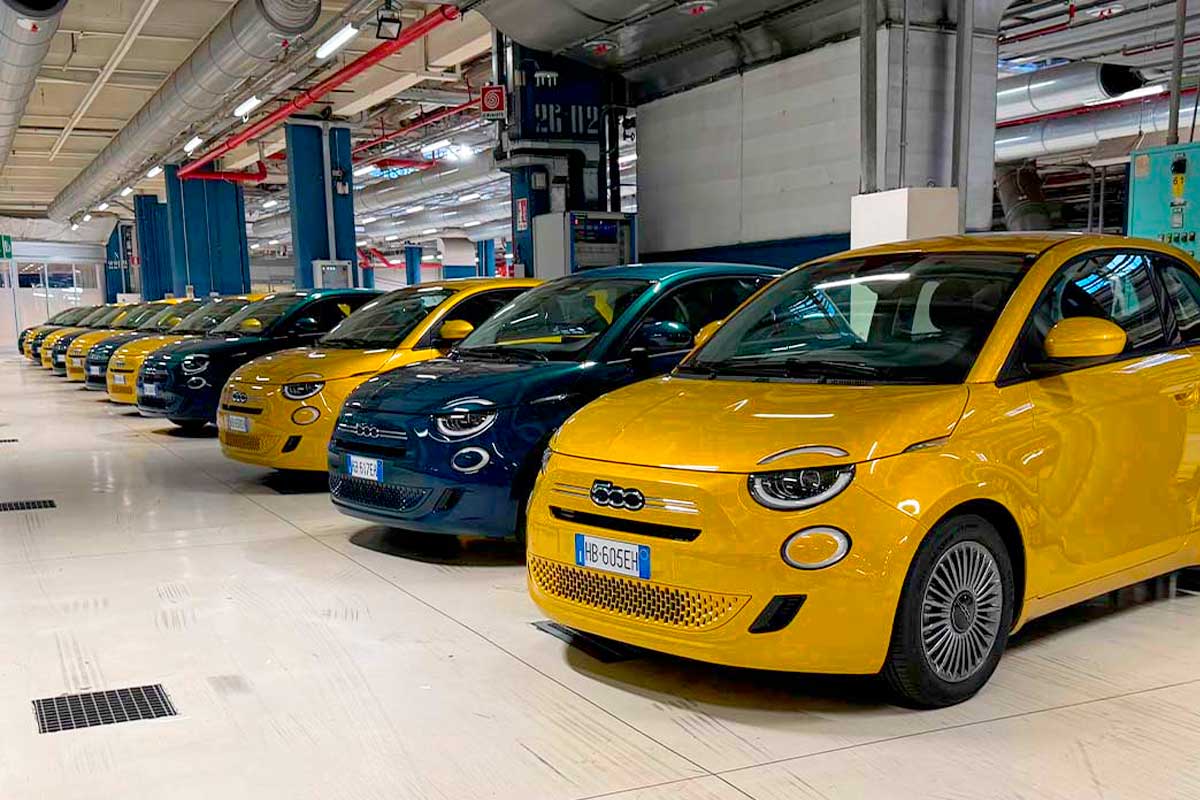
After embodying Mirafiori's industrial revival, the Fiat 500 hybrid may end up producing less than expected in 2026. Officially, Stellantis maintains its target of 120,000 annual units (electric and hybrid combined) at the Turin site. Behind the scenes, the reality is more cautious: according to several sources quoted by Milano Finanza, total production could plateau at around 85,000 units, or almost 30 % less than initial projections.
A lowered target, despite official rhetoric
Last year, the plan was clear: 100,000 Fiat 500 hybrids and around 20,000 electric versions, to give Mirafiori a lasting boost. The revival has indeed taken place. The end of short-time working on january 31, the arrival of over 400 new recruits and the gradual introduction of a second shift marked a symbolic turning point for the Turin plant.
But it takes time to ramp up production. Today, production still runs on a single shift, with around 220 to 240 Fiat 500 hybrids assembled every day, plus another 20 to 40 electrics on the same line. Reaching a rate of over 400 units a day will take several more weeks, the time needed to integrate the new employees and rediscover the industrial automation lost after years of reduced activity.
Against this backdrop, some observers feel that the 120,000 annual unit target seems optimistic. Even if the second shift kicks off as planned, 85,000 vehicles in 2026 now seems a more realistic estimate.
The hidden factor: emissions and European fines
Behind this industrial caution lies another, more sensitive subject: that of CO₂ emissions. The Fiat 500 hybrid boasts around 117 g/km. However, for the period 2025-2027, the brand Fiat must meet an average target of 99.1 g/km in Europe.
Theoretical overruns are subject to a penalty of 95 euros per excess gram and per vehicle sold. In the case of the 500 hybrid, this would represent a potential fine of around 1,700 euros per car. At 100,000 units sold in Europe, the bill could exceed 170 million euros.
Producing and selling a few thousand fewer 500 hybrids «could be advantageous for Stellantis». Fewer volumes would mechanically mean less exposure to European penalties, especially if the share of electric versions remains modest.
Officially, Stellantis does not link a possible revision of volumes to this regulatory issue. But in a group that recently recorded more than 22 billion euros in write-downs, every financial variable is carefully scrutinized.
Mirafiori between rebirth and fragility
Even at 85,000 units, 2026 would mark a clear improvement on previous years. In 2024 and 2025, Mirafiori had produced only 26,000 and then 30,000 vehicles, including Maseratis since transferred to Modena. We would have to go back to 2023 to find a level above 80,000 units.
The momentum remains positive. The first recruits have already joined the lines. The second shift is due to start in mid-March. But the unions point out that the current 500 line cannot exceed 120,000 vehicles a year, and that a second high-volume model would be essential to secure the site's future. The equation is a delicate one: produce enough to secure jobs and make the plant profitable, without increasing the regulatory bill for emissions.
In the space of a few months, Mirafiori has gone from a chronically under-active site to a factory scrutinized for its output, volumes... and now its carbon footprint. The Fiat 500 hybrid was supposed to be the saviour. It remains so, but its success may be measured with more restraint than expected. Paradoxically, in 2026, selling a little less could prove strategically more profitable. A more efficient, Euro 7-compatible hybrid system would therefore be welcome in the years to come.
 English
  French
  Italian
  Spanish
  Portuguese
  German
  Japanese
  Turkish
  Dutch
Dutch
At the same time, when I went to Fiat to try it out, even the salesman advised me against buying the new Fiat 500 Hybrid because it was so underpowered.
The problem with the 500 hybrid is that the 1.0 Firefly hybrid of the old 500 was hastily adapted for the new model, without having upgraded the engine with 12-valve technology to lower fuel consumption and CO 2 emissions to less than 100 g in order to comply with standards. .
I think (I hope) this is all the work that needs to be done on the Firefly Euro 7.
To be honest, I don't see the point of the new 500 hybrid.
The main issue of the 500e was its price, not the fact that its an EV.
Also, 65 hp is definitely not enough.
So finally the models with Firefly engine(100% Fiat)in Europe would not be as much panacea as some describe it on this site??? 😮
Between satisfying buyers' demands and trying to avoid European fines as much as possible, the solution would be for the new Fiat 500 EV with LPF battery to be brought to market quickly.
But it doesn't happen overnight, so we'll have to wait and see.
Meanwhile, the Aygo hybrid is exceeding forecasts. You have to say that with 87g it has room to spare 🙂. And it costs the same 🤨
Solange die Software vom Auto und der App nicht vernünftig laufen, muß sich Fiat nicht wundern, wenn sich die Autos nicht verkaufen, zumal der Fiat 500 eh schon nicht so billig ist und bei der App wollen sie auch noch ordentlich abkassieren, obwohl die nichtmal was besonderes kann und die im Kaufpreis des Autos enthalten sein müsste.
I reiterate the sentiment I expressed in December.
The future, the real salvation in the future for the Fiat 500... It will be the new, much less expensive electric 500 with LFP battery.
This one will put everyone in agreement: it won't be more expensive than this lousy hybrid, and it'll perform much better.
By 2027?
It will indeed have the LFP battery produced in Spain. As for the timeframe... maybe we'll start getting information in 2027, but for the moment it's very quiet.