

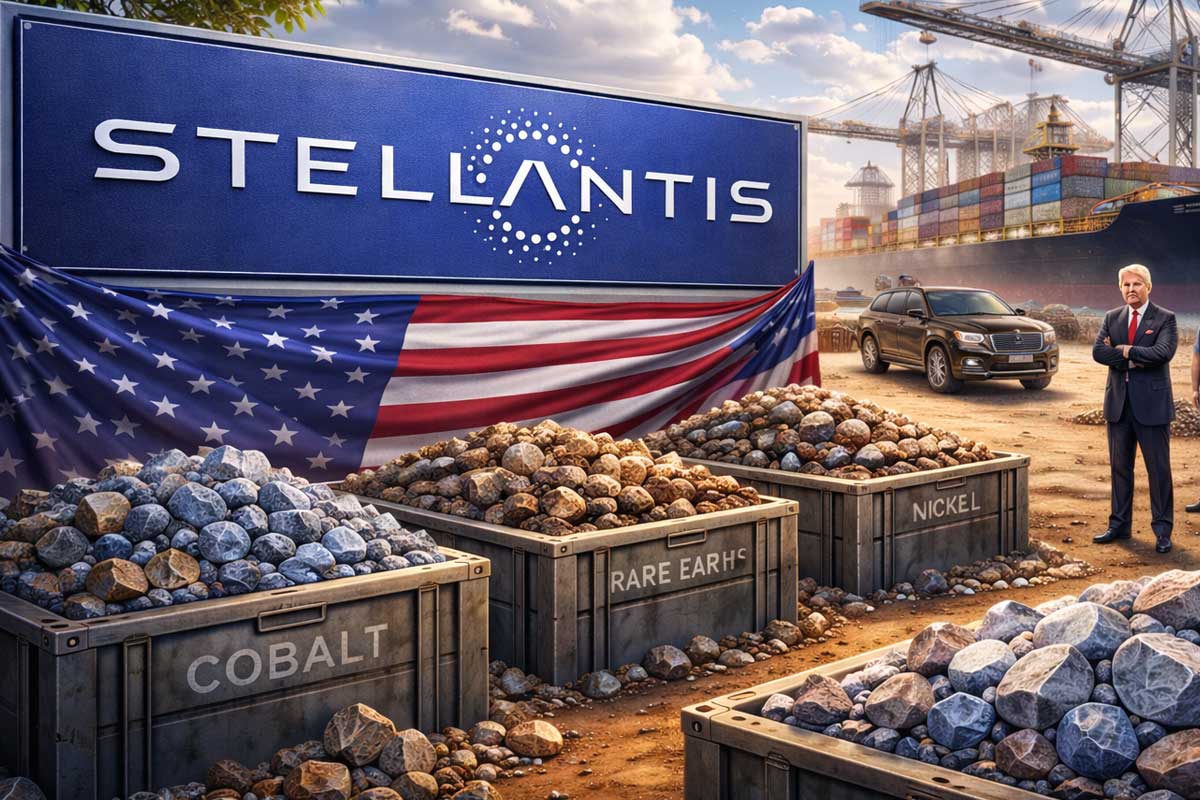
The United States is about to take a major step forward in the global raw materials war. Faced with China's domination of rare earths and critical metals, Donald Trump's administration is launching "Project Vault", a vast $12 billion program designed to secure supplies for American industries. Among the groups already involved are Stellantisconfirming the importance of these resources for the future of the automotive industry.
The strategic reserve inspired by oil, but dedicated to minerals
According to information reported by Bloomberg, Project Vault is based on an idea: to create a strategic mineral reserve, modelled on the US oil reserve. The aim is to protect industrial chains against supply shocks, against a backdrop of high geopolitical tensions. The plan calls for up to $10 billion in long-term loans from the U.S. Export-Import Bank, supplemented by $1.67 billion in private capital. These funds will be used to purchase and store critical materials such as cobalt, nickel, gallium and rare earths, all of which are essential to the automotive, technology, aerospace and energy sectors.
Why Stellantis is involved
Stellantis' participation in the project illustrates the growing concerns of the global automotive industry. In the midst of their transition to electric vehicles, automakers are becoming increasingly dependent on strategic metals, the supply of which is now largely controlled by China, particularly in terms of refining. Alongside Stellantis, several industrial giants have already joined the initiative, including General Motors, Boeing and Alphabet (Google). The presence of two major automotive players underlines the extent to which price volatility and the risk of shortages now pose a direct threat to the production of electric and hybrid vehicles.
Immediate impact on commodity markets
The announcement of Project Vault has not taken long to produce its first effects. Three major commodity trading houses - Hartree Partners, Traxys North America and Mercuria Energy Group - will be responsible for purchasing the minerals destined for the reserve. In the meantime, the shares of several US companies specializing in critical metals surged in pre-market trading. The Export-Import Bank's Board of Directors has yet to formally validate the loan, which could become the largest ever granted by the institution. Donald Trump is also due to meet General Motors CEO Mary Barra, as well as mining magnate Robert Friedland, a symbol of the strategic link between industrial demand and resource supply.
For Stellantis, as for the automotive industry as a whole, Project Vault is part of a wider battle: that of industrial sovereignty in the age of electrification. By securing access to key raw materials, the United States is seeking to regain the upper hand against China and guarantee the continuity of its production chains. It remains to be seen whether this initiative will be enough to restore lasting balance to a market that has been dominated for years by Beijing.
 English
  French
  Italian
  Spanish
  Portuguese
  German
  Japanese
  Turkish
  Dutch
Dutch