

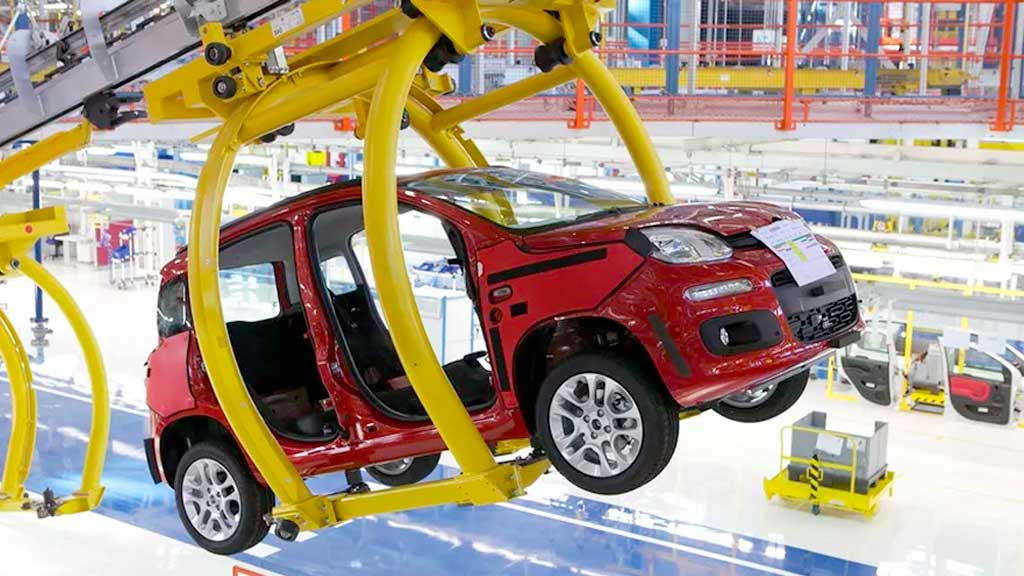
There are some painful figures. By 2025, Italy's Stellantis assembled 213,706 cars. So low, in fact, that you have to go back to 1955 to find a lower level of production. In that year, Italy still produced almost 231,000 cars. Seventy years later, the country that gave birth to Fiat, Alfa Romeo, Lancia and Maserati finds itself producing less than it did at the end of the post-war reconstruction. Meanwhile, a few hundred kilometers away, Spain has never accelerated so much.
Historical drop confirmed by 2025 figures
Data published in early January by Fim-Cisl leave no room for interpretation. Including commercial vehicles, total Stellantis production in Italy stood at 379,706 units in 2025, down 20 % year-on-year. In just two years, volumes have been halved compared with 2023, when Italian plants still exceeded 750,000 vehicles. The heart of the problem remains vehicles for private customers. With a year-on-year decline of almost 25 %, this segment has fallen to a level that even the unions are now describing as "unprecedented for seventy years". Italy has fallen out of the world's top 20 car-producing countries, and almost half of Stellantis' employees in the country are now affected by short-time working arrangements.
Mirafiori, the only bright spot in a gloomy industrial landscape
One site stands out in this gloomy picture: Mirafiori. The Turin plant is the only one to report growth in 2025, with an increase of 16.5 % over the previous year. But here again, the figure needs to be put into context. Mirafiori produced only around 30,000 cars over the year as a whole, a long way from the estimated industrial viability threshold of 200,000 units. This relative improvement is due almost exclusively to the late launch of the Fiat 500 hybrid. In two months, some 6,000 units were assembled, enabling the site to symbolically return to profit. Stellantis is now aiming for 100,000 units a year by 2026, with a second production line and a new production facility. several hundred recruitments announced. An encouraging sign.
Cassino, Melfi, Pomigliano: at a standstill
Elsewhere, the situation is far more worrying. Cassino recorded its worst year ever, with barely 19,000 vehicles produced. The Alfa Romeo Giulia and Stelvio are reaching the end of their cycle, STLA Large platform projects postponedThe future of the site is still hanging in the balance, pending the unveiling of an industrial plan... which has yet to be unveiled.
Melfi recorded a spectacular collapse of 47 % over the year, although the gradual launch of the new Jeep Compass on STLA Medium suggests a rebound in 2026. Pomigliano, buoyed by the Fiat Panda, also fell by more than 20 %. Even Italy's most-produced model can no longer escape the erosion of volumes.
At Atessa, the decline in light commercial vehicle sales is putting further pressure on employment. As for Termoli, its future remains one of the Group's most sensitive issues, with the promised gigafactory still without a clear timetable or industrial guarantees. However, Stellantis assures us that it will remain a major industrial pillar of the group.
Spain, the other face of Stellantis in Europe
The contrast is even starker on the other side of the Pyrenees. The Vigo plant has come close to producing 600,000 vehicles by 2025. On its own, it assembles almost twice as many cars as all the Italian sites put together. A performance made possible by high output, controlled energy costs and a model range perfectly aligned with European market demand. And Spain has no intention of stopping there.
In Zaragoza, Stellantis is already preparing for the future. With the gradual integration of the Leapmotor brand into its European manufacturing base, the Spanish plant is aiming for the following targets annual production of 200,000 additional vehicles. A volume which, on its own, would represent almost all current Italian automotive production. Within Stellantis Europe, Spain has become a central industrial pillar, while Italy is slipping into a peripheral role.
Rendezvous mid-2026
Industrial Italy now awaits the plan promised by Antonio Filosa for the first half of 2026. It will have to answer a simple but fundamental question: what place does Stellantis really want to give to its historic cradle? Without strong decisions, clearly assigned new models and credible volumes, the comparison with 1955 could cease to be a mere symbol and become a lasting trajectory.
 English
  French
  Italian
  Spanish
  Portuguese
  German
  Japanese
  Turkish
  Dutch
Dutch
Where are the Alfa Romeo Junior and the Fiat Grande Panda produced?
Poland and Serbia. When production is relocated, car production in Italy inevitably falls. Added to this is the fact that many of the Italian brands have a meagre range, and their models are aging or have not been replaced.
The old 500, which sold millions of units, was made in Poland, as were the highly successful Ypsilon and Panda II. These commercial successes made it possible to invest in higher-margin models made in Italy. FIAT's monumental mistake was to repatriate the 500 and Panda to Italy. All European carmakers manufacture their city cars abroad, because they are too unprofitable on home soil (VW, PSA, Renault...).
Fiat could have generated more cash to allocate higher-margin models to Italy...
The Panda III, produced in Italy, sold well - and is still No. 1 in Italy. The current 500, produced in Italy, is selling less well than its predecessor because, until now, it has only been available in electric version. Let's wait and see if sales take off with the hybrid variant.
Fiat hat seit Jahrzehnten mit den Servicestellen den Markt fahrlässig zu Grunde gemacht. Sie haben wegen Ihren Grösswahn den Verkauf zu NICHTE gemacht.
It's hard to see how we can avoid closing certain plants in both Italy and France, given the scale of overcapacity.
I don't have high hopes for the 500 hybrid. I don't think it's going to relaunch FIAT. At worst, it'll boost sales in Italy. And even then... It's already outdated in every respect, even in terms of pricing, it's no match for the competition. It's really its goodwill that can make the difference.
My personal money's on Melfi. The DS8, the Compass, Gamma and a future Opel. These are high-margin vehicles which, even if they sell less than the 500, will be much more profitable for the group and the local economy.
Melfi? I don't believe it for a second! DS N°8 has been criticized, so it's unlikely to be a success. The Gamma? I don't believe in it either. Then there's the Compass. The Opel project - the Manta - has been abandoned... or will go under the Alfa Romeo flag.