

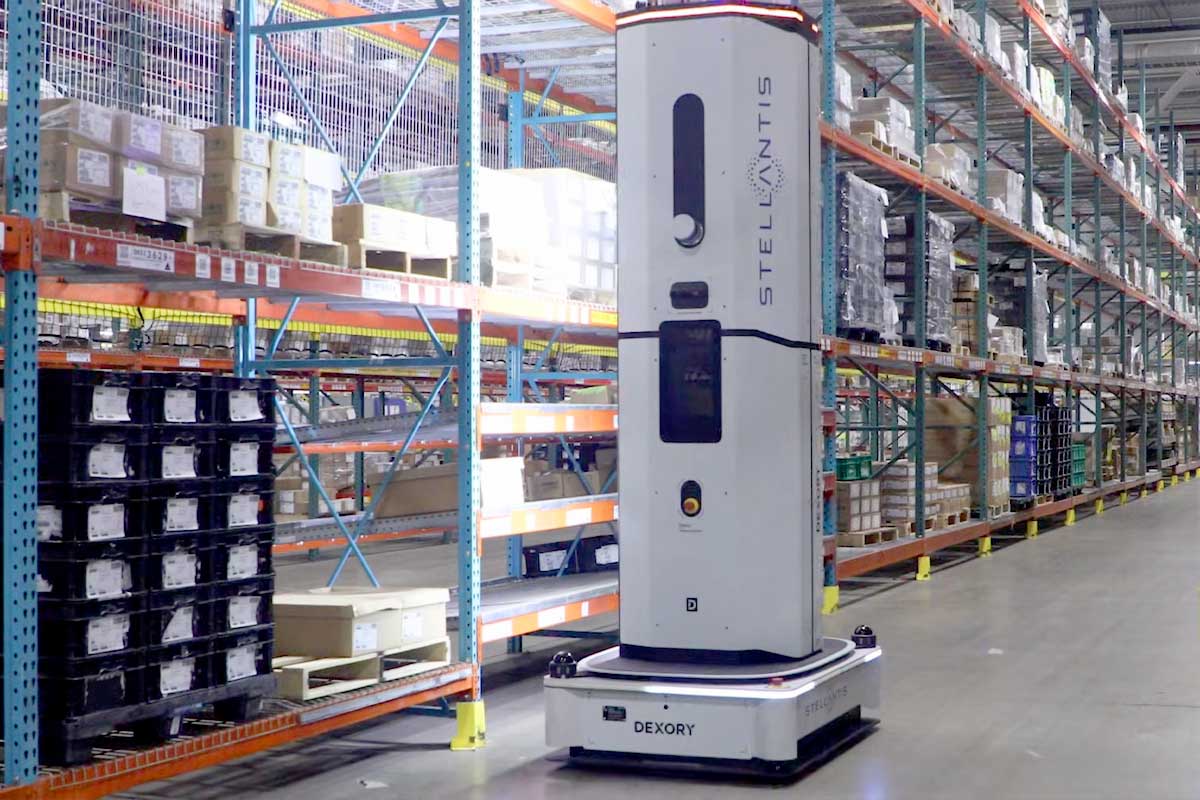
In a modern automotive plant, time has become as critical a resource as steel or semiconductors. At StellantisThis observation now has a very concrete translation: a robot capable of doing in 90 minutes a job that would take more than a month of human labor. Not on the assembly line, but in a key and often invisible link of production: internal logistics.
A robot that works while the factory sleeps
At the huge Sterling Heights complex near Detroit, where almost 7,000 people assemble Ram 1500 pickups every day, an autonomous robot now circulates between the aisles of the parts warehouse. Its name: Dexory V2. Developed by British start-up Dexory, it embodies what Stellantis calls "intelligent automation". Using a combination of LiDAR sensors, cameras and barcode scanners, Dexory V2 creates an ultra-precise digital map of inventory in real time. In less than an hour, it can scan over 36,000 square feet (approx. 3,300 m2), and repeat the operation several times a day. Where a human inventory would take up to 280 hours, the robot completes the task in an hour and a half, without breaks or fatigue, and with a regularity that would be impossible for an operator.
More than a robot
The challenge is not just to go fast. Coupled with the DexoryView artificial intelligence platform, the robot updates stock levels, reports anomalies, detects unstable pallets or overloaded shelves. The result: greater visibility, but also a direct improvement in on-site safety. At Stellantis, the message is reassuring: it's not a question of replacing employees. Teams previously dedicated to stock control have been reassigned to other missions. "It's not a substitution, it's a collaboration", insists management. With reliable, constantly updated data, operators can concentrate on assembly, with the certainty that the right parts will arrive at the right place, at the right time. Fewer unforeseen events, fewer lines at a standstill: in the automotive industry, this is a major competitive advantage.
Stellantis ahead of Ford and GM
Stellantis is now the first of the Detroit Three (ahead of Ford and General Motors) to deploy this technology on a large scale. The project was born at Factory Booster Day 2024, the Group's innovation showcase, and the results obtained at Sterling Heights have convinced the automaker to extend the system to other North American sites, such as Detroit Assembly Complex, Toledo and Warren Truck. Eventually, applications are even envisaged in engine plants. Precise figures for investment and savings remain confidential, but the group acknowledges a significant impact on overall efficiency. In fact, the collaboration with Dexory was recognized at the Stellantis Venture Awards 2025, proof that intelligent automation is no longer a simple test, but a strategic pillar.
Physical artificial intelligence?
This industrial offensive is part of a broader movement. Around the Agnelli-Elkann galaxy, investments are multiplying in what specialists call "physical AI": robots capable not only of executing, but also of learning and adapting to their environment. The Exor fund recently co-lead a $100 million round of investment in RobCo, a sign that intelligent autonomy on the factory floor is now seen as a key infrastructure for future industrial competitiveness. The idea is not of empty factories, but of factories where repetitive, time-consuming, tedious work is entrusted to autonomous systems, leaving higher value-added tasks to humans. A pragmatic approach, far from science-fiction fantasies.
Labour shortage accelerates robotization
So, should we really be surprised to see these robots gradually invading factories? When Elon Musk is openly betting on humanoids like Tesla Optimus, and some historic factories are struggling to attract young recruits, the question is no longer ideological, but very concrete. The Mirafiori site in Turin is a case in point: recruit employees under the age of 30 for industrial jobs is becoming increasingly difficult. The physical constraints, working hours and very image of the factory no longer match the aspirations of some of the new generations. Robotization appears less as a threat than as a response.

 English
  French
  Italian
  Spanish
  Portuguese
  German
  Japanese
  Turkish
  Dutch
Dutch
"The physical constraints, working hours and very image of the factory no longer correspond to the aspirations of some of the new generations."
Let's get one thing straight: THE problem is the pay.
You might think it's ONLY the salary. But I was surprised by the many reactions on facebook to this article, and it also seems that it really is a job... that doesn't make people dream! Young people" are no longer looking for a job that will provide them with food for the rest of their lives.