

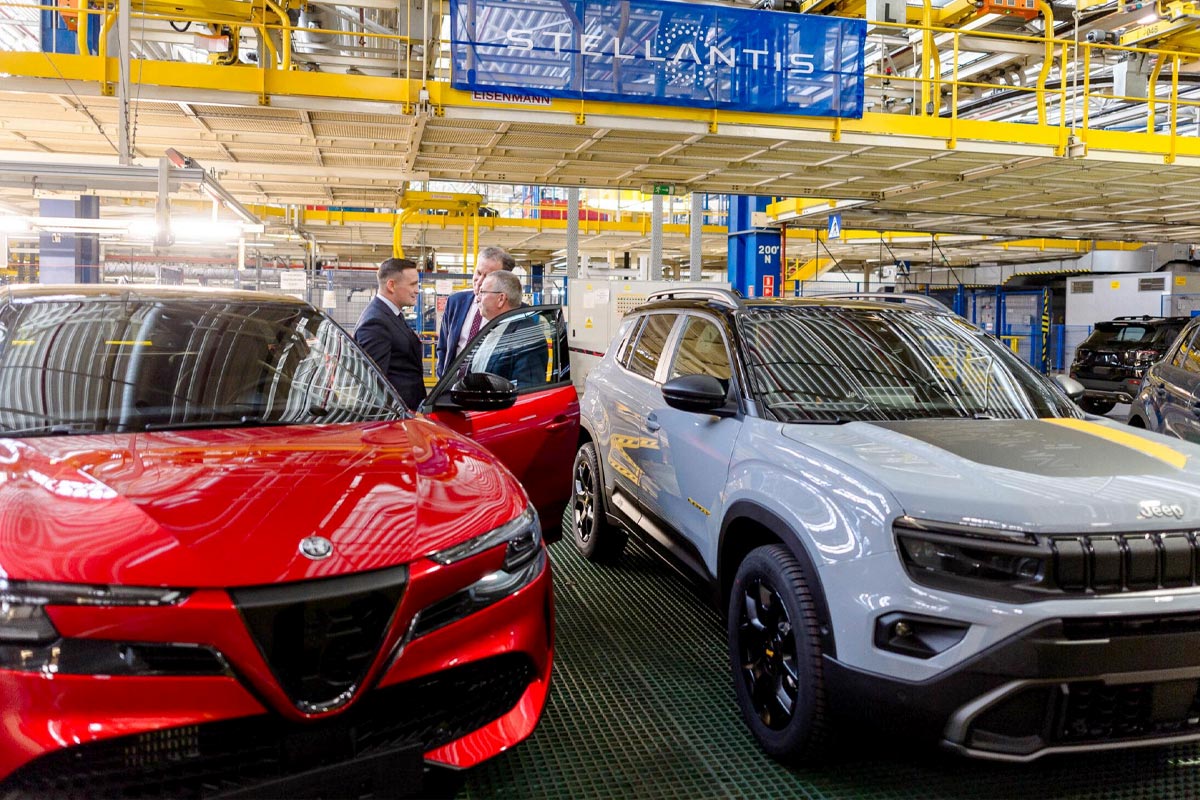
The social crisis shaking the plant Stellantis in Tychy, Poland, has reached a new turning point. After several weeks of tension, legal threats and particularly tense negotiations, an agreement has finally been reached between group management and trade unions. Behind this compromise, however, lies a more worrying reality: Stellantis is already anticipating a decline in demand for 2026, even for models considered strategic.
From legal threat to agreement
Until a few days ago, the social climate at Tychy seemed close to breaking down. The Solidarnosc trade union was accusing Stellantis of having broken off social dialogue, and was clearly threatening the group with a "crisis of confidence". a class action lawsuit. The decision, announced in mid-January, could affect up to 740 jobs, including temporary and fixed-term contracts. At the time, employee representatives were denouncing what they considered to be misleading commitments and severance conditions that were considered inadequate in comparison with the Group's other European sites. "We feel cheated", declared Grzegorz Maslanka, president of Solidarnosc in Tychy at the time, underlining the lasting loss of trust between employees and management.
Compromise finally reached for 320 employees on permanent contracts
After more than two weeks of intense negotiations, marked by ten particularly difficult sessions, an agreement was finally signed at the beginning of February. The agreement concerns 320 employees on permanent contracts, out of the 740 positions initially targeted by the reduction in activity. The unions say they are satisfied with the concessions obtained, which they consider to be much more favorable than Stellantis' initial proposals. The key points of the agreement are the exclusively voluntary nature of the departures - a strong demand of Solidarnosc - and the introduction of protection mechanisms for the most vulnerable employees. A joint commission, bringing together union representatives and management, will be responsible for examining sensitive situations, in particular those of single-income families or couples both working at the site.
Improved benefits
One of the main sticking points was the amount of severance pay. Here again, the agreement marks a clear evolution. The proposed severance payments exceed the legal minimums and can reach up to 24 months' salary for the longest-serving employees, equivalent to two years' pay. Employees with between 4 and 8 years' seniority will be entitled to eight monthly payments, while intermediate profiles will benefit from sixteen months' salary. For Solidarnosc, the final result is certainly "not the dream agreement", but it represents a compromise deemed acceptable, whereas common ground still seemed out of reach a few days earlier. The union also highlights the role played by regional structures and the Stellantis European Works Council in reaching the agreement.
A reorganization justified by an already declining market
Apart from the social aspect, the Tychy case above all reveals a very cautious reading of the future by Stellantis. The site's management has justified the loss of the third post by the slowdown in the European automotive market and by what it sees as a more wait-and-see attitude on the part of customers. More significantly, demand for 2026 is already estimated to be down. A strong signal, given that the Tychy plant assembles key models for the Group, such as the Alfa Romeo Junior, the Fiat 600 and the Jeep Avenger. These vehicles are expected to form the core of Stellantis' volumes in the electrified compact SUV segment. The fact that their production has been scaled back ahead of 2026 shows the extent to which the Group is anticipating a persistently depressed business environment.
 English
  French
  Italian
  Spanish
  Portuguese
  German
  Japanese
  Turkish
  Dutch
Dutch