

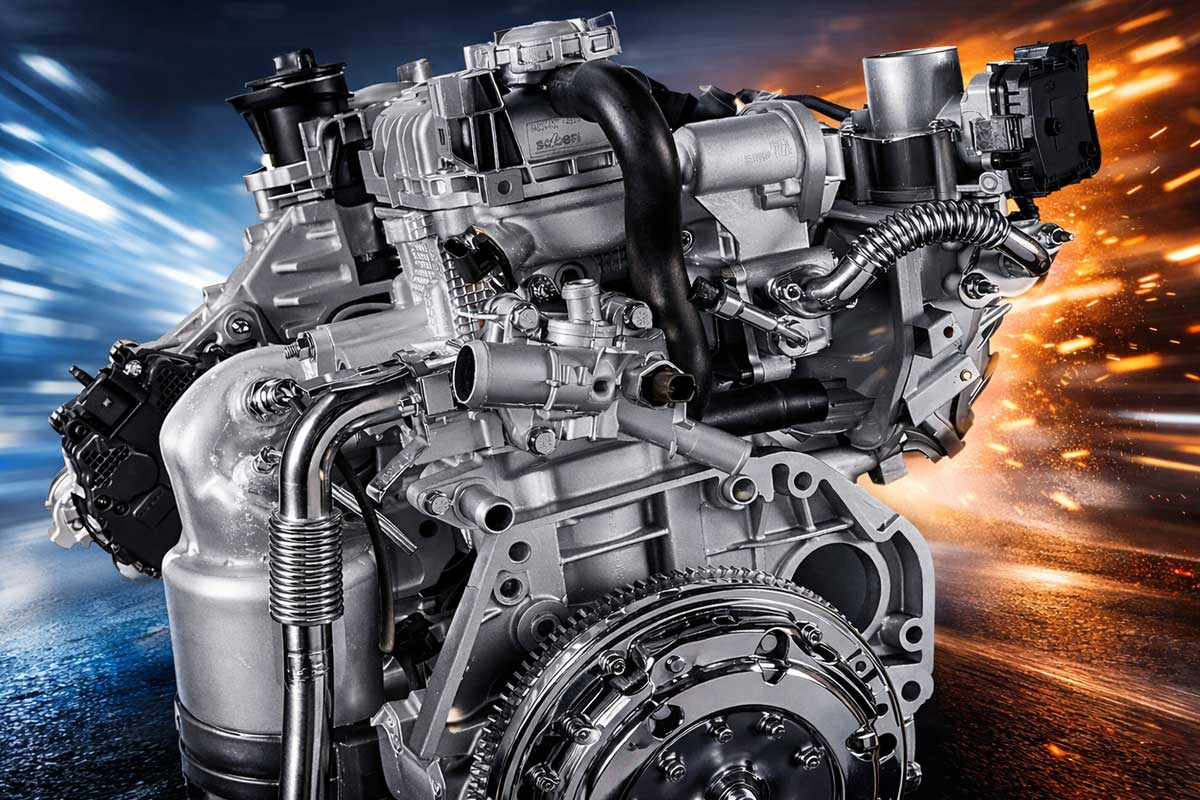
For several weeks now, the Stellantis seems to be evolving at high speed. The return of diesel, extension of the Italian FireFly engineWith each announcement, the same signal appears: the Group is gradually abandoning the idea of a single engine for the whole of Europe. Behind the scenes, however, discussions are going much further than the official communication suggests. According to several industry reports, Stellantis is now considering a major industrial changeover: gradually replacing PSA-sourced engines, including the famous 1.2 PureTech, with Italian engines from Fiat. And this time, it's no longer just a rumor.
Behind Euro 7, a budget battle
Officially, the arrival of the Euro 7 standard means that internal combustion engines will have to be modernized across the board. Unofficially, it forces manufacturers to choose what to invest in, and what not to invest in.
Adapting an entire engine family to this standard costs millions of euros. However, according to several sources inside the sector, Stellantis has made a clear choice: to concentrate its budgets on Italian engines rather than pursue the in-depth development of the PureTech and BlueHDi engines.
It's not just a question of industrial image or internal politics. It's first and foremost a technical and financial trade-off. The Group believes that modernizing French engines would be very costly for an uncertain result in the long term, particularly in terms of reliability and durability under Euro 7 constraints.
PureTech's problem isn't just a belt
For years, the 1.2 PureTech has had a difficult reputation surrounding its belt. But according to technical information from the industry, the problem goes deeper than that. Internally, the engine is said to be mechanically more fragile, with faster wear of certain key components and a higher risk of breakage over long distances. The Euro 7 upgrade could even accentuate these stresses, by increasing internal temperatures and pressures.
Conversely, the Fiat FireFly (GSE) engine is said to be more structurally robust. Its more recent design and larger components would offer a better margin of durability, making it a sounder basis for the next thermal decade. In other words, the debate would no longer be purely industrial, but purely mechanical.
The changeover has already begun
Internal reports even suggest that the timetable has already been set. The 1.6 JTD engine (present in the Alfa Romeo Tonale) is said to be in preparation for equipping a large part of the European range: Peugeot 208, 308, 2008, 3008, 4008, 5008, but also Opel Corsa, Astra, Mokka or Grandland, not forgetting numerous Citroën models.
Other displacements would follow, notably the 2.0 and 2.2 adapted to future standards. Ironically, the 2.2-liter is said to be a former PSA-FCA collaboration... but would now return under the Italian banner. If confirmed, this would mean a historic reversal: for years, Italian brands have adopted French engines within the group. The balance could now be reversed.
A strategy consistent with recent decisions
Taken separately, each event might seem isolated: the rescue of the FireFly, the return to diesel, the investment in Termoli, the new eDCT boxes... Taken together, they tell a different story: Stellantis is preparing a new common thermal base for Europe, but different from the one planned when the group was created.
The initial plan was based on PSA engines as the backbone, with the 1.2L EB2 and 1.6L EP6. The current plan could be based on Fiat engines. The logic becomes clear: rather than developing two complete Euro 7-compatible families, the Group chooses the one deemed the most technically sustainable.
This choice would also have important symbolic significance. At the time of the PSA-FCA merger, many believed that French technology would become dominant. For several years, this was indeed the case.
But the slower-than-expected energy transition is changing priorities: robustness and longevity are once again essential to amortize development costs. Stellantis could finally rely on its Italian mechanical heritage to get through the last decade of thermal power in Europe.
Nothing has yet been officially confirmed. But the industrial direction now seems coherent:
- an electrified Fiat diesel for long-distance travel,
- an electrified Fiat FireFly for hybrid petrol,
- and electric for the rest.
If this strategy comes to fruition, it would mark a major turning point in the Group's history. Not only would the PureTech no longer be Stellantis' core engine, but Peugeot could be driving tomorrow... with a Fiat heart, as is already the case in Brazil.
 English
  French
  Italian
  Spanish
  Portuguese
  German
  Japanese
  Turkish
  Dutch
Dutch
WELL IT'S ABOUT TIME !!!
Consequences for jobs in France: at least 2,000 redundancies, including the non-renewal of fixed-term contracts, and the safeguarding or creation of around 2,000 jobs in Italy.
Nice work in fine!
Will the Fiat factories be able to supply the whole group, because that's going to mean a lot more engines to be produced?
It seems to me that most French engine factories were going to convert to electric motors or gearboxes anyway, and a good proportion of EBs were no longer produced in France.
The Italian diesel engine is very reliable since a long time the common rail.👌
You weren't there when Tavares cut thousands of jobs in Italy and elsewhere...
On balance, Tavares was a disaster for stelantis, he wanted to make a maximum 😨! of profits to have a huge 🥵 bonus to collect for his departure 😡
Stellantis net profit of €5.5 billion for fiscal year 2024.
Stellantis net profit of €18.6 billion for fiscal year 2023.
Stellantis net profit of €16.8 billion for fiscal year 2022.
Stellantis net profit of €13.4 billion for fiscal year 2021.
Tavares has been gone for over a year.
Blaming everything on him won't help to straighten out Stellantis.
We need to see the future of the 14 brands and their new models, and when they arrive!
Potté, FCA hadn't cut thousands of jobs in Italy BEFORE 2021!????
Is Tychy Italy?
Yes, and one wonders why the puretech wasn't consigned to the graveyard of industrial disasters much earlier, to be replaced by the excellent, reliable and inexpensive Fire engines from Italy.
CO2: 1g more is €95 per vehicle sold in Europe. Last year, Stellantis sold 2.42 million vehicles, so just one gram too many means a €230 million fine!
The Puretech has its faults (which have been ironed out with the chain-driven version), but it also has a big advantage in Europe.
Sempre meno dei miliardi di euro che FCA ha dovuto sborsare per riparare e richiamare tutti i motori francesi, senza contare il crollo dell'immagine dell'intero gruppo...
Pochi giorni fa Trump ha abbandonato il programma della riduzione degli CO creata guarda caso da Obama e Company x ovvi interessi economici verso il mondo delle BEV
This is surely why Europeans no longer buy Fiat. In 2019, the last reference year before covid and the creation of Stellantis, PSA sold 3 million vehicles in Europe and FCA 900,000! Even DS, the new brand, sold more vehicles than Alfa Romeo!
Totally untrue, because in 2019 FCA sold 4,420,000 vehicles on the world market and DS was crushed by Lancia, which sold a single model in Italy, and DS with its entire range on all markets.
Abarth sold a thousand times more cars under FCA, and so did Maserati!
Alfa sold 54,000 cars in 2019.
DS Automobiles achieved 62,512 sales in 2019.
DS was often ahead of Alfa!
it's suicidal to continue in the thermal segment, where the market is shrinking every year! the worst mistake they could have made is now theirs, and it's industrial suicide!
Yes, it's about time, because we're fed up with the horrors of catastrophic French engines, and we can't wait for that time to be over.
Good news!
I just regret that these choices are made solely for financial reasons, as with the adoption of the Puretech at the time of the merger, and not for intelligent reasons of reliability. But no matter. This time, the right decisions have been made...
Barvo
Phew, no more puretech... but it's not at all easy to switch to Fiat engines because there's a big delay in the development/industrialization of these engines. And the 1.6 l is already in terminal development at Opel. And as I've already said, the 1.2 was ready to be installed 4 years ago.
There's no delay since the Firefly is more recent than the Puretech, so technically it's more modern and will have no trouble being adapted to Euro 7 and planned for hybridization.
And don't forget that Firefly is already adapted to the CMP base in South America, 208 , C 3 , future Argo etcc....
Rückstand der Fiat-Fireflymotoren? Das kann man aber auch anders sehen. In Kombination mit der Multiair-Technik gibt es schon seit Jahren eine hydraulisch betätigte Einlassnockenwelle und in manchen Varianten sind die schon auf die neue Euro7 Norm abgestimmt. Sie waren halt in der Produktion immer etwas teurer als die franz. PSA-Motoren. Und endlich gäbe es auch wieder 4-Zylindermotoren
The 1.6 l ex Puretech developed by Opel is already finished, since it is already under the hood of the new Jeep Cherokee Stla large hybrid engine manufactured in the United States. .
Here's hoping it's not just rumours
No rumors since Termoli has announced it. What doesn't add up is the number. The EB engine is 1 million per year. The GSE (Fiat) is at most 300,000 possible at present.
Is the 300,000 figure for Termoli alone? Because there are other factories making engines in Europe. Maybe they'll also supply Firefly. Like the one in Hungary, which also produces the EP6 Gen3.
Contrary to what has been said, the Fiat 2.2 multijet is not a collaboration with Peugeot, since the Fiat's displacement is 2.184 l, which derives from the mjtd 1.956 l, while the Peugeot hdi is 2.178 l, which derives from the hdi 1.997 l.
Peugeot collaborated with Ford for the Puma diesel engine on 2.198 l large commercial vehicles, which is replaced by the 2.2 l Multijet euro 7.
«Peugeot collaborated with Ford for the Puma diesel engine on the 2.198 l large utility vehicles, which is replaced by the 2.2 l Multijet euro 7».»
That's what I thought.
Der 2.2 Diesel kam ursprünglich von PSA, wurde aber von den Italienern angepasst.
No, the 2.2 diesel is a Fiat engine built in the Patrola Serra factory in Italy. This engine has already been adapted to the Jeep Cherokee and Jeep Wrangler, just check it out on the net, so there's nothing Peugeot about this engine. .
The Puretech 1.2L was also chosen because of its suitability for platforms, while the Firefly was adapted to the CMP in South America, partly because of the ethanol, but also because of slightly more permissive safety standards.
FCA's focus on North and South America is precisely because standards in these markets are more permissive, and products don't need to be as technically advanced as in Europe.
It's a good thing to settle the legacy of the Tavares industrial disaster.
Putting the PureTech in Alfa Romeos and Fiat cars was a disgrace, because it's a fragile engine with no character. Those who bought PureTech-equipped Alfa Juniors, Fiat 600s, Jeep Avengers and Lancia Ypsilons were duped.
The return of FireFly engines is obviously good news.
Indeed, it will remain a very dark period...
It's the hybrid version that's been fitted to Alfa and Fiat models, and for the time being, this one with a chain is much more reliable.
You must not have tested the Puretech 1.2l to say that. It's renowned for its pleasantness, which the Firefly doesn't have at all. Given the modifications it has undergone, the main problem has been solved. The 1.2l EB2 Euro 6e is easier to upgrade to E7 than the Firefly, which is just E6c. The boss of Stellantis is Italian, he wants Italian engines, that's the real reason.
Engineers work on an engine on the bench, so I don't see the problem in upgrading the Firefly to Euro 7, since it's more recent than the Puretech. .
They've upgraded Fiat's 2.2 Multijet to Euro 7 and, what's more, it was Tavares who decided to keep this engine to replace the old Ford and PSA Diesels for commercial vehicles.
I've driven several PureTech-powered Peugeots, 208 and 308, as well as the Alfa Romeo Junior. I'm still looking for the pleasure that the PureTech engine offers. Unless you like moving things around, and the chassis isn't too bad, but that's it.
The Junior is selling well, and so much the better. But as far as enjoyment and Alfa Romeo DNA are concerned, I'm still looking (except for the Veloce version, which is sharp).
As the saying goes, "you have to expect everything to be surprised by nothing".
What a slap in the face for the French automotive industry, and Peugeot in particular.
The Tavares era is definitely over.
To be continued...
The worst thing is that Peugeot has always made good engines, but here... ,
Then there's the e-DCT gearbox, which had quite a few problems when it was launched!
You're also forgetting about the platforms that mainly come from France.
Buongiorno, io sono italiano ma seguo spesso italpassion perché da sempre sono appassionato di motori. È logico che il cuore per ognuno di noi rimarrà sempre nazionale ma è un piacere vedere la tecnica di ognuno. Io, personalmente, sono felice di questo cambio perché so che i motori fiat sono sempre stati performanti e affidabili, sinceramente sono dispiaciuto perché comunque nel gruppo si poteva fare una distinzione di marchi e tenere ognuno con le sue peculiarità e pregi.
I fully agree with your analysis, Tavares has imposed Puretech on the Italians when he could very well have kept the Firefly, which is recent and much more reliable.
Sia italiani sia francesi. mi dispiace che vengano persi dei posti di lavoro, sia in Italia sia in Francia perché se non mangiano delle famiglie mi dispiace in ogni posto. Io abito in Piemonte, e vi posso garantire che dopo la fusione a Torino hanno chiuso quasi tutto. Spero che in entrambi gli stati si possano garantire posti di lavoro. Cmq, così giusto per chiarire, il giorno nel 1998 se non erro quando al rally di Sanremo vidi passare la 206 WRC ne rimasi estasiato... Questo, da appassionato di rally e di lancia. PS. L’ ultima Ypsilon non si può vedere... Buona serata a tutti
es wurde an der zeit das die purtech motoren verlassen werden.
eine bessere wahl mit den firefly konnte nicht gewägkt werden.
und die 2.2 hdi psa/ford sind auch von problemen geplagt....
es wäre besser für die italienische industrie sich wieder von psa trennen.
es hat nur problemen an der schon schwächender fiat gruppe gebracht.
Separating from PSA won't solve FCA's and PSA's problems, it's too late, they've merged, they can't go back, otherwise they'll both lose out to the competition.
Bravo
Sia italiani sia francesi. mi dispiace che vengano persi dei posti di lavoro, sia in Italia sia in Francia perché se non mangiano delle famiglie mi dispiace in ogni posto. Io abito in Piemonte, e vi posso garantire che dopo la fusione a Torino hanno chiuso quasi tutto.
To hear that Fiat is renowned for the quality of its products, especially its engines, is grotesque and makes you smile. Fiat was best known in Europe for the poor quality of its cars. Moreover, the technical backlog accumulated by the Fiat group in Europe was colossal. In fact, their vehicles were hardly ever sold on our continent. This is why we can only worry about Stellantis in Europe, as this continent had not been Fiat's priority for many years.
Fca is renowned for the quality of its powertrains, but when it comes to cars, we know that they're lagging behind, unlike PSA, which is good at chassis and not so good at engine quality.
When you say that, it's because you've never driven an Abarth with a reliable internal combustion engine, which is undoubtedly one of the best 1.4 L engines ever produced.
And yes, I can confirm that the Fire has always been a very good engine, equipping many Fca brands right up to the latest Tipo. I've had the Fiat Idea 1.4 l with 95 HP and no problems apart from maintenance, oil changes, spark plugs and timing belts.
So will the 1,6 L Diesel / Firefly also equipped in the Fiat and Jeep family for example at the 600 and Avenger? Putting it in the 206 suggests that it would fit in those cars as well?! Why is it semiannounced for the whole Peugeot family and not for the Jeep/Fiat?
So will the 1,6 L Diesel / Firefly also equipped in the Fiat and Jeep family for example at the 600 and Avenger? Why is it semiannounced for the whole Peugeot family and not for the Jeep/Fiat?
In my opinion I would rather see the future 1.6 diesel hybrid on compacts and Suv category C and D ex: 308 , Astra DS 4 , 3008 ,Grand Land , Tonale ,DS7 , future Lancia Gamma etc....
But not the B class, 208 , 2008, Mokka, which will instead get the Firefly hybrid.
Firefly hybrid yes diesel 1.6 mjtd no idea , let's wait to see Filosa's new plan to know more .
I would buy a Jeep Avenger with the 1.6 Multijet in an instant - Still love my 500x 1.6 Diesel, looking for a replacement with this solid engine. Would be great, still a Firefly 1.5 Hybrid would be great too. Never ever going to buy a fragile 3 Zylinder engine...
The firefly engine hasn't been modernized in years, having been replaced by the puretech in Europe.
You can't pull each other's legs in an industrial group, otherwise it's the end of Stellantis and all its brands.
I think Stellantis wants to get out of puretech for good by launching this type of information.
The main thing is to have a reliable engine that performs economically and meets environmental standards.
We must think of all Stellantis employees and hope that our beautiful brands flourish.
You a bit out 9f touch as stellantis has dropped the pure tech man frome there current 1.2 and 1.6 engines whimskr up the core of there European engine offering in private cars and vans.
The wet belt has been removed and the issue sorted. However there are huge issue with the fiat 1.6 and 2.4 used in the American markets they are not the best engines and they are old
The 1.6 and 1.8, 2.0 and 2.4 Tigershark engines you are talking about are original Chrysler engines and upgraded to Multiair by Fiat. .
When I think that PSA employees were sniggering internally when they referred to Fiat as a «bodybuilder»... No further comment.
MDR, you still have some here who defend the dung from Peugeot, the same ones who are able to say that Peugeot makes better engines than Ferrari Alfa or BM! 😂😂😂
Super. Diese Erkenntnis kommt nur leider zu spät. Habe vergangenes Jahr 3.500 € deswegen verloren.
Hello,
I appreciate it when they take my «inusine» information and delete my comments to make an in-house article.
I take over....the petrol engines will be fiat. The puretech is already stopped in simple version, we speak about 6 months so that the fire fly replaces the puretech+ on the hybrid version.
The jtd... the 308/ astra and other big cubes are already ready for grafting.
The 208 and its clones will inherit a 100 hp version, 85 thermal and 15 electric....toujours 1.6 une seule cylindrée pour simplifier.
Before the summer, it will replace diesel berlingos and their clones.
Hello, there are no deleted comments and the information you gave (thanks for sharing, it's appreciated) but you're not the only one. This article is an aggregation of several messages I received.
I don't know how they envision their future business.
Because the also ancient Fiat-engines (f.e. GSE/Firefly 1.0, 1,3, 1,5) are equally dirty like the Puretech and can't exist without attachments of the 48V-«e-bike-kits». Even worse - they're even dirtier and need stronger intervention of E-Power.
For the important segment above minicars they still have nothing, to make a car to a real car.
If BMW, Benz, Audi, Skoda, Seat/Cupra would ending their engine-line at 1,2 L 3-cyl, they also couldn't exist at the market.
Imagine, a MB A-Class, C-Class, their SUVs, BMW 1er/2er/3er top engines are 3-cyl. with 130 or «crazy» 150 hp! ...